
1723534562.png)

Verbal Reasoning Questions for NATA 2026 with Answers PDF Download here
March 18, 2026
Quick Answer: What are verbal reasoning questions for NATA?
Verbal reasoning questions for NATA assess your skills in reading comprehension, vocabulary, and grammar through topics like synonyms, antonyms, idioms, and sentence correction. Practicing topic-wise verbal reasoning questions for NATA with answers helps improve accuracy, speed, and overall performance in this high-scoring section.
Key Highlights: Verbal Reasoning Questions for NATA
- 5-6 questions expected in NATA from verbal reasoning section
- Covers reading comprehension, vocabulary, grammar, and logical interpretation
- Difficulty level is usually easy to moderate (high scoring section)
- Includes synonyms, antonyms, idioms, sentence correction, RC passages
- Focus on accuracy + speed for maximum score
- Practice topic-wise verbal reasoning questions for NATA with answers
- NATA previous year question papers help identify repeated vocabulary and question patterns
- Daily practice of 10-15 questions improves retention and speed
- Strong vocabulary + basic grammar ensures quick marks in exam
- Regular revision is key for high recall during exam
Verbal reasoning is one of the essential topics for all competitive exams, including the NATA Exam 2026. In the National Aptitude Test in Architecture, VR don't have a very high weightage, but you can easily score well in this section if you have a good grasp of the English language. And cracking it would help improve your overall NATA score.
Practice is the only key to scoring good marks in this section. To ease your NATA exam preparation, we have provided some important NATA 2026 verbal reasoning questions in this post.
Important Topics for Verbal Reasoning in NATA 2026
Before starting your preparation, you must familiarize yourself with the important verbal reasoning questions for NATA with answers.
In the NATA 2026 entrance exam, the verbal reasoning questions are primarily based on the topics given below.
- Reading Comprehension
- Synonyms
- Antonyms
- One word substitutes
- Cloze test
- Sentence correction
- Idioms and phrases
- Sentence formation
- Completing statements
Also Read: Strategies to Remember While Writing the NATA Exam
How to Prepare for Verbal Reasoning Questions for NATA 2026?
Understanding the vocabulary and phrasing used is insufficient for the verbal reasoning section. Instead, you will require comprehension and logical skills.
The following tips will help enhance your NATA preparation level and score well in the verbal reasoning section.
- Verbal reasoning test passages are deliberately written in complex, and sometimes the convoluted language and small assumptions can catch you. So, read each passage twice or thrice to understand the data clearly.
- Make sure to learn at least 10-15 new words daily and read the newspaper for at least 30 minutes regularly.
- Try to attempt at least one NATA Mock Test weekly to analyze your strengths and weakness and focus on improving your weak areas.
- Learning is fun when it is like a game! You can visit your local game store, pick out a few verbal games, such as Scrabble, and spend time mastering them.
- Practice as many questions as possible from the previous year's papers.
Important Verbal Reasoning Questions for NATA 2026
We have provided a few sample NATA verbal ability questions for your reference here to help you understand the type of questions asked in this section. These questions are curated from NATA sample papers and the previous year's question papers for NATA.
Verbal Reasoning Questions for NATA - Vocabulary
Q.1. Choose the mis-spelt word from among the following:
(a) lugagge
(b) baggage
(c) cabbage
(d) garbage
Q.2. Out of the four alternatives, choose the one which best expresses the meaning of the word 'gumption'.
(a) Sagacity
(b) Acumen
© Ingenuity
(d) Stupidity
Q.3. Choose from the following, the correct synonym of the given word "persuade".
(a) Conceive
(b) Convince
(c) Oppose
(d) refuse
Q.4. Choose from the following, the correct antonym of the given word "progressive"
(a) Orthodox
(b) Mundane
(c) Rebellion
(d) Uninhibited
Q.5. cheap : peach ::__ : large
(a) king (b) regal (c) orange (d) majestic
Q.6. Select the correct synonym of the given word. CREDULOUS
(a) suspicious (b) gullible (c) sophisticated (d) dubious
Q.7. Select the correct antonym of the given word. INIMICAL
(a) cordial (b) destructive (c) contrary (d) malicious
Verbal Reasoning Questions for NATA - English Grammar
Q. 8. Choose the correct word that best fits in the blank:
"There weren't _________________________ students in the lecture."
(a) more
(b) much
(c) some
(d) many
Q.9. Choose the correct sentence:
A. She don’t like drawing
B. She doesn’t likes drawing
C. She doesn’t like drawing
D. She not like drawing
Q.10. Identify the error:
“He go to school every day.”
Q.11. She ___ a beautiful sketch yesterday.
A. make
B. made
C. making
D. makes
NATA Reading Comprehension Questions
Q.12. Read the passage given below and answer the following question:

Statement: The passage suggests that it is safer to spread your savings across various investments.
A) True
B) False
C) Cannot say
Read more: Highly recommended books for NATA exam
Q.13. Read the passage given below and answer the following question:

Also Check: Important Logical Reasoning Questions for NATA 2026
Q.14. After reading the given TEXT answer the 4 questions based on the text by choosing the appropriate option.
TEXT
The Indian Army is the land-based branch and the largest component of the Indian Armed Forces. The President of India is the Supreme Commander of the Indian Army, and it is commanded by the Chief of Army Staff (COAS), who is a four star general. Two officers have been conferred with the rank of field marshal, a five-star rank, which is a ceremonial position of great honour. The Indian Army originated from the armies of the East India Company, which eventually became the British Indian Army, and the armies of the princely states, which finally became the national army after independence. The units and regiments of the Indian Army have diverse histories and have participated in a number of battles and campaigns across the world, earning a large number of battle and theatre honours before and after Independence. The primary mission of the Indian Army is to ensure national security and national unity defending the nation from external aggression and internal threats, and maintaining peace and security within its borders. It conducts humanitarian rescue operations during natural calamities and other disturbances, like Operation Surya Hope, and can also be requisitioned by the government to cope with internal threats. It is a major component of national power alongside the Indian Navy and the Indian Air Force. The army has been involved in four wars with neighbouring Pakistan and one with China. Other major operations undertaken by the army include: Operation Vijay, Operation Meghdoot and Operation Cactus. Apart from conflicts, the army has conducted large peace time exercises like Operation Brasstacks and Exercise Shoorveer, and it has also been an active participant in numerous United Nations peacekeeping missions including those in: Cyprus, Lebanon, Congo, Angola, Cambodia, Vietnam, Namibia, El Salvador, Liberia, Mozambique and Somalia. The Indian Army has a regimental system, but is operationally and geographically divided into seven commands, with the basic field formation being a division. It is an all-volunteer force and comprises more than 80% of the country's active defence personnel. It is the 2nd largest standing army in the world, with 1,237,117 active troops and 960,000 reserve troops. The army has embarked on an infantry modernisation program known as Futuristic Infantry Soldier as a System (F-INSAS), and is also upgrading and acquiring new assets for its armoured, artillery and aviation branches.
1) Who has a 5 -star rank in the Indian Army?
- (a) Chief of Army Staff
- (b) President of India
- (c) Field Marshal
- (d) Lieutenant Governor
2) What is the basic field formation in the Indian Army?
- (a) The regiment
- (b) The division
- (c) The infantry
- (d) Aviation
3) Which of the following is not an operation of the Indian Army
- (a) Operation Trident
- (b) Operation Vijay
- (c) Operation Meghdoot
- (d) Operation Surya Hope
4) What are the components of national power?
- (a) Navy is the only component
- (b) Government
- (c) Combination of Navy, Army and Air force
- (d) Army and Navy are the main components
Q.15. After reading the given TEXT answer the 4 questions based on the text by choosing the appropriate option.
Holi celebrations start on the night before Holi with a Holika Dahan where people gather, perform religious rituals in front of the bonfire, and pray that their internal evil be destroyed the way Holika, the sister of the demon king Hiranyakashipu, was killed in the fire. The next morning is celebrated as Rangwali Holi - a free-for all festival of colours, where people smear each other with colours and drench each other. Water guns and water-filled balloons are also used to play and colour each other. Anyone and everyone is fair game, friend or stranger, rich or poor, man or woman, children and elders. The frolic and fight with colours occurs in the open streets, open parks, outside temples and buildings. Groups carry drums and other musical instruments, go from place to place, sing and dance. People visit family, friends and foes to throw coloured powders on each other, laugh and gossip, then share Holi delicacies, food and drinks. Some customary drinks include bhang (made from cannabis), which is intoxicating. In the evening, after sobering up, people dress up and visit friends and family.
1) Why is Holika Dahan performed?
- (a) Because it is quite cold and everyone loves a bonfire
- (b) Because it symbolizes the end of destruction of the evil enemies
- (c) Because it symbolizes the end of destruction of our internal evil
- (d) Because Holika was King Hiranyakashipu's sister.
2) Choose the statement(s) that summarize the entire passage (i) There are two types of Holi - Holika Dahan & Rangwali Holi (ii) People do not celebrate it with their foes (iii) Food and Drinks are the heart of Holi celebrations (iv) Holi symbolizes the destruction of our inner evil and demons
- (a) (i), (ii), (iii), (iv)
- (b) (i), (ii), (iv)
- (c) (i), (iii), (iv)
- (d) (i), (ii) (iii)
3) Which word or phrase in the second para of the passage means a state ‘out of intoxication’?
- (a) Free for all
- (b) Cannabis
- (c) Fair game
- (d) Sobering up
4) Describe the type of adjective of the underlined word: "People visit family, friends and foes to throw colored powders on each other; laugh and gossip, then share Holi delicacies, food and drinks."
- (a) Adjective of quality
- (b) Adjective of quantity
- (c) Numeral adjective
- (d) Demonstrative adjective
Check: NATA 2025 Result
16. After reading the given TEXT answer the 4 questions based on the text by choosing the appropriate option.
"A principal fruit of friendship," Francis Bacon wrote in his timeless meditation on the subject, "is the ease and discharge of the fullness and swellings of the heart, which passions of all kinds do cause and induce." For Thoreau, friendship was one of life's great rewards. But in today's cultural landscape of muddled relationships scattered across various platforms for connecting, amidst constant debates about whether our Facebook "friendships" are making us more or less happy, it pays to consider what friendship actually is. That's precisely what CUNY philosophy professor Massimo Pigliucci explores in Answers for Aristotle: How Science and Philosophy Can Lead Us to A More Meaningful Life (public library), which also gave us this provocative read on the science of what we call "intuition." Philosophers and cognitive scientists agree that friendship is an essential ingredient of human happiness. But beyond the dry academic definitions - like, say, "voluntary interdependence between two persons over time, which is intended to facilitate socio-emotional goals of the participants, and may involve varying types and degrees of companionship, intimacy, affection and mutual assistance" - lies a body of compelling research that sheds light on how, precisely, friendship augments happiness. The way friendship enhances well-being, it turns out, has nothing to do with quantity and everything to do with quality - researchers confirm that it isn't the number of friends.
1) Name one change effected in the present situation which hastened a rethinking of the concept of friendship.
- (a) Bacon and Thoreau's theories are no longer available to read
- (b) The arrival of social media on the scene
- (c) There is more interest in the sciences
- (d) Friendships are not possible in the real world anymore, due to over competition
2) Friendship leads to happiness. Is it true?
- (a) Yes, researchers have proven that friendship does lead to happiness
- (b) No. There is no relationship between friendship and happiness
- (c) Friends cannot make each other happy
- (d) One needs to find one's happiness alone, with peace of mind.
3) Is the quality of friends important?
- (a) No, it is more important to have a greater number of friends. Quality does not matter
- (b) No, number of comments on social networking sites is important and not the quality of friends
- (c) Yes, it matters
- (d) Yes. With quantity comes quality.
4) What is the antonym of 'augment'?
- (a) Diminishes
- (b) Amplifies
- (c) Increases
- (d) boosts
Check: NATA 2024 Answer Key
17. After reading the given TEXT answer the 4 questions based on the text by choosing the appropriate option.
TEXT
The coconut is an unusual food for many reasons. It is technically a seed, produced by the coconut palm tree, and as such is one of the largest edible seeds produced by any plant. Its unusual contents also make it unique in the seed world-the interior consists of both "meat" and "water." The meat is the white pith with which we are all familiar, as it is used extensively for cooking and flavorings; the coconut water is a white liquid that is very sweet and thirst-quenching. Portuguese explorers gave the nut its name in the 15th century, referring to it as coco, meaning "ghost" in their language. The three dimples and the hairy texture reminded them of a ghost's face. It is used to make margarine, as well as various cooking oils. The coconut fluid is a favorite drink in hot climates, providing a cool and refreshing beverage right off the tree. This water is also used by manufacturers of various sports drinks because of its isotonic electrolyte properties. Even the shell itself has many uses, including cattle food and fertilizer. Coconut oil is used for cosmetics, medicines, and can even be used in place of diesel fuel. Dried coconut shells are used in many countries as a tool, such as a buffer for shining wood floors. The shells are also used for shirt buttons; they are even used for musical instruments and bird houses! And all these are only some of the uses found for the coconut fruit. The coconut palm tree, which produces the nut, also produces countless useful items. It's no wonder that the coconut palm has been called "the tree of life."
1) The word pith used in the first para of the text; most nearly means?
- (a) helmet.
- (b) hairy material.
- (c) black.
- (d) meaty substance.
2) What is the main focus of this passage?
- (a) the history of coconuts
- (b) coconut trees have many uses
- (c) how cooking oil is made
- (d) Portuguese discoveries
3) The passage implies that
- (a) coconut palms are a valuable plant.
- (b) coconut oil is the best way to cook.
- (c) Portuguese explorers loved coconuts.
- (d) coconut palms are good shade trees.
4) Which of the following is NOT a use for the coconut shell?
- (a) polishing wooden floors
- (b) musical instruments
- (c) shirt buttons
- (d) diesel fuel
Q.18. After reading the given TEXT answer the 4 questions based on the text by choosing the appropriate option.
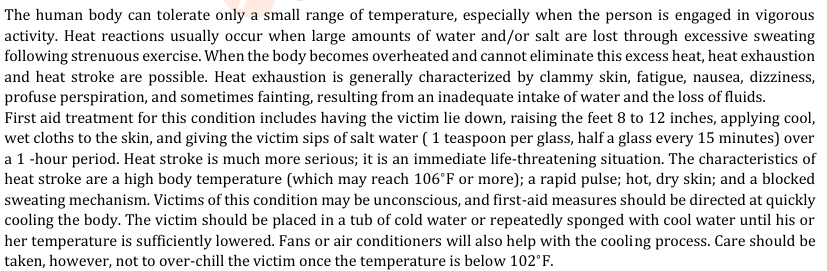
1) The most immediate concern of a person tending to a victim of heat stroke should be to __________.
- (a) gets salt into the victim's body.
- (b) raises the victim's feet.
- (c) lowers the victim's pulse.
- (d) lowers the victim's temperature.
2) Which of the following is a symptom of heat exhaustion?
- (a) unconsciousness
- (b) profuse sweating
- (c) hot, dry skin
- (d) a weak pulse
3) Heat stroke is more serious than heat exhaustion because heat stroke victims _______________.
- (a) do not sweat.
- (b) have no salt in their bodies.
- (c) cannot take in water.
- (d) have frequent fainting spells
4) Symptoms such as nausea and dizziness in a heat exhaustion victim indicate that the person most likely needs to ________________.
- (a) be immediately taken to a hospital.
- (b) be given more salt water.
- (c) be immersed in a tub of water.
- (d) sweat more.
Q.19. AZ, GT, MN, ?, YB
A) KF
B) RX
C) SH
D) TS
Check: Preparation Tips for NATA
Q.20. Read the sentence given below and find out whether there is any grammatical error in it.
A) We discussed the problem so thoroughly
B) on the eve of the examination
C) that I found it very easy to work it out
D) No error
Q.21. FOX: CUNNING :: RABBIT: ?
A) Courageous
B) Dangerous
C) Timid
D) Ferocious
Read more: Important GK questions for the NATA exam
Q.22. BILLY: GOAT ::
A) Cow: Bull
B) Lord: Maid
C) Man: Woman
D) Cow: Calf
Q.23. Choose the word which is most nearly the SAME in meaning as the word given
Q) ARDUOUS
A) Hazardous
B) Difficult
C) Different
D) Pleasurable
Q) VIABLE
A) Rudimentary
B) Practical
C) Negative
D) Impossible
Read more: Enhance your preparation with the best online coaching for NATA
In the following questions, choose the word which best expresses the meaning of the given word.
Q) Ponder
A) Increase
B) Anticipate
C) Evaluate
D) Think
Q) Tenacity
A) ingratitude
B) tendency
C) perseverance
D) splendour
Conclusion
The Verbal Reasoning questions for the NATA entrance exam 2026 can be challenging, but with practice, anyone can master them. By understanding the structure of the questions and the type of information needed to answer them, students can prepare for the exam. With a good understanding of logic, language and reasoning, students can effectively answer the questions in the exam. With sufficient practice, students can confidently attempt the Verbal Reasoning questions for NATA exam 2026 and achieve their desired results.
Attempt a Free NATA Mock Test
Fill your details
Frequently Asked Questions
Where can I find NATA Previous Year Question Papers?

Can I prepare for NATA drawing syllabus in two months?
How much time does it take to prepare for NATA Exam 2026?
How much time should I keep aside for revision in the NATA Exam Preparation plan?
How can I improve my creative skills for NATA drawing?

Vineeta Agrawal
Communications Executive


SHARE