


CUET Syllabus 2027 (UG) Official PDF Download (Subject-Wise)
October 16, 2026
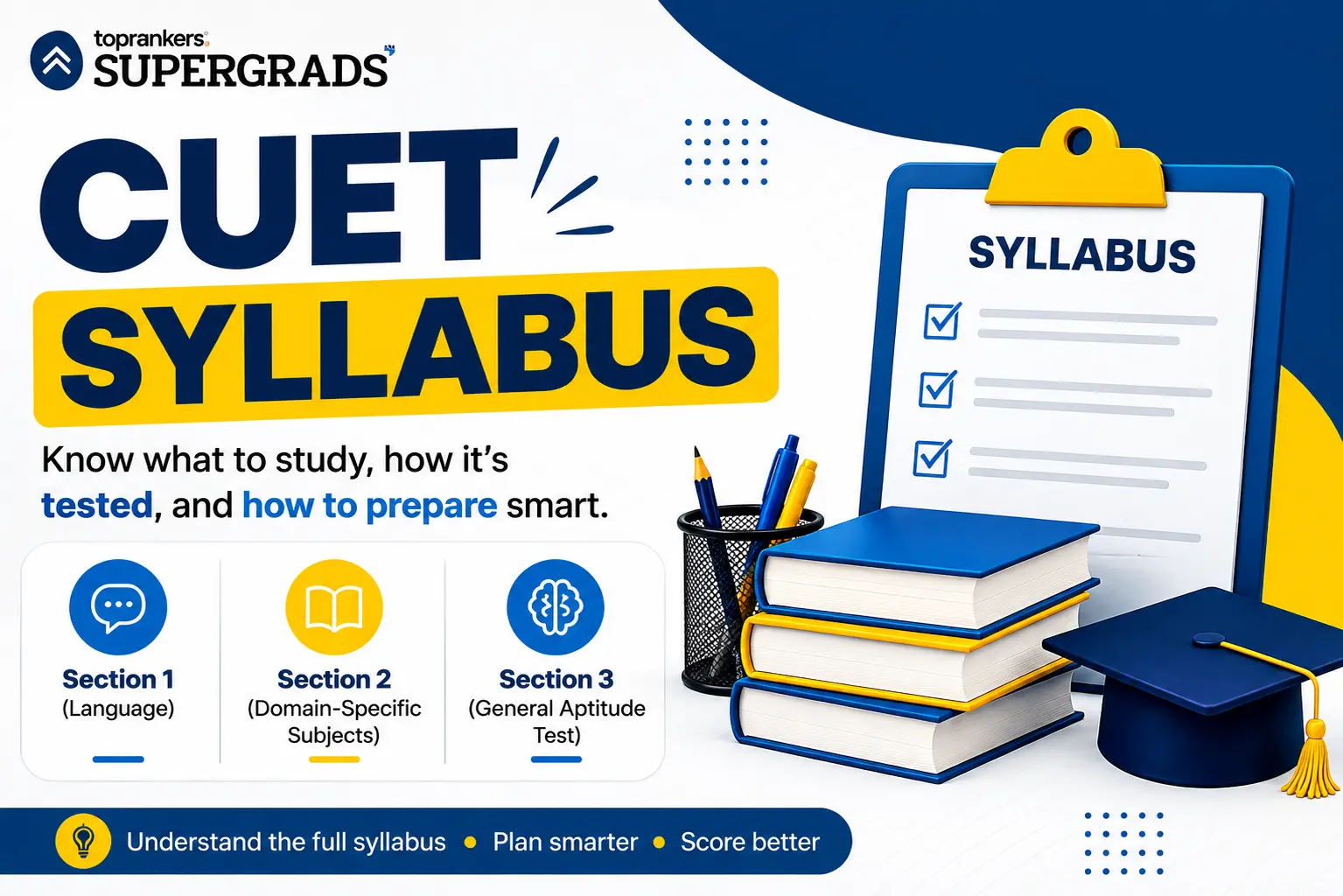
CUET Syllabus 2027: The CUET UG 2027 syllabus covers three main sections: Languages, Domain-Specific Subjects, and the General Aptitude Test (General Test). The National Testing Agency (NTA) releases the official syllabus to help students understand which topics they need to study for the entrance exam.
The topics vary by subject. Domain subjects generally follow the relevant NCERT curriculum, so students should check the syllabus for each subject they plan to choose.
In this guide, you can explore the section-wise syllabus, check the topics included in different subjects, and find PDF resources for revision. Use these details to plan your preparation and keep track of the topics you have covered.
What is the CUET Syllabus 2027?
The CUET syllabus 2027 is the official list of subjects and topics as prescribed by the NTA (National Testing Agency) for the Common University Entrance Test (Undergraduate). It lays out precisely what you'll be tested on across the three sections and is available on the official CUET site (cuet.nta.nic.in).
Think of the CUET 2027 syllabus as your admission roadmap.
CUET is the single route into hundreds of central, state and deemed universities (DU, BHU, JNU, JMI, AMU etc). Knowing exactly what the NTA is going to ask enables you to prepare with focus rather than in a state of complete guesswork.
The CUET 2027 syllabus is available for all three sections:
- Section 1: Language Paper
- Section 2: Domain-Specific Subjects (subject-wise)
- Section 3: General Aptitude Test (GAT)
CUET UG 2027 Syllabus PDF Download Links for Domain-Specific Subjects
Here's the subject-wise CUET Syllabus PDF Download link in English to enhance your CUET preparation:
| Subjects | CUET 2027 syllabus PDFs in English |
| CUET Accountancy Syllabus | |
| CUET Agriculture Syllabus | |
| CUET Environmental Science Syllabus | |
| CUET Geography Syllabus | |
| CUET Fine Arts/Visual Arts Syllabus | |
| CUET Knowledge, Tradition and Practices of India Syllabus | |
| CUET Physics Syllabus | |
| CUET Home Science Syllabus | |
| CUET Mathematics Syllabus | |
| CUET Business Studies Syllabus | |
| CUET Sanskrit Syllabus | |
| CUET Sociology Syllabus | |
| CUET Mass Media/Mass Communication Syllabus | |
| CUET Physical Education/NCC /Yoga Syllabus | |
| CUET Psychology Syllabus | |
| CUET Chemistry Syllabus | |
| CUET Biology/Biological Studies/Biotechnology/Biochemistry Syllabus | |
| CUET Computer Science/ Informatics Practices Syllabus | |
| CUET Political Science Syllabus | |
| CUET Performing Arts Syllabus | |
| CUET Anthropology Syllabus | |
| CUET History Syllabus | |
| CUET Economics Syllabus |
CUET Syllabus 2027: Complete Subject -wise List
Here is the complete subject-wise syllabus list to make your preparation better:
CUET Accountancy Syllabus 2027: Important Topics Asked
Preparing for Accountancy becomes so much easier when you know precisely what's in the exam.
The CUET Accountancy Syllabus covers accounting principles, financial statements, partnership accounts, and company accounts.
CUET Agriculture Syllabus 2027: Important Topics Asked
The CUET Agriculture syllabus brings together topics related to crops, soil, farming practices, horticulture, and other areas of agriculture.
Check the complete CUET Agriculture Syllabus to see what you need to study before starting your preparation.
CUET Environmental Science Syllabus 2027: Important Topics Asked
This CUET subject is all about the environment and the various factors which affect it.
Major areas of the CUET Environmental Science Syllabus include ecosystems, biodiversity, natural resources, pollution, and sustainable development.
CUET Geography Syllabus 2027: Important Topics Asked
The CUET Geography syllabus covers both physical and human aspects of geography.
You'll come across topics on landforms, resources, population, economic activities and geographical processes as part of the CUET Geography syllabus.
CUET Home Science Syllabus 2027: Important Topics Asked
Home Science covers the areas of nutrition, human development, textiles, food and resource management.
Going through the CUET Home Science Syllabus first can help you decide how much time to give to each area.
CUET Mathematics Syllabus 2027: Important Topics Asked
The maths syllabus covers topics from algebra, calculus, probability, relations and functions.
Keep the CUET Mathematics Syllabus handy while preparing so that you can track the topics you have completed and revised.
CUET Sanskrit Syllabus 2027: Important Topics Asked
The CUET Sanskrit syllabus covers the prescribed areas of the language, literature, grammar and textual understanding.
Students can use the CUET Sanskrit Syllabus to identify the sections that require more reading and revision.
CUET Sociology Syllabus 2027: Important Topics Asked
Sociology looks at society, social relationships, institutions, culture, and social change.
The CUET Sociology Syllabus also includes topics related to inequality and important issues affecting contemporary society.
CUET Chemistry Syllabus 2027: Important topics to focus on
The CUET Chemistry syllabus includes topics from physical, organic, and inorganic chemistry.
Candidates should use the official list of topics to construct their study plan and make sure they don't miss any of the key areas.
CUET Anthropology Syllabus 2027: Important Topics Asked
Anthropology is the study of humans, our evolution, our societies and our cultures.
The CUET Anthropology syllabus includes areas of biological, social, and cultural anthropology along with other related concepts.
CUET History Syllabus 2027: Topics to Cover
The CUET History syllabus takes students through important events, societies, cultures, and political developments.
Focus on understanding the major themes and developments rather than relying only on memorisation.
CUET Economics Syllabus 2027: Important Topics Asked
Economics covers important concepts from microeconomics, macroeconomics, national income, money and banking, markets, and the Indian economy.
Reviewing the CUET Economics syllabus early will help you organise your study plan and prioritise topics.
Who Decides the CUET syllabus?
The CUET UG syllabus is prescribed and published by the National Testing Agency (NTA) on its official website.
Domain-subject topics follow the NCERT Class 11 and 12 curriculum, while the Language and General Aptitude Test papers use NTA's own defined topic lists.
The syllabus is standardised for all candidates nationwide, ensuring students from CBSE, ICSE, and state boards are evaluated on the same content.
CUET UG 2027 Syllabus PDF Download Link for GAT
|
Aptitude Test |
CUET 2027 General Aptitude Test Syllabus PDFs |
|
General Aptitude Test (GAT) |
CUET 2027 Syllabus: Complete Details
The NTA CUET UG exam is your ticket to some of the country's top-ranked universities.
The CUET UG 2027 syllabus is standard for every test-taker; what differs is only the combination of papers you select.
| Section | CUET 2027 Syllabus |
|---|---|
| Language Papers (Section 1) | Reading Comprehension (Factual, Literary & Narrative passages), Verbal Ability, Literary Aptitude and Vocabulary |
| Domain Subjects (Section 2) | Based on the NCERT Class 11 & 12 syllabus for the chosen subject |
| General Test (Section 3) |
|
Is the CUET syllabus the same for everyone?
Yes, the CUET 2027 syllabus is the same for all candidates in each subject.
Every student doing Physics is faced with the same Physics syllabus.
What differs between candidates is simply which papers they choose, the language, the subject areas and whether or not they take the General Test. All of this is determined by the course and university that the student is aiming at.
CUET Exam Pattern 2027
A syllabus is only half the picture; you also need to know how it will be tested. NTA confirmed a revised structure that carries into 2027, and it changes how you should study.
| Feature | CUET 2027 Syllabus |
|---|---|
| Feature | Details |
| Mode | Computer-Based Test (CBT) |
| Sections | 3: Language, Domain, General Test |
| Total papers offered | 37 (13 languages + 23 domain + 1 GAT) |
| Max subjects you can choose | 5 |
| Questions per paper | 50 all compulsory |
| Duration per paper | 60 minutes |
| Marks per paper | 250 |
| Marking scheme | +5 correct, −1 wrong, 0 unattempted |
The most important change:
The earlier "answer any 40 of 50" flexibility has been removed. All 50 questions are now mandatory.
Practically, this means you can no longer skip two or three low-interest chapters; the entire NCERT syllabus for each chosen subject is now fair game.
For a deeper breakdown, see the full CUET exam pattern 2027 guide.
How many questions are there in CUET 2027?
Each CUET UG 2027 paper contains 50 multiple-choice questions, and all 50 are compulsory.
Every correct answer earns +5 marks, every incorrect answer deducts 1 mark, and unattempted questions score zero.
Each paper carries a maximum of 250 marks and must be completed in 60 minutes. A candidate can select a maximum of five papers across the three sections.
NTA CUET UG Syllabus 2027 [Section-Wise + PDFs]
You can expect Language and General Test questions to be pitched at roughly Class 8 level and above, while domain papers stick to NCERT Class 11–12.
CUET Exam Syllabus 2027 for Language Test (Section 1)
The exam is conducted in 13 languages. Taking a language paper keeps you eligible for the maximum number of CUET participating universities.
The three key areas evaluated are:
- Reading Comprehension: Three passage types (Factual, Narrative, Literary), each up to ~300–350 words. You're tested on grasping the central theme and word meanings.
- Verbal Ability & Vocabulary: Synonyms, antonyms, error spotting, cloze/fillers, and match-the-column.
- Grammar & Usage: Tenses, active/passive voice, and correct language usage.
For a focused deep-dive, use the CUET English syllabus guide.
Download CUET 2027 Language Test Syllabus PDFs - All 13 Languages
As per the new CUET exam pattern, the language test section includes a total of 13 languages. So, let's take a look at the CUET syllabus for all available languages.
| Language | CUET 2027 Language Test Syllabus PDFs |
| English | |
| Hindi | |
| Assamese | |
| Bengali | |
| Gujarati | |
| Kannada | |
| Malayalam | |
| Marathi | |
| Odia | |
| Punjabi | |
| Tamil | |
| Telugu | |
| Urdu |
NTA CUET UG Syllabus 2027 for Domain-Specific Subjects (Section 2)
The domain section offers 23 subjects. Questions are MCQs framed from your NCERT Class 11 and 12 textbooks.
Because several Class-12 CUET topics are actually taught in Class 11 by some boards, aligning your board revision with the CUET exam syllabus from the start pays off.
NTA CUET Syllabus 2027 for General Aptitude Test (Section 3)
Top universities (DU, JNU, etc.) make the CUET General Test a compulsory requirement for a number of UG courses. The GAT covers:
- General Knowledge & Current Affairs
- General Mental Ability
- Numerical Ability
- Quantitative Reasoning (arithmetic / algebra / geometry / mensuration / statistics)
- Logical & Analytical Reasoning
- General Science & Environment Literacy
For the detailed topic list and recommended reading, see the CUET General Test syllabus and CUET General Test books.
CUET UG Syllabus 2027: Stream-Wise Subject Map
Your domain subjects follow directly from your Class 12 stream. Use this table as your starting point for the CUET syllabus for science students, commerce, and humanities aspirants.
| Stream | Main Domain Subjects to Consider |
|---|---|
| CUET UG Syllabus for Science Students | Physics, Chemistry, Biology, Mathematics, Computer Science, Environmental Science, Agriculture, Anthropology |
| CUET UG Syllabus for Commerce Students | Accountancy, Business Studies, Economics, Mathematics |
| CUET UG Syllabus for Arts / Humanities | History, Political Science, Geography, Psychology, Sociology, Mass Media, Home Science |
Expert tip: Don't just pick subjects you scored well in at school; pick the ones your target course actually requires. A B.Com (Hons) aspirant at DU, for instance, benefits from choosing Accountancy + Economics + Mathematics + GAT.
Check the DU CUET subject combination guide before locking in your choices, because the wrong combination can quietly close doors to courses you want.
CUET Syllabus 2027 for Science Students
Science students in the CUET UG 2027 will be selecting from Physics, Chemistry, Biology, Mathematics and Computer Science as their subject areas. All of these are drawn from the NCERT Class 11 and 12 syllabi.
The vast majority of science track UG courses will also require the General Aptitude Test. The mix of papers required will vary according to the course you're aiming at. A B.Sc. in Mathematics, for instance, will almost certainly require the Mathematics paper, whereas the medical allied courses will be very much weighted towards Biology.
Why Understanding the CUET Exam Syllabus Matters:
The CUET UG syllabus is essentially just your Class 12 NCERT content (in a slightly different format) and is the same for everyone. So getting it down early is a massive advantage.
| Benefit | Why It Helps |
|---|---|
| Build a realistic timetable | The syllabus lets you map topics to weeks and design a workable CUET study plan. |
| Track your progress | Knowing every unit shows you exactly what's covered and what's left. |
| Revise systematically | A defined scope means cleaner, faster, more confident revision. |
| Fair, board-neutral prep | CBSE, ICSE, and state-board students all prepare from the same NCERT base. |
How to Prepare for the CUET English Syllabus 2027?
- Read a newspaper daily and maintain a running list of new words with meanings.
- Clear the easy topics first, then tackle the tougher ones in the CUET 2027 syllabus.
- Solve 5–10 sentence-rearrangement and para-jumble questions every day.
- Revise core vocabulary and drill idioms & phrases using flashcards.
- Attempt 2–3 reading-comprehension passages daily and review literary devices.
Pair this with the CUET English syllabus breakdown to see exactly which grammar and vocabulary areas repeat most often.
How to Prepare for CUET Domain Subjects 2027?
- Study the CUET syllabus 2027 for your chosen subject alongside its exam pattern before you begin.
- Weight your effort toward high-frequency, high-mark chapters.
- Make short notes as you cover each unit, flagging key definitions.
- Rely on NCERT as your primary source; the language is simple, and it maps directly to the NTA CUET UG syllabus.
- Attempt CUET mock tests and previous-year papers regularly to gauge progress.
Subject-specific strategy guides worth bookmarking: How to prepare for CUET Maths, Physics, and Chemistry.
How to Prepare for the CUET General Test (GAT) 2027?
- Watch the daily news to keep up to date with current affairs both domestically and internationally.
- Solve newspaper and online puzzles to improve your logical and analytical reasoning.
- Do 40 to 50 quantitative aptitude questions every day to build up speed and accuracy.
- Lock down the fundamentals: BODMAS, the tables and the standard formulae for faster solving.
- Take 10 to 20 topic specific practice tests to reduce the anxiety of the actual exam day.
For the full method, read How to prepare for CUET General Test 2027.
Common Mistakes Students Make With the CUET Syllabus 2027
This is the section most competing pages skip and where students lose easy marks.
- Assuming it's "Class 12 only." Roughly a third of domain questions trace back to Class 11 NCERT. Skipping Class 11 revision is the single most common error.
- Planning around the old "40 of 50" rule. With all 50 questions now compulsory, chapter-skipping strategies backfire; negative marking punishes blind guesses.
- Choosing subjects by comfort, not by course. Your 5-subject selection should be reverse-engineered from your target university's requirement, not your favourite subject.
- Ignoring the General Test until the end. For DU and JNU aspirants, GAT is often decisive; treat it as a core paper, not an afterthought. See Is General Test compulsory for DU CUET?
- Studying from random guides instead of NCERT. NTA frames domain questions from NCERT; unofficial guides often add topics that aren't tested.
CUET Exam Analysis: Previous Year Trends
Vocab questions have overtaken reading comprehension in the recent shifts, and the paper as a whole has remained 70-80% easy to moderate.
Sentence rearrangement generally had 6 to 7 questions. Don't expect NTA to stick to one style of question, so you'll have to be ready to see a variety. See how to conquer the reading comprehension section for CUET.
1. Quantitative (GAT)
The quant section has been quite tricky and time-consuming, with the usual suspects of mensuration, SI & CI, time & work, speed & distance, profit & loss, percentages, ratios, trigonometry, etc., recurring.
2. Reasoning
Circular seating, calendars, blood relations and coding-decoding are the topics that dominate the section; the difficulty level ranged from moderate to difficult.
3. GK & Current Affairs
Approx. 12-13 questions on static GK (current affairs based), i.e. rivers, capitals, books & authors, defence, articles and fundamental duties. Go through the full CUET exam analysis.
Conclusion
Understanding the CUET syllabus 2027 is genuinely the first real step of your preparation; everything else (study plan, mock tests, subject choice) flows from it.
Remember the three things that matter most: the syllabus spans NCERT Class 11 and 12, all 50 questions per paper are compulsory, and you may pick a maximum of 5 subjects.
Download the subject-wise PDFs above, align them with your target course, and start practising with CUET mock tests and previous-year papers.
If you'd like structured guidance, SuperGrads CUET Online Coaching maps your syllabus to a week-by-week plan.
Get CUET Study Materials
Fill your details
Frequently Asked Questions
Who prescribes CUET Syllabus 2027?

Is CUET based on class 12 syllabus?
Is NCERT enough for preparing for CUET syllabus?
Is CUET difficult?
Is the CUET syllabus different for each course or university?
Are there topics outside the NCERT syllabus in CUET?
How does the CUET Examination Syllabus differ for Science, Commerce, and Humanities students?
What is CUET Syllabus 2027?
Does the CUET 2027 syllabus include General Knowledge topics?
What subjects are included in the CUET 2027 syllabus?

Lalita Vishwakarma
Content Writer
SHARE