
1723534562.png)

CLAT Exam Pattern 2027: Section-Wise Weightage, Marking Scheme & Paper Format
July 22, 2026
Reader's Digest: If you're preparing for CLAT, one mistake can cost you your NLU dream — not understanding the exam pattern properly.
Before you solve mocks, before you pick books, before you even start preparation, you must be crystal clear about:
- How many questions will be asked
- What type of passages will you face
- How marks are awarded (and deducted
- Which section carries the most weightage
This guide breaks down the CLAT Exam Pattern 2027 in the simplest way possible, so you know exactly what to expect and how to prepare smartly.
Important Information
- No changes for CLAT 2027: The syllabus and pattern/sections of both UG and PG papers remain unchanged. Paper setters will only adopt the Expert Committee's suggestions on question format and quality where feasible.
- Expert Committee Report published: It's available on the Consortium's website for public feedback. Feedback can be submitted via the online form by August 31, 2026.
- Changes possible for CLAT 2028: The CJI's office will constitute a committee to consider the Report's recommendations. The Governing Body will engage with these recommendations and public feedback as it prepares for CLAT 2028.
- Bottom line: CLAT 2027 aspirants can prepare with the existing pattern; any reforms would affect CLAT 2028 onward.
Get the complete information about what's in the Expert Committee Report about CLAT 2027 - 2028. Download the simplified question answer PDF below.
Until the Consortium announces any changes in the CLAT 2027 exam Pattern, we expect it to remain consistent with the previous year's format.
To help you in your preparation, we have answered the commonly asked questions on the CLAT Paper Pattern 2027:
- What is CLAT? Common Law Admission Test is an entrance examination conducted in India for admission to undergraduate and postgraduate law programs at various national law universities and other law colleges nationwide.
- What is the CLAT 2027 test mode? The exam is conducted offline, that is, in pen-and-paper mode.
- Does the exam have any negative markings? Yes, the exam follows a negative marking scheme. 0.25 marks will be deducted from the total score for every incorrect answer.
- Does the CLAT exam pattern change every year? The CLAT pattern occasionally changes, although the core components of the exam remain the same.
Check Out - Are you eligible to take CLAT 2027 Or Not?
CLAT Exam Pattern 2027: Overview
Understanding the UG & CLAT PG Exam Pattern for 2027 is crucial for aspirants who aim to crack the CLAT on the first attempt.
- In the UG exam, you will be tested on English, GK, Logical Reasoning, Legal Aptitude/Reasoning, and Quantitative Techniques.
- In the PG Exam, you will be tested on subjects of the undergraduate program, including Constitutional Law, Jurisprudence, Administrative Law, Law of Contract, Torts, Family Law, Criminal Law, Property Law, Company Law, Public International Law, Tax Law, Environmental Law, and Labour & Industrial Law.
Check out the table below to get an idea about the exam pattern of CLAT UG & PG:
| Fields | CLAT Paper Pattern (UG) | CLAT Paper Pattern (PG) |
| Exam Mode ✏️ | Offline (Pen & Paper-based) | Offline (Pen & Paper-based) |
| Medium of Language 🌐 | English | English |
| Total Number of Questions 🔢 | 120 | 120 |
| Total CLAT Marks 💯 | 120 | 120 |
| Duration ⏰ | 2 Hours | 2 Hours |
| Type of Questions 📝 | MCQs-based Comprehension Passages | MCQs-based Comprehension Passages |
| Correct Marks ✅ | 1 Mark | 1 Mark |
| Negative Marking ⛔️ | Yes (0.25 Marks) | Yes (0.25 Marks) |
CLAT Exam Pattern 2027: Section-wise Weightage
As per the CLAT Exam Syllabus 2027, you may be mainly tested on five subjects:
- English Language
- Current Affairs & General Knowledge
- Legal Reasoning
- Logical Reasoning
- Quantitative Techniques
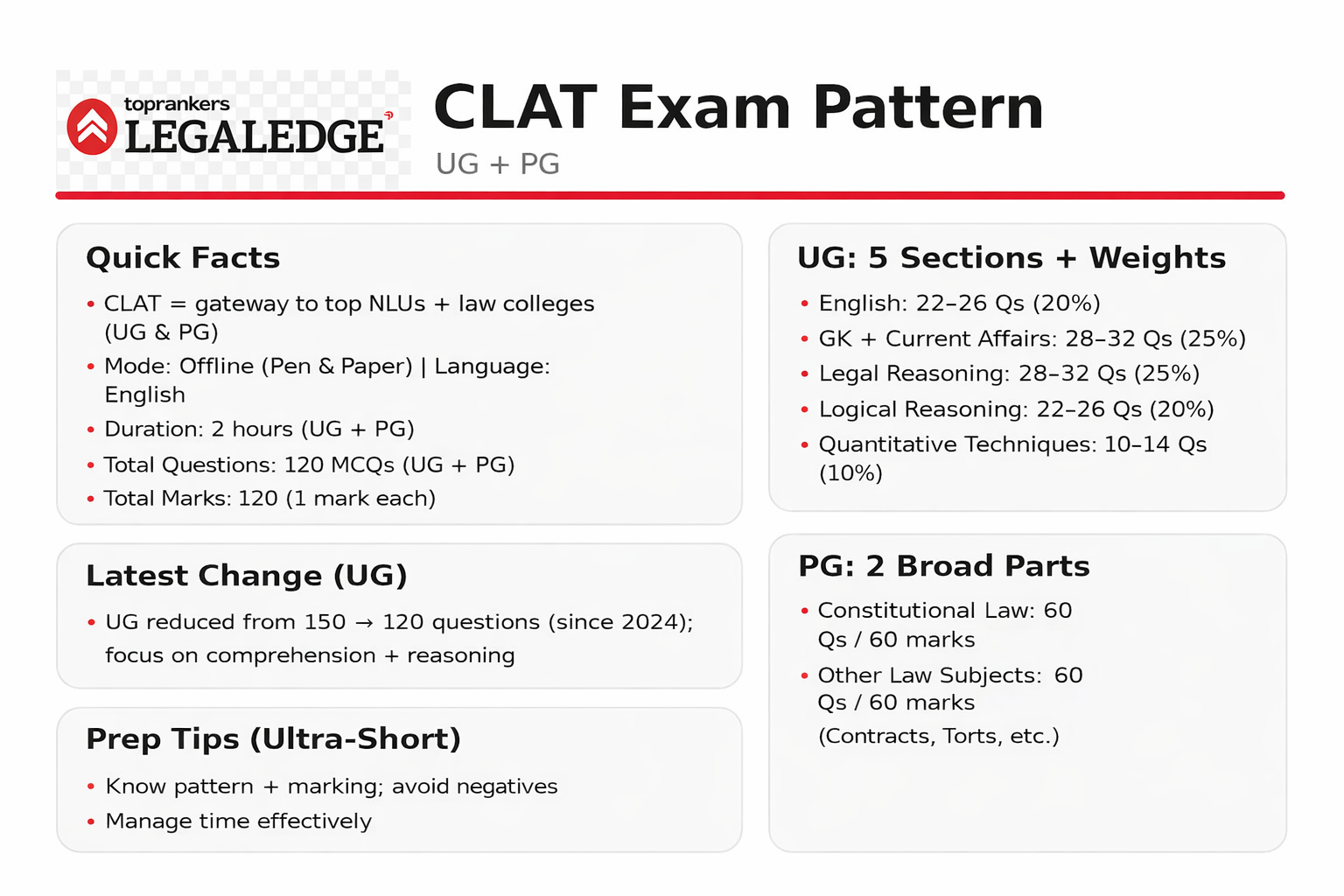
Check out the table below to know the paper pattern of the CLAT Exam UG:
| Subject | Number of questions | Percentage weightage |
| English Language | 22-26 questions | 20% |
| Current Affairs, including General Knowledge | 28-32 questions | 25% |
| Legal Reasoning | 28-32 questions | 25% |
| Logical Reasoning | 22-26 questions | 20% |
| Quantitative Techniques | 10-14 questions | 10% |
The table below explains the detailed CLAT LLM paper exam pattern, CLAT Total Marks, and the number of questions asked for each topic in the exam:
| CLAT Subjects | Number of MCQ questions | Marks |
| Constitutional Law | 60 | 60 |
| Other Law Subjects include Contracts Law, Law of Torts, Criminal Law, International Law, IPR, and Jurisprudence. | 60 | 60 |
| CLAT Total Marks | 120 | 120 |
Read More: CLAT Time Management Tips
What is CLAT Exam Pattern 2027 Marking Scheme
- As per the previous year's CLAT Paper Pattern (UG & PG), you will be awarded +1 mark for each question you answered correctly.
- 0.25 marks will be deducted for each wrongly answered question.
- No marks will be awarded or deducted for unanswered questions.
| Response | Marks |
| Correct Answer ✅ | + 1 Marks |
| Incorrect Answer ❌ | 0.25 Marks |
| Unanswered/ Unattempted Question ❓ | 0 Mark |
Read more: Best Books for CLAT 2027
What is the Importance of CLAT Exam Pattern 2027
Candidates appearing for CLAT 2027 must thoroughly know the CLAT Pattern. The exam pattern teaches the candidate about the exam mode, sections, the number of questions, the marks distribution, the duration, and the difficulty level.
It also focuses on helping the candidate understand what questions can be asked and what skills are tested. Thus, every candidate needs to be acquainted with the exam's modalities.
What are the New Changes in CLAT Exam Pattern 2027
The Common Law Admission Test (CLAT) has undergone notable changes in its exam pattern, particularly for the undergraduate (UG) program. Here's an overview of the latest modifications:
CLAT UG Exam Pattern
- CLAT Total Questions: Reduced from 150 to 120 multiple-choice questions (MCQs).
- CLAT Total Marks: Correspondingly decreased to 120 marks.
- Duration: Remains at 2 hours.
- Marking Scheme: Each correct answer awards 1 mark; each incorrect answer incurs a penalty of 0.25 marks.
- Sections and Weightage:
- English Language: 22–26 questions (approximately 20% of the paper).
- Current Affairs, including General Knowledge: 28–32 questions (approximately 25%).
- Legal Reasoning: 28–32 questions (approximately 25%).
- Logical Reasoning: 22–26 questions (approximately 20%).
- Quantitative Techniques: 10–14 questions (approximately 10%).
These changes aim to focus more on assessing candidates' comprehension and reasoning abilities rather than rote learning. The exam continues to be conducted in an offline, pen-and-paper format.
CLAT Exam Pattern 2027: Ideal Time To Spend on Each Section
| Subject | Time |
| English Language | 25 Mins |
| Current Affairs, including General Knowledge | 10-12 Mins |
| Legal Reasoning | 35 Mins |
| Logical Reasoning | 25 Mins |
| Quantitative Techniques | 15 Mins |
Read More: How to Prepare For CLAT 2027
What is the CLAT PG Exam Pattern 2027
The PG exam pattern remains unchanged, comprising 120 MCQs covering Constitutional Law and other law subjects. The marking scheme and duration are consistent with the UG exam.
CLAT UG vs PG Exam Pattern 2027: Quick Comparison
| 🔍 Feature | 🎓 CLAT UG (Undergraduate) | 🎓 CLAT PG (Postgraduate) |
|---|---|---|
| 📝 Question Type | MCQs based on comprehension passages | MCQs based on core law subjects |
| 📚 Subjects Covered |
|
|
| ❓ Number of Questions | 120 | 120 |
| ⏰ Exam Duration | 2 hours | 2 hours |
| 💯 Total Marks | 120 | 120 |
| ⛔ Negative Marking | Yes – 0.25 marks deducted per wrong answer | Yes – 0.25 marks deducted per wrong answer |
| 📖 Focus Areas | Comprehension, reasoning, analytical thinking | Subject knowledge from the LL.B. curriculum |
| 🗓️ Exam Mode | Offline (Pen & Paper) | Offline (Pen & Paper) |
| 🌐 Language Medium | English only | English only |
| 🆕 Recent Changes? | Yes – reduced from 150 to 120 questions in 2024 | No major changes |
How to Attempt a Paper Based on the CLAT Exam Pattern 2027?
Here’s what toppers actually do:
Step 1: Start with GK
Quick and less time-consuming
Step 2: Move to Legal + Logical
High weightage
Step 3: Attempt English
Moderate difficulty
Step 4: End with Quant
Time-consuming
Golden Strategy:
Maximize accuracy in high-weightage sections.
Common Mistakes Students Make
- Ignoring passage reading practice
- Attempting too many questions (negative marking trap)
- Skipping GK revision
- Not analyzing mocks
Avoid these, and your score jumps automatically.
How This CLAT Exam Pattern Impacts Your Preparation
The CLAT exam pattern clearly tells you:
- You need reading speed + accuracy
- You need conceptual clarity
- You need mock-based learning
Preparation is no longer about “studying more”
It’s about “studying smart”
What are the Tips for Scoring Well in CLAT 2027
Scoring well in the CLAT requires diligent preparation and a strategic approach. Here are some valuable tips to help you excel in the CLAT exam:
- Understand the Exam Pattern: Familiarise yourself with the CLAT exam pattern, including the number of questions, sections, time allocation, and marking scheme. This understanding will help you plan your strategy effectively.
- Create a Study Plan: Develop a well-structured study plan covering all subjects and allowing ample practice and revision time. Allocate more time to challenging subjects.
- Study Material: Choose high-quality study materials and reference books recommended by experts and previous CLAT toppers. This will ensure you have access to reliable and relevant content.
- Practice Mock Tests: Practice CLAT mock tests regularly. Mock tests help you become familiar with the exam format, improve time management, and identify your strengths and weaknesses.
- Time Management: Manage your time efficiently during the exam. Allocate a specific amount of time to each section and stick to it. Only spend a little time on one question; move on and return later if necessary.
- Revise Regularly: Regular revision is crucial. Create concise notes summarising essential concepts, formulas, and rules for quick review.
- Stay Calm and Confident: On the exam day, maintain a calm and focused mindset. Confidence in your preparation will help you perform better.
- Practice Previous Years' Papers: Solve previous years' CLAT papers to understand the question patterns and difficulty levels. It will also help you gauge your readiness.
Remember that success in CLAT depends on consistent effort and dedication. Stay focused, practice regularly, and remain determined to score well in the CLAT exam.
Check Out: How to prepare for CLAT?
Conclusion
In conclusion, being well-versed in the CLAT exam pattern is crucial for a successful attempt. It enables you to prepare efficiently and effectively, improving scores and increasing your chances of securing admission to prestigious law institutions.
- Familiarise yourself with the sections and weightage of the exam.
- Focus on developing strong comprehension, reasoning, and legal aptitude skills.
- Practice time management to complete all sections within the allotted time.
- Use previous years' question papers and mock tests to get accustomed to the exam format. Then, check the CLAT exam analysis to learn about recurring topics or types of questions.
- Pay attention to the CLAT 2027 marking scheme, avoid negative markings and attempt questions wisely.
- Stay updated on current affairs and legal developments in the General Knowledge section.
- Regularly assess your progress and adapt your preparation strategy accordingly.
By incorporating these takeaways into your preparation, you'll be well-equipped to tackle the sections confidently according to the CLAT weightage and exam and achieve your desired results. Best of luck!
NLU Dream, Zero Cost Start: Free CLAT Demo
Fill your details
Frequently Asked Questions
Is there negative marking in the CLAT exam?

What type of questions are asked in the CLAT exam?
3. How many questions are there in the CLAT exam?
Is the CLAT exam subjective or objective (MCQ or written)?
Is the CLAT exam conducted online or offline?

Samriddhi Pandey
Content Writer


SHARE