
1723534562.png)

CLAT 2027 Expert Committee Report Released: Key Reforms Proposed
July 23, 2026
Reader's Digest: The Consortium of National Law Universities has officially released the CLAT 2027 Expert Committee Report, giving students a first look at the reforms that may shape the future of India's biggest law entrance exam. While the report introduces several significant recommendations, the Consortium has clearly stated that CLAT 2027 will continue with the existing syllabus and exam pattern, giving aspirants much-needed clarity.
Direct Answer: The CLAT Expert Committee Report has been released for public consultation, but no changes will be implemented in CLAT 2027. The Consortium has confirmed that the exam scheduled for 6 December 2026 will follow the existing pattern and syllabus. The report contains recommendations that may influence CLAT 2028 or future examinations after they are reviewed by the Chief Justice of India's committee and the Consortium's Governing Body.
As per the official notification:
| Event | Important Date |
|---|---|
| CLAT 2027 Exam Date | Sunday, 6 December 2026 |
| Exam Timing | 2:00 PM – 4:00 PM |
| Application Start Date | 3 August 2026 |
| Last Date to Apply | 31 October 2026 |
| Public Feedback Deadline on Report | 31 August 2026 |
For every CLAT aspirant, the biggest takeaway is simple—continue preparing according to the current CLAT Exam pattern while keeping an eye on future announcements.
CLAT 2027 Expert Committee Report Highlights
The release of the CLAT 2027 Expert Committee Report has sparked discussions among students, coaching institutes, and legal education experts. Since several recommendations suggest major structural reforms, many aspirants initially feared immediate changes.
Fortunately, the Consortium has removed all confusion. Here are the biggest highlights of the CLAT 2027 Expert Committee Report:
| Key Update | What It Means |
| CLAT 2027 Pattern | No changes |
| CLAT 2027 Syllabus | No changes |
| Question Quality | Expert recommendations may be adopted wherever feasible |
| Public Feedback | Open until 31 August 2026 |
| Possible Reforms | Only under consideration for CLAT 2028 and beyond |
| Official Preparation Strategy | Continue preparing using the existing pattern |
The CLAT 2027 Expert Committee Report has been published to invite suggestions from students, teachers, legal professionals, and other stakeholders. This makes the reform process more transparent and participative. However, students should remember that these recommendations are not final policies.
Why Was the CLAT Expert Committee Formed?
The CLAT Expert Committee was established to review the overall quality of the examination and recommend improvements that better assess a student's legal aptitude rather than memorisation. Over the years, CLAT has evolved significantly, but concerns continued regarding:
- Excessive dependence on Current Affairs memorisation
- Coaching-driven CLAT preparation strategies
- Speed-based solving instead of analytical thinking
- The need for a more skills-oriented examination
Keeping these concerns in mind, the CLAT Expert Committee studied national and international aptitude tests, consulted experts, and proposed reforms aimed at creating a more balanced assessment. One of the report's primary objectives is to ensure that students from different educational backgrounds compete on equal footing while reducing dependence on rote learning.
The CLAT Expert Committee Report also encourages greater emphasis on reasoning, comprehension, and legal aptitude instead of factual recall.
Proposed Structural Changes by CLAT Expert Committee
Although the CLAT 2027 Expert Committee Report recommendations will not affect CLAT 2027, they provide a glimpse of what future editions could look like.
Proposed UG Pattern
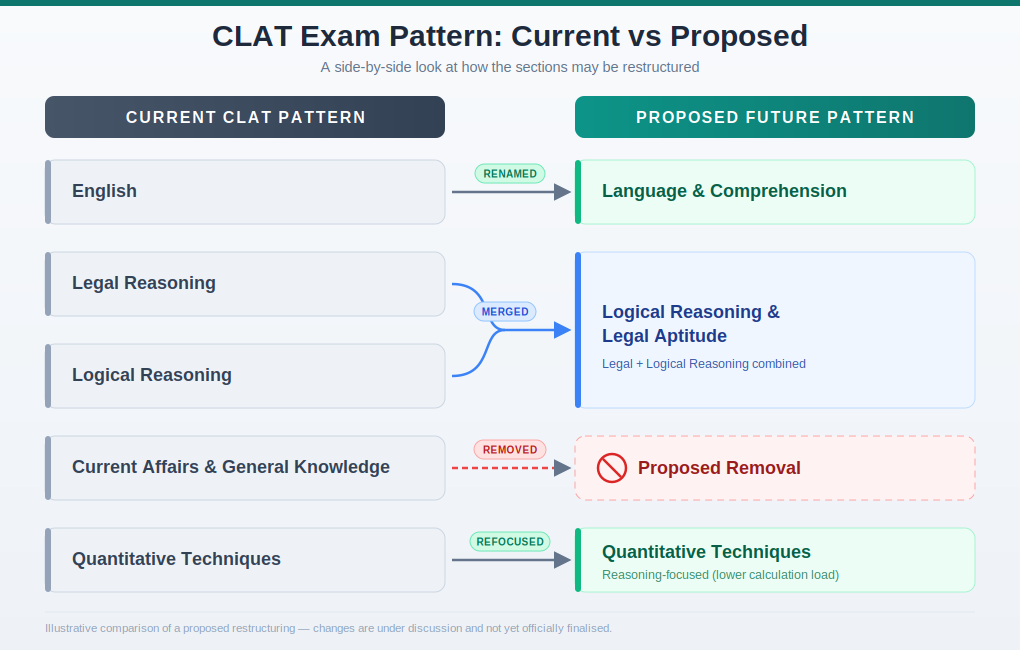
Instead of five sections, the exam may eventually consist of only three broad sections.
| Existing Pattern | Proposed Future Pattern |
| English | Language & Comprehension |
| Current Affairs & GK | Removed |
| Legal Reasoning | Merged into Logical Reasoning & Legal Aptitude |
| Logical Reasoning | Merged |
| Quantitative Techniques | Quantitative Techniques (revised focus) |
1. Logical Reasoning and Legal Aptitude
This section proposes combining Legal Reasoning and Logical Reasoning into one comprehensive paper. Students would be expected to:
- Apply legal principles to hypothetical situations
- Derive rules from given facts
- Analyse logical relationships
- Solve reasoning-based legal problems
Importantly, prior legal knowledge would not provide any additional advantage.
2. Language and Comprehension
The focus shifts beyond vocabulary and grammar. Students may be tested on:
- Reading comprehension
- Tone
- Inference
- Author's intention
- Critical reasoning
- Argument analysis
3. Quantitative Techniques
Instead of difficult mathematics, the emphasis would be on:
- Data interpretation
- Numerical reasoning
- Pattern recognition
- Analytical thinking
The CLAT Expert Committee Report also proposes reducing the total number of questions substantially while maintaining the two-hour duration. This indicates a shift from speed to quality of thinking.
Proposed CLAT PG Pattern
The report also introduces changes for postgraduate admissions.
| Proposed Section | Weightage |
| Three UG Aptitude Sections | 50% |
| Legal Knowledge (MCQs) | Included |
| Problem Question (Descriptive) | Included |
The Legal Knowledge section would focus only on recent legal developments from the previous two calendar years.
Meanwhile, candidates would answer one descriptive legal problem selected from multiple options covering:
- Public Law
- Private Law
- Commercial Law
- International Law
The CLAT 2027 Expert Committee has clarified that these remain recommendations and are subject to further review before implementation.
CLAT Expert Committee's Recommendation on Public Release
One of the most appreciated aspects of the CLAT Expert Committee Report is its emphasis on transparency. Instead of implementing reforms immediately, the Consortium has:
- Published the report publicly
- Invited stakeholder feedback
- Allowed students to share suggestions
- Fixed 31 August 2026 as the last date for responses
The CLAT 2027 Expert Committee Report also recommends that if any future CLAT PG pattern is adopted, the Consortium should release:
| Recommended Resources | Purpose |
| Sample Papers | Familiarise students |
| Skill Framework | Explain competencies being tested |
| Official Preparation Material | Reduce coaching dependence |
| Regional Language Resources | Improve accessibility |
This student-friendly approach ensures aspirants receive adequate preparation time before any major reforms are introduced.
Consortium's Final Word on CLAT 2027
The Consortium has left no room for speculation. According to its official announcement:
- CLAT 2027 will follow the existing syllabus.
- The current exam pattern remains unchanged.
- Proposed reforms are not applicable this year.
- The Chief Justice of India's office will constitute a committee to examine the recommendations.
- The Governing Body will consider both expert recommendations and public feedback before making future decisions.
Therefore, the CLAT 2027 Expert Committee Report should be viewed as a roadmap rather than an immediate rulebook.
For students preparing for CLAT 2027, the preparation strategy remains exactly the same.
At the same time, those targeting future admissions should read the CLAT Expert Committee Report carefully because it reflects the direction in which the examination may evolve.
The CLAT 2027 Expert Committee has indicated that reasoning skills, reading comprehension, analytical ability, and legal aptitude are likely to become increasingly important in future examinations.
If you're targeting CLAT 2028 or beyond, begin strengthening these transferable skills while continuing to prepare according to the current CLAT syllabus until any official notification confirms otherwise.
NLU Dream, Zero Cost Start: Free CLAT Demo
Fill your details
Frequently Asked Questions
Has the CLAT 2027 pattern actually changed?

Does this report apply directly to CLAT 2027?
Is the syllabus staying the same for 2027?
Has GK been removed from CLAT 2027?
Is GK removal only a future recommendation?
Will sections really drop from 5 to 3?

Samriddhi Pandey
Content Writer


SHARE