
1723534562.png)

Download CUET General Test Syllabus 2027 PDF [Section-wise]
August 19, 2026
If you're planning to take the CUET General Aptitude Test (GAT) 2027, understanding the syllabus is the first step towards effective preparation.
The General Test is required for admission to several undergraduate programmes offered by participating universities, including courses such as Delhi University's B.A. Programme, though many honours programmes do not require it.
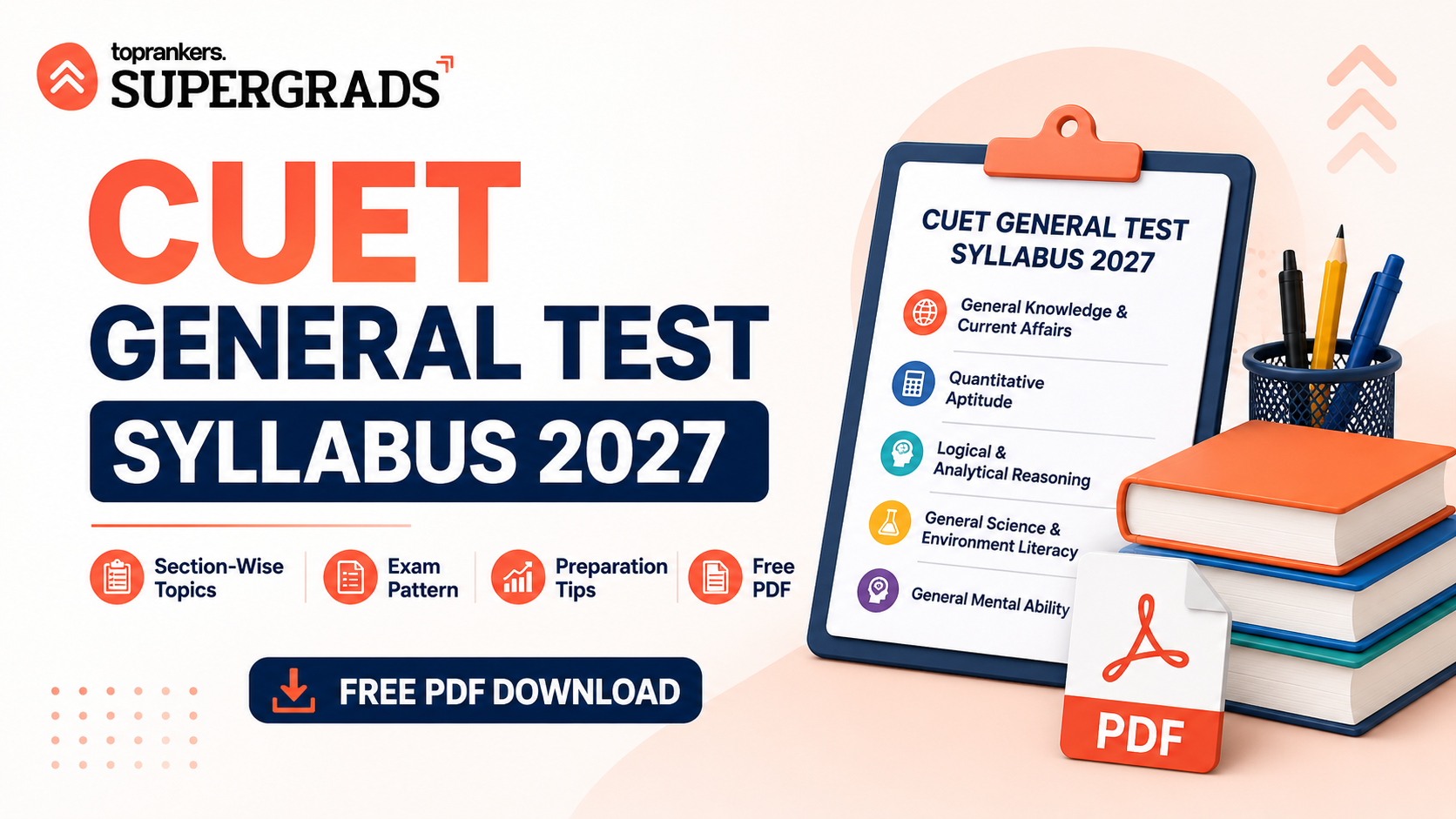
The CUET General Test Syllabus 2027 covers five key areas:
- General Knowledge & Current Affairs
- Quantitative Aptitude
- Logical & Analytical Reasoning
- General Mental Ability
- General Science & Environment Literacy.
The exam consists of 50 compulsory questions, carries 250 marks, and must be completed in 60 minutes.
In this guide, you'll find the complete section-wise syllabus, the latest exam pattern, important topics, weightage trends based on previous years, and practical preparation tips to help you decide how much focus the General Test deserves in your overall CUET preparation.
What Is the CUET General Test (GAT)?
The CUET General Test is Section III of the CUET UG exam, conducted by the National Testing Agency (NTA). Unlike the language and domain-subject papers, it does not test subject-specific knowledge from your Class 12 board syllabus.
Instead, it checks your general awareness, reasoning ability, and basic mathematical skills the kind of aptitude universities use to judge readiness for multidisciplinary and open-elective programmes.
Because GAT questions aren't tied to a fixed textbook, students often find it harder to predict than domain papers. That's exactly why a clear, section-wise syllabus map matters more here than anywhere else in CUET preparation.
CUET General Test Syllabus PDF Download Link 2027
The downloadable PDF of the CUET syllabus for General Test (GAT) is given below:
CUET General Test Syllabus 2027 (Topic List)
The CUET General Test Syllabus 2027 is expected to stay unchanged from the 2026 cycle until NTA releases the new information bulletin. It is divided into five broad areas:
| Section | Focus Area | Priority |
|---|---|---|
| 1 | General Knowledge & Current Affairs | |
| 2 | General Mental Ability & Numerical Ability | |
| 3 | Quantitative Aptitude (arithmetic, algebra, geometry, mensuration, statistics) | |
| 4 | Logical & Analytical Reasoning | |
| 5 | General Science & Environment Literacy |
Important Topics of CUET General Test Syllabus 2027
The CUET General Aptitude Test (GAT) 2027 is designed to assess a candidate's overall awareness, reasoning ability, numerical aptitude, and problem-solving skills.
Unlike subject-specific papers, the General Test evaluates how well you can apply concepts to real-world situations rather than simply recalling facts.
To score well, it is important to understand the topics that are frequently tested and prioritise your preparation accordingly.
Based on the latest CUET exam pattern and previous years' trends, the General Test primarily focuses on General Knowledge & Current Affairs, Quantitative Aptitude, Logical & Analytical Reasoning, General Mental Ability, and General Science & Environment Literacy.
Below is a detailed section-wise breakdown of the important topics covered in the CUET General Test Syllabus 2027.
CUET General Test Syllabus 2027 for General Knowledge & Current Affairs
General Knowledge and Current Affairs is one of the highest-scoring sections of the CUET General Test if prepared consistently.
According to the CUET 2026 exam analysis, around 10–12 questions in the General Test were asked from this section, making it one of the most important areas of the paper.
The questions are generally based on recent events, static General Knowledge, Indian history, geography, polity, economics, science, and major national and international developments.
Updating with daily news and revising static GK regularly can significantly improve your score.
Important Topics Covered
| Topic | Important Subtopics |
|---|---|
| Ancient History | Indus Valley Civilisation, Vedic Age, Mauryan & Gupta Empire, Important Dynasties |
| Medieval History | Delhi Sultanate, Mughal Empire, Bhakti & Sufi Movements |
| Modern History | Revolt of 1857, Freedom Struggle, Important Acts, National Movements, Independence |
| Indian Polity | Constitution, Fundamental Rights & Duties, Parliament, Judiciary, President, Prime Minister, Constitutional Bodies |
| Geography | Physical Geography of India, Rivers, Mountains, Climate, Agriculture, Natural Resources, World Geography |
| Indian Economy | Budget, Economic Survey, Banking, Inflation, GDP, Government Schemes, Economic Terminology |
| Physics | Basic Concepts, Motion, Electricity, Magnetism, Heat, Light, Everyday Applications |
| Chemistry | Elements & Compounds, Acids & Bases, Everyday Chemistry, Chemical Reactions |
| Biology | Human Body, Nutrition, Diseases, Plant Biology, Genetics, Ecology |
| Books & Authors | Famous Books, Writers, Literary Awards |
| Sports | National & International Sports Events, Major Tournaments, Players, Records |
| Awards & Recognitions | Padma Awards, Nobel Prize, Bharat Ratna, Film Awards, Sports Awards |
| Current Affairs | National & International News, Government Schemes, Science & Technology, Environment, Economy, Appointments, Summits, Defence, Important Days |
Learn How to score 250/250 in CUET GAT
CUET General Test Syllabus 2027 for Logical and Analytical Reasoning
The Logical and Analytical Reasoning section is designed to evaluate your ability to think critically, identify patterns, solve problems, and make logical decisions.
It is one of the highest-scoring sections in the CUET General Aptitude Test (GAT) 2027 because most questions are concept-based and can be solved quickly with regular practice.
Candidates should focus on improving their reasoning speed and accuracy by solving CUET mock tests and previous years' question papers.
Mastering common question types can help you attempt this section confidently within the limited exam time.
Important Topics in Logical and Analytical Reasoning
| Topic | Important Subtopics |
|---|---|
| Non-Verbal Reasoning | Figure Series, Pattern Recognition, Embedded Figures |
| Critical Reasoning | Assumptions, Conclusions, Arguments, Statement-Based Questions |
| Coding-Decoding | Letter Coding, Number Coding, Symbol Coding |
| Data Sufficiency | Statement Analysis, Decision Making |
| Calendar | Day & Date Calculations |
| Figure Counting | Counting Squares, Triangles, Rectangles |
| Seating Arrangement | Linear, Circular & Puzzle-Based Arrangements |
| Venn Diagram | Set Theory, Logical Representation |
| Clock | Time & Angle Problems |
| Ranking Test | Order and Position-Based Questions |
| Series | Number, Alphabet and Mixed Series |
| Analogy | Number, Alphabet, Word and Figure Analogies |
| Blood Relations | Family Tree-Based Questions |
| Direction Sense | Distance and Direction Problems |
| Probability | Basic Probability Concepts |
| Syllogism | Logical Conclusions using Statements |
| Missing Figure/Number | Pattern Completion |
| Mirror & Water Images | Reflection-Based Questions |
CUET General Test Syllabus 2027 for Quantitative Aptitude
The Quantitative Aptitude section tests your numerical ability, mathematical concepts, and calculation speed.
The questions are generally based on Class 8–10 mathematics and require conceptual clarity rather than advanced calculations.
If Mathematics isn't your strongest subject, don't worry. With regular practice and a good understanding of formulas, this section can become one of the highest-scoring topics of the CUET exam.
Time management is equally important, as lengthy calculations can consume valuable exam time.
Important Topics in Quantitative Aptitude
| Topic | Important Subtopics |
|---|---|
| Percentage | Increase & Decrease, Successive Percentage |
| Average | Mean, Weighted Average |
| Profit, Loss & Discount | Marked Price, Selling Price, Cost Price |
| Mixture & Alligation | Ratio-Based Mixture Problems |
| Simple & Compound Interest | Interest Calculations |
| Time & Work, Pipes & Cisterns | Efficiency-Based Problems |
| Ratio, Proportion & Ages | Partnership, Age-Based Questions |
| Time, Speed & Distance | Relative Speed, Boats & Streams, Trains |
| Partnership | Profit Sharing |
| Algebra, Surds & Indices | Basic Algebraic Expressions |
| Linear Equations & Simplification | Equations, BODMAS |
| Geometry & Coordinate Geometry | Lines, Angles, Triangles, Coordinate System |
| Mensuration | Area, Perimeter, Volume & Surface Area |
| Permutation & Combination | Basic Counting Principles |
| Trigonometry, Heights & Distances | Basic Ratios and Applications |
| Probability | Elementary Probability |
| Progression | Arithmetic & Geometric Progressions |
| Data Interpretation | Tables, Pie Charts, Graphs, Bar Charts |
| Number System | Divisibility, HCF, LCM |
| Statistics | Mean, Median, Mode |
CUET General Test Syllabus 2027 for General Science & Environment Literacy
The General Science & Environment Literacy section checks your understanding of everyday scientific concepts and environmental issues.
Questions are usually based on fundamental concepts from Physics, Chemistry, Biology, and Environmental Science, making this section relatively straightforward for candidates with a strong grasp of school-level science.
Besides basic science, the exam also includes questions on environmental conservation, climate change, pollution, biodiversity, and sustainable development.
Since many questions are application-oriented, candidates should combine conceptual learning with regular mock test practice and solving CUET PYPs.
Important Topics in General Science & Environment Literacy
| Physics | Chemistry |
|---|---|
| Motion, Force & Laws of Motion | Acids, Bases & Salts |
| Work, Energy & Power | Metals & Non-metals |
| Sound | Physical & Chemical Changes |
| Light & Reflection | States of Matter |
| Electricity & Magnetism | Elements, Compounds & Mixtures |
| Simple Machines | Everyday Chemistry |
| Biology | Environment & Ecology |
|---|---|
| Human Digestive System | Environment & Ecosystem |
| Human Circulatory System | Climate Change & Global Warming |
| Nutrition & Respiration | Biodiversity & Conservation |
| Reproduction in Plants & Animals | Renewable & Non-Renewable Resources |
| Diseases & Prevention | Air, Water & Soil Pollution |
| Cell – Structure & Function | Waste Management (Plastic Waste, E-Waste, etc.) |
| Indian Environmental Laws & Environmental Campaigns |
Explore CUET GAT Exam Analysis
Level of Difficulty in 2025 for each part of the CUET General Test Syllabus
You must make a CUET study plan that you can follow daily because:
-
In 2025, in most of the shifts as reported by students, the QA section in the GAT exam was time-consuming, with more questions on the tough side.
-
The questions in GK & Current Affairs were mainly asked from Polity, History, and Geography.
-
Many questions in the reasoning and quantitative ability sections of the General Test exam for CUET were quite intricate and tricky.
-
Most students could not attempt all 50 out of 50 questions since the QA questions were time-consuming and calculation-based.
-
Many students reported that 60 minutes was insufficient to answer all 50 questions.
Best Books to Prepare for the CUET General Test Syllabus 2027
Choosing the right study material can make your CUET preparation more focused and effective.
While the NCERT textbooks help build a strong conceptual foundation, dedicated CUET preparation books provide chapter-wise practice, solved examples, and mock questions aligned with the latest exam pattern.
For the best results, combine concept-building books with practice resources such as previous years' papers and mock tests.
Best CUET General Test Books
| Book | Author/Publisher | Best For |
|---|---|---|
| CUET UG Comprehensive Series for Logical Reasoning | SuperGrads | Complete coverage of Logical & Analytical Reasoning with practice questions |
| CUET UG Comprehensive Series for Quantitative Ability | SuperGrads | Quantitative Aptitude concepts, shortcuts, and chapter-wise practice |
| CUET UG Comprehensive Series for General Knowledge | SuperGrads | Static GK, Current Affairs, and topic-wise practice for the General Test |
Other Recommended Reference Books
| Book | Author/Publisher | Best For |
|---|---|---|
| General Knowledge | Lucent Publications | Static GK, History, Geography, Polity, Economy, Science |
| Quantitative Aptitude for Competitive Examinations | R.S. Aggarwal | Mathematical concepts, shortcuts, and extensive practice |
| NCERT Textbooks (Classes 11 & 12) | NCERT | Building strong fundamentals for Quantitative Aptitude and General Science |
Tips to Prepare for the CUET General Test Syllabus 2027
The CUET General Aptitude Test (GAT) assesses your overall aptitude rather than subject-specific knowledge.
Since the syllabus is broad, having a well-planned preparation strategy is just as important as studying the right topics. Consistency, regular revision, and mock test practice can significantly improve your performance.
Here are some practical CUET preparation tips to help you score well in the CUET General Test 2027:
1. Understand the Complete Syllabus
Before starting your preparation, go through the latest CUET General Test syllabus carefully. Identify high-weightage topics and divide your study schedule accordingly so that no section is left uncovered.
2. Identify Your Strengths and Weaknesses
Take a diagnostic mock test to evaluate your current preparation level. Spend more time improving weaker areas while continuing to practice your strongest sections to maintain accuracy.
3. Cover Every Section Regularly
Instead of studying only one subject for long hours, try to cover at least one topic each day from:
-
General Knowledge & Current Affairs
-
Logical & Analytical Reasoning
-
Quantitative Aptitude
-
General Science & Environment Literacy
This balanced approach helps you retain concepts more effectively.
4. Build Strong Fundamentals with NCERTs
Many questions in the General Science and Quantitative Aptitude sections are based on basic concepts.
Revising NCERT textbooks (Classes 11 & 12) will strengthen your conceptual understanding and make advanced questions easier to solve.
5. Stay Updated with Current Affairs
Develop the habit of reading a newspaper or monthly current affairs magazine every day. Focus on:
-
National & International News
-
Government Schemes
-
Economy
-
Awards & Honours
-
Sports
-
Science & Technology
-
Environment
Maintaining short notes for revision can save valuable time before the exam.
6. Practice Mock Tests and Previous Year Papers
Mock tests help you become familiar with the actual exam pattern while improving your speed and accuracy. Along with full-length mock tests, solve:
-
Topic-wise practice questions
-
Sample papers
-
Previous years' CUET General Test papers
-
Sectional quizzes
This will help you understand the types of questions frequently asked and improve your time management.
7. Revise Consistently
Revision is essential for retaining formulas, current affairs, and static GK facts. Reserve the last 30–45 minutes of your daily study schedule exclusively for revising topics you've already completed.
8. Focus on Accuracy Along with Speed
Since incorrect answers attract negative marking, avoid guessing randomly. Practice solving questions within the allotted time while maintaining a high level of accuracy.
9. Create a Weekly Revision Plan
At the end of every week:
-
Revise all important formulas and concepts.
-
Review current affairs from the week.
-
Attempt a CUET full-length mock test.
-
Analyse mistakes and work on weak areas before starting the next week's preparation.
Key Takeaways
The above blog covers the CUET General Test syllabus 2027, which includes all the topics to be covered in the exam.
- It is important to thoroughly review the syllabus and understand the topics appearing on the exam.
- Give yourself enough time to become familiar with the test exam pattern, syllabus and high-weightage topics.
- Create a study plan and stick to it to ensure effective and efficient preparation of CUET GAT syllabus.
- Get your doubts solved immediately by subject-matter experts through Supergrads CUET online coaching classes if required.
Get CUET Study Materials
Fill your details
Frequently Asked Questions
Can I prepare CUET General Test syllabus in one month?

Is NCERT enough for CUET GAT Syllabus Preparation?
Does the CUET General Test syllabus include current affairs?
Is the syllabus of General Test in CUET the same for all candidates?
Does the CUET Exam General Test syllabus vary for different streams (science, commerce, arts)?
Does the General Test syllabus for CUET test vocabulary skills?

Lalita Vishwakarma
Content Writer


SHARE