
1723534562.png)

NID 2027 Studio Test Questions with Solutions [Download Free PDF]
May 12, 2026
Quick Answer: NID studio test questions are practical, hands-on design tasks given in the NID DAT Mains stage to evaluate creativity, problem-solving, and material handling skills. These may include model making, storyboard creation, observation exercises, and real-world design challenges. The goal is to assess design thinking, presentation ability, and innovation beyond written exams.
Key Highlights - NID Studio Test Questions
- NID Studio Test questions focus on model making, material handling, storyboard, and real-world problem solving.
- It's about whether you are able to think like a designer under time, resource, and material constraints, when presented with an impromptu practical design challenge.
- Includes tasks like 3D composition, audio-visual analysis, and functional product ideation.
- Difficulty level is usually moderate but requires strong time management and execution skills.
- Practising NID studio test questions helps improve concept clarity, presentation, and interview readiness.
Once you clear the NID Prelims 2027, the next and most important round of the selection process will be the NID Studio Test. First time, in 2027 exam, NID declared zero weightage to Prelims score in the final result. It was only considered to qualify candidates for Mains. And only Mains score is about to be used for admissions into both B.Des & M.Des design programs at the National Institute of Design.
This blog goes beyond the basics and tells you things you won't find anywhere else:
- The exact types of NID Studio Test questions you can expect in 2027.
- Insights from NID previous year questions and what they reveal about exam trends.
- The key differences in B.Des and M.Des studio test question papers.
- Practical hacks for handling materials and finishing tasks on time.
- How NID evaluators actually judge your work (what matters more: neatness or originality?)
By the end, you won’t just know what to practice, you’ll know how to think in the NID Studio Test. Let’s get started.
Table of Contents
- What Happens in NID Studio Test?
- NID Studio Test Questions - Overview
- Weightage of NID Studio Test Questions in 2027 Exam
- Types of NID Studio Test Questions Asked
- NID 2027 Studio Test Questions - Trends and Expected Questions
- How to Approach NID Studio Test Questions?
- NID Studio Test Previous Year Questions
- NID M.Des Studio Test Questions for 2027 Prep
- Expert Tips to Solve NID Studio Test Questions 2027 Effectively
- NID Studio Test Materials Used vs Expected Outcome
- Effect of New 2027 Exam Pattern on NID Studio Test Questions
- Common Mistakes Students Make in NID Studio Test
- Checklist of Materials Required to Carry for NID Studio Test 2027
What Happens in NID Studio Test?
A NID studio test is part of the NID DAT Mains stage where shortlisted candidates complete practical design tasks to demonstrate creativity, problem-solving, and visualization skills.
During the studio test, students may be asked to build models using provided materials, create compositions, draw storyboards, solve design challenges, or present ideas based on given situations. The test evaluates observation, innovation, material handling, and how clearly candidates communicate their design thinking rather than just artistic ability.
It is the final and most important stage of the admission process conducted by the National Institute of Design. With the recent exam pattern change, Prelims marks have zero weightage in the final result. Selection now depends entirely on the Studio Test and the In-Person Sensitivity Test.
Here’s what typically happens in the NID Studio Test:
- Hands-on design tasks such as model-making, material manipulation, or 3D construction using provided materials.
- Drawing and visualization exercises based on observation, imagination, or problem-solving.
- Creative thinking & ideation rounds, where candidates respond to real-life design situations.
- Storytelling or visual narration tasks (especially for B.Des).
- Time-bound execution, testing how well candidates manage pressure and translate ideas into outcomes.
- Panel interaction or interview (mainly for M.Des), where candidates explain their concept, approach, and design decisions.
In short, the NID Studio Test evaluates how you think and work as a designer, not theory or aptitude. Qualifying NID Prelims only gets you shortlisted for DAT Mains, your Studio Test performance decides your final admission to NID.
NID Studio Test Questions - Overview
General Format of the NID Studio Test 2027 (As per Latest Exam Pattern):
|
NID Studio Test Questions |
||||
|
Marks |
Duration |
No. of Tasks |
Materials |
Evaluation Criteria |
|
100 |
3 hours |
2-3 major exercises (model making, doodling, storyboards, problem-solving, audio/visual exercises) |
Provided by NID (paper, straws, wires, clay, cardboards, thermocol, pins, etc.) |
Based on creativity, originality, problem-solving, neatness, and presentation |
Weightage of NID Studio Test Questions in 2027 Exam
The Studio Test is the second stage of the NID entrance exam, held after DAT Prelims. Before you start your NID studio test preparation for 2027, it's crucial to understand the pattern, format and requirements of the test first.
Weightage of NID Prelims vs NID Mains 2027 (B.Des)
|
NID Exam Pattern |
NID 2027 Exam Pattern - Weightage |
|
NID DAT Prelims |
0% |
|
NID DAT Mains |
Studio Test - 60% In-person Sensitivity Test - 40% |
This pattern is based on admissions handbook released on official NID website in 2027.
Weightage of NID Prelims vs NID Mains 2027 (For M.Des):
|
Exam |
Weightage |
|
NID DAT Prelims |
0% |
|
NID DAT Mains |
Studio Test- 40% and Interview- 60% |
Skills that NID Studio Test Questions Evaluates:
- Visualization & Creativity - Can you think differently?
- Material Handling - Can you use everyday items smartly?
- Problem-Solving Ability - Can you design a practical yet creative solution?
- Observation and conceptualization - Are you able to observe the nuances of objects, how they work, their purpose, etc. and translate it all into design solutions?
- Storytelling & Communication - Can you narrate your ideas clearly through sketches/models?
Simply put, the Studio Test simulates real-world design challenges where there is no single correct answer, only better and more innovative ones.
Know: Top 5 Skills Required to Crack NID
Types of NID Studio Test Questions Asked
Although NID doesn’t officially publish the NID Studio test question papers every year, based on past trends and insights from students who’ve already attempted the test, here are the broad categories of tasks you might face in 2027 NID exam:
1. Model Making Questions: Tests 3D visualization, stability, and functionality.
Example: Create a chair for a child using paper and straws.
2. Material Handling Questions: Evaluates how creatively you use limited materials.
Example: Build a structure that can hold a bottle using cardboard and rubber bands.
3. Problem-Solving & Innovation Tasks: Checks practical design thinking and empathy.
Example: Design a low-cost packaging for eggs that can withstand a fall from 2 feet.
4. Storyboard & Sequential Sketching: Tests narrative ability and visualization.
Example: Draw 4 frames showing the journey of rainwater from clouds to rivers.
5. Doodling & Expression Tasks: Judges imagination and ability to see beyond the obvious.
Example: Use given doodles/shapes and create a meaningful design.
6. NID Product Design Questions: These require candidates to design or redesign existing or new products with a particular audience group in mind. Requires empathy-driven design.
Example: Redesign a pen for children with disabilities.
These categories cover 90% of what appears in NID Studio Test Question Papers.
Must Read: NID tips to improve drawing Skills for NID Exam 2027

NID 2027 Studio Test Questions - Trends and Expected Questions in 2027
The NID studio test evolves every year to evaluate real-world design thinking rather than repetitive drawing skills. Based on recent NID DAT Mains patterns, studio test questions are increasingly focusing on problem-solving, material exploration, and communication of ideas. Candidates preparing for NID 2027 should expect tasks that combine creativity with practical reasoning instead of purely artistic exercises.
Key Trends Observed in Recent NID Studio Tests
|
Trend Area |
How Questions Have Evolved |
What to Expect in NID 2027 |
|
Model Making Tasks |
Shift from decorative models to functional concepts |
Emphasis on usability and structural logic |
|
Material Handling |
More constraints on materials and time |
Efficient and innovative material use |
|
Storyboarding |
Increased focus on storytelling and empathy |
Narrative-based design problems |
|
Observation Exercises |
Real-life scenario interpretation |
Design thinking based on daily environments |
|
Audio-Visual Rounds |
Some programs include presentation or communication tasks |
Clear explanation of ideas may be required |
|
Problem-Solving Prompts |
Open-ended challenges instead of fixed drawings |
Creative solutions with logical reasoning |
Practice: Design Thinking Awareness Questions and Answers PDF
NID Studio Test Question Pattern and Difficulty Analysis (Recent Years)
The NID studio test has gradually evolved from skill-based tasks toward concept-driven design challenges. Instead of testing only drawing ability, recent studio tests emphasize creativity, material exploration, storytelling, and real-world problem solving. Understanding how question patterns have changed helps candidates prepare strategically for NID 2027 studio test questions.
|
Year Trend |
Question Style |
Difficulty Level |
Key Observation |
|
Earlier Studio Tests |
Structured model making and composition tasks |
Moderate |
Focus on technical execution |
|
Transition Phase |
Introduction of scenario-based questions |
Moderate-High |
Creativity and logic combined |
|
Recent Tests |
Open-ended design challenges and storytelling |
Moderate |
Concept clarity more important than complexity |
Overall, the difficulty level has remained moderate, but the evaluation criteria have shifted toward originality and problem-solving rather than perfect craftsmanship.
Frequency of Common Studio Test Question Types
|
Question Type |
Frequency in Recent Tests |
Difficulty Level |
Skills Evaluated |
|
Model Making |
Very High |
Medium |
3D thinking, material handling |
|
Composition Tasks |
High |
Medium |
Creativity and balance |
|
Storyboarding |
Medium-High |
Medium |
Communication and narrative skills |
|
Product Redesign |
Medium |
Medium-High |
Innovation and usability |
|
Observation-Based Tasks |
Medium |
Low-Medium |
Attention to detail |
|
Audio-Visual or Presentation Tasks |
Low-Medium |
Medium |
Concept explanation |
This pattern indicates that hands-on design challenges continue to dominate the studio test format.
Check: Complete NID 2027 Exam Syllabus
How to Approach NID Studio Test Questions?
Understanding the types of NID studio test questions is only the first step. High-scoring candidates know how to approach each task strategically, avoid common errors, and present ideas clearly within limited time.
How to Approach Each Type of NID Studio Test Question
|
Question Type |
Step-by-Step Approach |
What Examiners Expect |
|
Model Making |
Read instructions carefully → plan structure → build base first → refine details last |
Logical construction, efficient material usage |
|
Composition Tasks |
Sketch rough layout → maintain balance and proportion → add focal point |
Visual clarity and originality |
|
Storyboarding |
Define user or scenario → plan sequence → keep frames simple and readable |
Clear storytelling and communication |
|
Product Redesign |
Identify problem → propose improvement → show functionality visually |
Practical thinking and innovation |
|
Observation Tasks |
Observe proportions → simplify shapes → avoid over-detailing |
Accuracy and clean execution |
This approach helps candidates manage time and avoid confusion during the studio test.
Also Check: NID 2027 Exam Preparation Tips
NID Studio Test Previous Year Questions
NID Studio Test Previous Year Questions provide valuable insights into the types of creative and problem-solving tasks asked in the exam. They help candidates understand the structure, expectations, and difficulty level of the studio test.
Regular practice with these questions enhances time management, material handling, and visual communication skills. Overall, NID Studio Test Previous Year Questions are essential for effective preparation and improved performance. Below are some of the Previous NID Studio Test Questions:
NID studio test questions asked in 2025:
As reported by CreativEdge students who attempted the test, the difficulty level of questions was easy to moderate.
- Section 1: AV Round (60 mins)
Part 1: A video was displayed about some workers in a quarry, depicting their slow walk and hardwork along with background music and some elements of nature which can be related to these workers such as a volcano symbolising their struggle.
There were no sketching questions. Students were instead required to write on the theme of the video, a suitable title for it, and about the soundscape of the video.
Part 2: A task where lines of a poem were broken ans shuffled into two columns. The candidates were asked to match the jumbled lines and sketch their interpreted meaning.
- Section 2: Situational Analysis (45 mins)
Question: A handicapped person has to get down the stairs and candidates were required to draw 2 set of sequences (10 frames). One from the point of view of the person and his struggles and other from the student's own point of view about what they would do to help if they see the situation happening.
- Section 3: Material Handling or Model Making
Question: Candidates have to make a working windmill model which should be standing without any external support and blades rotating. The model should be made by using atleast 2 of the given materials.
Materials provided:
Bamboo sticks, cloth, paper strips, jute rope/thread.
Toprankers Tips: Time Management Tips for NID 2027
NID Studio Test Questions from Past 4 Years:
Q: Real-world Awareness question on Uttarakhand Rescue Operation & Thailand Earthquake of march 28,2025.
Write in 100 words how would you handle the situation when you reach there as an officer or member of the rescue team?
Also make a story board on the same in 6 boxes.
Q: Students are provided with pictures (having numbers) of some objects/creatures. Then they'll be made to hear some sounds. They are required to write the correct picture's number corresponding to the sound they hear in the empty space provided to them.
Pictures provided with numbers: Zip, Clock, Train, Drill Machine, Hair Dryer, Radio, Mixer, Mobile, Flush
Q: You are provide with a PVC pipe, aluminium wire, thread, newspaper, and rubber bands. Design a bird feeding nest.
Q: Students are supposed to do some doodle drawings. 12 frames are provided with some random lines and students are supposed to complete the frames and provide captions.
Q: Describe and sketch 5 interesting things you noticed in the campus foyer.
Q: You will have to make a holder which can hold 3 cups at a time in a manner that it starts from point A to B to C. No adhesive to be used. Also explain your creation in 4 lines. Materials provided: 3 Plastic Cups, 10 straws that can bend, Transparent Nylon Thread.
These questions make it clear that NID studio test questions are more than random craft activities. NID design studio test questions by blending creativity, functionality, and sustainability.
Also Check: NID 2027 Expected Cut Off
More Sample NID Studio Test Questions 2027 (B.Des)
Q1: Complete the Shape Challenge- You're given random squiggles or abstract shapes.
Task: Convert each into a meaningful object, character, or scene.
Q2: Design from Function- Choose any everyday object (e.g., umbrella, pen, or mug). Task: Reimagine it for a child, a senior citizen, or an astronaut. Sketch the new version and explain the changes.
Q3: Elevator Lift System Create a basic model of an elevator or pulley system using the materials: • Transparent thread • Plastic caps • Straw pieces. It should lift one plastic cap 15 cm above the ground.
These questions are designed to test your creative thinking and problem-solving skills in real-time. NID wants to assess the candidate’s ability to transform ideas into tangible designs that solve actual problems.
NID M.Des Studio Test Questions for 2027 Prep
The M.Des Studio Test is slightly different from B.Des. While B.Des tasks focus more on hands-on creativity, M.Des is specialization based and emphasizes on concept depth and problem-solving.
How is M.Des Studio Test different from B.Des Studio Test?
- More Analytical: Questions demand reasoning along with models/sketches.
- Domain-Specific: Some questions relate to the specialization you’ve applied for (e.g., product design, textile design, animation).
- Documentation Required: You may need to explain your process or thought steps.
Example Tasks from Past Year NID M.Des Studio Test Question Paper:
- Redesign a workspace to improve productivity for remote workers.
- Create a product that helps farmers reduce water wastage.
- Visualize a future classroom and model it using paper and clay.
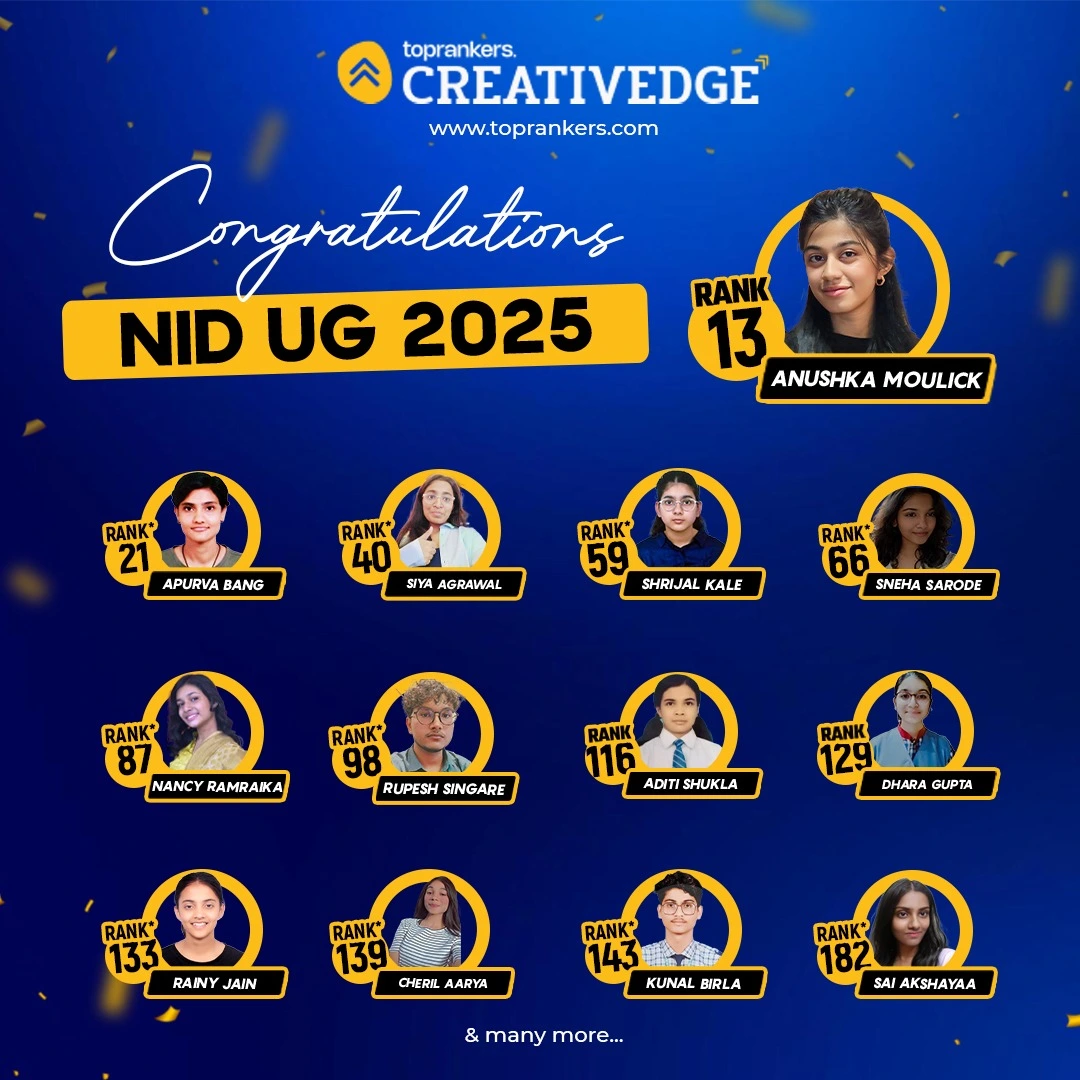
Also Check: Meet CreativeEdge’s NID Toppers List
How Practicing NID Studio Test Question Papers will Help in NID 2027 Prep
Practicing NID Studio Test Question Papers gives you several advantages:
1. Reduces Test Anxiety & Surprise Factor: Practicing all the possible types of activities under timed conditions can help you familiarize yourself with the test format. You get used to the unpredictable.
2. Improves Time Management: You’ll learn how long to spend on ideation vs. execution.
3. Refines Material Skills:
- You’ll get comfortable using different materials for different tasks quickly.
- The Studio Test uses a wide variety of materials like paper, cardboard, clay, thermocol, straws, wire, fabric, etc.
- Practice helps save precious minutes figuring out how a material behaves.
- With practice students already know material manipulation tricks. Like for example, wetting paper before folding weakens it, or that thermocol needs careful cutting to avoid uneven edges.
- Practice teaches students shortcuts, how to fold, cut, glue, or join quickly without compromising neatness.
- You know how to use leftover scraps effectively
- You understand how to combine materials for better stability or function
- Practice helps to learn how to adapt when a planned method doesn’t work
4. Boosts Confidence:
That familiarity with material from practice sessions allows students to focus on creativity and problem-solving, instead of panicking over how to join two straws or shape clay.
- Practice can also help identity strengths and weaknesses and refine exam strategies accordingly.
Check: Last Minute Preparation Tips for NID 2027
Expert Tips to Solve NID Studio Test Questions 2027 Effectively
Here are insights from our CreativEdge experts and past year NID Toppers:
1. Ideation First, Execution Later:
- Start with understanding the problem first and Identifying the requirements. List those out.
- Spend the first 10 minutes brainstorming original innovative ideas that best showcase your creative thinking
- Make quick thumbnails of the concept before jumping into model-making.
2. Material Understanding
- Don’t waste materials experimenting. Test small, then go big.
- Use every scrap intelligently.
3. Neatness > Complexity
- A simple, clean, well-finished model scores higher than a messy “big idea.”
- Focus on structure stability and presentation.
4. Tell a Story through your NID Studio Test Questions
Add labels or a short explanation card. It helps evaluators understand your thought process.
5. Practice Under Pressure:
Give mock tests in exam conditions: 3 hours, limited materials, no extra help. Train yourself to finish on time.
6. Focus on Functionality:
Ask yourself- would this design work in real life? Will it serve it's purpose? Is the design ideal for it's target audience?
7. Don't Over Complicate the Task:
Clean finished models always outrank incomplete complex ones.
Also Check: Common Mistakes to Avoid While Preparing for NID
NID Studio Test Materials Used vs Expected Outcome
During the NID studio test, candidates are usually provided with basic craft and model-making materials. Examiners do not judge how expensive or decorative the final output looks; instead, they evaluate how intelligently the materials are used to communicate an idea, structure, or concept.
Materials Used in NID Studio Test and What Examiners Expect
|
Material Provided |
How It Is Commonly Used |
Expected Outcome From Candidates |
|
Paper and Cardboard |
Base structures, folding forms, surfaces |
Stable construction with clear proportions |
|
Thermocol or Foam Sheets |
Lightweight volume creation |
Clean shaping and structural balance |
|
Ice-cream Sticks or Wooden Sticks |
Framework and support elements |
Logical joining and functional design thinking |
|
Wire |
Structural outlines, flexible connections |
Creative structural solutions |
|
Clay or Mouldable Material |
Form exploration and detailing |
Ability to visualize 3D concepts quickly |
|
Straws or Tubes |
Lightweight frameworks |
Efficient material use and innovation |
|
Thread or String |
Suspension or connection elements |
Thoughtful use to enhance concept |
|
Glue and Adhesives |
Assembly and finishing |
Neat construction without excess use |
|
Colors or Sketch Pens |
Highlighting concepts or surfaces |
Clear visual communication without over-decoration |
Check: NID Important Topics 2027
What Examiners Look For While Evaluating Material Usage
|
Evaluation Factor |
What It Means in Practice |
|
Efficiency |
Using minimal materials to achieve maximum impact |
|
Structural Logic |
Models should stand properly and look balanced |
|
Creativity |
Innovative ways of combining simple materials |
|
Clean Execution |
Neat finishing and thoughtful assembly |
|
Concept Clarity |
Materials should support the idea, not distract from it |
_(1)1754636837.webp)
1756536783.webp)
Effect of New 2027 Exam Pattern on NID Studio Test Questions
The NID 2027 admission process has introduced one of the most significant changes in recent years - the DAT Prelims score will no longer carry any weightage in the final result. This directly impacts the NID Studio Test (DAT Mains), making it the decisive stage for both B.Des and M.Des aspirants.
1. 100% Weightage Shift to NID 2027 Studio Test (and Interview for M.Des)
According to the official 2027 NID exam pattern, the final merit list will now be prepared solely based on DAT Mains performance -
- For B.Des, the Studio Sensitivity Test and In-person Sensitivity Test together carry 100% weightage (60% + 40%).
- For M.Des, the Studio Test and Interview carry 100% weightage (40% + 60%).
This means your creativity, thinking process, model-making, problem-solving, and communication in NID studio test questions will now determine your final rank, not your Prelims marks.
2. Higher Competition in the NID 2027 Studio Test Round
Since the Prelims now act only as a shortlisting filter, more emphasis is placed on hands-on design ability and real-time creativity during the Studio Test. Candidates shortlisted (1.5× the number of available seats per category) will need to focus on:
- Visual and spatial thinking
- Material handling
- Design interpretation
- Observation and problem-solving tasks
3. Expected Changes in NID Studio Test 2027 Evaluation
The 2027 pattern indicates a more comprehensive and skill-focused evaluation. The Studio Test is expected to include:
- Model making and material-based tasks
- Thematic composition and observation-based sketching
- Audio-visual or storytelling components
- Logical and design-thinking problems under time constraints
4. Greater Importance of Personal Interaction (Sensitivity/Interview)
For both B.Des and M.Des aspirants, the In-person Sensitivity Test / Interview will hold major weightage. This interaction will test:
- Design awareness and reasoning
- Communication and clarity of thought in NID Studio Test questions
- Portfolio presentation (where applicable)
- Originality of ideas and process understanding
5. Preparation Strategy Shift
With this new structure, students must now:
- Focus more on practicing NID studio test questions for 2027
- Build hands-on creative stamina. Practice material-based problem-solving regularly.
- Prepare for interview-style discussions, design justification, and conceptual articulation.
Must Read: NID Interview Questions with Answers 2027
What This Means for 2027 Aspirants?
|
Aspect |
NID 2025 Pattern |
NID 2027 Pattern (Revised) |
|
Prelims Weightage |
30% (carried to final merit) |
0% (used only for shortlisting) |
|
Mains Components |
|
|
|
Focus Area |
Aptitude + Creativity |
Practical Creativity + Design Thinking + Communication |
Also Read: NID Exam Day Instructions 2027
Common Mistakes Students Make in NID Studio Test
|
Mistake |
Why It Reduces Score |
Better Strategy |
|
Over-decorating models |
Focus shifts from concept to aesthetics |
Keep designs functional and simple |
|
Ignoring instructions |
Missing key requirements lowers evaluation |
Underline keywords before starting |
|
Poor time management |
Incomplete work reduces overall marks |
Allocate time for planning and finishing |
|
Weak presentation of ideas |
Examiners may not understand concept |
Add labels or short explanations where allowed |
|
Using too many materials |
Shows lack of design clarity |
Use materials efficiently with purpose |
Avoiding these mistakes often improves performance more than learning new techniques.
Resources for Practicing NID Studio Test Questions for 2027
NID 2027 Studio Test Kit by CreativEdge:
Designed by top mentors and past NID rankers, this NID 2027 studio test kit is an all-in-one resource that gives you everything you need to walk into NID Studio Test 2027 fully prepared and confident. It not only includes all the necessary insights on the test but also give you a step-by-step process to create your own practice prompts which can help you ace the exam effortlessly. Tap the button below to access it.
You can also join our NID 2027 Studio Test & the newly introduced In-person Sensitivity Test Preparation Masterclass right after the NID DAT Results 2027 for Prelims exam are out.
YouTube Channels for NID Sketching Questions Prep 2027:
For tutorials on perspective and object sketching and other drawing lessons, follow CreativEdge by Toprankers Youtube Channel.
Checklist of Materials Required to Carry for NID Studio Test 2027
Here’s a list of commonly recommended materials to carry for the NID Studio Test (based on past trends and toppers’ advice).
While NID provides basic materials for tasks, bringing your own toolkit helps you work faster and neater.
1. Cutting & Shaping Tools
- Pair of scissors
- Craft knife/cutter (with extra blades)
- A3 size cutting mat (for safety & precision)
- Paper cutter
2. Joining & Fixing Materials
- Transparent tape (small roll)
- Masking tape/paper tape
- Glue stick (quick drying)
- Liquid glue/Fevicol (small bottle)
3. Drawing & Marking Tools
- Lead pencils of varying grades, like HB, 2B (for sketching & labeling)
- Kneadable Eraser (soft, dust-free)
- Sharpener
- Scale/ruler (30 cm)
- Blue/Black Ball Point Pen
4. Coloring Tools (Optional)
- Basic set of dry color pencils (12–24 shades)
- Oil/Pastel colors/sketchpens
5. Other Useful Items
- Paper clips/rubber bands
- Small container or pouch to organize tools
Check: NID Exam Day Instructions 2027
Conclusion:
The NID Studio Test 2027 isn’t about being the best artist, it’s about being the best problem solver. Practicing with NID Studio Test Questions, previous year tasks, and mock papers gives you the clarity and confidence to think unique ideas, translate them in a physical form, and present them aesthetically under pressure.
Whether it’s building a model, sketching a storyboard, or redesigning an everyday product, remember the golden rule to keep it simple, creative, and functional.
And never underestimate the power of practice-feedback loop. It will help you develop the ability to think out of the box and come up with unique innovative design solutions.
Preparing for NID 2027? We can help you with exact strategic roadmap, study material and crucial feedback required to ace both Prelims and NID Mains (studio test + in-person sensitivity test).
Join CreativEdge, India’s leading NID online coaching and get expert guidance on all NID 2027 subjects. Reach us at 6363286363.


Frequently Asked Questions
What is asked in the NID studio test?

Are previous year studio test questions repeated?
How is the Studio Test evaluated?
Is the Studio Test different for B.Des and M.Des?
How can I practice for the Studio Test at home?
Where is the NID studio test conducted?
Is the NID exam hard?

Vineeta Agrawal
Communications Executive


SHARE