
1723534562.png)

CLAT Logical Reasoning Syllabus 2027 Check Important Topics & PDFs
July 28, 2026
Overview: Logical Reasoning is one of the most important sections in CLAT 2027, testing your ability to read critically, analyse arguments, and make logical decisions under time pressure. Instead of memorising question types, success comes from understanding the CLAT 2027 Logical Reasoning Syllabus and the reasoning skills it is designed to assess. This guide explains the syllabus, question pattern, and preparation strategy in a simple and practical way to help you maximise your score.
Quick answer: The CLAT 2027 Logical Reasoning syllabus covers five skills tested through 450-word passages: recognising arguments, identifying premises and conclusions, analysing how conclusions depend on evidence, drawing inferences, and spotting analogies and contradictions. The section carries 22–26 questions, about 20% of the paper.
CLAT Logical Reasoning Syllabus 2027 at a Glance
- Exam: CLAT UG 2027 (Conducted by the Consortium of National Law Universities)
- Exam Date: 6 December 2026
- Section Weightage: 22–26 questions out of 120, contributing around 20% of the total marks.
- Marking Scheme: +1 for every correct answer and −0.25 for every incorrect answer.
- Question Format: All questions are passage-based, with passages of around 450 words.
- Passage Sources: Editorials, opinion pieces, and moral or philosophical essays.
- Questions per Passage: Generally 4–6 questions follow each passage.
Skills Tested in CLAT Logical Reasoning
- Recognising arguments, premises, and conclusions.
- Identifying arguments within a passage.
- Analysing how premises strengthen or weaken conclusions.
- Making logical inferences and applying them to new situations.
- Drawing analogies, spotting contradictions, and evaluating the effectiveness of arguments.
- No prior legal knowledge is required to answer Logical Reasoning questions.
CLAT 2027 Update: Is the Logical Reasoning Syllabus Changing?
Short answer: no, not for CLAT 2027.
Read more: Best Books for Logical Reasoning for CLAT 2027
Why Logical Reasoning Is So Important in CLAT 2027
Logical Reasoning is not about formulas or shortcuts. It’s about how you think. The CLAT Logical Reasoning Syllabus 2027 is designed to test whether you can read an argument, understand what the author is saying, and judge whether that argument actually makes sense.
In law school, and later, in legal practice, you will constantly analyse arguments, question assumptions, and test conclusions. That’s why the Consortium gives this section nearly 20% weightage. The skills tested here overlap heavily with the critical reasoning syllabus for CLAT and even support your preparation for the legal reasoning syllabus for CLAT.
CLAT 2027 Logical Reasoning: Exam Pattern at a Glance
| Parameter | Detail |
|---|---|
| Number of questions | 22–26 |
| Total marks | 22–26 (1 mark each) |
| Section weightage | Approximately 20% of the paper |
| Question format | Passage-based multiple choice |
| Passage length | About 450 words |
| Questions per passage | 4–6 |
| Number of passages | Approximately 5 |
| Marking | +1 correct, −0.25 incorrect, 0 unattempted |
| Recommended section time | 22–25 minutes |
| Prior knowledge needed | None — pure reasoning and comprehension |
Explore Law Entrance Exams other than CLAT
Passage-Based Format: What You’ll Face
A defining feature of the CLAT Logical Reasoning Syllabus 2027 is its passage-based structure. You’ll be given short passages of around 300–450 words, followed by questions that test how well you understood and analysed the argument.
These questions will require you to:
- Recognise an argument, its premises, and conclusions
- Identify assumptions made by the author
- Analyse patterns of reasoning
- Judge whether the conclusions are strong or weak
- Apply inferences to new situations
- Identify contradictions, analogies, and equivalences
This is where most CLAT logical reasoning important topics come into play.
Core Skills Tested in the CLAT Logical Reasoning Syllabus 2027
At its heart, the CLAT Logical Reasoning Syllabus 2027 focuses on skill-based evaluation rather than theory. The exam checks whether you can:
- Identify arguments and their structure
- Analyse how conclusions depend on evidence
- Understand how changing premises affects outcomes
- Draw logical inferences
- Evaluate the effectiveness of arguments
These skills also support your understanding of the CLAT syllabus for logical reasoning as a whole.
Explore: Solve Most Important Critical Reasoning Questions for CLAT 2027
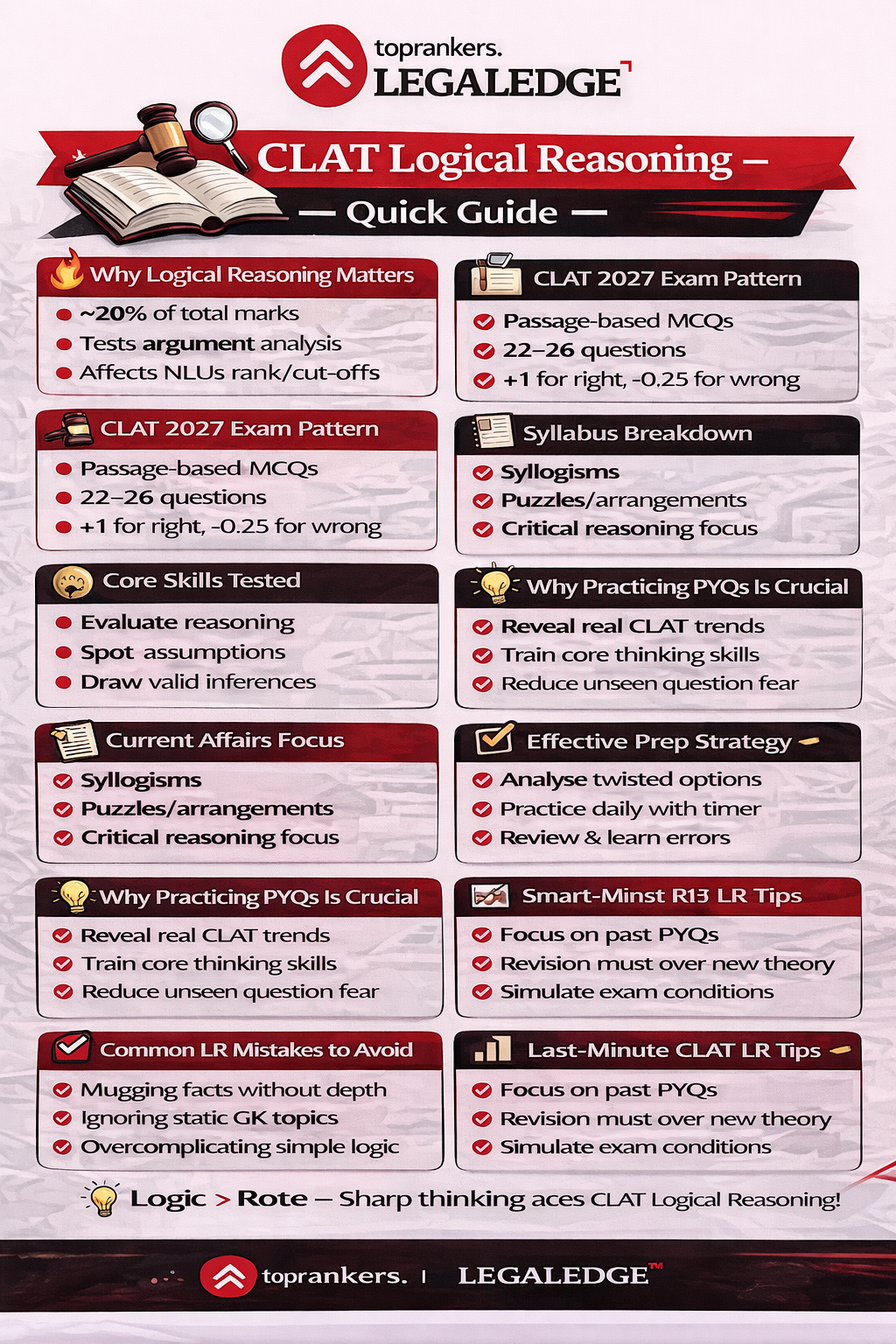
Detailed Breakdown of CLAT Logical Reasoning Topics 2027
Let’s now look at the main CLAT logical reasoning topics you must prepare.
1. Logical Deductions and Syllogisms
This area forms a strong foundation within the CLAT Logical Reasoning Syllabus 2027. These questions test your ability to draw valid conclusions from given statements.
Important areas include:
- Statements and assumptions
- Valid and invalid arguments
- Logical sequences
- Categorical syllogisms
Practising these regularly improves your command of core CLAT reasoning topics.
2. Logical Connectives and Statement Evaluation
Logical connectives like and, or, not, and if–then are an important part of the CLAT syllabus for logical reasoning.
You need to understand:
- Logical equivalence
- Statement contradictions
- Conditional reasoning
These questions reward clarity and careful reading.
Explore more: CLAT Logical Reasoning Preparation Tips
3. Analytical Reasoning
If you have picked up an older reasoning book, you will find long chapters on blood relations, coding-decoding, seating arrangements and alphabet series. Skip them.
Until 2019, CLAT asked those as standalone questions. When the Consortium moved to a fully passage-based paper in 2020, they went. The current official Logical Reasoning description does not list a single one of them. We still meet students in August who have finished an entire arrangement-puzzle workbook before anyone told them.
What survived is the thinking underneath those puzzles — holding several conditions in your head at once and tracking what follows from what. In CLAT 2027 that skill is tested inside a 450-word argumentative passage, not in a grid.
One honest caveat: a passage occasionally embeds a small conditional-deduction set ("if X applies, then Y cannot"). Handling that needs careful reading, not a puzzle technique. Prepare the reading; the deduction follows.
4. Critical Reasoning
Critical reasoning is the backbone of the CLAT Logical Reasoning Syllabus and directly overlaps with the critical reasoning syllabus for CLAT 2027.
Here, you’ll face questions on:
- Assumptions
- Strengthening and weakening arguments
- Logical flaws
- Conclusions and inferences
Most passage-based questions fall under this category, making it one of the most important CLAT logical reasoning topics.
Read More: Critical Reasoning Strategy for CLAT 2027
Connection Between Logical and Legal Reasoning
Many students don’t realise how closely logical reasoning is linked to legal reasoning. The thinking skills developed through the CLAT Logical Reasoning Syllabus directly help in mastering the legal reasoning for the CLAT syllabus 2027.
Both sections require you to:
- Identify premises and conclusions
- Apply rules logically
- Avoid emotional or personal bias
A strong grasp of logical reasoning makes the CLAT legal reasoning syllabus much easier to handle.
Important Things to Know About the Logical Reasoning Section
- Passage Length: Each passage is around 450 words and must be read carefully.
- Question Type: All questions are objective, but the thinking required is deep.
How Much Time Logical Reasoning Actually Deserves
Work backwards from the paper. 120 questions, 120 minutes. Logical Reasoning is about 20% of the paper, so it gets about 20% of the clock — roughly 24 minutes for the whole section, not per passage.
| What you're doing | Time | Running total |
|---|---|---|
| Read the 450-word passage once, properly | 1 min 45 sec – 2 min | 2:00 |
| Answer 4–6 questions, ~35 sec each | 2 min 30 sec – 3 min | 5:00 |
| Per passage | ~4–5 min | — |
| Full section (≈5 passages) | 22–25 min | — |
Read once, carefully. Re-reading a 450-word passage costs you two questions elsewhere in the paper.
How to Prepare for CLAT Logical Reasoning Effectively
Preparing for the CLAT Logical Reasoning Syllabus 2027 needs a strategy, not shortcuts.
1. Understand Question Types
Be clear about analytical reasoning, syllogisms, and critical reasoning before diving into practice.
2. Practice Daily
Consistency is the only way to master all CLAT logical reasoning topics.
3. Review Your Mistakes
Every wrong answer tells you something about your thinking.
4. Improve Reading Skills
Good reading speed improves performance across the CLAT syllabus for logical reasoning.
5. Stay Updated
Keep track of any changes in the legal reasoning syllabus for CLAT or the exam pattern.
Read More: How to Score 20+ in Logical Reasoning in CLAT 2027?
Why Application-Based Learning Matters
The Logical Reasoning section is not theoretical. Memorising definitions won’t help. You must apply logic in real time.
That’s why application-based learning is crucial for cracking the CLAT Logical Reasoning Syllabus 2027.
With enough practice, even the most unpredictable passages become manageable.
Conclusion
The CLAT Logical Reasoning Syllabus is not something to fear. It rewards clarity, curiosity, and consistent effort.
By understanding the core CLAT logical reasoning topics, strengthening your grip on the critical reasoning syllabus for CLAT, and seeing how it supports the legal reasoning for CLAT syllabus, you prepare yourself not just for the exam, but for law school and beyond.
Logical Reasoning is not about tricks. It’s about thinking clearly. And once you master that, this section can become your biggest strength in CLAT 2027.
Every passage is just an argument waiting to be untangled. Learn how to untangle it, and you’ll own the exam.
NLU Dream, Zero Cost Start: Free CLAT Demo
Fill your details
Frequently Asked Questions
How many questions are asked from the CLAT Logical Reasoning section?

What kind of passages appear in the CLAT Logical Reasoning section?
Is Logical Reasoning in CLAT more theoretical or application-based?
How is the CLAT Logical Reasoning Syllabus connected to Legal Reasoning?
How much time should I spend on Logical Reasoning during the exam?

Samriddhi Pandey
Content Writer


SHARE