
1723534562.png)

CLAT Maths Syllabus 2027: Must-Know Topics, Prep Strategies & Expert Tips
July 28, 2026
Reader's Digest: Reader's Digest: CLAT Quantitative Techniques is the smallest section in the paper — 10 to 14 questions, roughly 10% of your score — and it's built entirely on Class 10 mathematics. No calculus, no trigonometry. What makes it hard isn't the maths; it's that every question sits inside a data set you have to read correctly before you can calculate anything. This page covers the official CLAT 2027 syllabus, the exact topics that have repeated for the last seven years, and how much of your prep time this section actually deserves.
Quick Answer: The CLAT Maths syllabus 2027 — officially called Quantitative Techniques — covers elementary mathematics up to Class 10: ratios and proportions, basic algebra, mensuration and statistical estimation. It carries 10 to 14 questions, about 10% of the 120-mark paper, all presented as passage or graph-based data sets.
CLAT Maths Weightage 2027: Questions, Marks & Negative Marking
| Parameter | CLAT 2027 Quantitative Techniques |
|---|---|
| Number of questions | 10–14 (approx. 10% of the paper) |
| Marks per question | +1 |
| Negative marking | −0.25 per wrong answer |
| Unattempted questions | 0 (no penalty) |
| Format | Passage / data-set based MCQs |
| Difficulty level | Elementary mathematics up to Class 10 |
| Total paper | 120 questions, 120 marks, 2 hours |
| Recommended time in exam | 12–15 minutes |
The number that actually matters: at −0.25 per error, four wrong answers wipe out one correct answer. In a 12-question section, blind guessing on 4 questions has a negative expected value.
Here is a glimpse of the main points that will be discussed in the blog:
- Official CLAT Quantitative Techniques Syllabus by Consortium: Understanding the core topics you must master.
- Prep Strategies to Ace CLAT Maths Syllabus: Expert CLAT Maths preparation tips for effective preparation strategy.
- Type of Questions Asked in the CLAT: This is a breakdown of question types and patterns as per the CLAT quantitative aptitude syllabus.
- Top Books to Cover CLAT Maths Syllabus 2027: Recommended study resources to excel in the CLAT exam
Note: CLAT 2027 Maths Syllabus: Official Status
Confirmed — no change. The Consortium of National Law Universities released the official CLAT 2027 notification on 22 July 2026 and stated that the syllabus and exam pattern for both UG and PG papers remain unchanged. You can prepare from the existing Quantitative Techniques syllabus with confidence.
Overview of CLAT Maths Syllabus 2027
In the Quantitative Techniques section of the CLAT UG syllabus, you will encounter short sets of facts or propositions, graphs, and different ways of representing numerical information through text, pictures, or diagrams.
This section tests your ability to extract important information from these passages, graphs, or representations and use mathematical operations to analyze and solve the questions provided.
This section evaluates your Quantitative Techniques and problem-solving skills within legal education by applying mathematical concepts to real-life situations.
Official CLAT Maths Syllabus 2027
The CLAT exam 2027 may have a section called "Quantitative Techniques." As per the official CLAT 2027 notification released on 22 July 2026, the Consortium has confirmed no change to the syllabus or exam pattern. Quantitative Techniques will continue to present short sets of facts, propositions, graphs or other numerical representations, followed by questions that require you to derive, infer and calculate from that data.
The mathematics itself is capped at elementary level up to Class 10 — ratios and proportions, basic algebra, mensuration and statistical estimation. There is no calculus, no trigonometry, no coordinate geometry and no advanced algebra.
In this section, you will be given tasks that involve:
- Understanding and using numerical information in passages, graphs, or other formats.
- Using basic math operations like ratios, proportions, algebra, measurement, and statistics based on your knowledge in 10th grade.
These questions test your ability to analyze and work with numbers. You need to have a good grasp of math concepts and know how to apply them to do well. Make a Quantitative Techniques Study Plan for CLAT 2027.
By practising these tasks, you will improve your math skills, which will help you in the CLAT exam and other areas of your life.
Type of Questions Asked in the CLAT Maths Syllabus 2027
For the Quantitative Techniques section, you are given information that needs reading and understanding. After reading the information, you have to answer the related questions.
You can come across different topic-based questions in one passage. In the CLAT Question Paper, the mathematics section includes data interpretation-based questions.
Here are some important topics from the CLAT Maths Syllabus 2027 that you should pay special attention to:
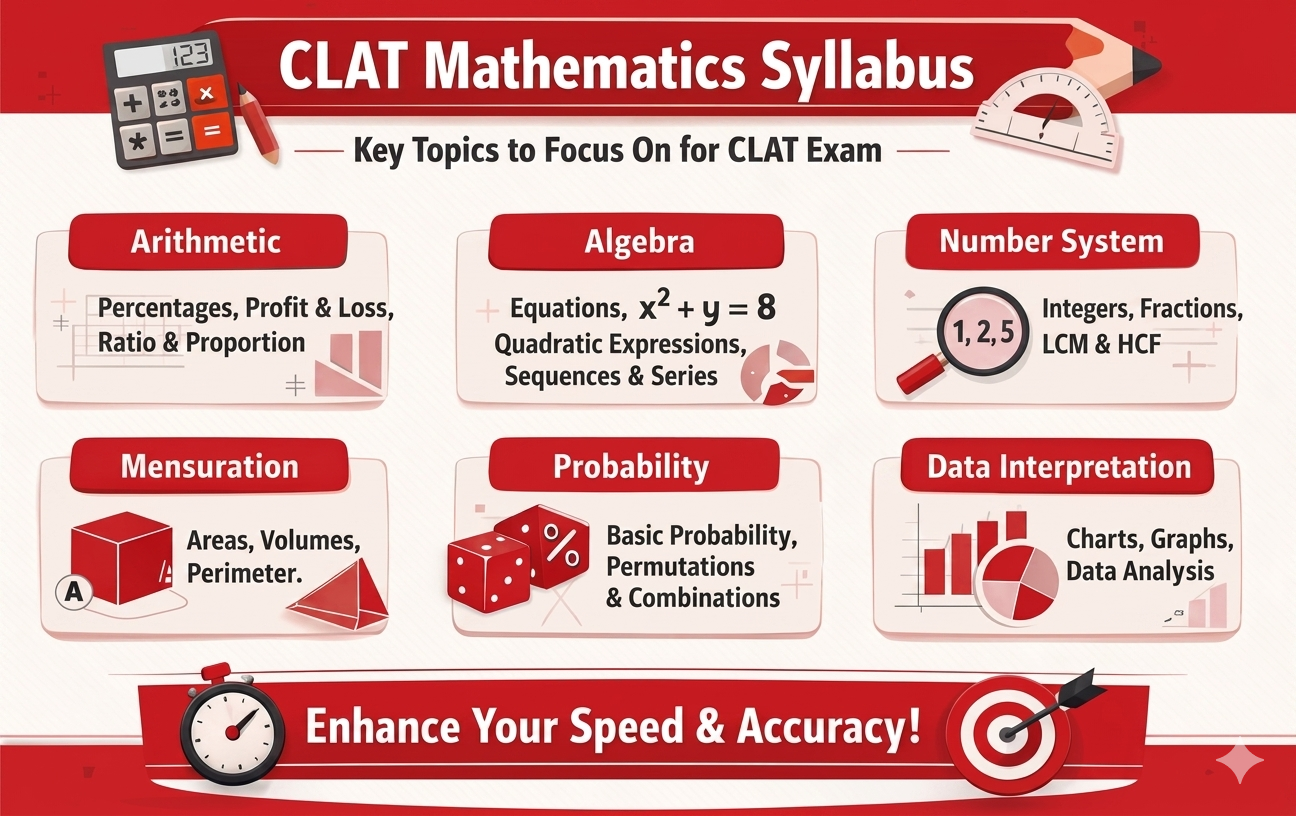
- Ratio and Proportion: Understanding ratios and proportions is crucial for solving various mathematical problems. This includes direct and inverse proportions, comparing ratios, and solving proportions-based problems.
- Average: Deriving the ratio of summation of all the data to the number of units present in the list.
- Percentage: Determining ratio or a number represented as a fraction of 100, i.e., a fraction with 100 as the denominator
- Profit and Loss: Interpreting information related to transactions, costs, selling prices, and profit percentages.
- Introductory Algebra: Questions involving algebraic expressions, linear and quadratic equations, and arithmetic progression.
- Mensuration: Problems calculating geometric shapes' area, volume, and surface area.
- Statistical Estimation: Questions on data interpretation, including mean, median, mode, and other statistical concepts.
By dedicating sufficient time and effort to these important topics, you can strengthen your understanding of the CLAT Maths Syllabus 2027 and improve your exam performance.
| Topic | Description |
|---|---|
| Number System | Covers concepts like HCF, LCM, fractions, decimals, and basic number properties. |
| Percentages | Understanding percentage calculations, profit & loss, and simple & compound interest. |
| Averages | Calculating means, medians, and modes, and solving problems related to averages. |
| Ratio and Proportion | Concepts of ratio, proportion, variation, and their applications. |
| Time and Work | Problems related to work done by individuals or groups, pipes and cisterns. |
| Time, Speed and Distance | Concepts of speed, distance, time, trains, boats, and streams. |
| Algebra | Basic algebraic identities, linear equations, and quadratic equations. |
| Mensuration | Formulas for area, perimeter, and volume of 2D and 3D shapes. |
| Data Interpretation | Analyzing data presented in charts, graphs, and tables. |
| Maths Preparation Tips | General strategies and expert advice for excelling in the CLAT Maths section. |
Effective Preparation Strategies for CLAT Maths Syllabus 2027
Solving CLAT Maths Questions requires a structured approach to ensure thorough understanding and efficient problem-solving.
Here are some effective preparation strategies to enhance your performance in the CLAT Quantitative Techniques section:
- Understand the Fundamentals: Revisiting the fundamental mathematical concepts from the elementary mathematics syllabus. Build a strong foundation in arithmetic and the basics of algebra.
- Learn Problem-Solving Techniques: Familiarize yourself with different problem-solving techniques and strategies for each topic. Practice applying these techniques to solve a variety of questions.
- Practice Regularly: Consistent practice is critical to improving your mathematical skills. Solve many practice questions from different difficulty levels, mock tests, and previous years' question papers to develop speed and accuracy.
- Topic-by-topic coverage: Complete and gain command topic by topic. Start with one topic, get all the basics and practice done, and then move to the next topic.
- Time Management: Develop practical time management skills to allocate appropriate time to each question during the exam—practice solving questions within a specified time frame to enhance your speed.
- Analyze and Learn from Mistakes: Review and analyze your mistakes while solving practice questions. Identify the areas where you face challenges and work on improving them through targeted practice.
- Seek Clarification: If you encounter doubts or difficulties while studying or solving practice questions, don't hesitate to ask teachers, mentors, or online resources for clarification.
- Mock Tests and Simulated Exams: Regularly take mock and simulated exams to assess your progress and get accustomed to the exam's pattern and time constraints.
Remember, consistent effort and dedication are crucial for success in the CLAT Maths section. Following these preparation strategies and focusing on critical topics can enhance your understanding and performance in the CLAT exam.
Best Books for CLAT Quantitative Techniques 2027
You can refer to the following books while preparing for CLAT Maths Syllabus 2027. Opting for the best books for CLAT will help you cover all the topics as per the latest syllabus.
| Book | Author / Publisher | Use it for | How to use it |
|---|---|---|---|
| Quantitative Aptitude for Competitive Examinations | R.S. Aggarwal | Concept building | Do only the chapters on percentage, ratio, averages, profit & loss, TSD and time & work. Skip the rest — it's built for banking, not CLAT. |
| Data Interpretation | R.S. Aggarwal | The section's core skill | This is the closest commercially available match to CLAT's actual format. Highest priority book on this list. |
| Quantitative Techniques with Numerical Ability | Prateek Jain | CLAT-specific practice | Written to the law-entrance level. Good for calibrating difficulty. |
| Magical Book on Quicker Maths | M. Tyra | Speed and calculation | Use for calculation shortcuts only, not concepts. |
| NCERT Mathematics, Class 8–10 | NCERT | Foundation, if you left maths after Class 10 | Two weeks of Class 9–10 NCERT exercises will close most conceptual gaps. |
Honest guidance: no book on this list matches CLAT's passage format exactly, because publishers write for the wider market. Books get you the concepts. Actual CLAT PYQs and full-length mocks get you the format. Budget your time accordingly — roughly 30% books, 70% papers and mocks.
| Maths Preparation Tips | Maths Questions | Number System Questions |
| DI Questions | Easy Calculation Techniques | Quant Study Plan |
Conclusion
Here are some important points about the CLAT 2027 Maths syllabus:
- The maths syllabus for CLAT is based on what you learn in the 10th grade.
- The CLAT Maths syllabus 2027 tests your understanding and application of basic math concepts.
- Practising and getting familiar with different types of math questions is important.
- Regularly reviewing and revising math concepts is necessary to remember them.
To do well in the math section of the CLAT Entrance Exam, it's crucial to have a good understanding of the CLAT Maths syllabus 2027 and practice consistently.
NLU Dream, Zero Cost Start: Free CLAT Demo
Fill your details
Frequently Asked Questions
How can I better prepare for CLAT's Quantitative Techniques section?

What are the best books for the preparation of the CLAT's Quantitative Techniques section?
Do I need to take specific coaching for CLAT Maths?
How many questions will be asked in the Quantitative Techniques section of CLAT?
What is the difficulty level of Quantitative Techniques section in CLAT?
Is 1 month preparation enough for CLAT Maths Preparation?

Samriddhi Pandey
Content Writer


SHARE