
1723534562.png)

20+ XAT Geometry Questions with Answers + Free PDF Download
May 30, 2026
Overview: Preparing for XAT Geometry Questions 2026? This blog brings you a carefully selected set of geometry questions based on the latest XAT exam pattern, covering important topics like triangles, circles, mensuration, polygons, and coordinate geometry. Questions are divided into easy, medium, and hard levels to help you practice step-by-step and build confidence.
You’ll also find quick solution approaches, answers, and previous year XAT Geometry Questions PDF to improve your speed and accuracy. Download the free PDFs and strengthen your Quant preparation with exam-level practice for XAT exam 2027.
What are XAT Geometry Questions?
XAT Geometry Questions are those math problems in the Quant section that deal with shapes, lines, and figures. You’ll find topics like triangles, circles, polygons, and even coordinate geometry popping up here.
They aren’t just about formulas you need to visualize and apply concepts smartly.
With the right theorems and shortcuts, these XAT coordinate geometry questions can actually become some of the easiest to crack.
One of the most effective ways to prepare for XAT geometry questions is by practicing previous year papers. This helps you understand the question pattern, difficulty level, and frequently asked concepts. Start with the most recent papers to stay up-to-date with trends.
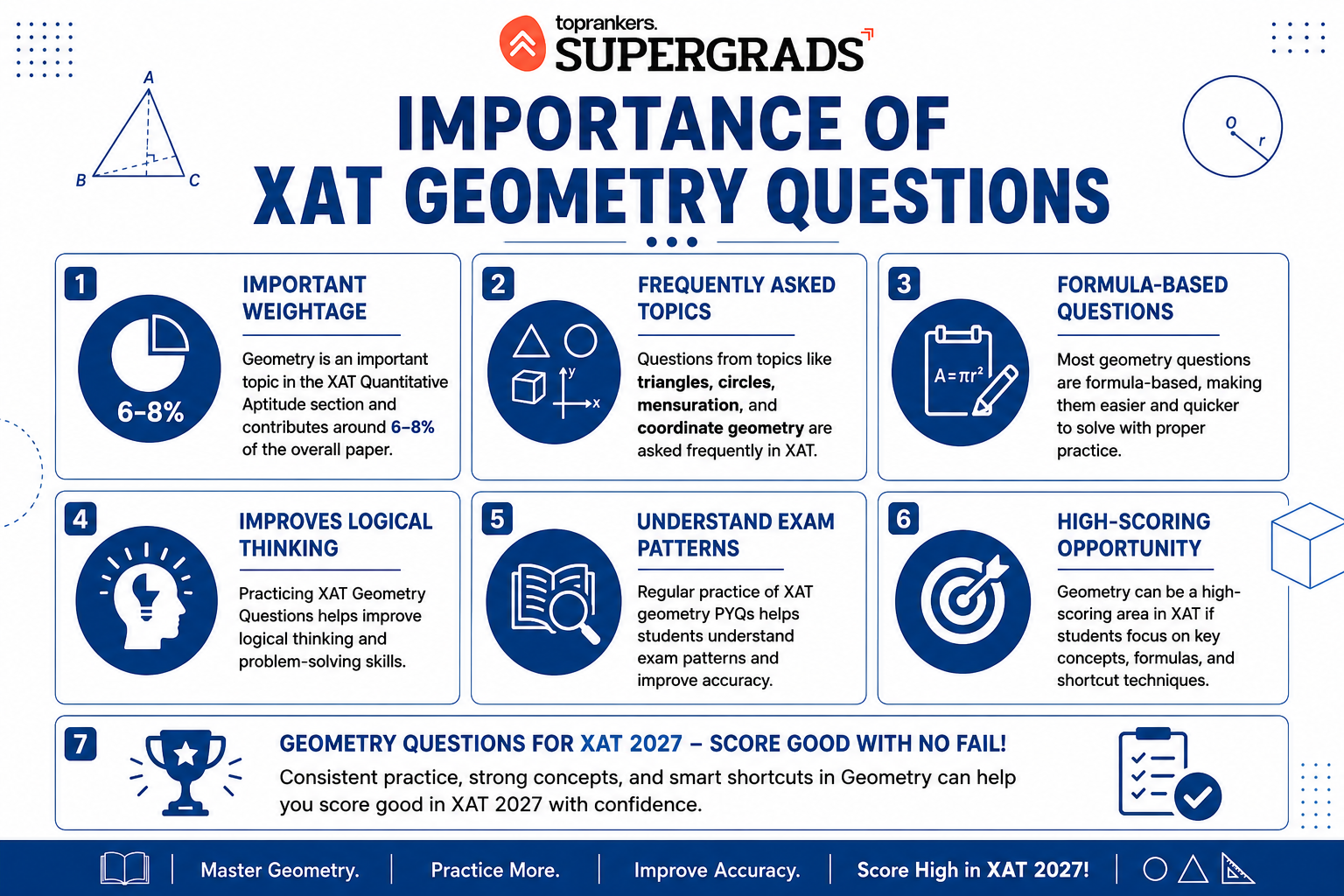
Importance of XAT Geometry Questions
- Geometry is an important topic in the XAT Quantitative Aptitude section and contributes around 6–8% of the overall paper.
- Questions from topics like triangles, circles, mensuration, and coordinate geometry are asked frequently in XAT.
- Most geometry questions are formula-based, making them easier and quicker to solve with proper practice.
- Practicing XAT Geometry Questions helps improve logical thinking and problem-solving skills.
- Regular practice of XAT geometry PYQs helps students understand exam patterns and improve accuracy.
- Geometry can be a high-scoring area in XAT if students focus on key concepts, formulas, and shortcut techniques.
- Also, Geometry Questions for XAT 2027 can help you score good with no fail.
Solve These XAT Geometry Questions 2026 to Boost Your XAT Scores
Easy Level XAT Geometry Questions to Practice
Q1. The topmost point of a perfectly vertical pole is marked A. The pole stands on a flat ground at point D. The points B and C are somewhere between A and D on the pole. From a point E, located on the ground at a certain distance from D, the points A, B and C are at angles of 60°, 45° and 30° respectively. What is AB : BC : CD?
A. 36 cm²(3 + √3) : (1 + √3) : 1
B. (3 − √3) : 1 : (√3 − 1)
C. 1 : 1 : 1
D. (3 − √3) : (√3 − 1) : 1
Answer: D. (3 − √3) : (√3 − 1) : 1
Q2. Let C be a circle of radius 20 cm. Let L1 and L2 be the lines given by 2x − y −1 = 0 and x + 2y −18 = 0 respectively. Suppose that L1 passes through the center of C and that L2 is tangent to C at the point of intersection of L1 and L2. If (a,b) is the center of C, which of the following is a possible value of a + b?
A. 22
B. 24
C. 26
D. 14
Answer: D. 14
Q3. What is the circumference of a circle with radius 7 cm? (Use π = 22/7)
A. 44 cm
B. 49 cm
C. 38.5 cm
D. 42 cm
Answer: A. 44 cm
Q4. A triangle has sides of lengths 3 cm, 4 cm, and 5 cm. What type of triangle is it?
A. Equilateral
B. Isosceles
C. Right-angled
D. Scalene
Answer: C. Right-angled
Q5. In the trapezium ABCD the sides AB and CD are parallel. Find the value of sin∠BAC / sin∠BAD.
A. AD / BC
B. CD / AB
C. CD / AC
D. AC / AD
Answer: D. AC / AD
Q6. A circle has a diameter of 14 cm. What is its area? (Use π = 22/7)
A. 154 cm²
B. 77 cm²
C. 100 cm²
D. 121 cm²
Answer: A. 154 cm²
Q7. Find the length of the diagonal of a square with side length 5 cm.
A. 5√2 cm
B. 10 cm
C. 7 cm
D. 6√2 cm
Answer: A. 5√2 cm
Q8. What is the sum of interior angles of a hexagon?
A. 540°
B. 720°
C. 900°
D. 1080°
Answer: B. 720°
Medium Level XAT Geometry Questions
Q9. In the figure below, AB = AC = CD. If ∠ADB = 20°, what is the value of ∠BAD?
A. 40°
B. 60°
C. 70°
D. 120°
Answer: C. 70°
Q10. A parallelogram has base 12 cm and height 5 cm. Find its area.
A. 60 cm²
B. 30 cm²
C. 24 cm²
D. 70 cm²
Answer: A. 60 cm
Q11. In the diagram below, CD = BF = 10 units and ∠CED = ∠BAF = 30°. What would be the area of triangle AED?
A. 100(√2 + 3)
B. 100(√3 + 4)
C. 50(√2 + 4)
D. 50(√3 + 4)
Answer: D. 50(√3 + 4)
Answer: A. 120 cm
Q12. There are two windows on the wall of a building that need repairs. A ladder 30 m long is placed against a wall such that it just reaches the first window which is 26 m high. The foot of the ladder is at point A. After the first window is fixed, the foot of the ladder is pushed backwards to point B so that the ladder can reach the second window. The angle made by the ladder with the ground is reduced by half, as a result of pushing the ladder. The distance between points A and B is
A. < 9 m
B. ≥ 9.5 m and < 10 m
C. ≥ 9 m and < 9.5 m
D. ≥ 10.5 m
Answer: D. ≥ 10.5 m
Q13. Circle C1 has a radius of 3 units. The line segment PQ is the only diameter of the circle which is parallel to the X axis. P and Q are points on curves given by the equations y= a^x and y = 2a^xrespectively, where a < 1. The value of a is:
A. ¹⁄₆√2
B. ¹⁄₃√6
C. ¹⁄√6
D. ¹⁄₆√3
Answer: A. ¹⁄₆√2
Q14. Consider a rectangle ABCD of area 90 units. The points P and Q trisect AB, and R bisects CD. The diagonal AC intersects the line segments PR and QR at M and N respectively. What is the area of the quadrilateral PQNM?
A. > 9.5 and ≤ 10
B. > 10 and ≤ 10.5
C. > 10.5 and ≤ 11
D. > 11 and ≤ 11.5
Answer: D. > 11 and ≤ 11.5
Q15. There are two squares S 1 and S 2 with areas 8 and 9 units, respectively. S 1 is inscribed within S 2 , with one corner of S 1 on each side of S 2 . The corners of the smaller square divides the sides of the bigger square into two segments, one of length ‘a’ and the other of length ‘b’, where, b > a. A possible value of ‘b/a’, is:
A. ≥ 11 and < 15
B. ≥ 13 and < 16
C. ≥ 20 and < 14
D. ≥ 14 and < 17
Answer: D. ≥ 14 and < 17
Q16. Two diagonals of a parallelogram intersect each other at coordinates (17.5, 23.5). Two adjacent points of the parallelogram are (5.5, 7.5) and (13.5, 16). Find the lengths of the diagonals.
A. 14 and 10
B. 15 and 20
C. 16 and 30
D. 17 and 40
Answer: D. 17 and 40
Q17. What is the inradius of a triangle with area 84 cm² and semi-perimeter 14 cm?
A. 6 cm
B. 5 cm
C. 7 cm
D. 4 cm
Answer: A. 6 cm
Difficult Level XAT Geometry Questions
Q18. A cone of radius 4 cm with a slant height of 12 cm was sliced horizontally, resulting into a smaller cone (upper portion) and a frustum (lower portion). If the ratio of the curved surface area of the upper smaller cone and the lower frustum is 1:2, what will be the slant height of the frustum?
A. 12 + 4 root 3
B. 12 − 3 root 6
C. 12 + 5 root 2
D. 12 − 4 root 3
Answer: D. 12 − 4 root 3
Q19. In the country of Four, there are four cities, A, B, C and D. B is to the East of A, C is to the South of B, D is to the West of C, and A is to the North of D. The Government of Four is planning to connect these four cities by road such that it is possible for a person to go from a city to any of the other three cities. At the same time, the Government wants to ensure that the total road length is minimum. The distances between A to B, B to C, C to D and D to A are all equal to 10 km. What should be the total length of the road?
A. 26.64 km
B. 27.32 km
C. 28.30 km
D. 36 km
Answer: C. 28.30 km
Q20. Triangle ABC is a right angled triangle. D and E are mid points of AB and BC respectively.
Read the following statements.
I. AE = 19
II. CD = 22
III. Angle B is a right angle.
Which of the following statements would be sufficient to determine the length of AC?
A. Statement I and Statement II
B. Statement I and Statement III
C. Statement II and III
D. All three statements
Answer: D. All three statements
Q21. The sides of a triangle are 10 cm, 24 cm, and 26 cm. What is the radius of the incircle?
A. 6 cm
B. 4 cm
C. 5 cm
D. 7 cm
Answer: B. 4 cm
Q22. In a circle of radius 14 cm, find the area of the sector with angle 45°.
A. 77 cm²
B. 38.5 cm²
C. 27.5 cm²
D. 30.25 cm²
Answer: A. 77 cm²
Q23. The difference between the circumradius and inradius of an equilateral triangle of side 6 cm is:
A. 2 cm
B. 3 cm
C. 1 cm
D. √3 cm
Answer: D. √3 cm
Q24. A trapezium has parallel sides 10 cm and 6 cm and height 5 cm. Find its area.
A. 40 cm²
B. 50 cm²
C. 45 cm²
D. 55 cm²
<p data-end=">Answer: A. 40 cm²
Q25. In a circle, two chords AB and CD are equidistant from the center. If AB = 12 cm, then CD is:
A. 12 cm
B. 11 cm
C. 10 cm
D. 9cm
Answer: A. 12 cm
Q26. AB is a chord of a circle. The length of AB is 24 cm. P is the midpoint of AB. Perpendiculars from P on either side of the chord meets the circle at M and N respectively. If PM < PN and PM = 8 cm. then what will be the length of PN?
A. 5 cm
B. 18 cm
C. 15 cm
D. 10 cm
Answer: B. 18 cm
Q27. Consider a right-angled triangle ABC, right angled at B. Two circles, each of radius r, are drawn inside the triangle in such a way that one of them touches AB and BC, while the other one touches AC and BC. The two circles also touch each other (see the image below). If AB = 18 cm and BC = 24 cm, then find the value of r
A. 3 cm
B. 4 cm
C.5 cm
D. 6 cm
Answer: B. 4 cm
Q28. A group of boys is practising football in a rectangular ground. Raju and Ratan are standing at the two opposite mid-points of the two shorter sides. Raju has the ball, who passes it to Rivu, who is standing somewhere on one of the longer sides. Rivu holds the ball for 3 seconds and passes it to Ratan. Ratan holds the ball for 2 seconds and passes it back to Raju. The path of the ball from Raju to Rivu makes a right angle with the path of the ball from Rivu to Ratan. The speed of the ball, whenever passed, is always 10 metre per second, and the ball always moves on straight lines along the ground. Consider the following two additional pieces of information: I. The dimension of the ground is 80 metres × 50 metres. II. The area of the triangle formed by Raju, Rivu and Ratan is 1000 square metres. Consider the problem of computing the following: how many seconds does it take for Raju to get the ball back since he passed it to Rivu? Choose the correct option.
A. I alone is sufficient to solve the problem
B. II alone is sufficient to solve the problem
C. Either of I or II, by itself, is sufficient to solve the problem
D. I and II both are required to solve the problem
Answer: A. I alone is sufficient to solve the problem
Q29. The centre of a circle inside a triangle is at a distance of 625 cm from each of the vertices of the triangle. If the diameter of the circle is 350 cm and the circle is touching only two sides of the triangle, find the area of the triangle.
A. 258126
B. 387072
C. 247089
D. 235609
Answer: B. 387072
Formulas For Geometry Questions For XAT 2027
Here are some important formulas to use in geometry XAT level questions:
Basic Shapes In XAT Coordinate Geometry Questions
1. Triangle
- Area: A = 1/2 * base * height
- Perimeter: P = base + side + side (where base and side represent the lengths of the triangle's sides)
2. Rectangle
- Area: A = length * width
- Perimeter: P = 2(length + width)
3. Square
- Area: A = side² (where side represents the length of a square's side)
- Perimeter: P = 4(side)
4. Circle
- Area: A = πr² (where π is a constant value approximately equal to 3.14 and r represents the circle's radius)
- Circumference: C = 2πr
Lines and Angles In Geometry XAT Level Questions
- Straight Angle: measure is 180 degrees
- Right Angle: measure is 90 degrees
- Complementary Angles: two angles that add up to 90 degrees
- Supplementary Angles: two angles that add up to 180 degrees
Theorems For Geometry And Mensuration Questions For XAT
- Pythagorean Theorem: a² + b² = c² (where a and b represent the lengths of the legs of a right triangle, and c represents the length of the hypotenuse)
Best Preparation Books for XAT Geometry Questions
Here is a list of some of the best books for Geometry questions for XAT that are widely recommended by experts and toppers
|
Book Title |
Author/Publisher |
Key Features |
|
How to Prepare for Quantitative Aptitude for the XAT |
Arun Sharma |
Comprehensive geometry coverage with level-wise XAT-oriented questions. |
|
Quantitative Aptitude Quantum XAT |
Sarvesh K. Verma |
Includes advanced geometry problems, shortcuts, and detailed solutions. |
|
Quantitative Aptitude for Competitive Examinations |
R.S. Aggarwal |
Ideal for building core geometry concepts with ample practice XAT geometry PYQ. |
Conclusion
XAT Geometry Questions form an essential part of the XAT exam and can greatly influence your Quantitative Aptitude score. With consistent preparation, a clear understanding of concepts, and regular practice, you can master geometry and perform well in the exam. Remember to focus on the key areas like lines, angles, triangles, circles, and coordinate geometry while also developing time-management skills.
By following a structured approach and knowledge about the XAT syllabus, Coordinate geometry questions for XAT can become one of your strongest sections in the XAT exam.
Frequently Asked Questions
Are Geometry questions important for XAT 2026?

Which topics are covered under XAT Geometry Questions?
How can I improve my accuracy in XAT Geometry Questions?
Are XAT Geometry Questions formula-based?
Should I practice XAT Geometry PYQs for preparation?
Is Coordinate Geometry important for XAT?

Zubeen Siddiqui
Content Writer | MBA & CAT Preparation


SHARE