
1723534562.png)

XAT Exam Pattern 2027 - Paper Format, Weightage, Marks Distribution, Section-wise Marks
July 10, 2026
Overview: The XAT 2027 exam is tentatively scheduled for January 3, 2027. It is best to understand the XAT exam pattern 2027 and syllabus to prepare well before the main examination. Read on to know more!
- The XAT or Xavier Aptitude Test 2027 will be conducted on January 3rd, 2027, across various cities in the country.
- The XAT 2027 registration starts on July 10, 2025, and the last date to apply is December 11, 2026.
- Xavier Aptitude Test is a national-level MBA entrance exam conducted by the XLRI on behalf of XLRI Associate Member Institutes (XAMI).
- The XAT exam lets you take admission to the prestigious Xavier School of Management (XLRI) and various other associated management institutes.
What's New for XAT 2027?
- There is no sectional time limit in the XAT 2027 exam. You can now move freely between sections during the exam.
- The number of XAT test cities has increased to 109 this year.
- You can choose two preferred test cities when you fill out your application.
- The application fee for XAT remains the same.
Knowing the XAT exam pattern 2027 and XAT marking scheme prepares you in advance. Scroll down to get the complete details!
Also Read: XAT 2027 Registration: Apply with the Direct Link
XAT Exam Pattern 2027 – Overview
The XAT 2027 exam pattern follows a computer-based test (CBT) format with a total duration of 180 minutes. The paper is divided into two parts – Part 1 (core aptitude sections) and Part 2 (General Knowledge). There is no sectional time limit in Part 1; you can switch between sections freely during the allotted time.
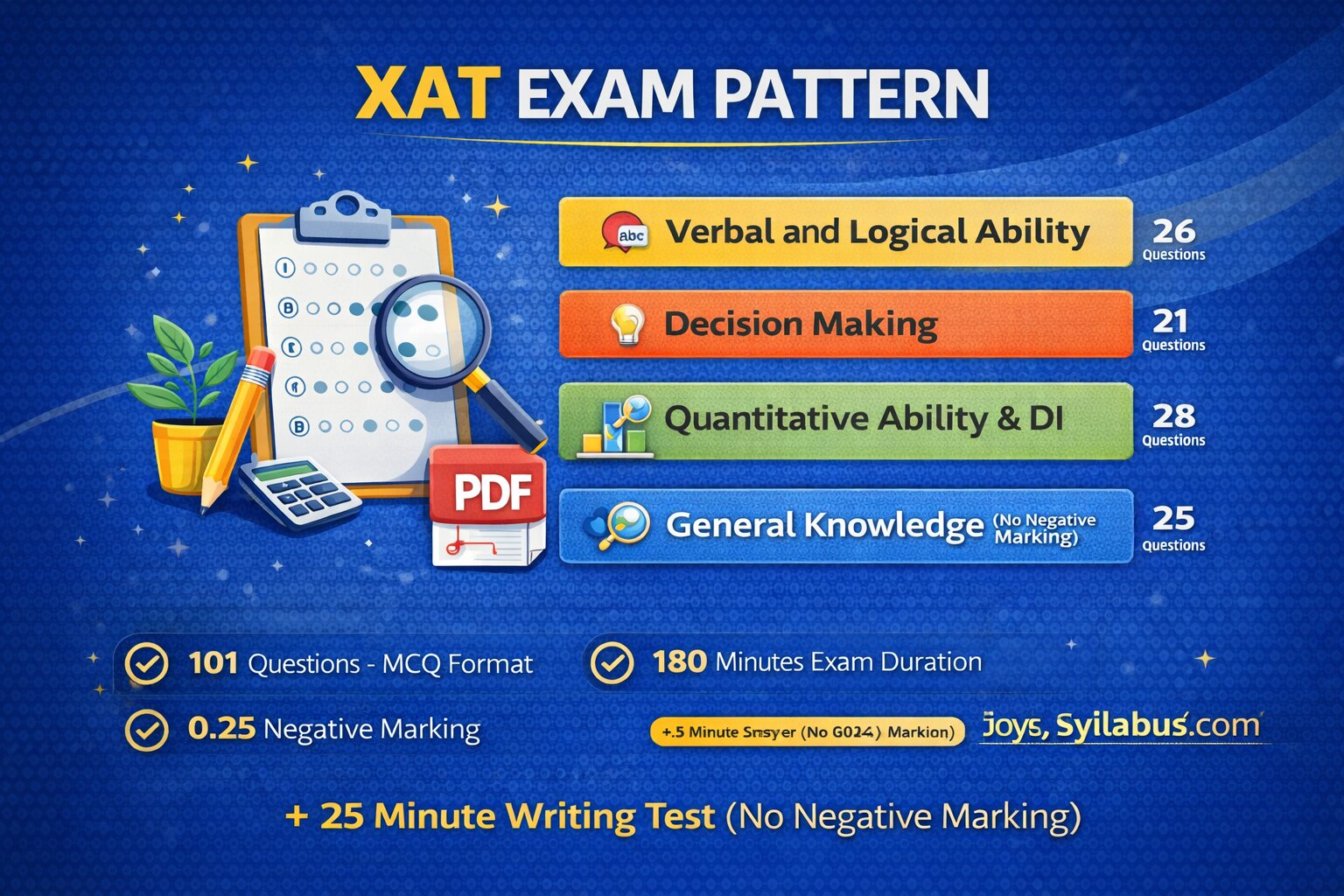
In total, you will face around 95 questions in XAT 2027, and the exam tests you on Verbal & Logical Ability, Decision Making, Quantitative Ability & Data Interpretation, and General Knowledge. The table below gives a quick snapshot of how the XAT exam is structured.
| Part | Sections Included | Total Questions (Approx.) | Duration | Key Points |
|---|---|---|---|---|
| Part 1 | Verbal & Logical Ability (VALR), Decision Making (DM), Quantitative Ability & Data Interpretation (QA & DI) | ~75 questions | 170 minutes | No sectional time limit; negative marking for wrong answers and for excessive unattempted questions. |
| Part 2 | General Knowledge (GK) | ~20 questions | 10 minutes | No negative marking; GK score is used mainly in later selection stages by XLRI and other institutes. |
This structure of the XAT exam pattern 2027 helps you plan how many questions to target from each section and how to distribute your 180 minutes on test day.
Try Now | Attempt a Free XAT Mock Test Here!
XAT Exam Pattern 2027 – Section-Wise Breakup
The XAT 2027 exam pattern consists of three core aptitude sections in Part 1 and one General Knowledge section in Part 2. All questions are asked in MCQ format, and there is negative marking in Part 1 but no negative marking in the GK section.
| Section | Part | Number of Questions (Approx.) | Duration (Shared) | Negative Marking |
|---|---|---|---|---|
| Verbal & Logical Ability (VALR) | Part 1 | ~26–28 | 170 minutes (no sectional time limit) | +1 for every correct answer −0.25 for every incorrect answer −0.10 for each unattempted question beyond 8 unattempted (across Part 1) |
| Decision Making (DM) | Part 1 | ~21–23 | +1 for every correct answer −0.25 for every incorrect answer −0.10 for each unattempted question beyond 8 unattempted (across Part 1) |
|
| Quantitative Ability & Data Interpretation (QA & DI) | Part 1 | ~26–28 | +1 for every correct answer −0.25 for every incorrect answer −0.10 for each unattempted question beyond 8 unattempted (across Part 1) |
|
| General Knowledge (GK) | Part 2 | ~20 | 10 minutes | No negative marking for incorrect or unattempted questions; GK score is generally used in the later selection stages. |
In summary, the XAT 2027 exam pattern includes around 75 questions in Part 1 and 20 questions in Part 2, making it a total of about 95 questions to be attempted in 180 minutes.
Which sections are included in the XAT exam pattern?
Verbal & Logical Ability, Decision Making, Quantitative Ability & Data Interpretation, and General Knowledge.
What's New in XAT Exam Pattern 2027?
The XAT 2027 entrance exam has come up with some updates, like:
- Integration of Analytical Essay Writing with GD and PI: The analytical essay writing component will now be administered with Group Discussion (GD) and Personal Interview (PI) in later stages.
- Revision in General Knowledge Section: The XAT 2027 GK section will comprise 20 Questions (12 current affairs and 8 static GK) that must be completed within 10 minutes.
- XAT Exam 2027 Timings: Now the XAT exam timings are 180 minutes (Part A: 170 minutes + Part B: 10 Minutes)
Note: The XAT exam pattern has been revised for 2027; please refer to the official notification for any clarification
XAT Marking Scheme 2027
XAT exam 2027 has a unique marking scheme compared to other MBA entrance exams. By understanding the marking scheme, you can effectively strategise your exam attempt. Here's a breakdown:
- Correct Answer: +1 mark
- Incorrect Answer: -0.25 marks
- Unanswered Questions:
- No negative marking for the first 8 consecutive unanswered questions.
- -0.10 marks for each unanswered question after the first 8 consecutive ones.
Important points to remember:
- General Knowledge (GK) section: There is no negative marking for incorrect answers in the GK section. XLRI Jamshedpur will utilise the GK scores to finalise the candidates.
Read More | How to Calculate XAT score in XAT Exam?
Is there negative marking in XAT?
Yes, there is a negative marking of -0.25 for each incorrect answer and a penalty for excessive unattempted questions.
XAT 2027 Exam Pattern: Verbal Ability and Reading Comprehension
This section of the XAT exam pattern 2027 assesses a candidate's proficiency in English language comprehension, grammar, and logical reasoning. A comprehensive understanding of grammar rules and logical reasoning principles is imperative to excel in the XAT VARC syllabus.
Key Topics Include
- Reading comprehension
- Grammar
- Vocabulary
- Critical Reasoning
- Inference-based questions.
XAT 2027 Exam Pattern: Decision-Making Section
The Decision-Making (DM) section of the XAT exam pattern 2027 and XAT syllabus evaluates a candidate's ability to analyse complex situations and make sound judgments.
Aspirants must hone their decision-making skills by practising case studies and developing a strategic approach to tackle diverse scenarios effectively.
Scenarios presented in this section often revolve around:
- Ethical dilemmas
- Business decisions
- Situational analyses
Also Read | XAT Exam Eligibility 2027: Registration & Many more
Is there a sectional time limit in XAT?
No, XAT does not have sectional time limits, allowing candidates to manage their own time across sections.
XAT 2027 Exam Pattern: Quantitative Aptitude & Data Interpretation
Quantitative Ability and Data Interpretation form the bedrock of analytical prowess in the XAT exam pattern 2027 & syllabus. Proficiency in mathematical concepts and the ability to interpret data effectively are indispensable for excelling in this section. Topics encompass:
- Arithmetic
- Algebra
- Geometry
- Set Theory
- Probability
- Charts & Data Analysis
- Data interpretation & Data sufficiency
Also Read | Best Tips to Prepare XAT Exam
Use SuperGrads Free Resources 2027 Strategically
| XAT Mock Test 2027 | |
| XAT Prep Videos 2027 | |
| XAT Syllabus 2027 | |
| XAT PYQs |
XAT 2027 Exam Pattern: General Knowledge Section
The General Knowledge section of the XAT exam pattern 2027 & syllabus evaluates a candidate's awareness of current affairs, business, economics, politics, and other pertinent topics. Regularly reading newspapers, magazines, and online resources is essential for staying informed about recent developments.
Additionally, referring to XAT GK syllabus resources and practising mock tests can significantly augment one's GK proficiency. Some of the topics that can be highlighted are as follows:
- Business, Finance, and Economics
- The Indian Constitution and Laws
- Famous Personalities
- Current Affairs of National and International Importance
- Books and Authors
- Awards and Winners
- History and Geography
The XAT exam includes a Decision Making section. While it previously had an Essay Writing section, some sources indicate it has been removed from the main exam paper and is now part of the Group Discussion/Personal Interview round.
How many questions are there in XAT?
The number of questions usually ranges between 95 and 105, depending on the year.
XAT 2027 Exam Pattern: Decision Making (DM)
This section is unique to the XAT exam and tests a candidate's ability to analyse and solve problems in various scenarios. It assesses your capacity for critical thinking, ethical reasoning, and quick decision-making.
- Number of Questions: 21 (all multiple-choice questions)
- Question Types:
-
- Caselets: Short scenarios or case studies followed by multiple questions. The questions require you to make decisions based on the information provided, often with ethical or business dilemmas.
- Data-Based Problems: Questions that present data in tables, charts, or other formats, requiring you to interpret the information and make a decision.
- Evaluation: The section is designed to test your ability to take a holistic view of a problem, consider multiple stakeholders, and arrive at a solution that is both logical and ethical. Avoid options that promote unethical practices or shortcuts.
Why is Decision Making important in XAT?
It is unique to XAT and carries significant weight, testing practical judgment and analytical thinking.
XAT 2027 Exam Pattern: Essay Writing
Recent changes to the XAT exam pattern 2027 have shifted the Analytical Essay Writing (AEW) section out of the main computer-based test. The essay is now conducted and evaluated during the GD/PI process by XLRI and other participating institutes, rather than being part of the scored CBT paper.
- Format: If an essay is required, it typically involves writing a short essay of around 200-300 words on a given topic. The topics are often general or abstract and may relate to social issues, business ethics, or current events.
- Evaluation: The essay is evaluated on several parameters, including:
- Clarity of Thought: How well you present your ideas and arguments.
- Logical Structure: A clear introduction, body, and conclusion.
- Relevance: Staying focused on the topic without straying.
- Grammar and Language: Correct use of grammar, punctuation, and vocabulary
XAT Exam Pattern 2027: Section, Number of Questions, Duration & Negative Marking
|
Section |
Number of Questions |
Duration |
Negative Marking |
|
Part 1 (170 minutes) |
|||
|
Verbal Ability & Logical Reasoning |
26 |
170 min |
|
|
Decision Making |
21 |
|
|
|
Quantitative Aptitude & Data Interpretation |
28 |
|
|
|
Part 2 (10 minutes) |
|||
|
General Knowledge |
20 |
10 minutes |
No negative marking. |
|
Total |
95 |
180 minutes |
|
Does GK affect the XAT percentile?
No, GK does not affect the percentile but is important for final selection.
Time Management Strategy as per XAT Exam Pattern 2027
For the XAT exam, effective time management is crucial because there are no specific sectional time limits for the three main sections:
Verbal and Logical Ability (VALR), Decision Making (DM), and Quantitative Ability and Data Interpretation (QA & DI).
Instead, you have a total of 170 minutes across these three sections. The General Knowledge (GK) section is separate and has its own 10-minute time limit.
Key Strategies for Time Management
1. Prioritise based on strengths: Unlike exams with strict sectional timings, XAT allows you to allocate time as you see fit. You should begin with your strongest section to build momentum and secure easy marks.
2. Allocate time wisely: A common strategy is to distribute the 170 minutes among the three main sections. You can roughly aim for:
- QA & DI: ~60 minutes
- VALR: ~55 minutes
- DM: ~45 minutes
This is a general guideline; you can adjust it based on your personal strengths and the difficulty of the paper.
3. Don't get stuck: If you encounter a complicated question, don't spend too much time on it. The XAT penalises you for more than eight unanswered questions, so it's essential to make strategic skips.
4. Practice with mock tests: Taking full-length mock tests under timed conditions is the best way to develop a personal pacing strategy. Analyse your performance to see where you're spending too much time and adjust your approach accordingly.
5. GK section: The GK section is separate and lasts for only 10 minutes. It does not have negative marking, so it's advisable to attempt all the questions you know within the time limit.
Evolution of XAT Exam Pattern Over the Years
Before XAT 2021, the exam had four sections: Verbal Ability & Logical Reasoning (VA & LR), Decision Making (DM), Quantitative Ability & Data Interpretation (QA & DI), and General Knowledge (GK). XAT 2022 introduced a new section, Analytical Essay Writing (AEW), and the exam pattern has been largely consistent since then.
|
Exam Year |
VARC |
DM |
QA & DI |
GK |
Essay |
Total Questions |
|
XAT 2024 |
26 |
22 |
28 |
25 |
1 |
102 |
|
XAT 2023 |
26 |
22 |
28 |
25 |
1 |
102 |
|
XAT 2022 |
26 |
21 |
28 |
25 |
1 |
101 |
|
XAT 2021 |
26 |
22 |
28 |
25 |
1 |
102 |
|
XAT 2020 |
26 |
22 |
28 |
25 |
- |
101 |
How to Prepare as per the XAT Exam Pattern 2027?
XAT Exam Strategies: Verbal and Logical Ability (VLA)
|
Strategy Category |
Specific Actions |
|
Reading & Comprehension |
|
|
Critical Reasoning |
|
|
Question Strategy |
|
|
Vocabulary & Grammar |
|
XAT Exam Strategies: Decision Making (DM)
|
Strategy Category |
Specific Actions |
|
Practice & Familiarity |
|
|
Problem-Solving Approach |
|
|
Decision-Making Principles |
|
|
Time Management |
|
XAT Exam Strategies 2027: Quantitative Ability & Data Interpretation (QA & DI)
The QA & DI section in the XAT exam pattern 2027 is usually moderate to difficult and can be time-consuming if your basics are weak. A smart strategy focuses on concept mastery in Arithmetic and Algebra, selective question attempts, and regular practice of DI sets.
| Focus Area | Strategy for QA & DI in XAT 2027 |
|---|---|
| Concept Building | Revise all fundamental formulas and theorems from Arithmetic, Algebra, Geometry and Number Systems. Maintain a formula sheet and revisit it daily so that you do not waste time recalling basics in the exam. |
| Topic Priority | Give higher priority to high-weightage areas such as percentages, ratio & proportion, TSD, time & work, progressions, equations and basic geometry. These topics frequently appear in XAT question papers. |
| Data Interpretation Practice | Practise DI sets from past XAT papers and mock tests – especially tables, bar graphs, mixed graphs and caselet-based DI. Focus on interpreting data quickly and identifying shortcuts for calculations. |
| Question Selection | In the XAT exam pattern 2027, you do not need to attempt all QA & DI questions. Start with questions that look familiar and are calculation-light. Skip lengthy or unfamiliar sets early and come back to them only if time permits. |
| Time Management | Allocate a rough time block for QA & DI within the 170 minutes of Part 1 and stick to it. Avoid getting stuck on a single question for more than 2–3 minutes and keep moving to maximise attempts. |
| Mock Analysis | After every mock, analyse which QA & DI topics took more time or led to incorrect answers. Reinforce those areas in practice sessions and adjust your attempt strategy accordingly. |
If you combine strong basics with smart question selection, QA & DI can become a scoring section in the XAT exam pattern 2027 instead of a bottleneck.
XAT Exam Strategies 2027 for General Knowledge
|
Strategy Category |
Specific Actions |
|
Current Affairs |
|
|
Static GK |
|
|
Practice & Revision |
|
|
Exam-Day Strategy |
|
Importance of XAT Mocks 2027: Simulating the Actual Exam Structure
Mocks are a critical part of XAT 2027 preparation, as they simulate the actual exam environment and help you develop an effective test-taking strategy.
Given the unique structure of the XAT exam, with its specific sections, no sectional time limits in Part 1, and negative marking rules, it's essential to practice with mocks that accurately replicate these conditions.
Here is a detailed breakdown of why mocks are so crucial for XAT preparation:
1. Building Mental and Physical Stamina
The XAT is a 3-hour exam that requires intense focus and concentration. Without practice, it's easy to get mentally fatigued halfway through. Full-length mocks help you build the endurance to stay sharp and attentive for the entire duration, preventing careless mistakes in the later stages of the exam.
2. Mastering Time Management
XAT has a unique two-part structure with a total of 180 minutes. The first part, with Verbal and Logical Ability, Decision Making, and Quantitative Ability & Data Interpretation, has a duration of 170 minutes with no sectional time limits. The second part, General Knowledge, has a separate 10-minute window. Mocks allow you to:
- Develop a Sectional Strategy: Experiment with different sequences of attempting the sections in Part 1 (e.g., starting with your strongest section or tackling Decision Making first) to find what works best for you.
- Allocate Time Effectively: Learn how to distribute the 170 minutes across the three sections without getting stuck on a single question and running out of time for others.
- Practice the GK Section: Get used to the time-bound nature of the 10-minute General Knowledge section, which requires quick and accurate answers.
3. Understanding the Exam's Nuances and Marking Scheme
The XAT has a distinct negative-marking policy that penalises unattempted questions after the first eight. Mocks are the perfect platform to:
- Get Familiar with Penalties: Practice making strategic decisions about whether to attempt a question, skip it, or risk a guess, keeping negative marking in mind.
- Experience the Interface: Become comfortable with the computer-based format, the on-screen calculator, and the navigation between questions and sections.
4. Identifying Strengths and Weaknesses
A thorough analysis of your mock test results is arguably more important than the test itself. It provides valuable data to:
- Target Your Preparation: Pinpoint the topics and question types where you consistently perform well (your strengths) and those where you need more practice (your weaknesses).
- Track Your Progress: Monitor your scores and percentiles over time to see if your preparation is on the right track.
- Benchmark Yourself: Many mock series provide an all-India rank and percentile, allowing you to gauge your standing among thousands of other serious aspirants.
5. Overcoming Exam-Day Anxiety
Familiarity reduces fear. By taking multiple mocks that simulate the pressure of the actual exam, you can:
- Reduce Nervousness: The environment, the timer, and the question patterns will no longer be a surprise on the big day.
- Build Confidence: Consistent performance in mocks, even with gradual improvement, boosts your confidence and helps you approach the exam with a calm and focused mindset.
Also Read | State-Wise XAT Exam Centres in India
Recommended XAT Books and Resources Per Section
Here’s a look at our handpicked, topic-wise resources:
|
S. No. |
Book Name |
Focus Area |
|
1 |
RSM Lateral Thinking Book |
Puzzle-solving & critical thinking |
|
2 |
RSM Maths Mantra |
Quant basics & fundamentals |
|
3 |
RSM 01 Quantum Quest |
Arithmetic & number system |
|
4 |
RSM 02 Quantum Quest |
Algebra, Geometry, Modern Math |
|
5 |
RSM 03 Quantum Quest |
Mixed-level Quant practice |
|
6 |
RSM 01 Vocabulary Vortex |
Vocabulary building & usage |
|
7 |
RSM 02 Grammar Mastery |
English grammar rules + application |
|
8 |
RSM 03 Comprehension Starters |
Beginner-level reading practice |
|
9 |
RSM 04 Comprehension Vitals |
Intermediate RC drills |
|
10 |
RSM 05 Comprehension Titans |
High-level RC + inference questions |
|
11 |
RSM 06 Decoding Verbal Ability |
All-round verbal ability practice |
|
12 |
RSM 07 Critical Reasoning Grail |
Critical reasoning, assumption, logic |
|
13 |
RSM 01 Absolute DI 01 |
Basic Data Interpretation drills |
|
14 |
RSM 02 Logic Mania 01 |
Intro to Logical Reasoning |
|
15 |
RSM 03 Logic Mania 02 |
Advanced Logical Reasoning sets |
|
16 |
RSM 04 Logic Mania 03 |
CAT-level puzzles, sets & patterns |
|
17 |
RSM 05 Absolute DI 02 |
Advanced DI sets with visuals & tables |
|
18 |
RSM GDPI Prep |
Group Discussion & Interview Preparation Strategy |
Also Check | XAT Exam Year Wise Question Papers
Conclusion
As we wrap up, updating your knowledge with the XAT 2027 exam pattern and marking scheme is an effective preparation strategy. Practice XAT mock tests and XAT previous year papers to get updated with the XAT exam pattern and difficulty level, and analyse your performance.
Check | How to download XAT admit card
Smart Prep for CAT: Join Our Free Demo Class
Fill your details
Frequently Asked Questions
How much negative marking is in XAT?

Does XAT include GK marks?
Does XLRI accept CAT scores?
What is the marking scheme for the XAT exam?
What is the XAT exam used for?
What is the pattern of XAT exam?
How many sections are there in the XAT exam pattern?
Are there negative marks in the XAT exam pattern?

Zubeen Siddiqui
Content Writer | MBA & CAT Preparation
SHARE