
1723534562.png)

Best Books for XAT Preparation: Subject-Wise Guide for 2027
September 29, 2026
XAT 2027 exam is scheduled on 3rd January 2027 across various centres in the country. To ace the exam with a good score, it is essential to prepare with the best XAT books. We have listed them in this blog. Read on to know more!
XAT MBA Exam consists of four major sections, including Verbal and logical ability, Quantitative ability, Data interpretation, Decision making and General knowledge.
Preparing for each section and XAT selection criteria with the best study material is also necessary; therefore, to help you, we have provided the list of the best books for each section of the XAT Exam 2027.
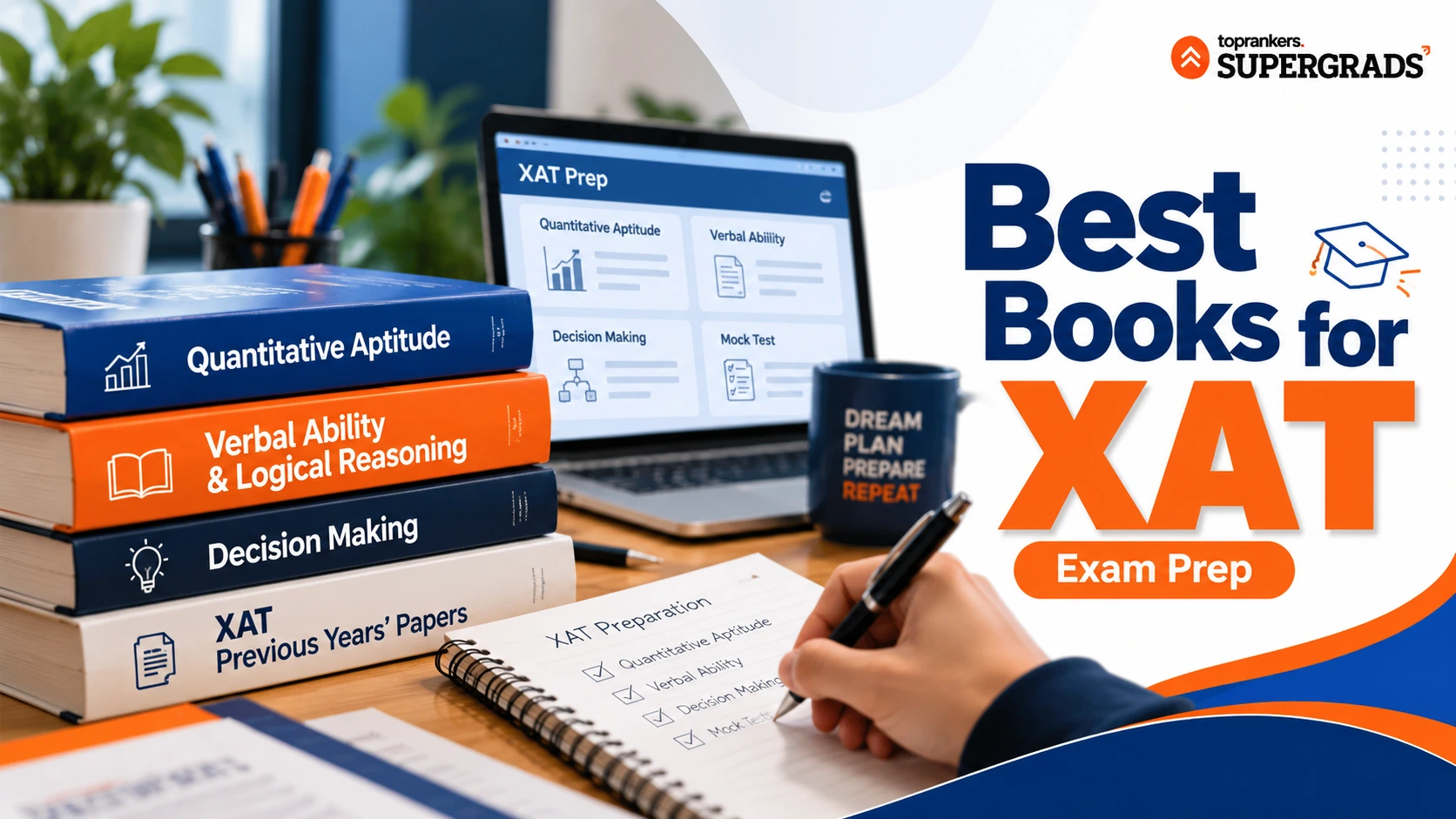
Table of Contents
- Top Recommended XAT Books 2027
- Best XAT Books 2027 for Decision Making
- Best XAT Books 2027 for Verbal Ability and Logical Reasoning
- Best XAT Books 2027 for Quantitative Ability and Data Interpretation
- The Best XAT Books 2027 for General Knowledge
- How to Use XAT Books Effectively?
- Why You Need the Right XAT Books?
- Common Mistakes in Choosing XAT Preparation Books
- Conclusion
Top Recommended XAT Books 2027
If you just want a quick list of the best XAT books before going into section-wise details, start with these tried-and-tested recommendations for each part of the XAT exam.
| XAT Section | Recommended Books | Best For |
|---|---|---|
| Decision Making | Jabbing the XAT (with solved papers) by R.K. Jha Target XAT (Past Papers & Mock Tests) by Disha Publications |
Learning from actual XAT DM caselets, ethics-based scenarios and past-year papers with detailed solutions. |
| Verbal Ability & Logical Reasoning | Word Power Made Easy by Norman Lewis Verbal Ability and Reading Comprehension by Ajay Singh |
Building strong vocabulary, grammar and RC skills tailored to XAT-style passages and critical reasoning. |
| Quantitative Ability & Data Interpretation | Quantitative Aptitude for Competitive Exams by R.S. Aggarwal Data Interpretation for the CAT by Nishit K. Sinha |
Strengthening core quant concepts and practising exam-level DI sets similar to XAT difficulty. |
| General Knowledge | Objective General Knowledge (Lucent's) by Sanjiv Kumar General Knowledge 2024 by Manohar Pandey |
Covering static GK plus recent national and international current affairs relevant for XAT. |
You can begin your XAT 2026 preparation with these books and then refer to the detailed section-wise lists below for more options and backups.
Best XAT Books 2027 for Decision Making
The XAT Decision Making section is unique to the XAT and, hence, can make or break your percentile as many candidates often come prepared only with the syllabus standard for other entrance examinations.
The XAT decision-making books should help students increase their ability to analyze complex situations and make sound judgments.
XAT Preparation Books should cover scenarios like:
- Ethical dilemmas
- Business decisions
- Situational analyses
The best books for XAT Exam Preparation for the above topics are listed below:
| XAT Decision-Making Books | Author of the XAT Book | Features of the XAT Preparation Books |
|---|---|---|
| Jabbing the XAT (with solved papers) | RK Jha | This XAT decision-making book has the following:
|
| Target XAT (Past papers and mock tests) | Disha Publications | This XAT decision-making book has the following:
|
| Analytical & Logical Reasoning | Arihant Publications | This XAT decision-making book has the following:
|
Are there specific books dedicated only to XAT Decision Making?
Yes, some books and guides specifically focus on XAT Decision Making with caselets and solved examples, which are highly recommended for targeted preparation.
Best XAT Books 2027 for Verbal Ability and Logical Reasoning
The XAT Verbal Ability and Logical Reasoning section checks your English language skills, reading ability, and reasoning skills. To prepare well, it is important to use books that explain the basics clearly and give you enough questions to practise.
Here are some useful books for XAT VA & LR preparation:
| XAT Books for VA & LR | Author | Why You Can Use It for XAT Preparation |
|---|---|---|
| Word Power Made Easy | Norman Lewis | A useful book for building vocabulary. It includes word exercises and tests that can help you learn new words and understand their usage. |
| A New Approach to Reasoning: Verbal & Non-Verbal | B.S. Sijwali | Covers different types of reasoning questions with simple explanations and practice questions. |
| Verbal Ability and Reading Comprehension | Ajay Singh | Helps with both verbal ability and reading comprehension. It covers topics from basic to advanced levels and also includes practice papers. |
| High School English Grammar & Composition | Wren & Martin | A good choice for strengthening English grammar. Each chapter covers important grammar rules followed by exercises for practice. |
| A Modern Approach to Verbal & Non-Verbal Reasoning | R.S. Aggarwal | Covers several reasoning topics and provides solved examples along with practice questions. It can be useful for improving accuracy and solving speed. |
| Analytical Reasoning | M.K. Pandey | Covers important analytical reasoning topics and different question types. The book also provides detailed explanations and plenty of questions for practice. |
Which Type of Books Are Best for XAT Verbal Preparation?
For XAT verbal preparation, choose books that cover Reading Comprehension, vocabulary, grammar, and critical reasoning. It is better to use a book that gives enough practice questions along with explanations, so you can understand where you went wrong and improve with regular practice.
Best XAT Books 2027 for Quantitative Ability and Data Interpretation
Quantitative Ability and Data Interpretation form the bedrock of analytical prowess in the XAT exam.
XAT decision-making books are indispensable for increasing proficiency in mathematical concepts and adeptness in data interpretation, which are essential for excelling in this section.
Choosing the right XAT Decision Making Book can help you understand the unique case-based questions that are exclusive to the XAT exam. A well-structured XAT Decision Making Book offers ample practice with detailed explanations and exam-level scenarios.
Some of the important topics that XAT Preparation Books for this section should encompass:
- Arithmetic
- Algebra
- Geometry
- Set Theory
- Probability
- Charts & Data Analysis
- Data interpretation & Data sufficiency
- To conquer the Quantitative Ability & Data Interpretation section, practice is crucial.
The Best Books for XAT for Quantitative Ability & Data Interpretation and check with the XAT score calculator
| XAT Books for QA & DI | Author | Features of the XAT Preparation Books for QA & DI |
|---|---|---|
| Quantitative Aptitude for Competitive Exams | R.S. Aggarwal | This XAT QA & DI book has the following features:
|
| Data Interpretation for the CAT | Nishit K. Sinha | This XAT QA & DI book has the following features: Focuses on strong concept building, helps with the application of problems, and includes the difficulty level of each topic to help students learn gradually |
| How to Prepare for Data Interpretation | Arun Sharma | This XAT book for QA & DI has the following features: Covers all types of DI questions. Self-sufficient in itself for preparation |
| Quantitative Aptitude for Competitive Examinations | Abhijit Guha | This XAT book for QA & DI has the following features: Covers a wide range of topics. Revised chapters as per the latest pattern. A Huge no. of solved examples, practice papers, exam-level test papers |
Should I choose separate books for QA and DI or a combined one?
Beginners can start with combined books, but for deeper practice, separate books for QA and DI are more effective.
Best XAT Books 2027 for General Knowledge
The XAT General Knowledge section covers both Static GK and Current Affairs. So, while preparing for this section, students should keep track of important events as well as topics that do not change over time.
Good XAT study material should cover all the major sections of the exam, including Decision Making, Verbal Ability, Quantitative Aptitude, and General Knowledge. For GK, it is useful to have a mix of short notes, practice questions, current affairs updates, and previous year questions.
For Static GK, you should mainly focus on topics such as:
- Business, Finance, and Economics
- Indian Constitution and important laws
- Famous personalities
- Books and authors
- Awards and winners
- History and Geography
- Important national and international events
You can also refer to XAT marking scheme while planning your attempts and check XAT exam tips for additional preparation guidance.
Some useful XAT books and study resources for General Knowledge are given below:
| XAT GK Books 2027 | Author | Features of the XAT 2026 Books for GK |
|---|---|---|
| Objective General Knowledge (Lucent's) | Sanjiv Kumar | This XAT book for GK has the following:
|
| General Knowledge 2024 | Manohar Pandey | This XAT GK book has the following:
|
| Manorama Year Book | Malayala Manorama Group | This GK XAT book has the following:
|
Which books are best for XAT General Knowledge preparation?
Standard GK books combined with current affairs magazines and yearly compilations are the best resources for this section.
How to Use XAT Books Effectively?
Choosing the right XAT books is only the first step. You also need to use them properly to understand concepts, practise questions, and work on your weak areas. Keep the XAT cut-off in mind while setting your preparation goals.
Here are some simple ways to make better use of your XAT study material:
1. Get Your Basics Right
Don't start with the toughest questions right away. First, go through the basic concepts and try the solved examples given in the book. Once you are comfortable with the basics, start solving questions on your own and then move to the harder ones.
2. Take One Section at a Time
XAT covers Verbal and Logical Ability, Decision Making, Quantitative Ability and Data Interpretation, and General Knowledge. Instead of trying to study everything together, pick one section and work through its important topics before moving to the next one.
3. Solve Questions Regularly
Use your books for regular practice. Start with easy questions and gradually move to moderate and difficult ones. If you get a question wrong, don’t just check the answer and move on. Look at the solution and find out where you went wrong.
4. Practise with Previous Year Papers
Previous year papers can help you understand the type of questions asked in XAT. Try solving them with a timer and without taking breaks in between. This will give you a better idea of how well you manage time during the actual exam.
5. Work on Your Weak Topics
Your practice sessions will show you which topics need more attention. Go back to those chapters in your XAT books and solve more questions. For example, if Decision Making is difficult for you, spend more time practising case-based questions and reviewing their solutions.
6. Study According to Your Needs
You don't need to spend the same amount of time on every topic. Give more time to the areas where you make mistakes and revise the topics you are already comfortable with from time to time. This makes it easier to cover the syllabus without rushing.
Do XAT preparation books include previous years’ papers?
Yes, most good XAT books include solved previous papers, which are essential for understanding exam trends.
Why You Need the Right XAT Books?
Choosing the right study material can make your XAT preparation much easier. A good book should help you understand the topics, give you enough questions to practise, and help you get used to the actual exam.
1. Helps You Understand the Basics
Before solving difficult XAT questions, you need to be clear about the basics. A good book explains each topic in a simple way and gives examples that make the concept easier to understand.
2. Covers the Important Topics
Your study material should cover the topics included in the XAT Syllabus. This is especially important for Decision Making, as you need to practise a different type of case-based question for this section.
3. Enough Questions to Practise
Reading concepts alone is not enough for XAT. Look for books that have plenty of questions at different difficulty levels. Detailed solutions are also helpful when you want to check your mistakes and understand a better way to solve a question.
4. Helps You Understand the Exam
Books with previous year XAT papers can give you an idea of the questions asked in the exam. Solving these papers also helps you get familiar with the marking scheme, question format, and time pressure.
5. Written by Reliable Authors
It is better to pick books from authors who have experience in competitive exam preparation. You can also check recommendations from teachers and students before deciding which books to use.
6. Useful for Section-Wise Preparation
Each XAT section needs a slightly different approach. For example, practising Decision Making questions can help you get comfortable with case-based situations, while books for Verbal Ability can be used for reading comprehension, vocabulary, and other verbal topics.
Common Mistakes in Choosing XAT Preparation Books
Choosing the right XAT books can make your preparation easier, but many students make a few common mistakes while picking or using study material. Here are some things to keep in mind:
Mistake #1: Using Only CAT Books
There is some overlap between CAT and XAT, especially in Quantitative Ability and Verbal & Logical Ability. However, XAT also has Decision Making, which needs separate practice. CAT books usually do not have enough questions to prepare you for this section.
How to avoid it: Keep a separate book or study material for XAT Decision Making. Books such as Jabbing the XAT by R.K. Jha can be used for practising case-based questions.
Mistake #2: Depending Only on Books
Books are useful when you are learning concepts, but they cannot replace actual exam practice. You also need to solve previous year papers and take mock tests to understand how to manage time and handle different types of questions.
How to avoid it: Once you have covered the basics, start adding XAT previous year papers and mock tests to your routine. You can also check the XAT Exam Pattern to understand the structure of the exam.
Mistake #3: Leaving GK for the End
Many students focus on the main sections and leave General Knowledge until the last few weeks. This can make it difficult to cover current affairs properly.
How to avoid it: Spend a little time on GK throughout your preparation. Follow important national and international news and revise monthly current affairs regularly. You can also use a standard GK book for topics such as history, geography, business, and economics.
Mistake #4: Collecting Too Many Books
It is common to buy several books after seeing different recommendations. But having a pile of books does not help if you are not able to complete even one of them properly.
How to avoid it: Choose one good book for a section and use it regularly. Once you finish it, move on to previous year papers and mock tests instead of buying another book.
Mistake #5: Using an Old Edition
Older books may not reflect the latest XAT pattern or include recent previous year questions. This can leave gaps in your preparation.
How to avoid it: Check the edition and publication year before buying a book. If possible, choose a recent edition that includes updated questions and papers.
Conclusion
The right XAT books can help you understand concepts and get enough practice, but you also need to use them along with previous year papers and mock tests. Give separate attention to areas such as Decision Making and keep up with General Knowledge.
You can also refer to XAT preparation for more preparation resources. Once you have selected your books, focus on completing them properly rather than constantly looking for new study material. Regular practice and revision will help you make better use of the resources you have.
Smart Prep for CAT: Join Our Free Demo Class
Fill your details
Frequently Asked Questions
What are the best XAT preparation books for beginners?

How many hours per week should I dedicate to studying XAT books?
How should I choose XAT preparation books?
Can I use CAT preparation books for XAT preparation?
Is it necessary to buy multiple books for XAT preparation?
Jainab Alvi
Content Writer | MBA & CAT Preparation
SHARE