


XAT GK Syllabus 2027: Static GK & Current Affairs Topics + PDF
October 10, 2026
To ace the XAT GK section with good marks and percentile, it is very important to have a good understanding of the XAT GK syllabus. Read on to get an idea about the topics asked in XAT 2027 Exam.
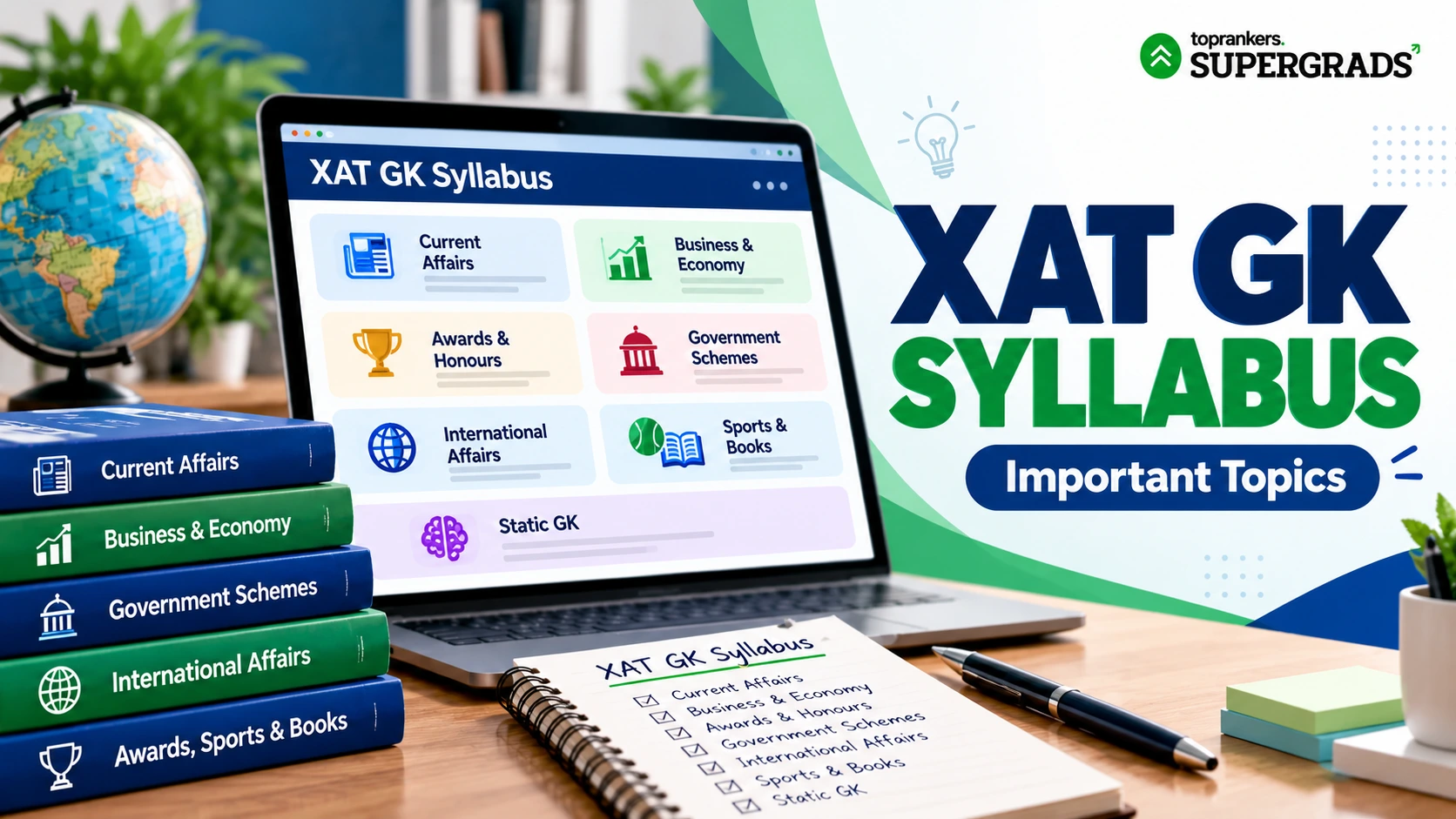
This page covers the complete XAT GK syllabus for 2027, including Static GK and Current Affairs. Use the topic tables as a checklist and download the PDF to track your preparation week-by-week.
What's New for XAT 2027?
- There is no sectional time limit in the XAT 2027 exam. You can now move freely between sections during the exam.
- The number of XAT test cities has increased to 109 this year.
- You can choose two preferred test cities when you fill out your application.
- The application fee for XAT remains the same.
Understanding the XAT GK Syllabus 2027
Preparing for the XAT GK syllabus 2027 is crucial for aspirants. Although the scores are not counted in the final list, this preparation can be a plus point during your interview and Group discussion rounds.
The XAT exam GK syllabus 2027 is divided into two parts.
Part 1: Static GK for XAT Exam 2027
Static GK, in short, refers to General Knowledge about facts that are fixed and do not change over time. The XAT exam asks about 8 questions from the static GK section. It comprises the following topics:
| Static GK Topics | ||
|---|---|---|
| Business, Finance and Economics | The Indian Constitution and Laws | History and Geography |
| Famous Personalities | Awards and Winners | Books and Authors |
| Science and Technology | Important Dates & Events | Art & Culture |
Check Now: XAT 2027 application form.
Part 2: Current Affairs for XAT 2027 Exam
Current affairs refers to recent events and developments that are happening around the world and are of social, political, economic, scientific, technological, or environmental importance.
The XAT exam asks about 12 questions from the current affairs section. These XAT GK questions are generally around the topics:
| Current Affairs Topics | ||
|---|---|---|
| National Current Affairs | International Current Affairs | Political Developments |
| Business and Economic News | Environmental Issues | New Government Schemes |
| Awards and Achievements | Sports News | Science and Tech Updates |
Detailed XAT GK Syllabus 2027
Here is the detailed syllabus for the XAT 2027 entrance exam:
I. Static GK Syllabus for XAT 2027
Static GK includes facts and information that do not change over time. This content is factual and requires memorization and understanding.
| Ancient India |
|
| Medieval India |
|
| Modern India |
|
Read More: XAT 2027 Registration
XAT GK Syllabus for Indian Geography
| Physical Features: |
|
| Rivers & Lakes: |
|
| Climate & Vegetation |
|
| Soils & Agriculture: |
|
| Minerals & Industries: |
|
XAT GK Syllabus for Indian Polity
|
Indian Polity & Constitution |
Constitutional Framework |
|
|
Parts of the Constitution |
|
|
|
Union Government |
|
|
|
Constitutional Bodies |
|
|
| Amendments & Schedules |
|
XAT GK Syllabus for Indian Economy
| Basic Concepts |
|
| Sectors of the Economy |
|
| Banking & Finance |
|
| International Organizations |
|
| Government Schemes |
|
XAT GK Syllabus for Art and Culture
| Art & Culture of India | Classical Dances: |
|
| Folk Dances: |
|
|
| Classical Music: |
|
|
| Folk Music: |
|
|
| Paintings: |
|
|
| Festivals: |
|
XAT GK Syllabus for General Science
| General Science | Physics |
|
| Chemistry |
|
|
| Biology |
|
XAT GK Syllabus for Sports
| Sports | Major Sports |
|
| Indian Sports Personalities |
|
|
| Awards & Honours |
|
|
| Sports Venues |
|
XAT GK Syllabus for Books and Authors
| Books & Authors | Classical Literature |
|
| Modern Indian Authors |
|
|
| International Authors |
|
|
| Literary Awards: |
|
XAT GK Syllabus for Miscellaneous
| Important Days & Dates |
|
| Awards & Honors (National & International) |
|
| First in India & the World |
|
| Superlatives (India & World) |
|
| United Nations & Other International Organizations |
|
| Countries, Capitals & Currencies |
|
| Important Personalities |
|
| Government Schemes & Policies |
|
| Indian States & Union Territories |
|
Read More | Best Books to Prepare for XAT Exam
II. Current Affairs Syllabus for XAT 2027
This part of the GK section includes recent events, mostly from the last 6–12 months before the exam. Staying updated through newspapers, magazines, and monthly capsules is crucial.
XAT GK Syllabus for India Politics & Governance
| Topic | Pointers |
|---|---|
| Post-General Election Government | A new cabinet has been formed, with key ministers appointed. |
| Important Judicial Rulings | Supreme Court judgments on major cases. |
| New Government Schemes | Any new initiatives for youth, women, farmers, or infrastructure |
| Key Appointments | New heads for RBI, PSUs, or other important bodies. |
| Parliamentary Session | Major bills passed or debated. |
| "Ek Ped Maa Ke Naam" Campaign | The government's drive to plant 140 crore trees. |
XAT GK Syllabus for Economy & Business
| Topic | Pointers |
|---|---|
| Union Budget 2025-26 | Key highlights for the economy, taxes, and social sectors. |
| Economic Growth | India's GDP growth rate (6.5% for 2024-25, fastest major economy). |
| Inflation Control | Consumer price inflation is falling to its lowest levels (2.82% in May 2025). |
| Exports & Trade | Record high total exports (over $824 billion in 2024-25). |
| FDI Trends | Major sectors receiving Foreign Direct Investment. |
| Startup Scene | Growth of new unicorns, funding trends. |
| RBI Decisions | Updates on interest rates or banking policies. |
XAT GK Syllabus for International Relations & Global Affairs
| Topic | Pointers |
|---|---|
| Ongoing Conflicts | Updates on Russia-Ukraine and Israel-Palestine. |
| Major Summits | Outcomes of G20, G7, BRICS meetings (if any in early 2025). |
| India's Diplomatic Engagements | PM Modi's visits abroad, foreign leaders visiting India. (Example: PM Modi received top civilian honours from Namibia and Brazil in July 2025). |
| International Organizations | India elected to the UN ECOSOC for the 2026-2028 term. India as Chairman of the Asian Productivity Organization for 2025-26. |
| Global Economy | Discussions on global inflation, potential recession risks. |
| Other Key World Events | France granted more autonomy to New Caledonia (July 2025). |
XAT GK Syllabus for Science & Technology
| Topic | Pointers |
|---|---|
| Indian Space Missions | Shubhanshu Shukla: First Indian astronaut to visit ISS, safely returned (July 2025). Updates on the Gaganyaan mission. Recent ISRO satellite launches (PSLV, GSAT, SSLV). |
| Artificial Intelligence (AI) | AI Appreciation Day: India observes it on July 16, recognizing AI growth. Discussions on AI ethics and applications. |
| Defense Tech | Indian Army successfully tested Akash Prime Air Defence System in Ladakh (July 2025). DRDO's new innovations (e.g., carbon fiber foot prosthesis). |
| Digital Initiatives | India launched the World's First Traditional Knowledge Digital Library (July 2025). India's First Digital Nomad Village opened in Sikkim (July 2025). |
| Infrastructure | First section of bullet train's undersea tunnel opened in Maharashtra. |
XAT GK Syllabus for Environment & Ecology
| Topic | Pointers |
|---|---|
| Climate Change Efforts | Progress on India's emission targets. Discussions on "Just Transition" in Climate Strategies (UN Report, July 2025). |
| Environmental Policies | New "Eco-mark Rules 2024" (Sept 2024) for eco-friendly products. Progress on the "MISHTI" (mangrove restoration) initiative. |
| Pollution Control | Efforts to combat plastic pollution (World Environment Day 2025 focus). |
| Natural Disasters | Major heatwaves, floods, and landslides in various parts of India (early-mid 2025). |
| Global Environmental Concerns | The oldest and largest iceberg, A23a, ran aground (March 2025). |
XAT GK Syllabus for Awards, Honours & Personalities
| Topic | Pointers |
|---|---|
| National Awards | Recent Padma Awards recipients. Deepika Sehrawat: First Indian to win Poligras Magic Skill Award in hockey (July 2025). Telangana won the National Award for Battery Manufacturing (July 2025). |
| International Awards | Nobel Prizes 2024: Winners (to be known by Oct 2024). Varsha Deshpande: Won 2025 UN Population Award (July 2025). Alex Ovechkin: Won 2025 ESPY Award for breaking NHL goal record (July 2025). Banu Mushtaq: Won International Booker Prize (June 2025). |
| Prominent Personalities | Sanjog Gupta: Appointed new CEO of the International Cricket Council (July 2025). Sanjay Kaul: Appointed CEO of GIFT City (July 2025). Jennifer Simons: First woman President of Suriname (July 2025). Deepika Padukone: Got Hollywood Walk of Fame Star (July 2025). |
Why GK Matters in XAT 2027?
GK may seem less important than other sections of XAT, but it still matters during the final selection. XLRI Jamshedpur takes your GK performance into account, making it worth spending some time on current affairs and general knowledge.
There is no negative marking, and this section is evaluated only during the final selection stage, making it a great opportunity to gain an edge over other candidates.
Let’s break down each part of the XAT GK syllabus 2027 with examples and explanations.
XAT Exam Pattern 2027 (Revised)
The XAT exam consists of two parts:
Part 1 of XAT Exam 2027
| Exam Sections | Number of questions | Overall Time Duration |
|---|---|---|
| Verbal Ability and Logical Reasoning | 26 | No Sectional Time Limit |
| Decision Making | 21 | No Sectional Time Limit |
| Quantitative Ability & Data Interpretation | 28 | No Sectional Time Limit |
| Total | 75 Questions | 170 Minutes |
Final Tips to Crack XAT GK Section 2027
Preparing for the XAT GK section becomes easier when you follow a regular study routine. Keep track of current affairs, revise important facts and solve GK questions regularly. Here are a few tips to help you prepare better:
- Start Early and Revise Regularly: Begin your GK preparation early and revise important facts from time to time. Regular revision will help you remember Static GK topics for longer.
- Focus on Recent Current Affairs: Cover important national and international news from the last 6–8 months. Try to understand why an event matters instead of just memorising facts.
- Attempt All Questions: Since there is no negative marking in the XAT GK section, try to answer every question. If you are unsure of an answer, use the available options to make an informed guess.
- Read the News Daily: Make time to read a good newspaper every day. It will help you stay updated on current affairs and also improve your vocabulary and reading skills.
- Use GK Notes and Quizzes for Revision: Read monthly current affairs compilations and take online GK quizzes. They will help you revise important topics, check your preparation and identify areas that need more work.
Frequently Asked Questions
What is the date of the XAT 2027 exam?

What is the duration of the XAT exam?
How many questions will be in the XAT exam?
Is there a negative marking in the XAT 2027?
What sections are included in the XAT syllabus?
What is the pattern of XAT exam?
How many sections are there in the XAT exam pattern?
Are there negative marks in the XAT exam pattern?

Jainab Alvi
Content Writer | MBA & CAT Preparation
SHARE