
1723534562.png)

CAT Logical Reasoning Syllabus 2026 PDF Download Important Topics
May 15, 2026
|
Quick Answer: What Is the CAT Logical Reasoning Syllabus? The CAT Logical Reasoning Syllabus covers topics tested under the DILR section of the CAT exam. Key areas include Seating Arrangements, Blood Relations, Syllogisms, Venn Diagrams, Binary Logic, Puzzles, and Constraint-Based Sets. There is no official syllabus published by the IIMs - it is derived from analysis of previous year CAT papers and typically comprises around 11 of the 22 DILR questions. |
If you are preparing for CAT 2026, understanding the CAT Logical Reasoning Syllabus is your first and most important step toward cracking the DILR section. Every year, thousands of students underestimate this section - and pay the price in their percentile scores.
The DILR section is unique: it does not test memory or formulas. It tests your ability to think under pressure, select the right sets, and solve structured puzzles within 40 minutes. That is why knowing exactly what topics appear, how often, and how to approach them makes all the difference.
This guide gives you the complete, enhanced CAT Logical Reasoning Syllabus 2026 with topic-wise weightage, difficulty levels, solved examples, preparation strategies, common mistakes to avoid, and a free PDF download.
Explore: Find the Latest CAT 2026 Syllabus and Topics
Key Takeaways - CAT Logical Reasoning Syllabus 2026
- The CAT Logical Reasoning Syllabus is part of the DILR section, contributing ~11 of 22 questions across 2–3 sets.
- There is no official IIM-published LR syllabus - it is derived from previous year paper analysis.
- All CAT LR questions are set-based (4–5 questions per set) - never standalone. Prepare accordingly.
- Top priority topics: Seating Arrangements, Games & Tournaments, Binary Logic, Distribution/Scheduling Puzzles, Venn Diagrams.
- Solving just 12–14 questions correctly in DILR can push you past the 90th percentile.
- Set selection strategy is the most important skill in DILR - scan all sets before starting to solve.
- Always attempt TITA questions (no negative marking), even with partial certainty.
- Use diagrams, grids, and matrices for every arrangement or puzzle set - never solve mentally.
- CAT PYQs (2015–2018) are the best practice resource - solve all of them under timed conditions.
- Phase your preparation: Learn → Practice → Mock Tests → Analysis. Never skip the analysis step.
- Post-mock analysis is as important as the mock itself - categorise every DILR error by type (conceptual / careless / time).
Table of Contents
- Why the CAT Logical Reasoning Syllabus 2026 Matters
- CAT Reasoning Syllabus - Overview & Exam Pattern
- Important Topics in CAT Logical Reasoning Syllabus 2026
- Topic-Wise Detailed Breakdown of CAT LR Syllabus
- CAT Logical Reasoning Topic-Wise Weightage & Frequency
- CAT Logical Reasoning - Solved Example Sets
- How to Attempt LR Sets in CAT - Strategy & Set Selection
- Common Mistakes Students Make in CAT LR
- CAT Logical Reasoning Preparation Tips 2026
- Best Books for CAT Logical Reasoning Section
- Supergrads Free Resources 2026
- Frequently Asked Questions (FAQs)
- Conclusion
- Key Takeaways
Why the CAT Logical Reasoning Syllabus 2026 Matters
Every year, over 3 lakh students appear for CAT. Most spend months on Quantitative Aptitude and VARC - and then scramble to cover DILR in the last few weeks. That is a costly mistake.
|
📊 Key Insight A score of just 12–14 in DILR can push you close to 90th percentile. You do not need to solve every question - you need to solve the right sets, completely and accurately. That is exactly what mastering the CAT Logical Reasoning Syllabus enables. |
The DILR section is the most differentiating section in CAT. While most students perform similarly in QA and VARC, DILR scores vary dramatically - creating the biggest spread in overall percentile ranks. A strong DILR performance can compensate for an average QA score and push you into the top 1%.
This guide does not just list topics. It tells you which ones actually appear in the exam, how much they are worth, and exactly how to prepare - from day one to exam day.
Is Logical Reasoning (LR) part of the CAT Exam?
Yes. Logical Reasoning is a core part of the CAT exam. It appears under the DILR section, which is the second section of the three-part CAT exam. The CAT Logical Reasoning Syllabus contributes roughly 11 of 22 DILR questions. Mastering LR is essential for scoring above the 90th percentile in DILR - the most competitive section of CAT.
CAT Reasoning Syllabus - Overview & Exam Pattern
The CAT Reasoning Syllabus sits within the broader DILR (Data Interpretation & Logical Reasoning) section, the second section of the CAT exam. Questions are almost always set-based — meaning 4–5 questions are grouped around a single scenario or puzzle.
| Feature | Details |
|---|---|
| Total Questions in DILR | 22 |
| LR Questions | ~11 (2–3 sets) |
| DI Questions | ~11 (2–3 sets) |
| Questions per Set | 4–5 questions |
| Time Allotted | 40 minutes |
| Marks per Correct Answer | +3 |
| Negative Marking (MCQ) | −1 |
| TITA Wrong Answer | 0 (no negative marking) |
| Question Format | MCQs + TITA (non-MCQ) |
| Difficulty Level | Moderate to High |
| Section Order in CAT | 2nd Section |
💡 Pro Tip: Understanding the set-based structure is step one. Most students make the mistake of preparing LR as standalone questions. In CAT, it is always sets - and that changes your entire preparation approach. You must practice solving complete 4–5 question sets under time pressure, not individual puzzles.
CAT Reasoning Syllabus 2026 – Summary Table
| Category | Topics Covered | Approx. Questions |
|---|---|---|
| Logical Reasoning (LR) | Seating arrangement, puzzles, blood relations, logical sequences, binary logic, games & tournaments | ~11 |
| Data Interpretation (DI) | Tables, bar graphs, pie charts, caselets, data sufficiency | ~11 |
| Critical Reasoning (CR) | Syllogisms, strengthening/weakening arguments, assumptions, inferences | Embedded in LR sets |
Check Now | CAT 2026 Exam Notification
If You Are a Beginner, Read This Before You Start CAT Prep
Important Topics in CAT Logical Reasoning Syllabus 2026
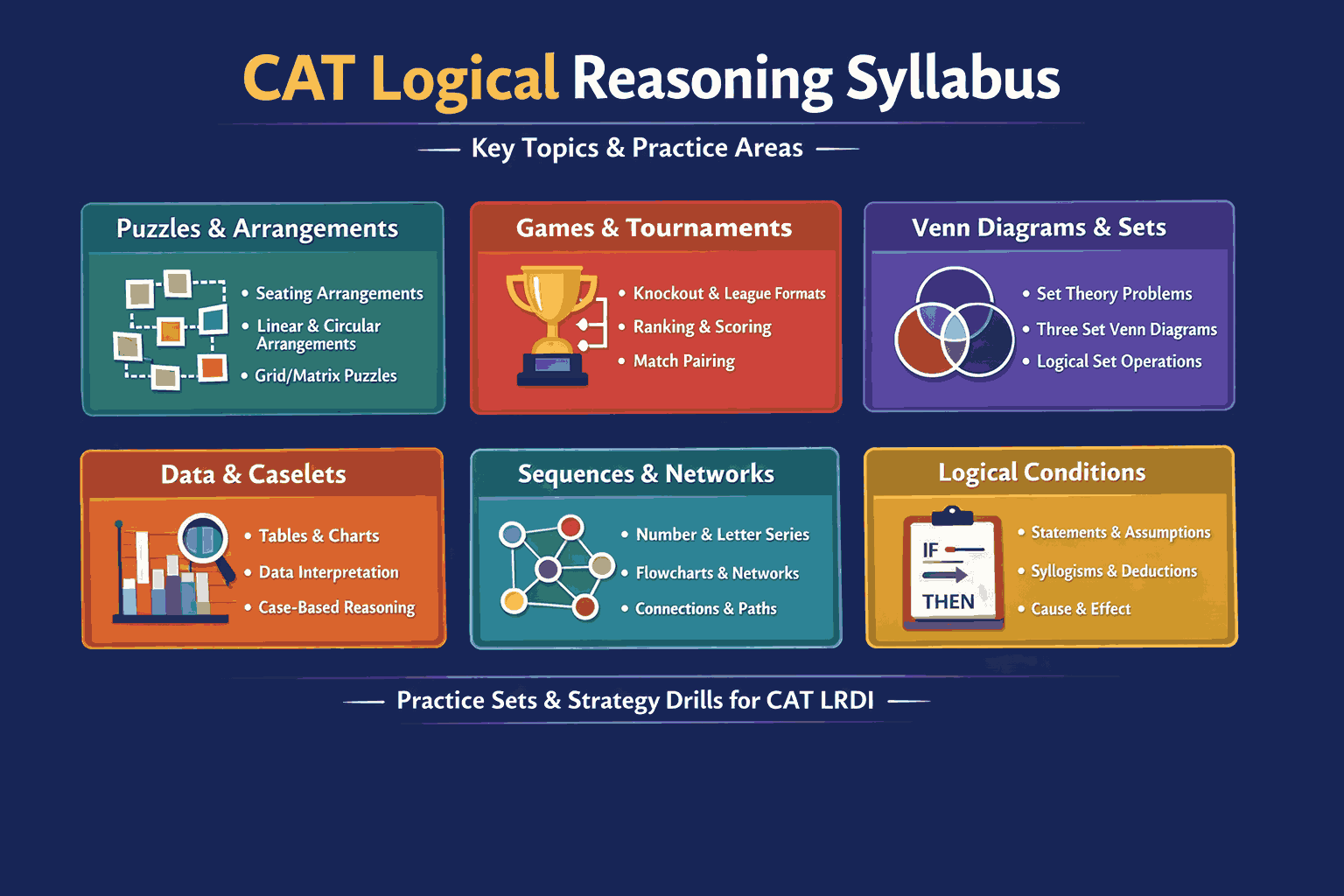
The following are the major CAT Logical Reasoning topics derived from analysis of previous year CAT papers (2015–2024):
- Arrangements – Linear & Circular
- Seating Arrangement (Single row, Double row, Circular)
- Puzzles (Scheduling, Distribution, Grid-based)
- Blood Relations
- Direction Sense
- Syllogisms
- Coding–Decoding
- Logical Sequences
- Clocks & Calendars
- Venn Diagrams (2-set, 3-set, 4-set)
- Binary Logic (Truthtellers & Liars)
- Games & Tournaments
- Team Formation / Selection
- Constraint-Based Sets
- Caselets with Logical Conditions
- Number Series & Letter Sequences (Miscellaneous)
Typically, CAT contains 20–22 questions in the DILR section, and about 8–11 questions are based on Logical Reasoning, spread across 2–3 sets.
📌 Most Frequently Tested LR Topics in CAT (High Priority):
- Seating Arrangements - appeared in nearly every CAT paper since 2015
- Games & Tournaments - very high frequency in recent years
- Binary Logic (Truthtellers & Liars) - high frequency, CAT 2019–2024
- Scheduling / Timetable puzzles - increasingly common post-2020
- Venn Diagrams (4-set) - appeared in CAT 2022, 2023, 2024
- Team Formation / Selection - moderate-high frequency
Check Now | How to Prepare for CAT Reading Comprehension?
Topic-Wise Detailed Breakdown of CAT LR Syllabus
Let us go deeper into each major topic of the CAT Logical Reasoning Syllabus, with sub-topics, what to expect, and how they appear in the exam.
1. Linear and Circular Arrangements (Seating Arrangement)
This is the most consistently tested topic in the CAT LR section. Almost every CAT paper has had at least one seating arrangement set.
| Sub-Type | Description | CAT Frequency |
|---|---|---|
| Single-row linear seating | People seated in a straight line facing one direction | High |
| Double-row seating | Two rows facing each other with positional clues | High |
| Circular arrangement | People seated around a table, with/without direction | Very High |
| Polygon arrangements | Hexagonal or square seating with additional constraints | Moderate |
| Multi-attribute arrangements | Seat + profession + city combinations | High (post-2020) |
💡 What CAT Actually Tests: Seating arrangement sets in CAT are not simple. They involve multiple constraints, conditional clues, and 5-question sets where missing one clue cascades into errors across all answers. Practice drawing grids and matrices rather than solving mentally.
2. Puzzles (Distribution, Scheduling, Grid-Based)
Puzzles are broad and increasingly hybrid in nature. Recent CAT papers (2021–2024) have featured combination puzzles that mix scheduling + floor/building arrangements + attribute assignment.
| Sub-Type | Example Scenario |
|---|---|
| Distribution puzzles | Assigning items/people to boxes, floors, or groups |
| Scheduling puzzles | People attending events on different days with constraints |
| Floor/Building arrangements | People living on different floors with profession/city clues |
| Grid puzzles | Filling a matrix based on row/column conditions |
| Hybrid puzzles | Combinations of 2–3 of the above types |
3. Binary Logic (Truthtellers & Liars)
Binary logic sets have surged in popularity in recent CAT papers. In these sets, each person either always tells the truth or always lies, and you must determine who is who based on their statements.
- Some sets involve three categories: Truth-tellers, Liars, and Alternators (who alternate between truth and lies).
- CAT 2019, 2022, 2023, and 2024 all featured binary logic sets.
- The key skill: set up a case-based analysis systematically rather than guessing.
4. Games & Tournaments
One of the fastest-growing topic areas in recent CAT papers. Tournament sets can involve:
- Round-robin leagues (points-based, determining standings)
- Knockout brackets
- Hybrid formats (group stage + knockout)
- Sets where match results are partially known and you must determine outcomes
These sets reward systematic tabulation. Always build a match-result grid before answering questions.
5. Venn Diagrams
CAT has evolved from 2-set and 3-set Venn diagrams to complex 4-set Venn diagrams with numerical data. These test your ability to:
- Apply set theory (union, intersection, complement)
- Use the inclusion-exclusion principle across multiple sets
- Derive unknown values from overlapping conditions
6. Blood Relations
These appear either as standalone questions or embedded within larger puzzle sets. CAT blood relation questions typically involve:
- Multi-generational family trees
- Gender-ambiguous clues that require careful reading
- Combined blood relation + seating arrangement sets
7. Syllogisms and Critical Reasoning
| Topic | Sub-Topics |
|---|---|
| Syllogisms | Statements, valid conclusions, All/Some/No logic |
| Strengthening & Weakening Arguments | Identifying which option most strengthens/weakens a conclusion |
| Assumption-Based Questions | Necessary vs. sufficient assumptions |
| Inference-Based Questions | What must/can/cannot be concluded from given statements |
| Paradox Questions | Resolving an apparent contradiction in a passage |
8. Data Interpretation (DI) Topics
The DI component of DILR is equally important. Here is what the CAT DI Syllabus covers:
| Topics | Sub-Topics |
|---|---|
| Tables and Graphs | Complex tables, stacked bar graphs, line graphs, scatter plots |
| Pie Charts | Single and multi-level pie charts with percentage calculations |
| Caselets | Text-heavy data scenarios requiring inference and calculation |
| Data Sufficiency | Determining if given data is sufficient to answer a question |
| Mixed Graphs | Two or more chart types combined in one set |
Check | How to Prepare for CAT Data Interpretation?
CAT Logical Reasoning Topic-Wise Weightage & Frequency
Based on analysis of CAT papers from 2015 to 2024, here is the frequency and relative importance of each LR topic:
| LR Topic | Frequency | Difficulty Level | Priority for CAT 2026 |
|---|---|---|---|
| Seating Arrangements (Circular) | Very High | Moderate–High | ⭐⭐⭐⭐⭐ |
| Seating Arrangements (Linear) | High | Moderate | ⭐⭐⭐⭐⭐ |
| Games & Tournaments | Very High | Moderate–High | ⭐⭐⭐⭐⭐ |
| Binary Logic | High | High | ⭐⭐⭐⭐ |
| Distribution / Scheduling Puzzles | High | Moderate–High | ⭐⭐⭐⭐⭐ |
| Venn Diagrams (4-set) | Moderate–High | Moderate | ⭐⭐⭐⭐ |
| Team Formation / Selection | Moderate | Moderate | ⭐⭐⭐ |
| Blood Relations | Moderate | Easy–Moderate | ⭐⭐⭐ |
| Direction Sense | Low–Moderate | Easy–Moderate | ⭐⭐ |
| Clocks & Calendars | Low | Easy–Moderate | ⭐⭐ |
| Coding–Decoding | Low | Easy | ⭐⭐ |
| Syllogisms | Low–Moderate | Easy–Moderate | ⭐⭐ |
📌 Strategy Insight: Focus at least 70% of your Logical Reasoning preparation on Seating Arrangements, Games & Tournaments, Binary Logic, and Distribution/Scheduling Puzzles. These four areas alone account for the majority of Logical Reasoning questions in recent CAT papers.
CAT Logical Reasoning - Solved Example Sets
Here are representative example problems for the most important CAT LR topics, with complete step-by-step solutions.
Example 1 - Circular Seating Arrangement
Question: Six people - A, B, C, D, E, and F - are seated around a circular table. A is not adjacent to B. C sits directly opposite D. B sits to the immediate right of C. E and F are adjacent to each other. Who sits to the immediate left of A?
Step-by-Step Solution:
- Fix C at position 1 (in circular arrangements, fix one person to eliminate rotational ambiguity).
- D is directly opposite C → D is at position 4.
- B is to the immediate right of C → B is at position 2.
- Remaining positions: 3, 5, 6 for A, E, F.
- E and F must be adjacent → E and F occupy positions 5 and 6 (or 6 and 5).
- A takes position 3.
- A is not adjacent to B: position 3 is adjacent to positions 2 and 4. Position 2 is B → Contradiction!
- Adjust: A takes position 6, E and F at positions 3 and 5 (not adjacent - invalid). Try E at 3, F at 5 - not adjacent either.
- So E and F must be at positions 5 and 6 → A at position 3.
- Check: A (pos 3) is adjacent to B (pos 2) - violates the constraint. So the arrangement must be re-examined with B at position 6 instead (B to immediate right of C in the other direction in a 6-person circle).
- Corrected final arrangement: C(1) – D(4) opposite; B(6) is to C's right; E and F at 2 and 3; A at 5.
- Immediate left of A (position 5) = position 4 = D.
💡 Takeaway: Always draw the circle physically. Work clockwise, fix one person, and assign positions systematically. Verify adjacency constraints last.
Example 2 - Binary Logic (Truthteller/Liar)
Question: Three people - P, Q, and R - are either truth-tellers (always tell the truth) or liars (always lie). P says: "Q is a liar." Q says: "R is a truth-teller." R says: "P and Q are both liars." Identify who is what.
Step-by-Step Solution (Case Analysis):
- Case 1: P is a truth-teller → Q is a liar (P's statement is true) → Q's statement "R is a truth-teller" is false → R is a liar → R's statement "P and Q are both liars" is a lie → at least one of P, Q is a truth-teller → P is a truth-teller ✓
- This is consistent: P = Truth-teller, Q = Liar, R = Liar.
- Case 2: P is a liar → Q is a truth-teller → R is a truth-teller (Q's statement is true) → R's statement "P and Q are both liars" must be true → Q is a liar. Contradiction (Q is truth-teller). ✗
- Answer: P is a truth-teller, Q and R are liars.
Example 3 - Games & Tournaments
Question: Four teams - W, X, Y, Z - play a round-robin tournament (each pair plays once). A win = 2 pts, draw = 1 pt each, loss = 0 pts. Final standings: W has 5 pts, X has 4 pts, Y has 3 pts, Z has 0 pts. How many matches were drawn?
Step-by-Step Solution:
- Total matches in a 4-team round-robin = 4C2 = 6 matches.
- Total points distributed: if no draws, 6 × 2 = 12 pts. Actual total = 5 + 4 + 3 + 0 = 12 pts.
- Since total = 12 and every draw keeps the total the same (1+1=2), the number of draws cannot be determined from points alone - but Z has 0 points meaning Z lost all 3 games.
- Z lost to W, X, and Y → W, X, Y each got 2 pts from Z matches.
- Remaining: W vs X, W vs Y, X vs Y (3 matches among W, X, Y). W remaining points = 5−2=3; X=4−2=2; Y=3−2=1.
- W must have gotten 3 from 2 matches → one win (2 pts) + one draw (1 pt) = 3. ✓
- So W drew one of those matches → 1 drawn match in the tournament.
How to Attempt LR Sets in CAT - Strategy & Set Selection
The biggest differentiator in CAT DILR is not knowledge - it is set selection strategy. Here is a proven approach:
Step 1 - Scan All Sets in the First 3–4 Minutes
Read the opening paragraph of every set quickly. Do not start solving. Identify which sets look doable based on:
- Familiar topic type (e.g., tournament, seating)
- Number of constraints (fewer = easier)
- Number of questions per set (5-question sets give more marks per time invested)
Step 2 - Rank Sets by Ease and Attempt in Order
Prioritise sets where you can determine a unique arrangement. Avoid sets with too many "either/or" conditions early on - save these for last.
Step 3 - Complete Sets Fully, Never Partially
Half-solving a set and moving on wastes all the time invested. CAT rewards complete set solutions. If a set is taking more than 12 minutes, mark it and move on.
Step 4 - Use TITA Questions to Your Advantage
TITA (Type In The Answer) questions have no negative marking. Even if you are not 100% sure of a numerical answer in a set, always attempt TITA questions after solving as much as possible.
| Time Budget for DILR (40 min) | Recommended Allocation |
|---|---|
| Set scanning and selection | 3–4 minutes |
| First attempted set | 10–12 minutes |
| Second attempted set | 10–12 minutes |
| Third set (if time permits) | 10–12 minutes |
| Buffer / review TITA answers | 2–3 minutes |
Common Mistakes Students Make in CAT Logical Reasoning
These are the most frequent errors that cost students marks in the DILR section - and how to avoid them:
- Preparing LR as standalone questions: CAT LR is always set-based. Practicing individual puzzle questions does not simulate the real exam experience. Always practice in complete sets of 4–5 questions.
- Attempting too many sets: Many students try to solve 4–5 sets and end up with none solved completely. Two fully solved sets score more than four half-solved ones.
- Not drawing diagrams: Trying to solve seating arrangements or binary logic mentally leads to errors. Always draw grids, tables, or circular diagrams.
- Misreading directional clues: In circular arrangements, "to the right" means the person's right, which is clockwise. Confusing this is one of the most common errors.
- Ignoring TITA questions: Since there is no negative marking on TITA, students must always attempt these, even with partial certainty.
- Spending too long on a stuck set: If you cannot crack a set's core structure within 4–5 minutes, move on. Come back only if time permits.
- Not practicing under timed conditions: LR under exam pressure is very different from leisurely practice. Always time yourself during practice - use a 40-minute window for a full DILR mock.
- Skipping set selection: Jumping into the first set without evaluating all sets is a trap. The first set in a CAT paper is not necessarily the easiest.
CAT Logical Reasoning Preparation Tips 2026
Here is a phase-wise preparation strategy for the CAT LR syllabus:
Phase 1 - Foundation (Months 1–2): Learn All Topic Types
- Understand the format and approach for each LR topic type.
- Solve 2–3 complete sets per topic before moving to the next.
- Master the diagrammatic tools: grids, matrices, circular diagrams, family trees.
- Focus especially on Seating Arrangements, Puzzles, and Binary Logic.
Phase 2 - Practice (Months 3–4): Build Speed and Accuracy
- Solve 2–3 full DILR sets daily under timed conditions.
- Start with 12 minutes per set, gradually reduce to 10 minutes.
- Use previous year CAT papers (2015–2024) as primary practice material.
- Tag every set by topic and difficulty after solving.
Also Check: How to Prepare for Logical Reasoning in CAT?
Phase 3 - Mock Tests (Last 2 Months): Simulate Exam Day
- Take one full CAT mock test every week.
- After each mock, spend equal time analyzing your DILR performance.
- Track: which sets you attempted, which you abandoned, accuracy rate, time per set.
- Identify your comfort topics - these are your "sure attempt" sets on exam day.
💡 Expert Insight: The post-mock analysis is more valuable than the mock itself. Understand why you missed questions - was it a conceptual gap, a misread clue, or a time management issue? Each error type needs a different fix.
Important: How to Use Previous Year CAT Papers for LR Prep
- CAT 2015–2024 papers are freely available - solve all of them.
- CAT switched to a set-based DILR format in 2015. Papers from 2015 onwards are most relevant.
- CAT 2017 and 2019 DILR sections are considered among the hardest - essential for advanced preparation.
- Do not just solve PYQs - study the official answer key explanations to understand IIM-level reasoning patterns.
Check: Download CAT 2026 Sample Papers and Question Papers PDF
Best Books for CAT Logical Reasoning Section
Here is a curated list of the most recommended CAT books for mastering LR and DILR:
| Book | Author / Publisher | Best For | Recommendation |
|---|---|---|---|
| How to Prepare for Data Interpretation for CAT | Arun Sharma | CAT-level strategy, Level of Difficulty (LOD) practice | Must-Have |
| Logical Reasoning and Data Interpretation for CAT | Nishit Sinha | Concept clarity, set-based practice, CAT patterns | Highly Recommended |
| Logical Reasoning and Data Interpretation for CAT | Pearson | Wide variety of set types, good for beginners | Good Supplement |
| CAT Previous Year Papers (2015–2024) | IIM Official / Publishers | Real exam exposure, authentic difficulty calibration | Essential |
| Supergrads Online Study Material | Toprankers / Supergrads | Topic-wise practice, video solutions, mock tests | Recommended for Online Prep |
The LR section requires a multi-faceted approach. Efficient strategies - such as elimination techniques, case-based analysis, and the use of diagrams - are essential. Time management is equally vital: avoid getting bogged down by a difficult set and always practice under exam conditions.
Check: CAT 2026 Slot Timings
Supergrads Resources 2026 - Use Them Strategically
Master QA Prep for CAT 2026 Here
Master DILR Prep for CAT 2026 Here
Master VARC Prep for CAT 2026 Here
Conclusion
The CAT Logical Reasoning Syllabus 2026 is well-defined, consistent from year to year, and very much crackable - if you approach it the right way. The key is not to memorise every possible puzzle type, but to build a structured, set-based problem-solving approach that you can apply to any scenario the IIMs throw at you.
Master Seating Arrangements, Games & Tournaments, Binary Logic, and Distribution Puzzles - these four topic areas alone will cover the bulk of what you face on exam day. Add smart set selection strategy, consistent timed practice, and thorough mock test analysis, and DILR transforms from your biggest fear into your biggest scoring advantage.
Start your preparation today, and make DILR the section that differentiates you from every other CAT 2026 aspirant. You've got this! 🚀

Smart Prep for CAT: Join Our Free Demo Class
Fill your details
Frequently Asked Questions
What is the importance of the reasoning section in the CAT exam?

How many questions are typically present in the CAT Logical Reasoning section?
What are some of the core topics covered in the CAT Exam Reasoning Syllabus 2023?
Is the reasoning section only MCQ-based?
Are there any recommended books for the CAT's reasoning section?
What includes in CAT Reasoning Syllabus?
How do I prepare for CAT Logical Reasoning Syllabus?

Zubeen Siddiqui
Content Writer | MBA & CAT Preparation


SHARE