
1723534562.png)

CLAT 2026 AIR 9 Interview: Manvi on Beating Maths Fear, 115 Attempts with High Accuracy & LegalEdge Gurugram Support
January 28, 2026
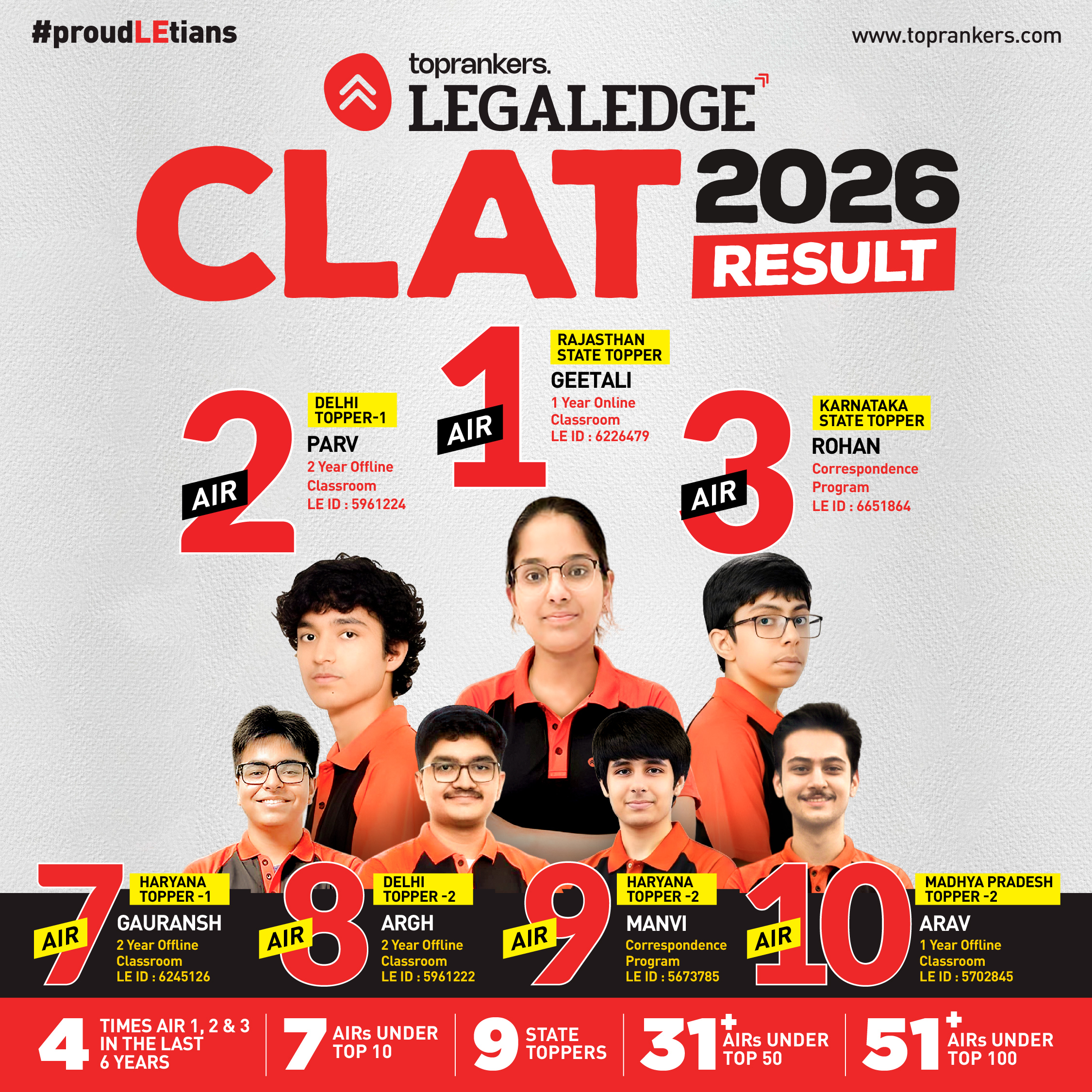
On the night of the CLAT results 2026, Harsh Gagrani (Founder, TopRankers) speaks with CLAT 2026 AIR 9, Manvi. Based in Gurugram, a Humanities student with Legal Studies in Class 11–12, Manvi shares how writing shaped her career choice, how she turned her weakest section (Maths) into a full-score area, her calm exam-week mindset, her high-accuracy strategy with 115 attempts and 110 marks, and how LegalEdge (online batch + Gurugram centre support) played a key role.
Who is CLAT 2026 AIR 9?
CLAT 2026 AIR 9 is Manvi From LegalEdge. A Humanities student with Legal Studies in Classes 11–12, she credits writing for shaping her law journey, turned her weakest section, Maths, into a full-score area, and followed a calm exam-week routine with a high-accuracy strategy—115 attempts for 110 marks. Manvi also highlights LegalEdge (online batch + Gurugram centre support) as a key factor in her preparation.
Quick Snapshot: CLAT 2026 AIR 9 Manvi
- Rank: CLAT 2026 AIR 9
- Base City: Gurugram
- Coaching: LegalEdge
- Stream: Humanities (Class 11 & 12)
- Early Interest Trigger: Legal Studies + strong inclination towards writing
- Joined LegalEdge: From Class 12 (Online Batch); visited Gurugram centre for mocks/classes
- Initially Tough Sections: Maths + GK (heavy at the start)
- CLAT Attempts & Score: 115 attempts; 110 marks
- Mindset on Exam Day: Calm, focused on “solve what’s in front of me”
Interview: Harsh Gagrani Sir [LegalEdge] X Manvi [CLAT 2026 AIR 9]
Q1. Manvi, tell us about yourself—your background and when you started thinking of law as a career.
Manvi: I’m Manvi, and I’m based out of Gurugram. I had Humanities in Grades 11 and 12. I also had Legal Studies, which really helped build my interest towards this field.
Manvi: Why law? It was a mix of elimination and deciding what I’m good at. I decided pretty early that I don’t want a career in Maths or Science or anything closely associated with those subjects.
Manvi: I also started writing around middle school and early high school. I knew I wanted to do something that involves something to write about. Taking Legal Studies was a great step in that direction, and it helped pique my interest in law.
Q2. When did you start preparing for CLAT?
Manvi: I enrolled with LegalEdge coaching on Grade 12.
Q3. Which section was the toughest initially? Did it change over time?
Manvi: Maths was something I did not enjoy doing. I would not pay that much attention in Maths class or even while solving Maths in mocks. I would keep delaying it—“I’ll do it later, eventually.”
Manvi: Initially, GK was heavy too because you’re suddenly exposed to so much content. But in my second attempt, especially, I came to love GK. I enjoyed reading compendia and learning as much as I could.
Manvi: Maths also—I worked on it, and I scored full in the paper.
Q4. From Maths being a weak section to scoring full—what was your strategy to remove the fear?
Manvi: I had a mock diary, and then I had a Maths diary. I maintained the sectionals that I did.
Manvi: I started solving Maths under a time limit. I began with a time limit—like “take 40 minutes but solve it yourself, don’t refer to anything.” That really helped.
Manvi: I noted the time for each Maths set and the topic—speed, trains, downstream, upstream—then I would note what I wasn’t good at and why I wasn’t thinking the way the question wanted me to think.
Manvi: If I couldn’t solve a Maths sectional in a mock, I would revisit it later that day and try again and again until I got it right myself, without looking at the answer key.
Q5. How was your CLAT day? Were you surprised by AR? Did you change your strategy?
Manvi: I was very calm the entire CLAT week. I had one little meltdown on the day the sample paper came out, but that’s it.
Manvi: Before the paper, I had nothing on my mind. I was calm. In my paper, the first section was Logical. I was okay with it. I enjoy doing Analytical Reasoning as well, so it wasn’t that big of a surprise.
Manvi: I did not change my strategy. My strategy was the same—solving the paper in the order CLAT has always come: English, GK, Logical, Legal, Logical, and Maths.
Q6. On the exam day, did you feel you might get a single-digit rank?
Manvi: Not really. I was not hyper-fixating on a college either. I was like—“I’ll just solve whatever is in front of me, and I’ll walk out of this.”
Manvi: I definitely did not think I would get a single-digit rank. I felt others might have attempted more. I could have done 2–3 more, too.
Q7. How many questions did you attempt, and what score did you get?
Manvi: I attempted 11,5, and I got 110 marks.
Q8. What was your GK strategy throughout the preparation?
Manvi: GK was heavy to start because I started preparing seriously only in September. I had to cover GK from December to August—so it was a lot.
Manvi: I wake up quite early—around 2 or 3 AM—and start with the compendium. I try to finish it in the first 3–4 hours.
Manvi: I wouldn’t force myself to know everything written there. I would skim through it, read through it, and see how much I remember.
Manvi: In a week, I would do each compendium repetitively—three to four compendiums, twice or thrice. Repetition is what helped my memory stick.
Q9. How did your sections go overall (including English and Logical)?
Manvi: I left only a few questions in GK. I scored full in English. I got three questions wrong in Logical, and one question is under objection—hopefully it’s accepted.
Q10. What role did LegalEdge play in your success?
Manvi: LegalEdge was the first place I enrolled in Grade 12. I was in the online batch—classes online, mocks online.
Manvi: But I still went to the LegalEdge Gurugram centre. I got in touch with Rakesh sir. I used to go every week for mocks, and he constantly encouraged me to attend different classes—GK, Maths, Legal.
Manvi: This year as well, I enrolled in the LegalEdge Test Series and attempted all of my mocks there.

Insights from CLAT 2026 AIR 9 Manvi's Story
- Career clarity came from elimination: She identified early what she didn’t want (Maths/Science careers) and leaned into writing + Legal Studies.
- Maths fear is fixable: a separate Maths diary, timed practice, and a retry-until-right approach helped her achieve a full score.
- Accuracy beats blind attempts: 115 attempts with 110 marks show a strong accuracy-first approach.
- GK got easier through repetition: Compendia repeated multiple times per week, not “perfect memorisation,” made recall stick.
- Stay calm, solve what’s in front of you: She avoided college-obsession and stayed task-focused on paper day.
- Online + centre support worked together: Online classes + Gurugram centre mocks/classes built consistency and confidence.
Conclusion
Manvi’s CLAT 2026 AIR 9 Manvi's journey is proof that single-digit ranks aren’t only about being “naturally great” at every section. From avoiding Maths to mastering it, from GK overload to enjoying compendiums, and from overthinking to calm execution—her strategy was structured, repetitive, and accuracy-led. Add strong mentorship support from LegalEdge Online + Gurugram Centre, and you get a result-night story that aspirants can genuinely learn from.
Start CLAT 2027-28 preparation with LegalEdge, Watch Free Demo Classes: CLAT Demo Classes
Relevant Important Links
| CLAT 2026 AIR 1 | CLAT 2026 AIR 2 |
| CLAT 2026 AIR 3 | CLAT 2026 AIR 7 |
| CLAT 2026 AIR 8 | CLAT 2026 AIR 9 |
| CLAT 2026 AIR 10 | CLAT 2026 Toppers List |
| CLAT Rank List | CLAT 2026 Topper Interviews |
CLAT 2026 AIR 1 Geetali From LegalEdge Says
Stay consistent every day, even if it’s a small slot of study, and make sure you’re doing something CLAT-related daily—a mock, mock analysis, practice sets, or revision. She also stresses building a daily newspaper habit (even 30 minutes or selective reading) for GK/CA, and not getting mentally shaken by fluctuating mock ranks—focus on your own process, keep revising and practising, and trust that sustained effort will compound into results.
Preparing for CLAT 2027–2028? Watch FREE demo classes by LegalEdge—start here: CLAT Demo Classes
CLAT 2027 Latest Updates
| Event / Milestone | Expected Month (for CLAT 2027 cycle) | What to do (quick action) |
|---|---|---|
| Official notification/information brochure | Late July 2026 (expected) | Check the Consortium website and note eligibility, fees, and key dates. |
| Application form opens | August 2026 (expected) | Register early, upload documents, and lock your test city preferences. |
| Application last date | Late October / early November 2026 (expected) | Submit well before the deadline; avoid last-day payment issues. |
| Correction window (if announced) | October / November 2026 (expected) | Fix photo/signature/category details (only if the window is enabled). |
| Admit card release | Late November 2026 (expected) | Download and verify the centre, slot, and instructions. |
| CLAT 2027 exam date | Early December 2026 (expected) | Carry admit card + valid ID; follow exam-day instructions. |
| Provisional answer key | December 2026 (expected, shortly after exam) | Download key + response sheet (if released) and calculate score. |
| Objection window | December 2026 (expected) | Raise objections with proof within the given time window. |
| Final answer key | December 2026 (expected) | Recompute score using the final key. |
| Result declaration | Mid–late December 2026 (expected) | Download the scorecard and prepare a preference list for counselling. |
| Counselling registration & fee payment | December 2026 (expected) | Register for counselling immediately and lock your preferences carefully. |
| Seat allotment rounds | Late December 2026 – January 2027 (expected) | Choose Freeze/Float/Exit as per your target NLU and backup options. |

Admin
Subject Matter Expert


SHARE