
1723534562.png)

How to prepare for Data Interpretation for CAT 2026
March 20, 2026
Overview: Data Interpretation (DI) is one of the most scoring yet most feared sections of CAT 2026. It is not about complex mathematics it is about your ability to read, analyze, and extract meaning from data presented in tables, charts, graphs, and caselets. For aspirants wondering how to prepare for Data Interpretation for CAT 2026, the good news is that with the right strategy, consistent practice, and smart time management, DI can become your biggest score booster.
CAT 2026 will be conducted in November 2026 by one of the IIMs. The DILR (Data Interpretation & Logical Reasoning) section carries significant weightage, and a strong performance here can push your overall percentile into the 99+ bracket. This guide gives you a full roadmap from understanding the exam pattern to building the skills that top scorers rely on.
Quick Answer: How to Prepare for Data Interpretation for CAT 2026
To prepare for Data Interpretation for CAT 2026:
- Understand the DI question types,
- Master speed calculation techniques like approximation and Vedic math,
- Practice 2–3 DI sets daily from previous CAT papers and mock tests,
- Learn to identify solvable vs. time-trap sets, and
- Review every mistake systematically. Consistency over intensity is the key.
Understanding the CAT 2026 DILR Section
Before diving into preparation, it is essential to understand exactly what CAT 2026 tests in the DI domain. In recent years, IIMs have merged Data Interpretation and Logical Reasoning into a single section (DILR). Each question comes in sets of 4–6 questions based on a shared data source.
CAT 2026 DILR Section at a Glance
|
Feature |
Details |
|
Total Questions |
~20 questions (varies) |
|
Number of Sets |
4–5 sets |
|
Questions per Set |
4–6 questions |
|
Time Allotted |
~40 minutes (recommended) |
|
Question Types |
MCQ + TITA (non-negative marking for TITA) |
|
Negative Marking |
-1 for wrong MCQ answers |
Types of DI Questions in CAT 2026
Knowing how to prepare for Data Interpretation for CAT 2026 starts with recognizing the different data formats you will encounter. Each type demands a different reading and calculation approach.
- Tables: Rows and columns of numerical data. Tests your ability to quickly locate and compute values. Most common in CAT.
- Bar Graphs: Vertical or horizontal bars comparing quantities. Questions often involve percentage change, ratios, or ranking.
- Line Graphs: Trends over time. Requires understanding slopes, peaks, and intersections.
- Pie Charts: Proportional data. Common questions involve finding actual values from percentages.
- Caselets (Paragraph DI): Data embedded in text. Increasingly popular in recent CAT papers. Requires careful reading before calculation.
- Combination Sets: Two or more data formats used together. Considered the most challenging DI type.
Important Links
| DILR Syllabus | DILR for CAT | Prepare DI |
| Improve DILR Accuracy | Manage Time in CAT | DILR Questions |
| Caselets Questions | Puzzles for CAT | Linear Seating Arrangement |
Step-by-Step Strategy: How to Prepare for Data Interpretation for CAT 2026
The following ordered plan is designed for aspirants with 6+ months of preparation time. Adapt the pace based on your starting level.
- Build Your Calculation Foundation (Month 1)
DI is 60% calculation speed and 40% analysis. If your arithmetic is slow, even easy sets will eat up your time.
- Learn percentage-fraction equivalents by heart (e.g., 1/8 = 12.5%, 3/7 ≈ 42.86%)
- Practice approximation: 48.7% of 612 ≈ 50% of 600 = 300
- Master ratio comparison techniques without cross-multiplication
- Memorize squares (1–30), cubes (1–15), and common square roots
- Learn to Read Data Smartly (Month 1–2)
Before solving any question, spend 60–90 seconds studying the data source. Note the units, labels, time periods, and the overall trend. Most errors happen because students misread the chart, not because they calculated wrongly.
- Master Each Data Format Individually (Month 2–3)
Spend two to three weeks on each data type — tables, bar graphs, line graphs, pie charts, and caselets before practising mixed sets. This builds format-specific intuition.
- Practice Previous Year CAT Papers (Month 3–4)
CAT papers from 2017 to 2024 are the single best resource for how to prepare for Data Interpretation for CAT 2026. The IIMs recycle problem-types, difficulty levels, and even thematic patterns. Solve at least 2–3 complete DILR sections per week from official papers.
- Build Set-Selection Intelligence (Month 4–5)
In the actual exam, you will encounter 4–5 sets. Your first job is to spend the initial 3–4 minutes scanning all sets and deciding which ones to attempt. Train yourself to identify:
- Easy sets: clean data, straightforward questions, direct calculations
- Medium sets: one complex question, but rest are manageable
- Trap sets: seem easy but involve multiple layers of conditions skip these if time is tight
- Take Full-Length Mocks and Analyse Deeply (Month 5–6)
Take at least 2 full-length CAT mocks per week in the final two months. The mock is only 40% of the work the remaining 60% is analysis. For every mock, track: which sets you attempted, which you skipped, accuracy within attempted sets, and time spent per set.
Key Techniques to Crack DI Sets Faster
Smart technique — not just hard work — separates the 95 percentilers from the 99 percentilers in DILR. Here are proven methods:
- Approximation over exactness: Unless a question demands a precise answer, approximate aggressively. Get within 2–3% and use options to choose.
- Column/row anchoring in tables: Fix a reference row or column and express other values relative to it. This speeds up ratio and percentage questions.
- Work backwards from options: For complex caselet questions, plug answer choices into the condition to verify — often faster than forward calculation.
- Draw mini-diagrams: For visual data, quickly sketch the key trend on your rough sheet. This prevents mis-reading.
- Use TITA questions strategically: Non-MCQ questions carry no negative marks. Attempt these even if uncertain — a partial approach is better than skipping.
- The 4-minute rule: If you have not cracked the entry point of a set within 4 minutes, move on. Cut losses early.
Common Mistakes to Avoid in CAT 2026 DI Preparation
Understanding how to prepare for Data Interpretation for CAT 2026 also means knowing what not to do. Avoid these pitfalls that consistently pull down scores:
- Ignoring units: Always check whether values are in lakhs, crores, thousands, or percentages before computing.
- Over-investing in one set: Spending 15+ minutes on a single set is a red flag. Move on if you are stuck.
- Skipping the data read: Jumping directly to questions without studying the chart leads to multiple wrong answers on the same set.
- Neglecting caselets: Many aspirants avoid paragraph DI. This is a mistake — caselet sets have appeared repeatedly in CAT and are manageable with practice.
- Not tracking accuracy: Attempting more sets is useless if accuracy is below 60%. Quality over quantity always.
- Memorising formulas without applying: DI does not test formulas. It tests your ability to apply basic arithmetic in an unfamiliar, data-rich context.
Best Resources for CAT 2026 Data Interpretation Preparation
Books
CAT Books remain the most structured and reliable resource for CAT DI preparation. Unlike random online content, a well-chosen book gives you a progressive difficulty curve, worked examples, and enough practice sets to build real exam stamina. The three titles below are trusted by thousands of CAT toppers and cover everything from beginner fundamentals to advanced combination sets.
- How to Prepare for Data Interpretation for CAT – Arun Sharma (McGraw Hill): The gold standard for DI prep. Covers all set types with graded difficulty levels.
- Data Interpretation & Data Sufficiency – Ananta Ashisha: Good for beginners. Clear explanations and progressive difficulty.
- CAT Data Interpretation & Logical Reasoning – Gautam Puri: Excellent for combination sets and newer DI formats.
Online Platforms
- SuperGrads: Known for concept-first video-based learning — particularly useful for beginners building DI fundamentals.
- Previous Year CAT Papers (2017–2024): Available on official and coaching websites. Non-negotiable resource.
Ideal Weekly Schedule for DI Preparation
Here is a sample weekly DI routine for someone in the middle phase of preparation (Month 3–5):
|
Day |
Activity |
|
Monday |
2 DI sets (tables/bar graphs) + calculation drills (30 mins) |
|
Tuesday |
2 DI sets (line graphs/pie charts) + error review |
|
Wednesday |
1 caselet set + 1 combination set + concept revision |
|
Thursday |
2 sets from CAT previous year papers (timed: 25 mins for both) |
|
Friday |
Sectional mock: full DILR section under exam conditions |
|
Saturday |
Deep mock analysis: categorize errors, identify weak set types |
|
Sunday |
Revision of calculation techniques + light practice (1 set) |
Week-Wise DI Preparation Plan for CAT 2026 (24 Weeks)
This 24-week roadmap is designed for aspirants starting from scratch with CAT 2026 in November. It is divided into four phases: Foundation, Skill Building, Application, and Exam Readiness. Follow each week’s focus areas consistently and you will enter the exam hall fully prepared.
Phase 1: Foundation (Weeks 1–4)
|
Week |
Focus Area |
What to Do |
|
Week 1 |
Arithmetic & Calculation Speed |
Learn percentage-fraction table, squares up to 30, cubes up to 15. Practice 50 calculations daily using approximation. |
|
Week 2 |
Ratio, Proportion & Percentages |
Master ratio comparison without cross-multiplication. Solve 30 percentage change problems daily. Learn CAGR shortcuts. |
|
Week 3 |
Introduction to DI – Tables |
Study how to read tables quickly. Solve 2 table-based DI sets per day. Focus on row-column anchoring technique. |
|
Week 4 |
Bar Graphs & Line Graphs |
Learn to identify trends, slopes, and peak points fast. Solve 2 sets each of bar graphs and line graphs. Review errors daily. |
Phase 2: Skill Building (Weeks 5–12)
|
Week |
Focus Area |
What to Do |
|
Week 5 |
Pie Charts |
Practice converting percentages to absolute values and vice versa. Solve 2 pie chart DI sets daily. Focus on multi-pie comparison questions. |
|
Week 6 |
Caselets (Paragraph DI) |
Learn to extract numerical data from text. Practise tabulating caselet information before solving. Solve 1–2 caselet sets daily. |
|
Week 7 |
Mixed Format Revision |
Revise all 5 formats learnt so far. Identify your weakest format and dedicate extra time to it. Solve 3 mixed sets daily without time pressure. |
|
Week 8 |
Combination Sets (DI+DI) |
Begin two-source DI sets (e.g. table + bar graph). Learn to cross-reference data between two formats. Solve 2 combination sets daily. |
|
Week 9–10 |
CAT 2017–2019 Papers (DILR) |
Solve full DILR sections from CAT 2017, 2018, 2019. Time yourself. Note which set types appear most frequently and understand marking patterns. |
|
Week 11–12 |
CAT 2020–2022 Papers (DILR) |
Focus on newer DI formats introduced post-2020. Note the increasing complexity of caselet and combination sets. Revise all errors in an error log. |
Phase 3: Application & Speed (Weeks 13–20)
|
Week |
Focus Area |
What to Do |
|
Week 13–14 |
Timed Set Practice |
Solve every DI set within a strict 10–12 minute limit. Practice the 4-minute entry rule: if you can’t start a set in 4 minutes, move to the next one. |
|
Week 15–16 |
Set Selection Training |
Practise identifying easy, medium, and trap sets within 3 minutes. Develop a consistent set-selection strategy you can rely on under exam pressure. |
|
Week 17–18 |
CAT 2023–2024 Papers |
Solve most recent CAT papers under full exam conditions. These closely reflect what CAT 2026 will look like. Deep analyse every set you attempted and skipped. |
|
Week 19–20 |
Weakness Elimination |
Review your error log. Target your two weakest set types with focused extra practice. Aim for 80%+ accuracy in at least 3 of the 5 DI formats. |
Phase 4: Exam Readiness (Weeks 21–24)
|
Week |
Focus Area |
What to Do |
|
Week 21–22 |
Full-Length Mock Tests |
Take 2 full CAT mocks per week. Simulate exam conditions strictly — no breaks, no distractions. Track DILR score, number of sets attempted, and accuracy separately for each mock. |
|
Week 23 |
Mock Analysis & Strategy Lock |
Deep analyse last 6 mocks. Identify recurring errors. Lock your set-selection strategy. Stop experimenting with new approaches — trust your preparation. |
|
Week 24 |
Final Revision & Confidence |
Light practice only — 1 set per day. Revise shortcuts and your personal technique notes. Rest well and enter exam week with full mental clarity. |
Key Takeaways: How to Prepare for Data Interpretation for CAT 2026
- DI is a skill, not a talent. Anyone can excel at it with structured practice.
- Calculation speed is non-negotiable. Invest at least 20–30 minutes daily in arithmetic drills.
- Set selection during the exam determines your score more than your DI knowledge.
- Previous year CAT papers are irreplaceable. Prioritise them over any other resource.
- Mock test analysis is more important than the mock itself.
- Do not avoid caselets. They are scoring sets for prepared aspirants.
- Target 2–3 sets attempted with 80%+ accuracy rather than 4–5 sets with 50% accuracy.
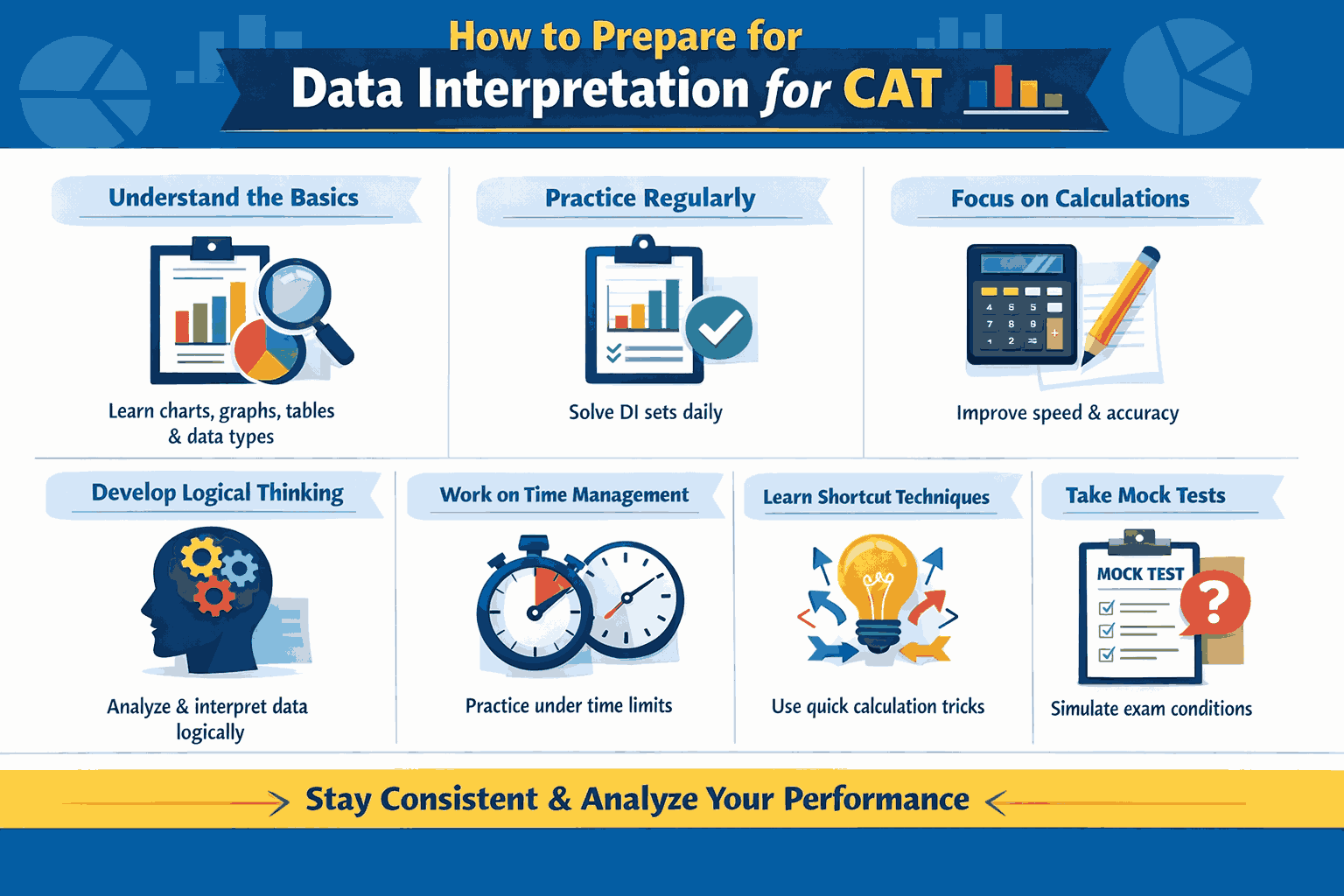
Conclusion
Learning how to prepare for Data Interpretation for CAT 2026 within the CAT syllabus is less about finding secret tricks and more about building a rock-solid foundation, training your eye for data patterns, and developing the exam temperament to make smart real-time decisions. Data Interpretation rewards those who are patient, methodical, and consistent.
Start with calculation drills. Progress to format-specific practice. Solve every CAT paper from 2017 onward. Take mocks seriously and analyse them even more seriously. By the time November 2026 arrives, DILR should be the section you walk into with confidence not anxiety.
The aspirants who crack CAT 2026 will not be the ones who studied the most they will be the ones who studied the smartest. Your DI preparation starts today.

Smart Prep for CAT: Join Our Free Demo Class
Fill your details
Frequently Asked Questions
How to prepare for Data Interpretation for CAT?

What strategies can I use to help me prepare for Data Interpretation for the CAT?
How can I improve my speed in Data Interpretation for the CAT?
What resources can I use to help me prepare for Data Interpretation for the CAT?
How important is data interpretation in the CAT?

Lalita Vishwakarma
Content Writer


SHARE