
1723534562.png)

Negative Marking in CAT Exam 2026: Marking Scheme, TITA Rules & Strategy
June 15, 2026
Overview: Understanding negative marking in CAT exam is crucial for maximising your score and avoiding unnecessary penalties. Many aspirants lose marks not because they lack knowledge, but because they don’t clearly understand CAT negative marking rules and TITA question strategy.
Key Takeaways
- CAT negative marking applies only to MCQ (Multiple Choice Questions).
- Every correct answer gives +3 marks.
- Every incorrect MCQ results in a -1 mark deduction.
- TITA questions in the CAT negative marking rule: There is no negative marking.
- Unattempted questions receive 0 marks.
What You Will Get in This Blog: Negative marking in CAT, how the CAT exam negative marking system works, and how to attempt questions strategically to protect your score.
Is There Negative Marking in CAT?
So the answer to questions "Is There Negative Marking in CAT Exam" is, yes, there is negative marking in the CAT exam, but it applies only to specific types of questions.
The CAT negative marking system works differently for MCQs and TITA questions.
CAT Marking Rule
|
Question Type |
Correct Answer |
Wrong Answer |
Unattempted |
|
MCQ |
+3 marks |
-1 mark |
0 |
|
TITA (Type In The Answer) |
+3 marks |
0 |
0 |
This means that only incorrect MCQ answers incur a penalty, while TITA questions are not negatively marked.
Negative Marking in CAT Exam Explained
The negative marking in CAT exam exists to discourage random guessing.
Example
Suppose a student attempts 10 MCQs:
|
Attempt Type |
Count |
Score |
|
Correct |
6 |
+18 |
|
Incorrect |
4 |
-4 |
|
Total Score |
14 marks |
If the same student guessed randomly and got more answers wrong, the negative marking in the CAT exam could significantly reduce the score.
This is why accuracy matters more than the number of attempts in CAT.
TITA vs MCQ: CAT Exam Marking Scheme 2026
The negative marking in CAT Exam 2026 is as follows:
|
Question Type |
Marks for Correct Answer |
Negative Marking for Incorrect Answer |
|
MCQ |
+3 |
-1 |
|
TITA |
+3 |
0 |
TITA Questions in CAT Negative Marking
Many aspirants ask: What are the TITA questions in the negative marking in CAT Exam and it's rules?
TITA (Type In The Answer) questions require students to type their answers rather than select from options.
Key Features of TITA Questions
|
Feature |
Details |
|
Answer type |
Numeric or text input |
|
Options |
No options provided |
|
Negative marking |
No |
|
Marks for a correct answer |
+3 |
Because TITA questions in CAT negative marking have no penalty, students can attempt them even if they are not 100% sure.
This makes them a strategic opportunity to increase attempts safely and avoid negative marking in CAT exam.
Section-Wise Marking Pattern in CAT 2026
The CAT exam negative marking rules apply across all three sections.
|
Section |
Approx Questions |
Question Type |
|
24 |
MCQ + TITA |
|
|
22 |
MCQ + TITA |
|
|
22 |
MCQ + TITA |
Each section includes both MCQs and TITA questions, but the exact number may vary each year.
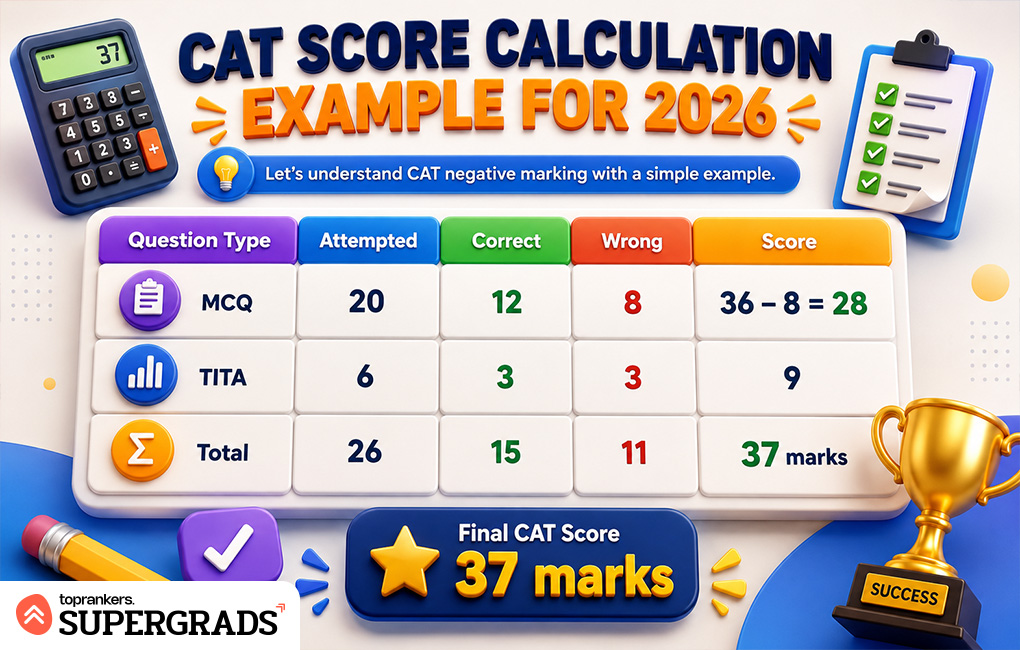
CAT Score Calculation Example for 2026
Let’s understand CAT negative marking with a simple example.
|
Question Type |
Attempted |
Correct |
Wrong |
Score |
|
MCQ |
20 |
12 |
8 |
36 – 8 = 28 |
|
TITA |
6 |
3 |
3 |
9 |
|
Total |
26 |
15 |
11 |
37 marks |
In this scenario:
- Wrong MCQs reduced the score by 8 marks
- Wrong TITA answers had no negative impact
This example clearly shows how CAT negative marking affects overall scores.
How CAT Negative Marking Affects Your Percentile?
In CAT, the percentile depends on relative performance, not just raw marks.
Negative marking can:
- Reduce your raw score
- Lower your sectional percentile
- Impact your overall percentile
- Affect your chances of getting IIM calls
Even 2–3 incorrect guesses due to the CAT exam negative marking can change your percentile significantly.
Smart Strategy to Avoid Negative Marking in CAT Exam 2026
To minimise the impact of negative marking in CAT exam, aspirants should follow a strategic approach.
1. Attempt TITA Questions First
Since TITA questions in CAT negative marking have no penalty, they are safer to attempt.
2. Avoid Blind Guessing
Random guesses can quickly reduce scores due to CAT negative marking.
3. Use Elimination Technique
If you can eliminate two incorrect options, guessing becomes more reasonable.
4. Focus on Accuracy
Maintaining 80–85% accuracy is more beneficial than attempting too many questions.
5. Manage Time Wisely
Spending too much time on one question increases pressure and leads to risky guesses.
Common Mistakes Students Make Due to CAT Negative Marking
Many students lose marks due to a poor strategy.
Common Errors
- Attempting too many questions blindly
- Ignoring TITA questions
- Guessing under time pressure
- Not reviewing answers before submission
- Focusing on attempts instead of accuracy
- Focusing on the errors made and negative marking in CAT exam
Avoiding these mistakes can help you protect your score from CAT exam negative marking.
Conclusion
Understanding negative marking in CAT exam is essential for building a smart exam strategy. While CAT negative marking penalises incorrect MCQ answers, TITA questions provide a safe opportunity to increase attempts without risk.
By focusing on accuracy, smart guessing, and strategic attempts, aspirants can minimise the impact of CAT exam negative marking and significantly improve their chances of achieving a high percentile and ignoring the negative marking in CAT exam.

Smart Prep for CAT: Join Our Free Demo Class
Fill your details
Frequently Asked Questions
What is the CAT marking scheme 2026 (expected)?

Is there a penalty for skipping questions in the CAT exam?
How many questions are there in each section, and what is the total score?

Zubeen Siddiqui
Content Writer | MBA & CAT Preparation


SHARE