


1723534562.png)

CAT Important Topics: Subject Wise Important Topics for CAT 2026
May 13, 2026
Quick Answer: What are the CAT Important Topics 2026? The CAT exam 2026 covers 68 questions across three sections in 120 minutes. Based on 10+ years of CAT paper analysis, here are the most CAT important topics:
- VARC (24 Qs): Reading Comprehension (16 Qs / 67%), Para Jumbles, Para Summary, Odd One Out
- DILR (22 Qs): Seating Arrangements, Games & Tournaments, Caselets & Tables, Bar/Line Charts
- QA (22 Qs): Arithmetic (40–45%), Algebra (20–25%), Geometry (15–18%), Number System (10–12%), Modern Math (8–10%)
RC + Arithmetic + Seating Arrangements = ~50% of the entire CAT paper. Master these three areas first.
With approximately 8 months left for CAT 2026 (expected November 29, 2026), the most productive thing an aspirant can do right now is not study harder - it is study smarter. Knowing exactly which topics carry the most weight, which ones appear every year, and which ones to skip entirely is the difference between a 90 percentile and a 99 percentile.
The IIMs do not release an official CAT syllabus. sEverything in this guide is derived from a rigorou analysis of CAT papers from 2016 to 2024, cross-referenced with question-count data across sections. This is the real, exam-validated map of CAT important topics 2026.
CAT 2026 Exam Pattern - Know Before You Prepare
Before zeroing in on CAT important topics, every aspirant must understand the CAT 2026 exam structure. The marking scheme and section order directly shape which CAT Important topics deserve priority.
|
Section |
Questions |
MCQs |
TITA |
Max Marks |
Weightage |
|
VARC - Verbal Ability & Reading Comprehension |
24 |
16 |
8 |
72 |
35% |
|
DILR - Data Interpretation & Logical Reasoning |
22 |
15 |
7 |
66 |
32% |
|
QA - Quantitative Ability |
22 |
14 |
8 |
66 |
32% |
|
Total |
68 |
45 |
23 |
204 |
100% |
Key rules that affect your topic strategy:
- Sections are timed independently (40 min each) - you cannot borrow time from one section to another
- MCQs carry –1 for wrong answers; TITA questions carry 0 for wrong - always attempt every TITA question
- The section order is fixed: VARC → DILR → QA. You cannot change it
- CAT is conducted in 3 slots; difficulty varies across slots but percentile scores are normalized
CAT Important Topics 2026: VARC Section
VARC is the first section every candidate faces on exam day and the one most underestimated by engineering graduates, making it one of the key CAT important topics areas to master early in preparation. It has 24 questions in 40 minutes split between RC (16 Qs) and Verbal Ability (8 Qs). The most crucial thing to understand: all 8 VA questions are TITA zero negative marking, which makes this segment within CAT important topics highly scoring if approached strategically.
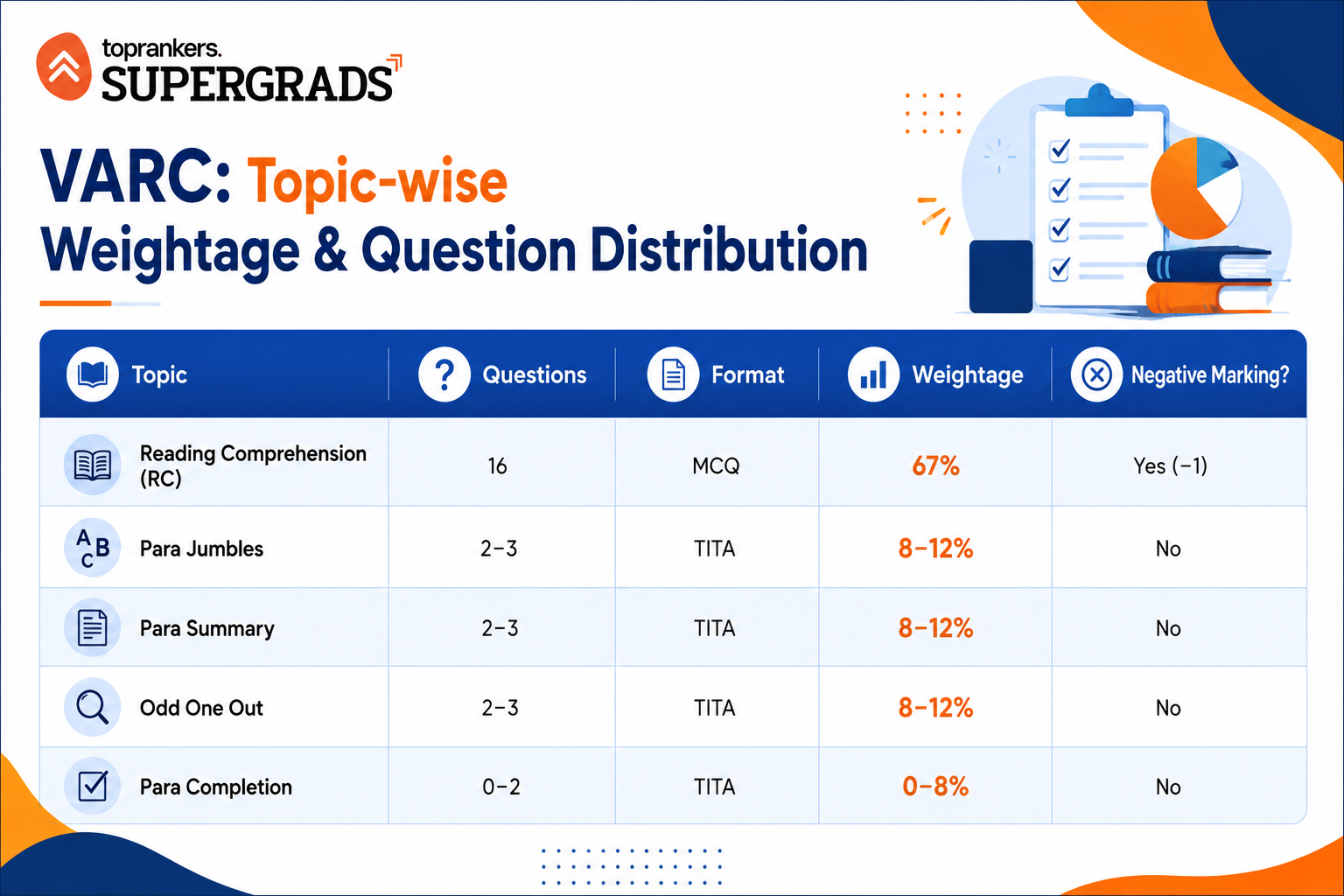
VARC: Topic-wise Weightage & Question Distribution
|
Topic |
Questions |
Format |
Weightage |
Negative Marking? |
|
Reading Comprehension (RC) |
16 |
MCQ |
67% |
Yes (−1) |
|
Para Jumbles |
2–3 |
TITA |
8–12% |
No |
|
Para Summary |
2–3 |
TITA |
8–12% |
No |
|
Odd One Out |
2–3 |
TITA |
8–12% |
No |
|
Para Completion |
0–2 |
TITA |
0–8% |
No |
1. Reading Comprehension - Most Important Topic in Entire CAT
RC alone accounts for 16 of 68 total CAT questions - more than any other single topic, making it one of the most critical CAT important topics to focus on during preparation. Four passages of 500–900 words each, with 4 questions per passage. Getting RC right is non-negotiable for any score above 90 percentile, which is why mastering it remains a top priority among all CAT important topics.
RC passages in CAT are NOT straightforward summaries. They are dense, argumentative, and test inference - not surface reading. The question types you must master:
- Central Idea / Main Point:
Identify what the entire passage is arguing - the option must be neither too broad nor too narrow
- Author's Tone & Attitude:
Critical, appreciative, skeptical, nostalgic, neutral - trained readers spot this in the first paragraph
- Inference Questions:
Never go beyond what the author states. The right answer is always the one that follows directly from the text
- Title of the Passage:
Must reflect the passage's central argument, not just the opening topic
- Specific Detail / Fact-Based:
Least reasoning-heavy - go back to the exact line. Do not answer from memory
RC passage themes by historical frequency (last 8 years):
|
RC Theme / Genre |
Avg. Questions (Last 8 Yrs) |
Passage Length |
Difficulty |
|
Science & Technology |
12–16 Qs |
500–700 words |
Medium |
|
Philosophy & Abstract Ideas |
10–14 Qs |
600–900 words |
Hard |
|
Business & Economics |
10–12 Qs |
500–750 words |
Medium |
|
Literature, Arts & Culture |
8–12 Qs |
600–800 words |
Hard |
|
History & Politics |
8–10 Qs |
550–750 words |
Medium |
|
Social Sciences & Sociology |
6–10 Qs |
500–700 words |
Medium |
📌 RC Preparation Tip: Science & Technology and Philosophy passages appear in nearly every CAT paper. Build comfort with dense, opinion-heavy writing from The Economist, Aeon, and Nautilus. Read at least one full article daily.
2. Para Jumbles - 2–3 Questions, TITA, Zero Negative Marking
4–5 scrambled sentences must be arranged into a logical paragraph. These are always TITA - never skip them. Key techniques:
- Identify the mandatory opener: The first sentence introduces a topic without a pronoun referring to something unnamed
- Find pronoun-antecedent links: If sentence B uses 'this theory' or 'she', sentence A must introduce the theory/person
- Use discourse connectors: 'However', 'Moreover', 'Therefore' signal logical transitions - map them before arranging
- Find logical pairs: Identify 2 sentences that clearly belong together (cause → effect, claim → evidence), then build around them
3. Para Summary - 2–3 Questions, TITA
A short paragraph is given; choose the best summary from 4 options. The right answer captures the central argument - not a detail, not an extreme claim.
- Eliminate options that focus on just one supporting example
- Eliminate options that use extreme language ('always', 'never') unless the paragraph does the same
- Eliminate options that introduce an idea not mentioned in the paragraph
- The correct option is usually the most balanced one - it covers the 'what' and 'so what' of the paragraph
4. Odd One Out - 2–3 Questions, TITA
Five sentences are given; four form a coherent paragraph and one is the odd sentence. The outlier is usually thematically disconnected - it makes a factually correct but topically irrelevant point.
- Read all five to identify the central theme shared by four sentences
- The odd sentence often shifts time frame, perspective, or subject without warning
- TITA - zero negative marking. Attempt even if unsure
📋 VARC Time Management Strategy (Exam Day)
Spend the first 90 seconds scanning the opening lines of all 4 RC passages. Rank them by difficulty. Attempt the 2 easiest passages first (8 Qs), then attempt all 8 TITA questions (zero risk), then return to the harder RC passages with remaining time. This sequence protects your TITA score while maximizing RC accuracy.
CAT Important Topics 2026: DILR Section
DILR is the most unpredictable and feared section of CAT, making it one of the most challenging CAT important topics for aspirants. With 22 questions across 4–5 sets in 40 minutes, this section has no fixed formula but the set types that appear are highly predictable from historical data, which is why consistent practice of these CAT important topics is essential for success.
The most important DILR skill is not speed it is set selection. In the first 3–4 minutes, scan all sets and identify the 2–3 you can solve completely. Attempting 3 sets with full accuracy beats attempting 5 sets partially.
Logical Reasoning (LR): High-Frequency Set Types
CAT typically includes 2–3 LR sets per paper. Based on CAT papers from 2016–2024:
|
LR Set Type |
Questions/Set |
Frequency |
Difficulty |
Priority |
|
4–5 |
Every year |
Medium |
MUST DO |
|
|
4–5 |
Very High |
Hard |
MUST DO |
|
|
Networks & Routes |
4–5 |
High |
Hard |
MUST DO |
|
Binary Logic (Truth-Tellers/Liars) |
4–5 |
High |
Hard |
HIGH |
|
Scheduling & Allocation |
4–5 |
Medium |
Medium |
HIGH |
|
Grid & Matrix Puzzles |
4–5 |
Medium |
Medium–Hard |
HIGH |
|
Venn Diagrams (Constraint-based) |
4 |
Medium |
Medium |
MEDIUM |
|
4 |
Low–Medium |
Easy–Medium |
MEDIUM |
CAT DILR Topic-wise Frequency (2018–2024)
CAT typically includes 1–2 DI sets per paper. DI sets have become increasingly caselet and reasoning-heavy since 2019:
| Topic | Frequency Trend (2018–2024) | Approx Weightage | Priority |
|---|---|---|---|
| Arrangements (Linear/Circular/Grid) | Very High (asked every year) | 10–19% | ⭐⭐⭐⭐ |
| Games & Tournaments | High (major rise post-2020) | 5–17% | ⭐⭐⭐⭐ |
| Grouping & Distribution | High | 6–25% | ⭐⭐⭐⭐ |
| Puzzles (Mixed Logic Sets) | High | 10–19% | ⭐⭐⭐⭐ |
| DI – Charts (Bar/Pie/Line/Table) | Very High (consistent) | 20–30% | ⭐⭐⭐⭐ |
| DI – Caselets (Logic-based DI) | High | 10–19% | ⭐⭐⭐⭐ |
| DI – Calculation-heavy | Moderate (declining trend) | 5–10% | ⭐⭐⭐ |
| Networks / Routes / Graphs | Medium (increasing trend) | 5–10% | ⭐⭐⭐ |
| Venn Diagram / Set-based LRDI | Medium | 5–10% | ⭐⭐⭐ |
| Scheduling | Low | 0–7% | ⭐⭐ |
| Miscellaneous LR Sets | Low–Moderate | 3–8% | ⭐⭐ |
CAT 2026 Mock Test to Boost Your Prep
| Free CAT Mock Test -01 | |
| Free CAT Mock Test- 02 | |
| Free CAT Mock Test- 03 |
CAT DILR: Subject-Level Topic Guide with Preparation Approach
|
Topic |
What to Master |
Preparation Approach |
|
Seating Arrangements |
Linear (1-row, 2-row), circular, hexagonal, rectangular - all with constraints |
Start Week 1. Solve 10 beginner sets, then 10 medium. Time yourself after Week 2. |
|
Games & Tournaments |
Knock-out, league/round-robin, hybrid formats, points table deduction |
Start Month 2. CAT 2018–2024 sets are the best practice material. |
|
Caselets |
Text-heavy sets with multiple conditions; extract data and build table before solving |
Practice reading and tabulating caselets fast - 3–4 min to set up the table. |
|
Networks & Routes |
Path connectivity, min/max flow, node-based deduction |
Attempt past CAT sets from 2019 onward. Visualization is key. |
|
Bar/Line Chart DI |
Multi-variable comparison, indexed growth, calculation-heavy sets |
Practice approximation. Never calculate exact values in DI - estimate within 2%. |
|
Binary Logic |
Knights and knaves, 3-person truth-teller chains, statement-based deduction |
Learn the standard framework first. 20 practice sets is enough to handle most CAT versions. |
CAT Important Topics 2026: Quantitative Aptitude (QA) Section
CAT QA has 22 questions in 40 minutes covering Class 9–10 level math - but applied in non-routine, creative ways. The key insight: you do not need to attempt all 22 questions. Most 95–99 percentilers solve 14–16 questions correctly. Selectivity and accuracy beat speed in QA.
CAT QA: Subject-wise Weightage & Expected Questions in CAT 2026
|
Subject Area |
Weightage |
Expected Questions |
Difficulty |
Priority |
|
Arithmetic |
40–45% |
8–10 Qs |
Medium |
Tier 1 - Start First |
|
Algebra |
20–25% |
4–6 Qs |
Medium–Hard |
Tier 1 - Start First |
|
Geometry & Mensuration |
15–18% |
3–4 Qs |
Hard |
Tier 2 - Month 3 |
|
Number System |
10–12% |
2–3 Qs |
Hard |
Tier 2 - Month 3 |
|
Modern Mathematics |
8–10% |
1–3 Qs |
Medium |
Tier 2 - Month 4 |
Subject 1: Arithmetic - 40–45% of QA (Start Here)
Arithmetic is the most important subject in all of CAT's QA section. It is Class 10-level math but tested with multi-step, scenario-based problems. Master every chapter below before moving to Algebra or Geometry.
|
Arithmetic Chapter |
Key CAT-Level Concepts |
Priority |
|
Percentages |
% change, successive %, reverse %, percentage of percentage, error % |
★★★★★ Critical |
|
Profit, Loss & Discount |
CP/SP, marked price, successive discounts, dishonest dealer problems |
★★★★★ Critical |
|
Time, Speed & Distance |
Average speed, relative speed, trains, boats & streams, circular tracks, meetings |
★★★★★ Critical |
|
Time & Work |
Efficiency method, combined work, pipes & cisterns, work-wage problems |
★★★★★ Critical |
|
Ratio & Proportion |
Direct/inverse ratio, partnership, compound ratio, proportion |
★★★★★ Critical |
|
Mixtures & Alligation |
Alligation rule, replacement in mixture problems, multi-component mixing |
★★★★ High |
|
Averages |
Weighted average, combined average, average after inclusion/exclusion of members |
★★★★ High |
|
Simple & Compound Interest |
SI/CI formulas, difference between SI and CI, growth/depreciation, population models |
★★★★ High |
Subject 2: Algebra - 20–25% of QA
Algebra in CAT tests conceptual depth, not formula recall. Inequalities, functions, and quadratic behavior appear regularly with creative twists.
|
Algebra Chapter |
Key CAT-Level Concepts |
Priority |
|
Linear Equations |
2-variable systems, word-problem framing, unique vs infinite solutions |
★★★★★ Critical |
|
Nature of roots (discriminant), sum/product of roots, quadratic inequalities, max/min of quadratics |
★★★★★ Critical |
|
|
Linear inequalities, modulus inequalities, AM-GM-HM applications, wavy curve method |
★★★★★ Critical |
|
|
Functions |
Domain/range, composite f(g(x)), even/odd functions, inverse functions, graph-based questions |
★★★★ High |
|
Polynomials |
Remainder theorem, factor theorem, roots and their symmetric functions |
★★★★ High |
|
Log properties (product/quotient/power), log equations, change of base, log inequalities |
★★★ Medium |
|
|
Surds & Indices |
Simplification, rationalization of surds, comparing surds, index equations |
★★★ Medium |
Subject 3: Number System - 10–12% of QA
Number System questions are concept-heavy and elegant. CAT regularly tests Remainders and Factorials - knowing the theorems here saves enormous calculation time.
|
Number System Chapter |
Key CAT-Level Concepts |
Priority |
|
Divisibility Rules |
Rules for 2–19, combined divisibility, divisibility of algebraic expressions |
★★★★★ Critical |
|
Remainders |
Basic remainder theorem, Wilson's theorem, Euler's theorem, Fermat's theorem, Chinese Remainder Theorem basics |
★★★★★ Critical |
|
Euclidean algorithm, HCF/LCM of fractions, HCF/LCM word problems |
★★★★ High |
|
|
Factorials & Highest Powers |
Highest power of a prime in n!, trailing zeros (Legendre's formula), exact divisibility |
★★★★ High |
|
Unit Digits & Cyclicity |
Cyclicity of unit digits for all bases, unit digit in a^b expressions |
★★★★ High |
|
Prime Factorization & Factors |
Prime factorization, number of factors, sum of factors, number of divisors |
★★★ Medium |
|
Base Conversion |
Decimal to binary/octal/hex and vice versa, operations in other bases |
★★★ Medium |
Subject 4: Geometry & Mensuration - 15–18% of QA
Geometry questions in CAT are often elegant if you find yourself computing for 5 minutes on a geometry problem, you are missing a shortcut. Visual intuition matters more than formula memorization.
|
Geometry Chapter |
Key CAT-Level Concepts |
Priority |
|
Triangles |
Similarity & congruence rules, median/altitude/angle bisector properties, area formulas, centroid/circumcenter/incenter/orthocenter |
★★★★★ Critical |
|
Circles |
Tangent-radius relationships, angle in semicircle, chords, common tangents, two circles (internal/external) |
★★★★★ Critical |
|
Coordinate Geometry |
Distance formula, section formula, slope, line equations (slope-intercept, two-point), circle equation, distance from point to line |
★★★★ High |
|
Quadrilaterals & Polygons |
Properties of parallelogram, rhombus, trapezoid; sum of interior angles; regular polygons |
★★★★ High |
|
Mensuration - 2D |
Area of all standard shapes, composite figures, area change when dimensions scale |
★★★★ High |
|
Mensuration - 3D |
Volume and surface area of cube, cuboid, cylinder, cone, sphere, hemisphere; frustum |
★★★★ High |
|
Trigonometry (Basic) |
Sin/cos/tan values, sine/cosine rule, heights & distances, basic identities |
★★★ Medium |
Subject 5: Modern Mathematics - 8–10% of QA
Modern Math is increasingly important in recent CATs. P&C and Probability questions test combinatorial thinking - they cannot be solved by formula alone; you need structured counting logic.
|
Modern Math Chapter |
Key CAT-Level Concepts |
Priority |
|
Permutation & Combination |
Arrangements with restrictions, circular permutation, selections from identical/distinct groups, distribution problems, derangements |
★★★★★ Critical |
|
Probability |
Classical probability, conditional probability, P(A∪B), independent events, Bayes' theorem basics |
★★★★ High |
|
Arithmetic Progressions (AP) |
nth term formula, sum formula, inserting arithmetic means, application problems |
★★★★ High |
|
Geometric Progressions (GP) |
nth term, finite/infinite sum, inserting geometric means, combined AP-GP problems |
★★★★ High |
|
Set Theory & Venn Diagrams |
Union/intersection formulas, 3-set overlaps, maximum/minimum elements in intersection |
★★★★ High |
|
Binomial Theorem (Basic) |
Expansion, general term, middle term, properties of binomial coefficients |
★★★ Medium |
|
Harmonic Progression (HP) |
nth term, relationship with AP/GP, harmonic mean applications |
★★ Low–Medium |
CAT Important Topics 2026: Complete Priority Matrix
This matrix consolidates every major topic across all three sections, ranked by ROI for CAT 2026 preparation. Use this as your weekly planning reference.
|
Section |
Topic / Chapter |
Weightage |
Difficulty |
Priority Tier |
When to Start |
|
VARC |
Reading Comprehension |
67% of VARC |
Medium–Hard |
Tier 1 |
Day 1 |
|
QA |
Arithmetic (all chapters) |
40–45% of QA |
Medium |
Tier 1 |
Day 1 |
|
DILR |
Seating Arrangements |
~20% of DILR |
Medium |
Tier 1 |
Day 1 |
|
VARC |
Para Jumbles |
8–12% of VARC |
Medium |
Tier 1 |
Week 2 |
|
VARC |
Para Summary |
8–12% of VARC |
Medium |
Tier 1 |
Week 2 |
|
QA |
Algebra |
20–25% of QA |
Medium–Hard |
Tier 1 |
Month 2 |
|
DILR |
Caselets & Tables (DI) |
~30% of DILR |
Medium |
Tier 1 |
Month 2 |
|
DILR |
Games & Tournaments |
~20% of DILR |
Hard |
Tier 1 |
Month 2 |
|
QA |
Number System |
10–12% of QA |
Hard |
Tier 2 |
Month 3 |
|
QA |
Geometry & Mensuration |
15–18% of QA |
Hard |
Tier 2 |
Month 3 |
|
DILR |
Networks & Routes |
~15% of DILR |
Hard |
Tier 2 |
Month 3 |
|
VARC |
Odd One Out |
8–12% of VARC |
Medium |
Tier 2 |
Month 3 |
|
DILR |
Bar/Line Charts (DI) |
~25% of DILR |
Easy–Med |
Tier 2 |
Month 3 |
|
QA |
Permutation & Combination |
5–8% of QA |
Medium–Hard |
Tier 2 |
Month 4 |
|
QA |
Probability |
3–5% of QA |
Medium |
Tier 2 |
Month 4 |
|
DILR |
Binary Logic |
~10% of DILR |
Hard |
Tier 2 |
Month 4 |
|
QA |
AP / GP / HP |
3–5% of QA |
Medium |
Tier 2 |
Month 4 |
|
QA |
Trigonometry / Logarithms |
~5% of QA |
Medium |
Tier 3 |
Month 5 |
|
DILR |
Venn Diagrams (LR) |
~10% of DILR |
Medium |
Tier 3 |
Month 5 |
|
VARC |
Vocabulary / Grammar |
0% |
- |
SKIP |
Never |
CAT 2026 Preparation Strategy: Month-by-Month Roadmap
With 8 months to CAT 2026 from March, here is a phased roadmap aligned to the topic priority matrix above:
- Month 1 (March–April) - Foundation: Master Arithmetic completely (all 8 chapters). Start daily RC reading (1 article/day from Aeon or The Economist). Begin Seating Arrangements in DILR - linear and circular only. Target: 100 arithmetic problems + 5 RC passages per week.
- Month 2 (May) - Core Concepts: Algebra - Linear Equations, Quadratics, Inequalities. Start full DILR sets (Seating + Caselets). Begin Para Jumbles and Para Summary practice. Target: 2 DILR sets daily, 3 Algebra chapters.
- Month 3 (June) - Depth & Expansion: Geometry + Number System in QA. Games & Tournaments + Networks in DILR. Timed RC practice -8 minutes per passage + 4 questions. Begin Odd One Out practice.
- Month 4 (July) - Modern Math + Sectional Mocks: P&C, Probability, Set Theory, AP/GP. First sectional mocks - analyze every wrong answer. Binary Logic in DILR. Target: 2 sectional mocks/week per section.
- Month 5 (August) - Full Mock Integration: First full-length CAT mocks (1 per week). Mock analysis is as important as the mock itself. Track topic-level accuracy. Identify top 3 weak areas and drill them.
- Month 6 (September) - Mock Marathon: 2 full mocks per week. For every CAT mock: spend equal time analyzing as taking. Revise Arithmetic and RC strategy every week - these two decide your percentile.
- Month 7 (October) - Accuracy & Speed Drills: Topic-level drilling on weak chapters. Revisit all DILR set types with fresh sets. Maintain exam-hour daily routine (8–10 AM practice window). Target: 80%+ accuracy in Arithmetic and RC.
- Final 3 Weeks (November) - Consolidation Only: No new topics. Short formula notes only. 1 mock per week treat it as the real exam. Simulate the 40-40-40 section split daily. Sleep 7–8 hours without compromise.
Common Mistakes CAT 2026 Aspirants Must Avoid
Starting VARC too late:
RC fluency takes 3–4 months of consistent reading to build. Starting RC in August is too late for most aspirants.
Skipping TITA questions:
Para Jumbles, Odd One Out, and some QA questions have zero negative marking. Every skipped TITA is a free +3 you left on the table.
Attempting all 22 QA questions:
Most 99%ilers solve 14–16 QA questions correctly. Attempting all 22 with 60% accuracy scores less than attempting 14 with 90% accuracy.
Taking mocks without analysis:
A mock without a 60-minute post-analysis session is a wasted test. The analysis - not the score - is where the improvement happens.
Ignoring DILR until it's too late:
DILR cannot be crammed. 2 sets per day starting now beats 10 sets per day starting in October.
Over-preparing Tier 3 topics:
Spending weeks on Trigonometry or HP when Arithmetic accuracy is still 70% is the most common preparation error.
Conclusion
The CAT important topics 2026 are not a mystery. Based on a decade of CAT question papers, the exam is remarkably consistent: Reading Comprehension dominates VARC, Arithmetic dominates QA, and structured reasoning dominates DILR. The aspirant who masters these core areas first - and builds progressively from there - will always outperform one who spreads preparation thin across every topic.
You now have a complete, data-backed, subject-level map of everything that matters for CAT 2026: prioritized topic tables for all five QA subjects, historical RC genre frequencies, DILR set-type rankings, a month-by-month roadmap, and the common mistakes that cost aspirants percentile points every year.
The plan is in front of you. CAT 2026 is yours to crack - one topic, one set, one RC passage at a time.

Smart Prep for CAT: Join Our Free Demo Class
Fill your details
Frequently Asked Questions
What are the most important topics in CAT 2026?

Is vocabulary important for CAT 2026?
How many topics should I cover for CAT QA?
Which section should I prepare first?
How many mocks should I take for CAT 2026?

Zubeen Siddiqui
Content Writer | MBA & CAT Preparation


SHARE