
1723534562.png)

How to Improve Visual Spatial Ability for UCEED: 30-Day Plan & PYQ Strategy
July 15, 2026
Quick Answer: How to Improve Visual Spatial Ability for UCEED 2027?
Visualization & spatial ability for UCEED exam can absolutely be improved through consistent practice of 2D/3D transformation questions, spatial reasoning exercises, paper folding, perspective drawing, and mental rotation problems.
Most students struggle with UCEED visualization questions because they try to memorize patterns instead of training their brain to mentally rotate, transform, and analyze shapes.
Key Highlights: How to Improve Visual Spatial Ability for UCEED 2027?
1. Visualization and spatial ability is one of the highest-weightage topics in UCEED Part A
2. UCEED 2027 visualization questions are supposed to test mental rotation, spatial reasoning, and pattern recognition, not rote learning
3. Improving visual spatial ability is more about skill-building and exposure than natural talent or IQ
4. Daily practice of 2D/3D transformation, mirror image, paper folding, and spatial arrangement questions can significantly improve performance
5. Perspective drawing and object manipulation practice also strengthen Part B drawing performance
6. The best way to improve visualization skills for UCEED 2027 is through a combination of:
- PYQs
- UCEED Mock tests
- Timed visual reasoning exercises
- Real-world observation practice
Table of Content
- What Is Visual Spatial Ability in UCEED?
- How to Improve Visual Spatial Ability for UCEED?
- Best Exercises to Improve Visualization Skills for UCEED
- Important Visualization Topics for UCEED with Sample Questions
- How Long Does It Take to Improve Visual Spatial Ability for UCEED?
- Best Resources for UCEED Visualization Practice
- Expert Tips to Improve Visual Spatial Ability Faster
What Is Visual Spatial Ability in UCEED 2027?
Visual spatial ability in UCEED 2027 refers to your ability to mentally visualize, rotate, manipulate, and understand objects in space.
It is a core part of the UCEED visualization and spatial ability syllabus and is heavily tested in Part A through logical and diagram-based questions.
This section evaluates how well you can:
- Perform mental rotation of objects and shapes
- Understand 2D and 3D relationships
- Analyze spatial arrangement and positioning
- Interpret perspective and orientation
- Visualize transformations without physically drawing them
Common UCEED Visualization Question Types for 2027
|
Question Type |
What It Tests |
|
Cube Rotation Questions |
Mental rotation and object visualization |
|
Paper Folding & Cutting |
Sequential visualization and transformation |
|
Mirror & Water Image Questions |
Reflection and symmetry understanding |
|
Hidden Figures |
Observation and visual memory |
|
Top / Front / Side View Questions |
Perspective understanding and spatial arrangement |
|
2D-3D Transformation Questions |
Understanding object manipulation and dimensional relationships |
|
Pattern & Shape Recognition |
Visual logic and pattern analysis |
Check: Complete UCEED 2027 Syllabus (Part A + Part B)
How to Improve Visual Spatial Ability for UCEED 2027?
✅ 1. Practice Mental Rotation Daily
Mental rotation is one of the most important skills in the UCEED 2027 visualization and spatial ability syllabus.
Practice:
- Rotating cubes mentally
- Turning objects in different directions
- Visualizing flipped or inverted shapes
Example:
Imagine rotating a cube 90° clockwise and predicting which face becomes visible.
This directly helps in:
- cube rotation questions
- spatial arrangement problems
- object manipulation questions
✅ 2. Solve 2D-3D Transformation Questions
A large number of UCEED spatial ability questions involve converting:
- 2D → 3D
- 3D → 2D
Practice:
- unfolded cube nets
- shape transformation
- object assembly/disassembly
Example:
Visualize how a flat cube net folds into a 3D cube.
This improves:
- dimensional understanding
- spatial reasoning ability
- transformation speed
Check: What is a Good Score in UCEED 2027?
✅ 3. Train Through Real Objects
One of the best ways to improve visualization skills for UCEED 2027 is through real-world observation.
Take everyday objects like:
- mugs
- boxes
- bottles
- chairs
and try to:
- rotate them mentally
- visualize top/front/side views
- redraw them from different perspectives
Example:
Place a water bottle on your table and sketch how it would look from above.
This builds practical spatial imagination much faster than theory alone.
Check: UCEED 2027 Preparation Tips
✅ 4. Improve Observation Skills
Visualization starts with observation. Students who carefully notice:
- angles
- proportions
- symmetry
- depth
- positioning
usually perform much better in UCEED 2027 visualization questions.
Simple Exercise:
Observe a crowded street scene for 30 seconds and mentally reconstruct object positions afterward.
This improves:
- hidden figures
- visual memory
- spatial arrangement understanding
✅ 5. Practice Perspective Drawing
Perspective drawing trains your brain to understand:
- depth
- distance
- orientation
- object relationships
Focus on:
- one-point perspective
- two-point perspective
- object placement in space
Example:
Draw a road disappearing into the horizon with buildings on both sides.
This strengthens:
- perspective understanding
- 3D visualization
- UCEED Part B drawing performance
✅ 6. Solve UCEED PYQs Consistently
UCEED Previous year questions are one of the best resources to improve visual spatial ability for UCEED 2027 because they reveal:
- actual question patterns
- recurring visualization concepts
- IIT-level difficulty
Check: Past 11 Years UCEED Question Papers with Answers
✅ 7. Use Timed Visualization Exercises
Many students can solve spatial reasoning questions slowly but struggle under exam pressure.
Use:
- timed quizzes
- rapid visual puzzles
- quick transformation exercises
Example:
Set a 30-second limit for each mirror image or paper folding question.
This improves:
- decision-making speed
- mental clarity under pressure
- exam temperament
✅ 8. Learn Pattern Recognition
UCEED visualization questions often follow recurring logical patterns.
Train yourself to identify:
- repeating rotations
- symmetry logic
- transformation sequences
- shape movement trends
Example:
In paper folding questions, punch holes usually mirror symmetrically after unfolding.
Must-Read: 10 Best Tips to Tackle Trick Questions in UCEED 2027 Exam
✅ 9. Build Spatial Imagination
Spatial imagination means visualizing movement without physically seeing it.
Try:
- imagining objects from different angles
- mentally rearranging furniture
- visualizing movement paths
Example:
Imagine how your room would look if viewed from the ceiling.
This improves:
- object manipulation
- spatial arrangement understanding
- advanced visualization ability
Check: UCEED 2027 Exam Pattern and Marking Scheme
_(1)1754636837.webp)
1756536783.webp)
Best Exercises to Improve Visualization Skills for UCEED 2027
|
Exercise |
Skill Improved |
Recommended Frequency |
|
Cube Rotation Questions |
Mental rotation, spatial reasoning, object manipulation |
Daily (10-15 questions) |
|
Lego / Block Visualization |
3D understanding, structure visualization, spatial arrangement |
3-4 times/week |
|
Paper Folding & Cutting Exercises |
Sequential visualization, transformation logic, symmetry understanding |
Daily practice |
|
Perspective Sketching |
Depth perception, orientation, 3D visualization |
4-5 sketches/week |
|
Tangrams & Shape Puzzles |
Pattern recognition, shape manipulation, visual logic |
15-20 minutes daily |
|
Visual Memory Games |
Observation, hidden figures, recall ability |
Daily (5-10 minutes) |
|
Mirror & Water Image Questions |
Reflection analysis, symmetry recognition |
Alternate days |
|
Top / Front / Side View Practice |
Perspective understanding, object visualization |
3-4 times/week |
|
2D-3D Transformation Questions |
Dimensional understanding, mental conversion ability |
Daily practice |
|
Hidden Figure Exercises |
Observation skills, visual scanning speed |
10-15 minutes daily |
|
Object Redrawing from Different Angles |
Spatial imagination, visualization accuracy |
3-4 objects daily |
|
Timed Spatial Reasoning Quizzes |
Speed, decision-making under pressure |
2-3 times/week |
Check: UCEED Year-wise Exam Analysis
Important Visualization Topics for UCEED 2027 with Sample Questions
|
Topic |
What It Tests |
Difficulty Level |
Sample Question |
|
Mirror & Water Image Questions |
Reflection understanding, symmetry, orientation analysis |
Easy-Moderate |
If a figure is reflected in water, which option shows the correct inverted image? Similar reflection-based visual logic questions appear frequently in UCEED visualization questions. |
|
Paper Folding & Cutting |
Sequential visualization, transformation ability, symmetry logic |
Moderate |
A paper is folded multiple times and punched with holes. Predict the final pattern after unfolding. |
|
Hidden Figures |
Observation skills, visual scanning, pattern identification |
Moderate |
Find the missing portion that correctly completes the complex square pattern. |
|
Spatial Arrangement & Rotation |
Mental rotation, positioning, spatial reasoning |
Moderate-High |
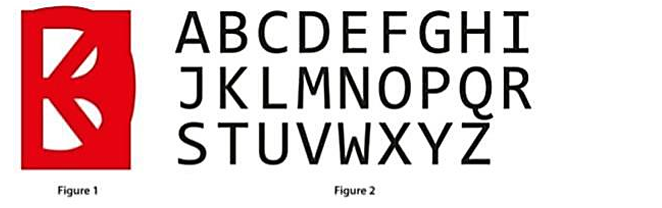
Four vehicles are taking a circular turn. Identify which vehicle has the correct wheel orientation while rotating. |
|
Perspective & Orientation Questions |
Depth perception, top/front/side view understanding |
High |
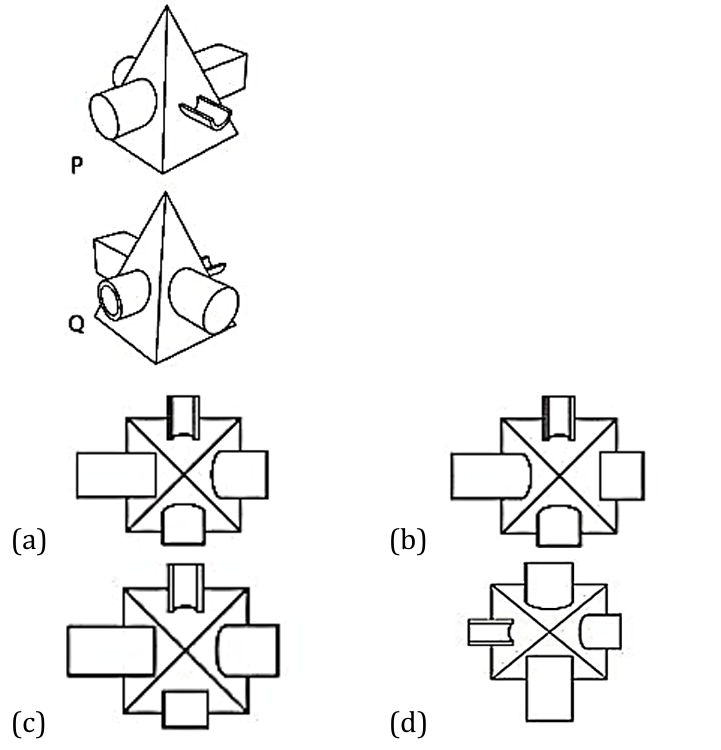
A cube and pyramid are merged together. Identify the correct top view of the final structure. |
|
Object Manipulation & Cube Rotation |
2D–3D transformation, mental object visualization |
High |
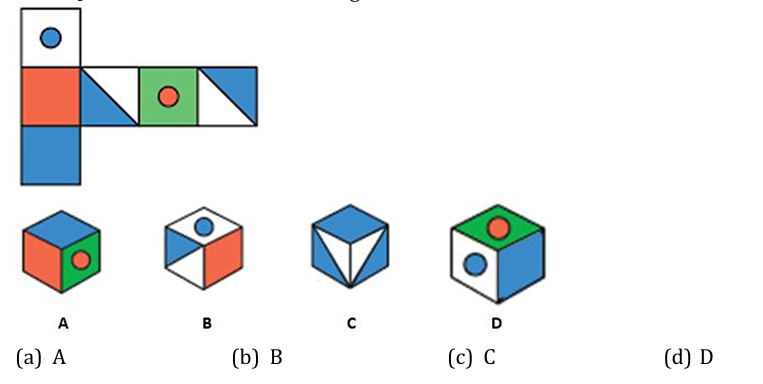
Identify which cube can be formed after folding the unfolded cube net. |
Must-know: Tips on How to Avoid Negative Marking in UCEED
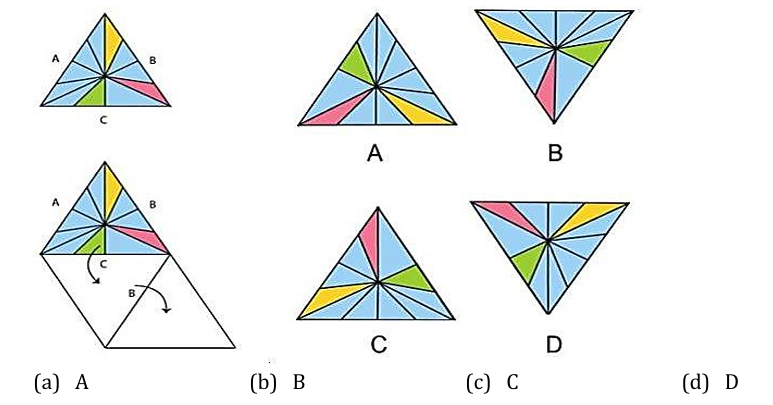
Mirror & Water Image Questions:
Q. The given triangle reflects along the sides in the order given below. Which of the options will be the resultant figure? Order of reflections: C – B – A – B – A – C – A – C
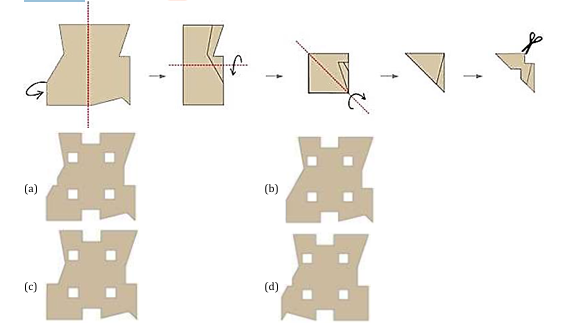
Paper Folding & Cutting:
Q. An irregular piece of paper is folded and cut as shown below. Which option shows the correct cuts when the paper is unfolded?
Hidden Figures:
Q. Which piece completes the picture?
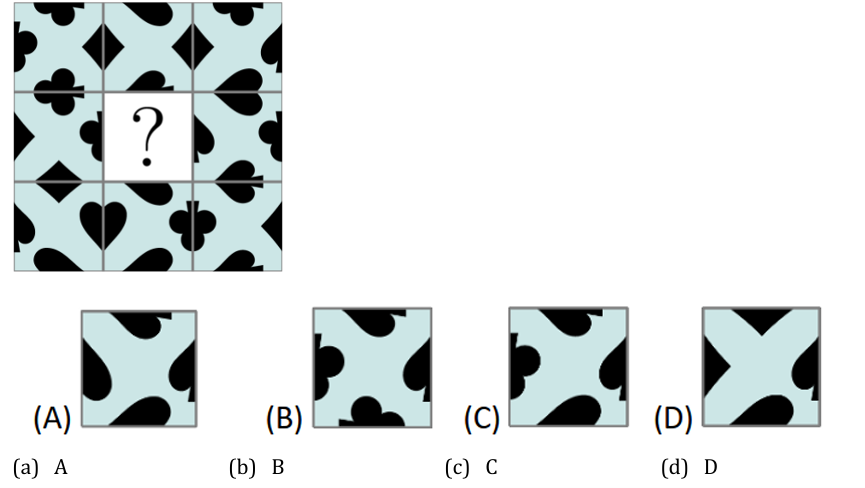
Spatial Arrangement & Rotation:
Q. Figure 1 has been constructed by overlapping some alphabets. Assuming the alphabets may be rotated, how many alphabets from figure 2 cannot be overlapped to fit within figure 1?
Perspective & Orientation Questions:
Q. P and Q show two different views of the same solid object. Which of the options represent(s) the top view of the solid object?
Object Manipulation & Cube Rotation:
Q. Identify the dice formed after folding the unfolded dice.
Also Check: Physics Preparation Tips for UCEED
How Long Does It Take to Improve Visual Spatial Ability for UCEED 2027?
The good news is that visual spatial ability for UCEED is highly trainable. Most students start seeing noticeable improvement in UCEED visualization questions within 30-45 days of regular practice.
Realistic Improvement Timeline
|
Time Period |
Expected Improvement |
|
2-3 Weeks |
Better observation and faster recognition of basic patterns |
|
30-45 Days |
Noticeable improvement in spatial reasoning and mental rotation |
|
2-3 Months |
Stronger speed, accuracy, and confidence in UCEED visualization questions |
|
3-4 Months |
Significant improvement in advanced visualization and perspective-based problems |
Must Read: Most Imp. UCEED 2027 GK Questions with Answers
Best Resources for UCEED Visualization Practice for 2027
|
Resource Type |
Recommended Resource / Platform |
Link |
|
UCEED Previous Year Questions (PYQs) with QR-Based Video Solution of Each Part B Drawing Question |
UCEED Previous Year Question Papers Book |
|
|
UCEED Previous Year Question Papers with Answer Key (Online PDFs) |
UCEED PYP PDFs | |
|
UCEED Sample Papers |
UCEED Sample Papers PDF |
|
|
UCEED Mock Tests |
Full-Length UCEED Mock Tests |
|
|
Cube Rotation, Paper Folding & Spatial Reasoning Puzzles |
Spatial Reasoning Puzzle Sets |
|
|
Perspective Drawing Exercises |
Perspective Sketching Practice PDFs |
Check: Common Mistakes to Avoid While Preparing for UCEED 2027
Expert Tips to Improve Visual Spatial Ability Faster for UCEED 2027
These practical techniques can significantly improve your performance in UCEED visualization questions and help you solve spatial reasoning problems more efficiently.
1. Think in Layers, Not as a Flat Image
Many students struggle because they see objects as flat 2D figures instead of layered structures.
Try to mentally separate:
- front layer
- back layer
- hidden surfaces
- depth relationships
Example:
While solving cube rotation or object manipulation questions, imagine which faces become hidden or visible after rotation.
This improves:
- 3D understanding
- spatial arrangement accuracy
- perspective visualization
Check: Time management skills for UCEED
2. Visualize Movement, Not Static Shapes
Instead of memorizing shapes, imagine them actively moving:
- rotating
- flipping
- folding
- reflecting
Example:
In paper folding questions, mentally animate the unfolding process step-by-step instead of trying to guess the final pattern.
This is one of the most effective ways to improve:
- mental rotation ability
- transformation speed
- object visualization skills
3. Use Elimination in Rotation Questions
In many UCEED spatial ability questions, directly finding the correct answer can be difficult. Instead, eliminate impossible options first.
Check for:
- incorrect face adjacency
- impossible reflections
- wrong orientation relationships
Example:
If two cube faces appear opposite in one option but adjacent in the original figure, eliminate it immediately.
This improves:
- solving speed
- accuracy under time pressure
- decision-making efficiency
Also Solve: UCEED Logical Reasoning Questions 2027
4. Draw Rough Transformations Mentally or on Paper
Don’t try to visualize everything perfectly in your head initially.
Use quick rough sketches to:
- track rotations
- mark visible faces
- understand object movement
Example:
While solving top/front/side view questions, sketch tiny directional arrows or reference shapes beside the figure.
This reduces confusion and improves:
- perspective understanding
- transformation clarity
- complex spatial reasoning ability
Check: UCEED Marks vs Rank Analysis
Final Takeaway
Improving visual spatial ability for UCEED 2027 is completely possible with the right approach and consistent practice.
Regular exposure to UCEED visualization questions, spatial reasoning exercises, cube rotation, paper folding, perspective drawing, and 2D/3D transformation problems gradually strengthens your mental visualization and problem-solving ability.
Focus on pattern recognition, observation, and timed practice, and you’ll see major improvement in both UCEED Part A performance and overall design aptitude over time.
Preparing for UCEED 2027? We can help you with exact strategic roadmap, study material and crucial feedback required to ace this exam.
Join Inda's most trusted UCEED Coaching by CreativEdge and get expert guidance on all UCEED subjects.

Frequently Asked Questions
Can visualization skills be improved for UCEED?

How to solve UCEED spatial ability questions faster?
Are visualization questions difficult in UCEED?
How much weightage does spatial ability carry in UCEED?
What are the best books and resources for UCEED visualization questions?

Vineeta Agrawal
Communications Executive
SHARE