
1723534562.png)

11 Common Mistakes to Avoid While Preparing for UCEED 2027 & Expert Tips to Fix Them
May 22, 2026
Summary: Preparing for UCEED 2027? Avoiding common mistakes is key to scoring high. This guide covers the most common mistakes to avoid while preparing for UCEED, including section-wise errors, exam-day pitfalls, and expert-backed UCEED preparation strategies. Learn the dos and don’ts to crack UCEED and boost your chances of getting into IITs.
If you’re preparing for the UCEED 2027 (Undergraduate Common Entrance Exam for Design), you probably already know that cracking it takes more than just creativity. It demands strategic preparation, practice, and awareness of what not to do.
In this detailed guide, we’ll explore the top common mistakes to avoid while preparing for UCEED, why they happen, and how to fix them, so that you can stay on track and aim confidently for IIT Bombay or other top design institutes.
Table of Contents
- Why Knowing the Common Mistakes to Avoid While Preparing for UCEED 2027 Matters
- Top 11 Mistakes to Avoid While Preparing for UCEED 2027
- Dos & Dont's while Preparing for UCEED 2027
- Section-wise Common Mistakes to Avoid in UCEED Exam [During the Paper]
- Common Misconceptions vs Reality About UCEED 2027
Why Knowing the Common Mistakes to Avoid While Preparing for UCEED 2027 Matters
UCEED is an exam that tests creativity, logical reasoning, design thinking, observation, visualization, and general awareness and unlike traditional entrance exams, it doesn’t have a single-track preparation strategy.
Many students follow a scattered approach and end up wasting valuable months, eventually missing their target scores because of avoidable errors. That's why knowing the common mistakes to avoid while preparing for UCEED 2027 is as important as mastering the syllabus itself. It will help you:
- Create a focused and effective UCEED preparation strategy
- Save time by avoiding ineffective practices
- Strengthen your conceptual and creative approach
- Increase your confidence before exam day
- Increase your chances of achieving a higher rank for IIT admission
Top 11 Common Mistakes to Avoid While Preparing for UCEED 2027
Let’s now look at the top 11 UCEED preparation mistakes that aspirants commonly make and learn how to overcome them.
1. Ignoring the UCEED Syllabus and Exam Pattern
One of the most common mistakes in UCEED preparation is jumping into UCEED mock tests or sketching practice without understanding the exam pattern.
Here's how to Fix it:
Start your UCEED 2027 preparation strategy by reading the official syllabus released by IIT Bombay. UCEED has two parts:
- Part A (Computer-Based Test): Tests numerical ability, logical reasoning, environment & social awareness, design sensitivity, and visualization.
- Part B (Sketching Test): Tests creativity, drawing, and visualization ability.
Not knowing what’s actually tested can waste your effort on irrelevant topics. Always align your practice with the syllabus to avoid this common mistake during UCEED 2027 preparation.
Plus, if you are not well aware of the exam pattern and marking scheme, you won’t understand how to avoid negative marking in UCEED 2027 exam.
2. Focusing Only on Sketching Skills
While sketching is important, UCEED isn’t an art competition. A huge number of aspirants make the mistake of focusing only on drawing while ignoring practice for analytical and reasoning sections.
Every year almost 70-80% of the paper is based on visual + spatial reasoning questions and observation + design sensitivity questions.
How to Fix it:
UCEED is as much about thinking creatively and logically as it is about drawing.
- Divide your time between Part A practice (aptitude, reasoning, general awareness) and Part B (sketching & visualization) practice.
- A balanced UCEED 2027 preparation strategy ensures that you don’t lose marks where others score easily. Like in GK section. If you keep well informed about basic facts and have basic design awareness, you can get an easy edge over your competitors.
Refer: Designing Sketches and Human Figures for UCEED 2027
3. Neglecting General Awareness and Design Sensibility
Design exams like UCEED often include questions about current affairs, art, culture, design trends, and innovation. Many students overlook this aspect, considering it 'optional' but it’s not.
That’s because UCEED GK questions are the easiest to score full marks, no calculations, no sketching, just knowledge of hard facts. If you ignore them in your preparation, you are losing on easy marks.
For what kind of GK to prepare, we suggest you solve past year UCEED question papers.
How to Fix it:
- Read design magazines, follow architecture & product design trends, study about basic design
- Build a daily habit of reading about visual culture, Indian art, design history & movements, environmental & social awareness, practical & scientific knowledge, and modern design practices to avoid this common mistake in UCEED prep.
4. Not Practicing Observation/Visualization-Based Questions
The UCEED exam often includes questions where your observation, perspective, and visualization are tested, like counting patterns, completing shapes, or visualizing folded/unfolded cubes or paper patterns, etc.
These questions appear frequently in Part A of the exam and test your ability to see beyond the obvious.
In 2025, there were 14 questions alone from observation and 12 questions from visualization & spatial reasoning. That is 26 questions out of 57.
Why Students Make This Common Mistake While Preparing for UCEED:
Many aspirants underestimate observation-based questions because they seem “simple” at first glance, until they realize these are actually time-traps that test accuracy and perception, not speed.
Students either skip them during practice or solve them casually without real analysis.
What Observation-Based Questions Look Like:
Here are some common formats you’ll encounter in the UCEED 2027 exam:
1) Pattern Recognition: Identify the missing part of a visual sequence.
Example: Four shapes are shown, each rotated in a specific pattern. You must find the fifth one that logically follows the rotation rule.
2) Perspective and Viewpoint: Understand how an object looks from different angles.
Example: A cube with designs on its faces is unfolded; you must determine which pattern matches the folded cube.
3) Counting and Visual Accuracy: Identify the number of identical elements or errors.
Example: “How many identical figures are hidden in this design?” or “Spot the difference” type puzzles.
4) Spatial Visualization: Imagine how objects look when transformed or rearranged.
Example: If a paper is folded twice and a hole is punched, what will the unfolded paper look like?
All these require sharp observation, logical imagination, and calm analysis, plus proven hacks that can help manage time, not guesswork.
How to Fix it:
Train your eyes! Practice puzzles, visual reasoning games, and perspective drawing regularly. This will not only boost your performance in Part A but also refine your creative accuracy for Part B.
If you neglect them, you’re directly losing 40-50 potential marks that could drastically affect your overall rank.
Toppers often highlight that being good at observation-based questions gives them an early advantage, because these questions are less about memorization and more about mental alertness.
5. Overlooking Time Management
Another big and common mistake to avoid while preparing for UCEED 2027 is not tracking your speed during mock tests. Many students know the answers but fail to complete the paper on time.
The UCEED exam pattern demands a sharp balance between analytical thinking, logical reasoning, and creativity, and without strong time control, even the most prepared students end up leaving questions unanswered or unfinished.
Why Time Management Matters So Much in UCEED 2027:
UCEED is a 300-mark test divided into two parts:
- Part A (200 marks, 2 hours 30 minutes, 57 Questions) - Computer-based, includes NAT, MSQ, and MCQ.
- Part B (100 marks, 60 minutes, 2 Questions) - Drawing-based, tests creativity and visualization.
That means you get roughly 100-120 seconds per question in Part A, and barely 30 minutes to execute each creative idea in Part B.
So, even a few minutes wasted on overthinking one tricky question can cost you 10-15 marks or more.
How to Fix it:
- Attempt timed mock tests at least twice a week.
- Learn to prioritize - don’t get stuck on a single question.
- Set mini time goals for each section.
- Time efficiency is one of the key dos and don’ts to crack UCEED 2027.
Also Read: How to Prepare for UCEED 2027 in 2 Months [Study Plan & Tips]
6. Not Reviewing Mock Tests or Practice Papers
Taking mock tests alone doesn’t help unless you analyse them. A lot of students keep attempting tests without checking what went wrong and think attempting more mocks equals progress, but that’s far from truth.
UCEED 2027 isn’t just about accuracy, it’s about how you think, how fast you solve, and how creatively you interpret questions.
When students skip mock analysis, they:
- Keep repeating the same conceptual or calculation errors.
- Fail to identify weak sections (for example, weak in visualization but strong in numerical reasoning).
- Never develop a consistent UCEED preparation strategy based on data.
- Get surprised in the real exam by similar question traps they could’ve learned from.
Here's an example of What Happens When You Don’t Review Your Mocks:
Let’s say you score 180/300 on one mock and 182/300 on the next two. It looks like progress, but if you don’t analyze why your score remains stagnant, you miss the opportunity to jump to 220+.
How to Fix it:
After every test, spend at least 30-45 minutes reviewing:
- Mistakes made
- Topics you’re weak in
- Questions you guessed but got lucky
This will help you fine-tune your UCEED 2027 study plan and build consistency.
Also Check: What is a Good Score in UCEED 2027?

7. Ignoring Creativity and Conceptual Thinking
Some students try to “mug up” concepts instead of developing creative problem-solving ability. UCEED questions are often open-ended, they test how you think and visualize, not what you memorize.
How to Fix it:
Work on concept-based creativity. Practice design thinking exercises, create concept sketches, or visualize alternate solutions for daily-life problems.
This habit builds originality, a must-have trait for high scorers.
Also Check: Best Tips to Tackle Trick Questions in UCEED Exam 2027
8. Not Solving Previous Year Papers
Skipping previous year papers is another one of the common mistakes to avoid while preparing for UCEED 2027. These papers give you direct insight into question types, difficulty levels, and time management expectations.
How to Fix it:
- Solve at least the past 5 years of UCEED papers, and evaluate your performance section-wise.
- Identify repeated question patterns. IITs often test similar concepts with creative variations.
9. Relying Only on Random Study Material
Rote learning from random notes is also one of the most common mistakes that you should avoid while preparing for UCEED 2027. The exam tests innovation, not memorization. Your answers need to reflect your personal thinking.
How to Fix it:
- Take professional guidance from experts of the best UCEED coaching in India, CreativEdge.
- You can also explore CreativEdge YouTube tutorials, design blogs, and solved UCEED sketching questions.
- Experiment with ideas instead of sticking to one fixed method, that’s what will make your work stand out.
10. Persisting to Do It All Alone Instead of Seeking Guidance:
One of the most underrated and common mistakes to avoid while preparing for UCEED 2027 is believing you have to do it all on your own.
Many students spend months studying solo, creating their own strategy, and trying to figure everything out from scattered resources, only to realize too late that they’ve been moving in the wrong direction.
While self-study is valuable, guidance gives direction. Whether it’s from mentors, coaching programs, online peer groups, or seniors who’ve cracked the exam, learning from others helps you identify blind spots, correct misconceptions, and save time you might otherwise waste experimenting.
Why This Mistake Happens:
- Students feel seeking help means “they’re not capable enough.”
- They underestimate how complex UCEED’s analytical and creative balance really is.
- They keep postponing doubt clarification, thinking they’ll “figure it out later.”
- They fear comparing progress with others or being judged in study groups.
But the truth is the most successful aspirants are rarely lone wolves. They ask, share, and learn faster because they actively seek clarity.
How It Impacts Your UCEED 2027 Preparation:
- You keep repeating the same mistakes in sketching, reasoning, or visualization because there’s no one to correct you.
- You spend hours on a concept or approach that could’ve been simplified in minutes by someone experienced.
- You miss valuable exam-tested strategies (like balancing Part A and Part B time) that only mentors or toppers can teach.
- You lack constructive feedback which is critical for design exams like UCEED.
Without feedback, your creativity has no benchmark. You might think your drawing, concept, or visual idea is strong, but without expert review, it’s impossible to identify flaws in proportion, storytelling, or perspective.
Over time, this creates a false sense of progress, where your effort increases but your performance plateaus.
You risk low confidence during the actual exam, because you’ve never validated your preparation under real guidance.
How to Avoid This Mistake:
- Opt for structured guidance: Enroll in a reliable UCEED 2027 preparation course that provides mock test reviews, design feedback sessions, and doubt-solving support.
- Join a learning community: Participate in UCEED groups or forums where you can discuss problems and review sketches.
- Ask for critique: Share your sketches, mock papers, or design ideas for review, learn to take feedback positively.
Expert Tip:
“Feedback is the mirror of creative progress.”
In UCEED 2027, improvement isn’t about more practice, it’s about the right corrections. The earlier you expose your work to review, the faster you grow. Don’t isolate your preparation; learn to iterate based on feedback, just like real designers do.
11. Ignoring Mental Health and Rest
Among all mistakes to avoid while preparing for UCEED 2027, this one is often ignored. Overworking without rest leads to burnout, which affects creativity and focus.
How to Fix it:
- Take short breaks between study sessions.
- Practice mindfulness or light exercise.
- Sleep 7-8 hours daily, a fresh mind performs better than an exhausted one.
Remember, creative clarity comes from a calm mind.
Common Mistakes to Avoid while Preparing for UCEED 2027 - Dos and Don’ts to Crack Exam.
Dos:
- Do understand the UCEED 2027 syllabus thoroughly.
- Do maintain a balance between analytical and creative practice.
- Do analyze every mock test carefully.
- Do build a portfolio of sketches and design ideas to track growth.
- Do revise design concepts and general awareness topics regularly.
Don’ts:
- Don’t rely only on sketching practice.
- Don’t ignore mock tests and time-bound exercises.
- Don’t compare your progress with others.
- Don’t skip the fundamentals of design, logic, and reasoning.
- Don’t panic if your early mock test scores are low, improvement takes time.
Following these dos and don’ts to crack UCEED 2027 will help you stay consistent and confident.
Common Mistakes to Avoid in UCEED Exam [During the Paper Mistakes - Section-wise]
UCEED Part A and Part B test different abilities like analytical, creative, and observational. Understanding section-wise common mistakes to avoid in UCEED 2027, helps you refine your preparation and avoid unnecessary score loss.
Let’s break them down:
(A) NAT Section (Numerical Answer Type)
In NAT questions, you enter numerical answers without options. They test analytical thinking, geometry, and logical reasoning.
Common Mistakes:
- Making calculation errors due to poor time management.
- Ignoring unit conversions (e.g., cm to mm, kg to g).
- Forgetting to round off decimals correctly.
- Not reading “approximate value” or “nearest integer” in the question.
Example:
If a question asks for the “nearest integer value of the area,” and you type 53.6 instead of 54, you lose the mark completely.
Expert Tip:
- Always keep rough space on your scratch pad for NAT questions.
- Double-check units and rounding rules before final submission.
- Practicing 10-15 NAT-type questions daily improves both accuracy and speed.
FREE Resource: UCEED Marks vs Rank 2027 - Analysis & Admission Insights
(B) MSQ Section (Multiple Select Questions)
These are trickier than they appear. Multiple options can be correct and partial marking is risky. Even if you choose one incorrect option, you lose 1 mark.
Common Mistakes:
- Random guessing, since negative marking applies.
- Not reading all statements carefully before selecting.
- Misinterpreting “which of the following may be true” type questions.
Example:
If two statements are true, you mark one correct and another one that you are not '100% sure' about, you score +1 for the correct one and -1 if the unsure marked option turn out to be incorrect.
Expert Tip:
Before selecting options, eliminate the clearly wrong ones first. If you’re unsure about the second correct answer, skip marking anything else. MSQs are high risk, high reward. Don’t gamble.
(C) MCQ Section (Multiple Choice Questions)
MCQs test general awareness, design sensitivity, logical reasoning, and environmental knowledge.
Common Mistakes while Preparing for UCEED MCQ Questions:
- Overthinking simple questions.
- Relying only on guesswork without logic.
- Ignoring topics like architecture, art movements, or design materials.
- Not managing time, spending 2-3 minutes or more on a single question.
Example:
A question asks:
“Who designed the famous ‘Furniture for Chandigarh’?”
If you guess randomly instead of recalling that it’s Le Corbusier, that’s a classic prep gap. And for wrong MCQ answer you loose 0.71 marks.
Expert Tip:
- Maintain a 'Design GK Notebook' where you note down one designer, one famous design, and one architecture fact every day. Also include visual GK.
- By exam time, you’ll have 60-80 reliable facts, enough to secure full marks in awareness-based MCQs.
- Invest in a trust-worthy and solved past years paper UCEED book and try answering all past year UCEED GK questions. This way you can also analyze the type of GK topics you need to prepare for 2027 exam.
Read: UCEED Marking Scheme - Understand Section-wise Weightage
(D) Part B (Drawing Section)
This section tests creativity, composition, proportion, and idea originality.
Many students underestimate its depth, it’s not about “pretty sketches,” but conceptual visualization.
Common Mistakes:
- Making the drawing too artistic but conceptually weak.
- Ignoring storytelling and context.
- Using poor perspective or human proportions.
- Not finishing the sketch within time.
- Copying ideas seen online, which kills originality.
Example:
If the question asks you to 'Draw a waiting area at a railway station from a child’s point of view,' and you draw it from an adult’s angle, you lose creativity marks, even if your sketch looks beautiful.
Expert Tip:
- Practice scene-based sketching with daily-life scenarios. Focus on composition, proportion, and viewpoint.
- Spend 2 minutes planning before sketching, that’s what differentiates toppers from average scorers.
Quick Overview of Section-Wise Common Mistakes in UCEED Exam:
|
Section |
Common Mistakes |
Impact |
How to Avoid It |
|
NAT |
Calculation & rounding errors |
Lose full marks |
Double-check units and rounding |
|
MSQ |
Selecting only one option |
Zero marks |
Eliminate wrong ones, mark carefully |
|
MCQ |
Guessing or overthinking |
Negative marking |
Prepare for UCEED GK & manage time |
|
Drawing |
Weak concept, poor composition |
Creativity loss |
Plan story & sketch with perspective |
Common Misconceptions vs Reality About UCEED 2027
Many myths float around in design prep circles about the UCEED exam and believing them can derail your strategy.
Here’s a truth table you should keep pinned near your study desk.
|
Misconception |
Reality Check |
|
UCEED is all about sketching |
Only 100 out of 300 marks are for drawing; analytical and reasoning matter more. |
|
You must come from an art background |
UCEED tests creativity and logic, not formal art education. |
|
You can skip general awareness |
At least 10-15 questions directly relate to design, art, and culture. |
|
Mock tests are optional |
They’re crucial for improving speed, accuracy, and question interpretation. |
|
Drawing neatness is more important than idea |
Examiners prioritize concept clarity and visualization over neatness. |
|
Memorizing design facts is enough |
You need to apply logic and observation, not just recall facts. |
|
UCEED has a fixed pattern every year |
IIT Bombay often tweaks weightages and question logic. Adaptability wins |
Toppers’ Insights on Common Mistakes to Avoid While Preparing for UCEED
Learning from those who’ve already cracked the exam gives you clarity on the dos and don’ts to crack UCEED.
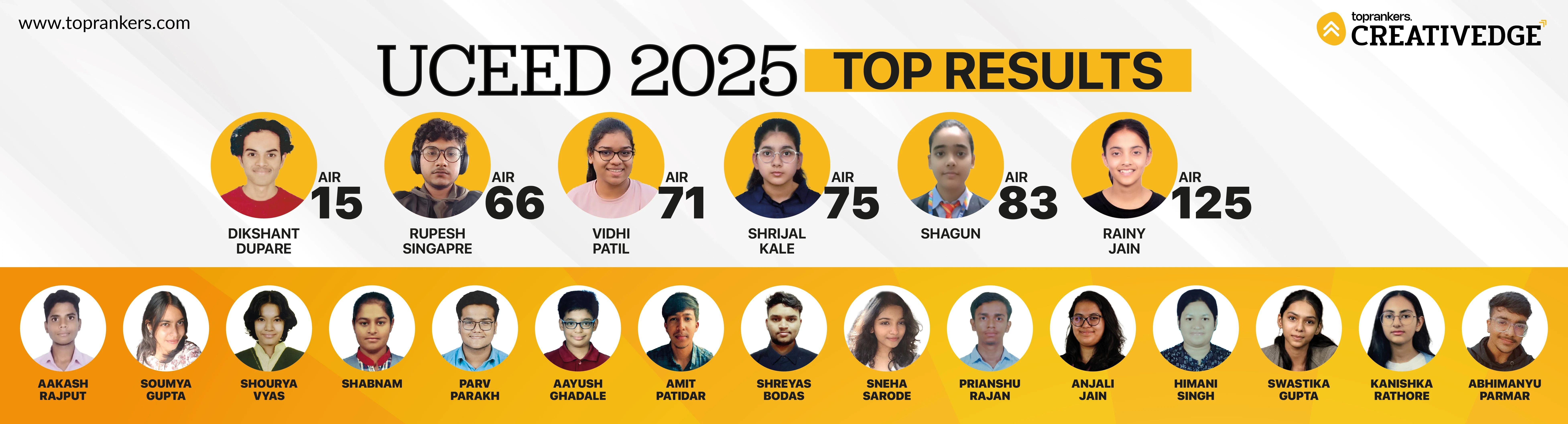
Here are some realistic insights from Dikshant Dupare [UCEED 2025, AIR 15]. Hear what our star achiever has to say about the common mistakes to avoid in UCEED 2027:
1. Not understanding the importance of guidance and feedback.
Dikshant says - "I gave uceed in 2024 also, but at the time i was overwhelmed with 12th boards and jee preparation along with uceed and ended up with a rank of 800+. At that time i studied for uceed by myself for 2 months with the help of random resources and stuff from the internet. Although i gave it my all then also, but it still fell short.
So in 2025, i joined CreativeEdge, because I realized that I need mentorship, I couldn't do this just by myself. I needed people to guide me and support me. Their feedback has really helped me reach from AIR 800+ to AIR 15."
2. Ignoring Aptitude and focusing only on Drawing
Dikshant adds that - "Many people don't realise this common mistake while preparing for UCEED- ignoring aptitude. Infact it comes before drawing. If you don't qualify in part A, drawing of part B doesn’t even matter, it won't even get checked. I practiced for it daily consistently."
3. Neglecting Mocks and Past Papers
Dikshant emphasize on the significance of mocks -
“If you don't give the mockscand assignments regularly, the exam can overwhelm you. Not being habitual would result in the exam format making you nervous. Preparing from PYPs alone is not enough. It has to be a combination of both mocks (curated based on latest exam pattern) and past year papers.”
Final Thoughts: Learn Smart, Not Hard
Preparation for UCEED 2027 is not about studying more hours, it’s about studying smartly. Avoiding the common mistakes to avoid during UCEED preparation can make a huge difference in your final score.
To recap, the top 10 mistakes to avoid in UCEED include:
- Ignoring syllabus and exam pattern
- Focusing only on sketching
- Neglecting general awareness
- Not practicing observation/visualization skills
- Poor time management in UCEED exam
- Not reviewing mock tests
- Ignoring creativity
- Skipping previous year papers
- Over-relying on coaching
- Ignoring rest and mental health
Avoiding these pitfalls will refine your UCEED preparation strategy and give you a strong competitive edge.
Pro Tips for UCEED Aspirants:
The difference between an average scorer and a topper lies in the awareness of common mistakes to avoid while preparing for UCEED.
Stay consistent, stay curious, and let your creativity shine.
Whether you’re targeting IIT Bombay, IIT Delhi, or IIITDM Jabalpur, remember - strategy, not stress, wins UCEED.
Preparing for UCEED 2027? We can help you with exact strategic roadmap, study material and crucial feedback required to ace this exam.
Join best UCEED Online Coaching by CreativEdge and get expert guidance on all UCEED 2027 subjects.



Attempt a Free UCEED Mock Test
Fill your details
Frequently Asked Questions
What are the most common mistakes in UCEED preparation 2027?

How can I create a good UCEED preparation strategy for 2027 exam?
How many hours should I study for UCEED daily?
Is sketching all I need to focus on for UCEED 2027?
When should I start practising previous years’ UCEED papers?
How important is feedback and mentoring for UCEED 2027 prep?
Vineeta Agrawal
Communications Executive
SHARE