



UCEED 2020 Question Paper PDF with Answer Key & Solutions (Download)
October 30, 2026
The UCEED 2020 question paper was conducted by IIT Bombay on 18 January 2020 for admission to B.Des programs.
The paper had two parts for a total of 300 marks in 3 hours:
- Part A - 68 computer-based questions (240 marks) across NAT (18), MSQ (18) and MCQ (32)
- Part B - one sketching question (60 marks)
NAT had no negative marking, while MSQ (−0.19) and MCQ (−0.71) did. You can download the official UCEED 2020 question paper PDF with the answer key and solved questions below.
Download UCEED 2020 Question Paper (Official PDF)
| UCEED 2020 Paper PDF | Download Link |
|---|---|
| Official UCEED 2020 Question Paper PDF | |
| UCEED 2020 Answer Key - Direct Link |
Looking for more practice? Download the full set of UCEED previous year question papers (2016-2026) with answer keys.
UCEED 2020 Question Paper Key Highlights
- Total Questions & Structure:
68 questions in Part A (NAT, MSQ, MCQ) + 1 sketching question in Part B - Marking Scheme:
- NAT: No negative marking
- MSQ & MCQ: Negative marking with no partial marks in MSQ
- Difficulty Level:
Overall moderate to difficult, especially due to MSQ risk and multi-step NAT questions - Most Challenging Section:
MSQ – high risk due to all-or-nothing marking - Most Scoring Section:
NAT – no negative marking, but time-consuming - Part B Insight:
Focused on observation, storytelling, and composition, not just drawing - Core Skills Tested:
Visualization, spatial reasoning, logical thinking, observation, and design sensitivity - Relevance for 2027 & 2028:
Still highly relevant for building fundamentals, even though the UCEED exam pattern has evolved
UCEED 2020 Exam Structure (From Official Paper)
According to the UCEED 2020 paper from the official UCEED website by IIT Bombay:
| Section | Type | Questions | Marks | Negative Marking |
|---|---|---|---|---|
| NAT | Numerical | 18 | 72 | No |
| MSQ | Multi-select | 18 | 72 | Yes (−0.19) |
| MCQ | Single correct | 32 | 96 | Yes (−0.71) |
| Part A Total | — | 68 | 240 | — |
| Part B | Sketching | 1 | 60 | No |
Total duration: 3 hours (2.5 hours Part A + 30 mins Part B)
What You’ll Actually Learn from This Paper?
Here’s what you gain if you use it properly:
- How UCEED tests multi-step reasoning
- How to handle MSQ risk (no partial marking)
- How UCEED visualization questions are framed
- How real-life observation converts into drawing (Part B)
UCEED 2020 Question Paper - Section-Wise Breakdown
| Section | Topics Covered | Example Questions Asked | Insight |
|---|---|---|---|
| NAT (18 Questions) | Geometry, 3D reasoning, logical puzzles, counting & visual estimation | Tile counting in a perspective corridor; cube slicing; dice stacking; family umbrella-crossing puzzle | Time-consuming but the safest section — no negative marking |
| MSQ (18 Questions) | Logical reasoning, reading comprehension, spatial reasoning, analytical thinking | AI & human-perception passage; transparent-sheet overlapping; pentagon shortest-route puzzle; clock-hands reasoning | All-or-nothing marking with negative marking — the most dangerous section |
| MCQ (32 Questions) | Visualization, product logic & mechanics, pattern recognition, design awareness | Boat reflection in water; ant's-eye perspective; rolling-cylinder trace; substitution coding | The most balanced, scoring section |
| Part B (Sketching) – 60 Marks | Narrative-based observational sketching (pencil only) | Sketch Prof. Shastri's desk from her usual point of view, based on a narrative; do not draw the person | Tests observation, object selection, composition and storytelling - not just drawing |
For the full current scope, see the UCEED syllabus.
UCEED 2020 Question Paper: Sample Questions with Solutions
Here are nine questions from the official UCEED 2020 question paper - three each from NAT, MSQ and MCQ - with step-by-step solutions and verified answers from the official key.
Section A - NAT (Numerical Answer Type)
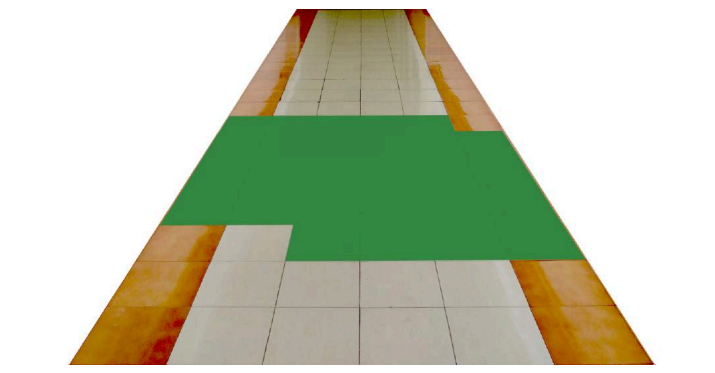
Q1) The image shows a corridor floor covered with identical square tiles. How many tiles are covered by the green patch? (figure-based — refer to the image)
Solution:
This tests observation in perspective.
- The corridor is drawn in one-point perspective, so the tiles shrink toward the vanishing point - you can't just count a rectangle.
- Work row by row along the green patch, counting the tiles (including the partially-covered ones that the patch spans) in each receding row, and add them up.
- Counting carefully across all the rows the patch touches gives 33 tiles.
Answer: 33.
Q2) A family of four - grandfather (10 min), father (5 min), son (2 min), daughter (1 min) - must cross from the bus stop to home in heavy rain with one umbrella that holds at most two people. What is the minimum total time for all four to reach home without getting wet?
Solution:
This is the classic "bridge crossing" puzzle - when two walk together, they move at the slower person's pace, and someone must bring the umbrella back. The optimal strategy sends the two fastest to shuttle the umbrella:
- Daughter + Son cross → 2 min; Daughter returns → 1 min (running total: 3)
- Grandfather + Father cross → 10 min; Son returns → 2 min (running total: 15)
- Daughter + Son cross → 2 min (running total: 17)
Answer: 17 minutes.
Q3) Six cards each have a number on one side and a letter on the other. To verify the rule "a card with a vowel on one side always has an even number on the other side," what is the minimum number of cards you must flip?

Solution:
This is the Wason selection task. To test "vowel ⟹ even," you only need to check cards that could break the rule: every card showing a vowel (flip to confirm an even number is behind it) and every card showing an odd number (flip to confirm there's no vowel behind it). You do not flip consonants (the rule says nothing about them) or even numbers (the rule doesn't require even numbers to have vowels). The count of vowel-cards plus odd-number-cards gives 3.
Answer: 3.
Part B rewards consistent drawing practice - work through our UCEED drawing/sketching practice questions to build observation and composition skills.
Section B - MSQ (Multiple Select Questions)
Q4) Five friends - Puru, Qadir, Roy, Sham, Tom - stand clockwise on the vertices of a regular pentagon. Puru walks to meet Roy; on the way he meets Qadir (who was heading to Tom) and Qadir joins him to Roy; then all three go to Tom. Taking shortest straight-line routes, which statements are true?
(A) Qadir walked more than Puru. (B) Puru walked more than Qadir. (C) Qadir walked double the distance Roy did. (D) Returning home from Tom's, Puru travels the least.
Solution:
- Label the pentagon clockwise: Puru, Qadir, Roy, Sham, Tom.
- In a regular pentagon, a side and a diagonal have two distinct lengths (diagonal ≈ 1.618 × side).
- Trace each path along sides/diagonals: Puru goes Puru→Roy (a diagonal) then Roy→Tom (a diagonal); Qadir goes Qadir→Roy (a side) then Roy→Tom (a diagonal).
- Comparing totals, Puru covers two diagonals while Qadir covers one side + one diagonal, so Puru walks more than Qadir (B).
- Roy only travels Roy→Tom (one diagonal), and Qadir's total (side + diagonal) is not double Roy's.
- For the return, Puru→home (Puru's own vertex) from Tom is an adjacent side - the shortest of the returns (D).
Answer: B, D (per the official key).
Q5) Which statements are TRUE about the hour and minute hands of an analogue clock?
(A) They make a 90° angle 24 times a day. (B) They overlap fewer than 24 times a day. (C) They overlap exactly on an hour-number marker only once every half day. (D) They form an acute angle for almost as long as an obtuse angle during the day.
Solution:
- A: The hands are at 90° 44 times a day (22 per 12 hours), not 24 → false.
- B: The hands overlap 22 times a day (11 per 12 hours), which is fewer than 24 → true.
- C: In 12 hours the only overlap landing exactly on an hour marker is at 12:00 → true (once every half day).
- D: By symmetry of the hands' relative motion, the time spent at acute separation is nearly equal to the time at obtuse separation → true.
Answer: B, C, D (per the official key).
Qualifying puts you on the rank list, but admission depends on your rank - see what counts as a good UCEED score.
Section C - MCQ (Multiple Choice Questions)
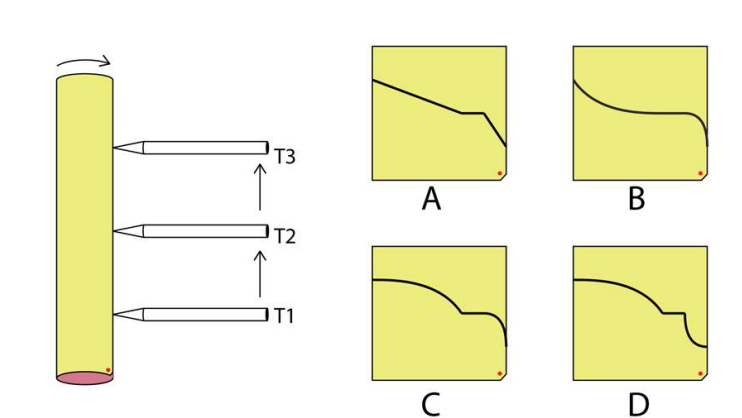
Q6) A rolled yellow paper cylinder is rotating clockwise direction at a constant rate of 1 revolution / 60 seconds. A pencil is touching the paper cylinder and is moving from T1 to T2 in 10 seconds and stops for 10 seconds. Then it moves to T3 in next 40 seconds (total time=60 seconds) as shown in figure 2. What would be the graph on paper when it is unrolled?
Solution:
Think of the unrolled paper as a graph: the horizontal axis is time (one full revolution = 60 seconds = the full width of the unrolled sheet), and the vertical axis is the pencil's position along the cylinder's length. Because the cylinder rotates at a constant rate, equal time intervals map to equal horizontal distances - so you can translate each phase of the pencil's motion into a line segment:
- 0-10 s (T1 → T2): the pencil moves steadily while the cylinder turns, so the trace is a sloped straight line (diagonal) covering the first one-sixth of the width.
- 10-20 s (stops): the pencil doesn't move along the cylinder but the paper keeps rotating, so the trace is a horizontal line (flat segment) across the next one-sixth of the width.
- 20-60 s (T2 → T3): the pencil moves again over 40 seconds - a longer, gentler sloped line spanning the remaining two-thirds of the width.
So the unrolled pattern is: a steeper short diagonal, then a flat horizontal segment, then a longer shallower diagonal, in that left-to-right order and proportion (10 s : 10 s : 40 s). The option matching this slope–flat–slope sequence with the correct proportions is the answer.
Answer: A (per the official key).
Q7) Aastha is sailing a paper boat in still water. Which option shows the reflection correctly?
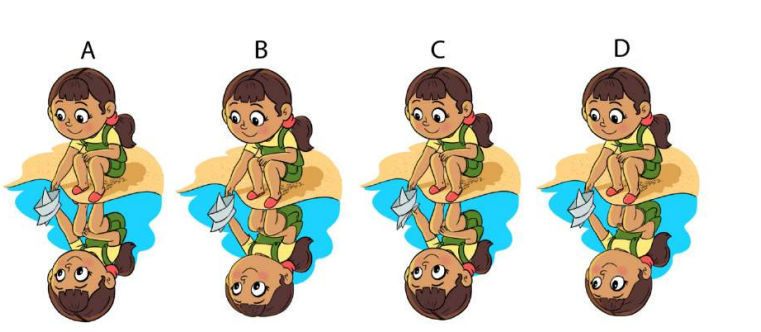
Solution:
A reflection in still water is a vertical mirror image - flipped top-to-bottom about the waterline, with left-right orientation unchanged. The reflected boat appears inverted directly below the real boat, and details like the sail and hull flip downward (not sideways). The correct option is the one showing an upside-down mirror image aligned beneath the boat, not a left-right flip.
Answer: B (per the official key).
Q8) In a chess variant where no piece captures, a knight must reach the diagonally opposite square (marked X). It can't land on a pawn's square but can jump over it. What is the minimum number of knight moves?
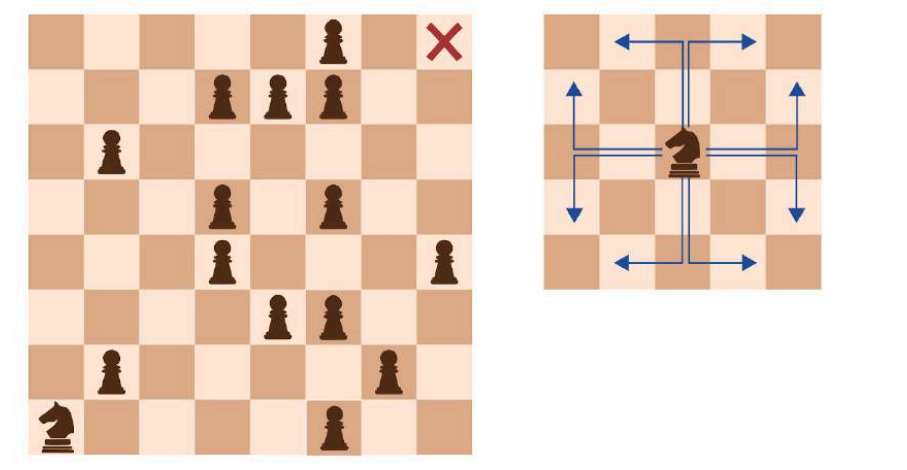
Solution:
A knight moves in an L-shape. To cross from one corner to the diagonally opposite corner of the board, the knight needs a minimum path of knight-moves - and here the pawns block some landing squares, forcing a slightly longer route than the unobstructed minimum. Tracing the shortest legal sequence of L-moves that avoids landing on pawn squares gives 6 moves.
Answer: B (6) (per the official key).
Looking for more current exam-level practice questions? try the UCEED mock test series to build speed under real timing.
UCEED 2020 Question Paper: Difficulty Level Analysis
Based on the official UCEED 2020 paper, the exam was clearly concept-heavy and time-intensive, especially due to multi-step reasoning and high-risk sections like MSQ.
Here’s a section-wise difficulty breakdown with real insights from the paper:
Section-Wise Difficulty Analysis
| Section | Difficulty Level | Why It Felt Difficult |
|---|---|---|
| NAT (18 Qs) | Moderate to Difficult | Multi-step problems involving geometry, counting, and 3D reasoning (e.g., cube cutting, tile counting) required time and accuracy |
| MSQ (18 Qs) | Difficult (Highest Risk) | No partial marking + negative marking made it the most dangerous section; required complete certainty |
| MCQ (32 Qs) | Moderate | Conceptual but manageable; included visualization, logic, and everyday reasoning |
| Part B (Sketching) | Moderate | Required strong observation + storytelling + composition (not just drawing) |
| Overall Paper | Moderate to Difficult | Time pressure + high cognitive load across sections |
Knowing the difficulty helps you set a realistic target - see the UCEED cut-off to understand the marks and ranks you’re aiming for.
Good Attempts Strategy (If You Were Writing This Paper)
| Section | Ideal Attempts | Accuracy Target |
|---|---|---|
| NAT | 14–16 | 85–95% |
| MSQ | 8–10 | 90%+ |
| MCQ | 22–26 | 80–90% |
| Part B | Strong attempt | — |
Key insight: Accuracy > Attempts, especially in MSQ
Also Check: Year-wise Detailed UCEED Exam Analysis
Explore our UCEED Previous Year Question Papers Book, featuring past 11 years’ papers (including UCEED 2026):
- Covers past 11 years’ UCEED papers (including UCEED 2026)
- Includes detailed step-by-step solutions for Part A questions
- Features QR-based video solutions for Part B drawing questions
- Useful for both self-study and guided preparation
Search ‘UCEED Previous Year Solved Papers Book Toprankers’ on Amazon or Flipkart and purchase NOW!

Download Other UCEED Previous Year Question Papers (with Detailed Analysis)
Final Takeaway
The UCEED 2020 question paper is not just a past paper, it’s a training blueprint.
If you use it properly, it helps you:
- Build core design aptitude
- Improve accuracy and decision-making
- Understand how UCEED actually tests thinking
Don’t just solve the UCEED 2020 question paper, use it to train how you think, not just how you answer.
Preparing for UCEED 2027? We can help you with exact strategic roadmap, study material and crucial feedback required to ace this exam.
Join Inda's most trusted UCEED Online Coaching by CreativEdge and get expert guidance on all UCEED subjects.



Attempt a Free NID Mock Test
Fill your details
Frequently Asked Questions
Where can I download the official UCEED 2020 question paper PDF?

Was the UCEED 2020 question paper difficult?
Is the UCEED 2020 sample question paper still useful for UCEED 2027 and 2028 preparation?
What type of questions were asked in the UCEED 2020 question paper?
How should I use the UCEED question paper 2020 for preparation?
Vineeta Agrawal
Communications Executive
SHARE