


UCEED 2021 Question Paper PDF Download (Official) + Answer Key
October 29, 2026
Download the official UCEED 2021 question paper PDF and answer key below. UCEED 2021 had 68 Part A questions (240 marks) across NAT, MSQ and MCQ, plus one Part B sketching question (60 marks) - a total of 300 marks in 3 hours. Solve it as a timed mock to understand the pattern and build your aptitude for UCEED 2027 and 2028.
UCEED 2021 Question Paper with Answer Key PDF Download
| UCEED 2021 Paper PDF | Download Link |
|---|---|
| Official UCEED 2021 Question Paper PDF | |
| UCEED 2021 Answer Key - Direct Link |
Want more practice? Download and solve UCEED previous year question papers to experience different question patterns and strengthen your preparation before the exam.
Key Highlights: UCEED 2021 Question Paper
- Conducted by: IIT Bombay, for admission to B.Des at IITs and participating institutes.
- Total marks: 300 - Part A (240 marks) + Part B (60 marks).
- Part A: 68 questions across NAT, MSQ and MCQ (computer-based).
- Part B: 1 sketching question (60 marks), evaluated subjectively.
- Duration: 3 hours (2 hours 30 minutes for Part A + 30 minutes for Part B).
- Negative marking: in MSQ and MCQ; none in NAT.
- Difficulty: moderate to difficult - an analytical, visualization-heavy paper.
Download the official UCEED 2021 question paper PDF and the official answer key using the links below. After you download, use the section-wise breakdown (NAT/MSQ/MCQ + Part B sketching) to analyze your score and identify weak areas.
What You’ll Get by Solving UCEED 2021 Question Paper
- Understand actual exam-level difficulty and pattern
- Improve time management under pressure
- Build visual reasoning + problem-solving ability
- Identify weak areas before actual exam
Table of Content
- UCEED 2021 Question Paper with Answer Key PDF Download
- UCEED 2021 Exam Structure & Marking Scheme
- Section-Wise Deep Dive: UCEED 2021 Question Paper
- UCEED 2021 Question Paper Analysis
- Good Attempts for a 200+ Score in UCEED 2021
- How to Use the UCEED 2021 Question Paper for 2027 & 2028 Prep
- What Changed After UCEED 2021?
UCEED 2021 Exam Structure & Marking Scheme
UCEED 2021 Question Paper - Part A Breakdown:
Part A was a computer-based test with three question types. Knowing the marking scheme is key, because the negative marking in MSQ and MCQ makes accuracy more important than attempting everything.
| Section | Question Type | No. of Questions | Marks | Negative Marking |
|---|---|---|---|---|
| Section 1 | NAT (Numerical Answer Type) | 18 | 72 | No |
| Section 2 | MSQ (Multiple Select) | 18 | 72 | Yes |
| Section 3 | MCQ (Multiple Choice) | 32 | 96 | Yes |
| Part A Total | - | 68 | 240 | - |
| Part B | Sketching (subjective) | 1 | 60 | No |
| Grand Total | - | 69 | 300 | - |
NAT carries no negative marking, so it's the safest section to maximize. MSQ and MCQ carry negative marking - attempt them selectively. For the latest structure, see the current UCEED exam pattern.
UCEED 2021 Question Paper - Part B Breakdown:
| Section | Type | Questions | Marks |
|---|---|---|---|
| Part B | UCEED Sketching Question | 1 | 60 |
The question required scene-based drawing from imagination + observation.
Section-Wise Deep Dive - UCEED 2021 Question Paper
Questions Asked in Part A
| Section | What Was Asked | Difficulty |
|---|---|---|
| NAT (18) | Geometry and mensuration, counting, probability, and logic puzzles (e.g., the gloves problem, infection-spread sequence) - many required multi-step thinking. | Moderate-High |
| MSQ (18) | Logical reasoning, design awareness (posters, product logic), spatial reasoning (folding, rotations) and interpretation-based questions. The highest-accuracy section. | High |
| MCQ (32) | Visualization and perspective, animation principles, design awareness (logos, history) and pattern recognition. Relatively more scoring than MSQ. | Moderate |
| Part B (Sketching) | An interior scene with sunlight direction and objects (plants, tea setup, cat), evaluated on observation, composition, light & shadow and detailing. | Moderate-High |
Questions Asked in Part B
| Question Type | What Was Asked | Skills Tested | Difficulty |
|---|---|---|---|
| Sketching | Interior scene with sunlight, cat, plants, tea setup | Observation, composition, lighting, storytelling | Moderate-High |
Students had to sketch a real-life scene with light direction, objects, and environment composition.
For the current scope, see the full UCEED syllabus.
UCEED 2021 Question Paper: Sample Questions with Solutions
Here are nine representative questions from the official UCEED 2021 question paper each from NAT, MSQ and MCQ - with step-by-step solutions and verified answers from the official key.
They show exactly the kind of reasoning, visualization and design-awareness the exam tests.
Section 1 - NAT (Numerical Answer Type) Questions
Q1. A cricket team has 10 blue pairs of gloves and 10 white pairs of gloves in a kit. If a batter pulls out one glove at a time without looking, what is the least number of gloves she must pull out to be sure she has a matching pair of the same colour?
Solution:
This is a worst-case (pigeonhole) problem. Gloves also have a left/right hand, so there are four types: blue-left, blue-right, white-left, white-right. To be sure of a same-colour pair (one left + one right of the same colour), consider the worst possible draw:
- She could pull all 10 blue-left and all 10 white-left gloves first - 20 gloves - without a single matching pair (no rights yet).
- The very next glove (the 21st) must be a "right" glove of some colour, which completes a same-colour pair.
Answer: 21 gloves.
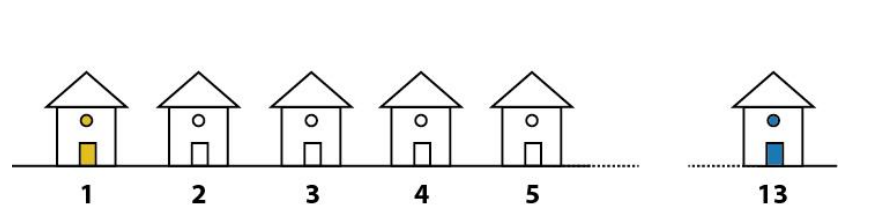
Q2. A street has 13 houses in a row. The virus starts at house 1 and spreads only left-to-right, either to the next house or by jumping to the house after next. House 2 can be infected in 1 way, house 3 in 2 ways, house 4 in 3 ways, house 5 in 5 ways, and so on. In how many ways can house 13 be infected?
Solution:
Each house can be reached from the previous house (step of 1) or the one before that (step of 2). So the number of ways to reach house n is the sum of the ways to reach the two preceding houses - the Fibonacci pattern:
1, 2, 3, 5, 8, 13, 21, 34, 55, 89, 144, 233 … for houses 2, 3, 4, 5, 6, 7, 8, 9, 10, 11, 12, 13.
Answer: 233 ways.
Q3. A basket holds a maximum of 50 fruits (apples and oranges). The number of rotten apples is twice the number of good apples. The number of good oranges is twice the number of rotten oranges. The number of oranges is thrice the number of apples. If there are more than 40 fruits, what is the total number of apples and oranges?
Solution:
- Apples = good + rotten = good + 2×good = 3×(good apples), so the number of apples is a multiple of 3.
- Oranges = 3 × apples, so total fruits = apples + oranges = apples + 3×apples = 4 × apples.
- Total must be a multiple of 12, more than 40, and at most 50 → the only value is 48 (apples = 12, oranges = 36).
- Check the orange condition: good oranges = 2 × rotten oranges, so oranges must be a multiple of 3 — 36 works. ✓
Answer: 48 fruits.
Section 2 - MSQ (Multiple Select Questions)
Q4. Three friends P, Q, R walk around a ground in the same direction at different speeds. R walks half as fast as P. Q walks 1.5 times faster than R. P takes 1 minute per round. They stop when R finishes 4 rounds. Which statements must be true?
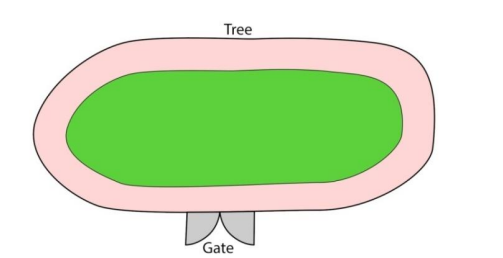
(A) Between start and end, P and R meet thrice. (B) Between start and end, P meets Q only once. (C) Q overtakes R once near the tree. (D) At the end, P, Q and R reach the gate together.
Solution:
Set speeds from the data: P = 1 round/min. R = half of P = 0.5 round/min. Q = 1.5 × R = 0.75 round/min. They stop when R finishes 4 rounds → total time = 4 ÷ 0.5 = 8 minutes. In 8 minutes: P does 8 rounds, Q does 6 rounds, R does 4 rounds.
- A: P gains on R at (1 − 0.5) = 0.5 round/min → laps R 0.5 × 8 = 4 times, but the final lap coincides with the end instant (excluded), so they meet 3 times in between. ✓
- B: P gains on Q at (1 − 0.75) = 0.25 round/min → laps Q 0.25 × 8 = 2 times, the last at the end instant (excluded) → P meets Q once in between. ✓
- D: At 8 minutes all three complete whole numbers of rounds (8, 6, 4), so all return to the gate together. ✓
- C: Q is faster than R and gains steadily, lapping R - not a one-time "overtake near the tree." ✗
Answer: A, C, D (per the official key).
Note: this is a tricky timing-and-relative-speed MSQ - exactly the type where over-attempting costs marks, since the full set of correct options must be selected with no partial credit.
Q5. Pressure cookers are sometimes made using copper and stainless steel. In such a pressure cooker:
(A) The bottom is steel and the rest copper, because it's aesthetically pleasing. (B) The bottom is steel and the rest copper, because copper is a germicide. (C) The bottom is copper because it's a better heat conductor than steel and more energy-efficient. (D) The bottom is copper because that's the only way to heat it on an induction stove.
Solution:
This tests material/design awareness. Copper is an excellent conductor of heat, so a copper base transfers heat to the food faster and more efficiently than steel - that's the real design reason for a copper-bottom cooker. Option D is false (induction needs a magnetic base, not copper); A and B are not the functional reason.
Answer: C.
Q6. From one side of a solid cube of side 2 units, a square pyramid of height 1 unit is removed, giving a solid with 9 surfaces. If one more identical pyramid is removed from another side, how many surfaces can the new solid have?
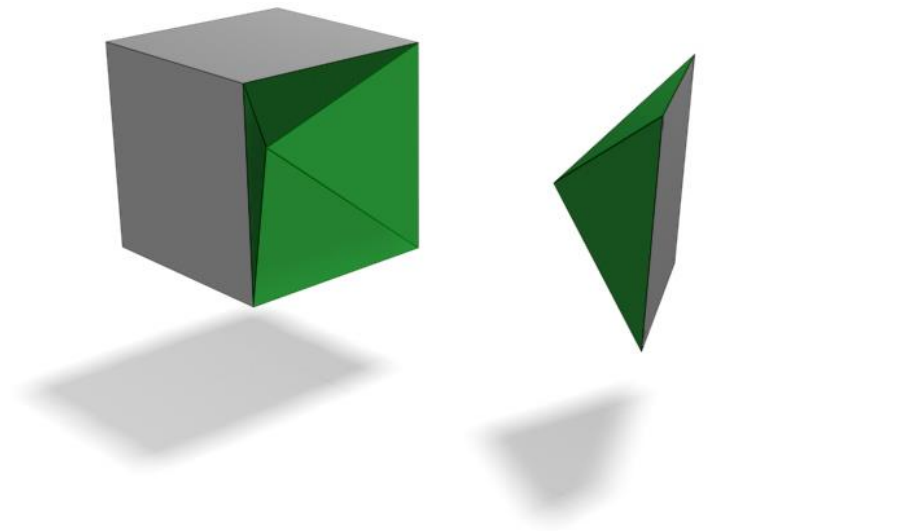
(A) 10 (B) 11 (C) 12 (D) 13
Solution:
A cube has 6 faces. Removing a pyramid from one face replaces that 1 flat face with a conical hollow of 4 triangular faces → 5 original faces + 4 new = 9 surfaces (as stated). Removing a second identical pyramid from another face removes 1 more flat face and adds 4 triangular faces again. Depending on whether the second face is adjacent to or opposite the first (which affects how edges/surfaces merge), the resulting count can be 12, and in another valid configuration 13 - so more than one option is defensible, which is why the key accepts both C and D.
Answer: C, D (per the official key).
Also Check: Why Students Across India Trust CreativEdge for UCEED Coaching
Section 3 - MCQ (Multiple Choice Questions)
Q7. At 6:00 pm, the hour and minute hands of an analog clock are 180° apart. After approximately how much time will they be 180° apart again?
(A) 48 min 40 s (B) 54 min 33 s (C) 60 min (D) 65 min 27 s
Solution:
The minute hand moves at 6° per minute and the hour hand at 0.5° per minute, so the minute hand gains on the hour hand at 5.5° per minute. To return to the same 180° relative position, the minute hand must gain a full 360° on the hour hand:
Time = 360 ÷ 5.5 = 65.45 minutes ≈ 65 minutes 27 seconds.
Answer: D.
Q8. A frame of a bouncing ball is shown. This illustrates which animation principle?
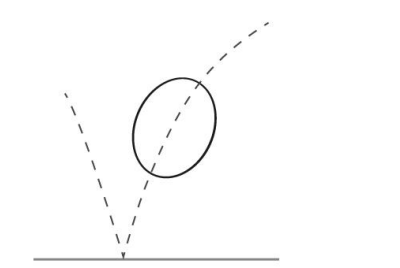
(A) Stretching Principle (B) Distortion Principle (C) Squash and Stretch Principle (D) Motion Principle
Solution:
A bouncing ball flattens (squashes) on impact and elongates (stretches) as it moves fast through the air. This classic deformation that conveys weight, flexibility and speed is one of the 12 principles of animation - "Squash and Stretch." A design-awareness MCQ rather than a calculation.
Answer: C.
Q9. Three white squares overlap a cyan square so that one corner of each meets at the centre of the cyan square. What is the ratio of the shaded (overlapping) area to the original cyan square?
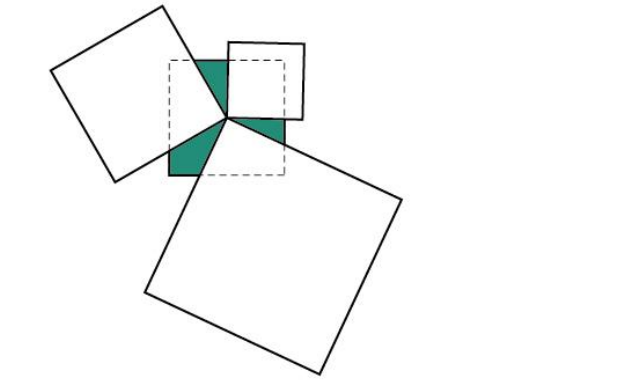
(A) 1/6 (B) 1/4 (C) 1/3 (D) 3/8
Solution:
When a square's corner is pinned at the centre of another square and rotated, the overlapping region is always exactly one-quarter of the central square - regardless of the rotation angle - because the two perpendicular edges from the centre always cut off a quarter-area. With three such squares meeting at the centre and dividing it symmetrically, the shaded portion works out to 1/4 of the cyan square.
Answer: B.
Want more practice like this? try the UCEED mock test series to build speed under real timing.
Good Attempts for 200+ Score in UCEED 2021 (Section-Wise Strategy)
A score of 200+ out of 300 in UCEED 2021 was a strong, competitive score that put aspirants in a good position for a B.Des seat at the IITs and participating institutes. But hitting 200+ isn't about attempting everything - it's about high accuracy and smart section selection, especially in MSQ and MCQ, where negative marking punishes guessing.
Here's the section-wise target and strategy to aim for 200+.
| Section | Max Marks | Target (200+ Goal) | Negative Marking | Strategy |
|---|---|---|---|---|
| NAT | 72 | 48-56 | None | Your safest, highest-ROI section - attempt every question you can reason through; there's no penalty for a wrong answer. |
| MSQ | 72 | 40-48 | Yes (-0.19), no partial marks | The riskiest section - select all correct options and no wrong ones. Attempt only when fully confident; even 2-3 wrong attempts can noticeably drop your score. |
| MCQ | 96 | 70-80 | Yes (-0.71) | The biggest section and relatively scoring. Use elimination - attempt when you can rule out two options, and skip blind guesses. |
| Part B (Drawing) | 60 | 45-55 | None | Rank-deciding and penalty-free - invest real effort in composition, observation and presentation. Never leave it incomplete. |
| Total | 300 | 200-220+ | - | A competitive, seat-securing range at the IITs and participating institutes. |
The golden rule for a 200+ score:
Maximize NAT and Part B (no negative marking), be strictly selective in MSQ (all-or-nothing marking), and use elimination in MCQ. Because negative marking compresses scores, accuracy on fewer questions beats volume - a focused, high-accuracy attempt reaches 200+ more reliably than an aggressive, error-prone one.
Want to know exactly what score converts to a seat? See our guide on UCEED cut-off.
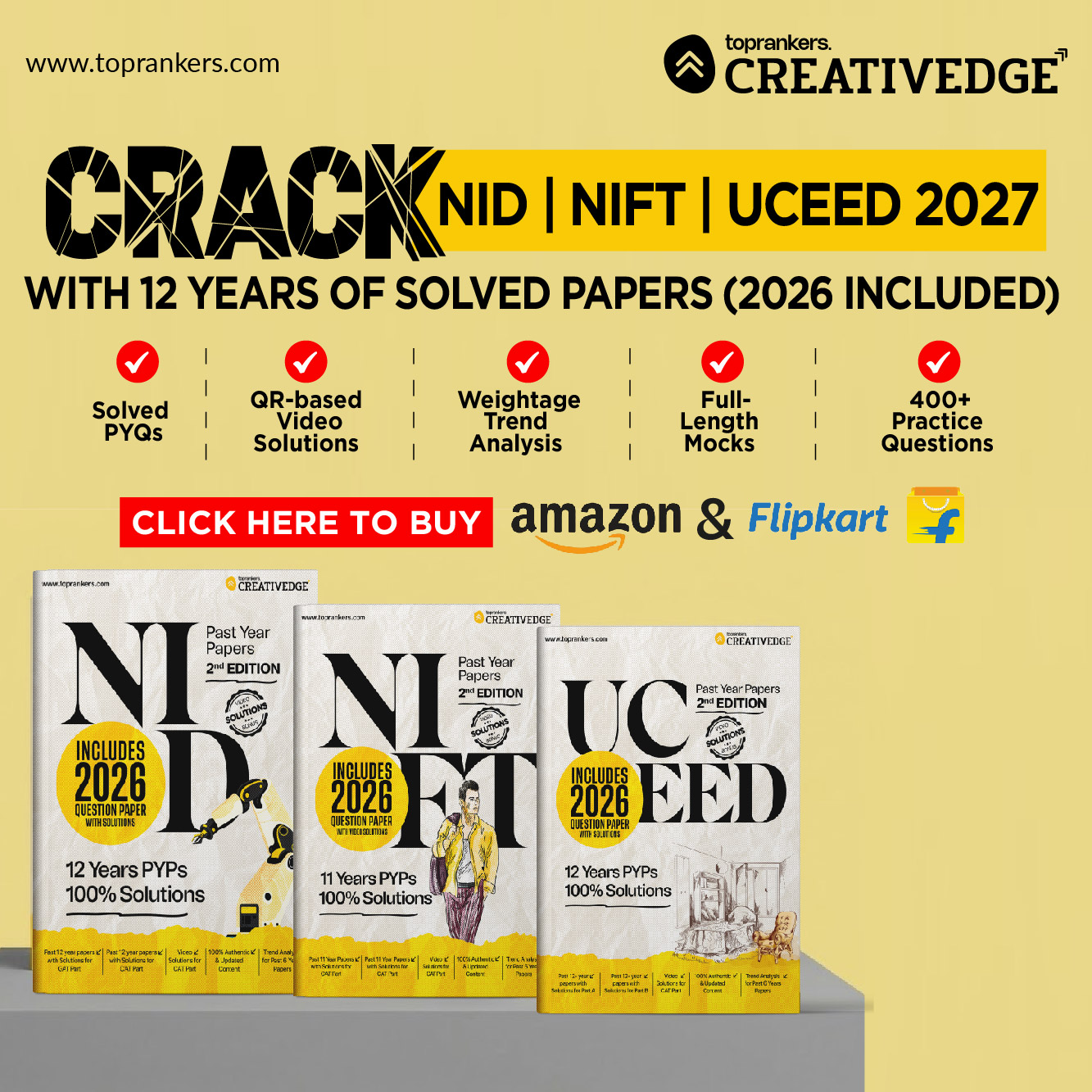
Explore our UCEED Previous Year Question Papers Book, featuring past 11 years’ papers (including UCEED 2026):
- Covers past 11 years’ UCEED papers (including UCEED 2026)
- Includes detailed step-by-step solutions for Part A questions
- Features QR-based video solutions for Part B drawing questions
- Useful for both self-study and guided UCEED preparation
Search ‘UCEED Previous Year Solved Papers Book Toprankers’ and Buy NOW!
How to Use UCEED 2021 Question Paper for 2027 & 2028 Preparation
Simply reading the UCEED 2021 question paper won't improve your score - how you practice it will. Although UCEED 2021 followed an older pattern, its Part A aptitude and Part B sketching fundamentals are still central to the exam, which makes it one of the best previous-year papers for building core skills. Here's how to use it the right way.
1. Solve It as a Timed Mock
Attempt the full UCEED 2021 question paper in one sitting under real exam conditions - 2 hours 30 minutes for Part A and 30 minutes for Part B. No pauses, no checking answers midway. This builds exam stamina and shows you where you actually stand.
2. Play the Marking Scheme Smartly
Because the UCEED 2021 paper had negative marking in MSQ and MCQ, accuracy beats volume. Maximize the NAT section first (no negative marking), attempt MSQ only when you're confident, and avoid blind guessing - a few wrong MSQ attempts can quietly sink your score.
3. Analyze Every Question, Not Just Your Score
The real value of solving the UCEED 2021 question paper is in the review. For each mistake, note whether it was conceptual, calculation-based or careless, and maintain an error log. For Part B, review your composition, perspective and detailing, then redraw an improved version.
4. Target Your Weak Areas
Use your analysis to identify weak spots - visualization, MSQ logic, or time management - and focus your next week of preparation there. This turns a single past paper into a personalized study plan.
5. Reattempt to Measure Progress
Solve the UCEED 2021 question paper again after 10-15 days. If your speed and accuracy have improved, your preparation is working; if not, you know exactly what to revisit.
Adapt it to the latest pattern: since UCEED has evolved (Part B now carries more weight), treat the 2021 Part A as core aptitude training and build your design-thinking separately.
Benchmark against what counts as a good UCEED score.
Common Mistakes to Avoid While Solving the UCEED 2021 Question Paper
Most aspirants use the UCEED 2021 question paper only to "check their score" - and that's exactly why it doesn't improve their preparation. The real value comes from how you practice and analyze it. Avoid these common mistakes to get the most out of the paper.
| Mistake | Why It Hurts | What to Do Instead |
|---|---|---|
| Solving it once and moving on | No analysis means no learning - the same mistakes repeat. | Reattempt the UCEED 2021 paper after reviewing, to track real progress. |
| Ignoring exam conditions | Pausing or checking answers midway gives a false sense of your score. | Attempt it as a strict 3-hour timed mock (2.5 hrs Part A + 30 mins Part B). |
| Over-attempting MSQ questions | MSQ carried negative marking with no partial credit - guessing sinks your score. | Attempt MSQ only when confident; maximize the NAT section (no negative marking) instead. |
| Focusing only on the score | A number doesn't reveal why you lost marks. | Analyse accuracy, time spent and error type (conceptual, calculation or careless). |
| Neglecting Part B practice | Drawing is a high-scoring, rank-deciding section that's easy to under-prepare. | Practise the sketching question with focus on composition, light and detailing. |
| Treating the old pattern as current | UCEED has evolved since 2021 (Part B now carries more weight). | Use the 2021 paper for aptitude; build design-thinking skills separately. |
In short, don't just solve the UCEED 2021 question paper - dissect it. Attempt it under timed conditions, play the negative marking smartly, and analyze every mistake. That's what turns one past paper into a genuine score boost. To avoid losing easy marks to penalties, read our guide on how to avoid negative marking in UCEED.
What Changed in UCEED After 2021? (UCEED 2021 vs the Latest Pattern)
If you're using the UCEED 2021 question paper to prepare for UCEED 2027 or 2028, it's important to know how the exam has evolved since then. The good news - the core skills tested like visualization, logical reasoning, and design thinking are unchanged, so the 2021 paper remains excellent practice.
What has changed is the structure and the weight given to each part. Here's a clear comparison.
| Component | UCEED 2021 Question Paper | Latest UCEED Pattern |
|---|---|---|
| Part A Marks | 240 marks | 200 marks |
| Part A Questions | ~68 questions (NAT, MSQ, MCQ) | ~57 questions (NAT, MSQ, MCQ) |
| Part B | 1 sketching question (60 marks, 30 minutes) | 2 questions - Drawing + Design Aptitude (100 marks, 60 minutes) |
| Part B Weightage | Lower - single drawing question | Higher - now a rank-deciding section |
| Overall Emphasis | Aptitude and freehand drawing | Design thinking and real-life problem solving |
| Total Marks & Duration | 300 marks in 3 hours | 300 marks in 3 hours (unchanged) |
The 3 Changes That Matter Most for Your Prep
- Part B is now worth more. In the UCEED 2021 question paper, Part B was a single 60-mark drawing; today it carries 100 marks across two tasks, including a design-aptitude problem. Practice drawing and design thinking, not just sketching.
- Fewer Part A questions, more depth. The question count dropped from ~68 to ~57, but the questions are more conceptual. Speed still matters, but reasoning depth matters more now than in 2021.
- Real-world design focus. Recent papers lean toward practical, user-centric and observation-based problems - so use the 2021 Part A for aptitude, and supplement it with current-style design-thinking practice.
What this means: treat the UCEED 2021 question paper as core aptitude and visualization training, and build your design-thinking and Part B skills separately to match the latest pattern.
UCEED 2021 Cut-Off (Qualifying Marks)
To be included in the UCEED 2021 rank list, candidates had to meet the minimum qualifying marks — both an overall total and a minimum in each section of Part A. As with every UCEED year, these cut-offs are lower than many aspirants expect, because negative marking and the paper's difficulty compress scores. The category-wise qualifying marks were:
| Category | Section A (min) | Section B (min) | Section C (min) | Minimum Total Marks (Part A) |
|---|---|---|---|---|
| General / OPEN | 8 | 10 | 12 | 100 |
| OBC-NCL / EWS | 7 | 9 | 10 | 90 |
| SC / ST / PwD | 4 | 5 | 6 | 50 |
Important: these are the qualifying marks to enter the rank list - not the admission cut-off. Qualifying puts you on the UCEED merit list; actual admission to an IIT or participating institute depends on your rank, the institute, and seat availability across counselling rounds. For rank-based admission data, see the UCEED cut-off page.
Note: UCEED qualifying marks follow a fixed formula each year (reserved-category cut-offs are 0.9× and 0.5× the General cut-off), so these figures reflect the standard UCEED 2021 qualifying criteria. Always confirm against the official IIT Bombay UCEED result for the exact year.
UCEED Previous Year Question Papers (Other Years)
Conclusion
The UCEED 2021 question paper remains one of the most important resources for serious aspirants.
By solving the UCEED 2021 paper with the right strategy, mock practice, analysis, and improvement, you can significantly improve your performance for upcoming exams like UCEED 2027 and 2028.
Preparing for UCEED 2027? We can help you with exact strategic roadmap, study material and crucial feedback required to ace this exam.
Join best UCEED Crash Course by CreativEdge and get expert guidance on all UCEED 2027 subjects.



Frequently Asked Questions
Where can I download the official UCEED 2021 question paper PDF?

Was the UCEED question paper 2021 difficult?
Is the UCEED question paper 2021 useful for UCEED 2027 and 2028 preparation?
What was the pattern of the UCEED 2021 question paper?
Does the UCEED 2021 paper have negative marking?
Vineeta Agrawal
Communications Executive
SHARE