
1723534562.png)

Important NID Perspective Questions with Answers PDF Download (for 2027)
September 7, 2026
NID perspective questions ask you to draw 3D scenes - rooms, streets, markets - on paper with correct depth, scale and vanishing points, using one, two, three, or five-point (fish-eye) perspective.
They appear in the CAT (Creative Ability Test) section in NID DAT Prelims exam and are even more decisive in the Studio Test (Mains), which from 2026 carries 100% of the final NID merit.
To master them, practice horizon lines, vanishing points and drawing real-life scenes daily. This guide explains you about the types, a step-by-step method to draw, solved examples, common mistakes and a downloadable practice PDF.
Key Highlights: NID Perspective Questions 2027
- Perspective questions test depth, spatial understanding and visualization skills in your drawings.
- Types asked- one-point, two-point, three-point, and five-point (fish-eye ~180°) perspective.
- They are scored in the CAT (Prelims) and the Studio Test (Mains) - and Mains now decides admission (100% weightage since 2026).
- Examiners reward accurate vanishing points, believable scale, clean line-work and a clear focal point.
- Most common mistakes- wrong number of vanishing points, wrong proportions, disturbed receding lines, and human figures out of scale.
- Best preparation- Use box drill method daily to train your spatial awareness and understanding of vanishing points, practice real-life observation and do timed practice with PYQs (30-35 min per scene).
- Download the free NID Perspective Questions with Answers PDF and practice with model sketches.
NID perspective questions test how well you can represent three-dimensional scenes on paper - conveying depth, spatial relationships, and realism. Mastery of perspective helps transform ideas into believable visuals, which is a major advantage in the subjective section of the exam.
In this blog, you’ll learn:
- What are NID perspective questions
- Why they’re critically important
- Types of perspective questions that appear
- Step-by-step methods + solved examples (NID perspective questions and answers)
- How to practice and avoid mistakes
- Tips & FAQs to help you ace the perspective section
By the end, you’ll be well-equipped to tackle perspective questions for NID 2027 with confidence.
Table of Contents
- Importance of Perspective Questions for NID 2027
- Types of NID 2027 Perspective Questions
- How to Approach NID Perspective Questions 2027: Step-by-Step
- Sample NID Perspective Questions with Solutions for 2027
- Mistakes to Avoid with NID Perspective Questions
- Practice Strategy for NID Perspective Questions 2027
What are NID perspective Questions?
Expect prompts framed around an unusual viewpoint (a child, a bird, a security camera) rather than the word "perspective". See more in our NID previous year question papers.
Importance of Perspective Questions for NID 2027
1. Significant Weight in Drawing / Creative Tasks
Amongst all kinds of subjective drawing questions of NID, perspective questions usually carry more marks. A well-executed perspective sketch can catch the examiner’s eye and help you clear the overall cut-off.
2. Shows Spatial Visualization Skills
Perspective drawing reveals your understanding of form, depth, foreshortening, vanishing points - skills central to design thinking.
3. Realism & Clarity
Many design prompts require scenes, environments, product views. Faulty perspective breaks realism, confuses the onlooker, and weakens your concept.
4. Benchmarks in Studio / Mains
In the NID Studio Test, you may need to visualize scenes, spatial setups, or integrate form in context - perspective is foundational.
Hence, NID perspective questions 2027 aren’t optional, they’re essential for scoring high in the creative section.
Types of NID 2027 Perspective Questions
Following are the primary types of perspective drawing out of which NID subjective questions are expected to be asked in 2027:
|
Perspective type |
Vanishing points |
Best for (typical NID prompt) |
Difficulty |
Suggested time in exam |
|
One-point |
1 |
Room interior, corridor, straight street facing you |
Easy |
15-20 min |
|
Two-point |
2 |
Building corner, street with two facades, angled product |
Moderate |
20-30 min |
|
Three-point |
3 |
Tall building (worm's-eye) or aerial plaza (bird's-eye) |
Hard |
30-35 min |
|
Five-point (fish-eye) |
5 (~180°) |
Immersive/curved scenes, reflections, dramatic panoramas |
Advanced |
Use only if confident |
Rule of thumb: pick the simplest system that answers the prompt, unless specified in the question itself. A clean two-point scene beats a distorted five-point one every time.
1) Single-point (One Point) Perspective
All orthogonal (receding) lines converge to a single vanishing point (VP) on the horizon line. Used when the viewer faces a plane head-on (e.g., simple interior or street scenes with one vanishing point).
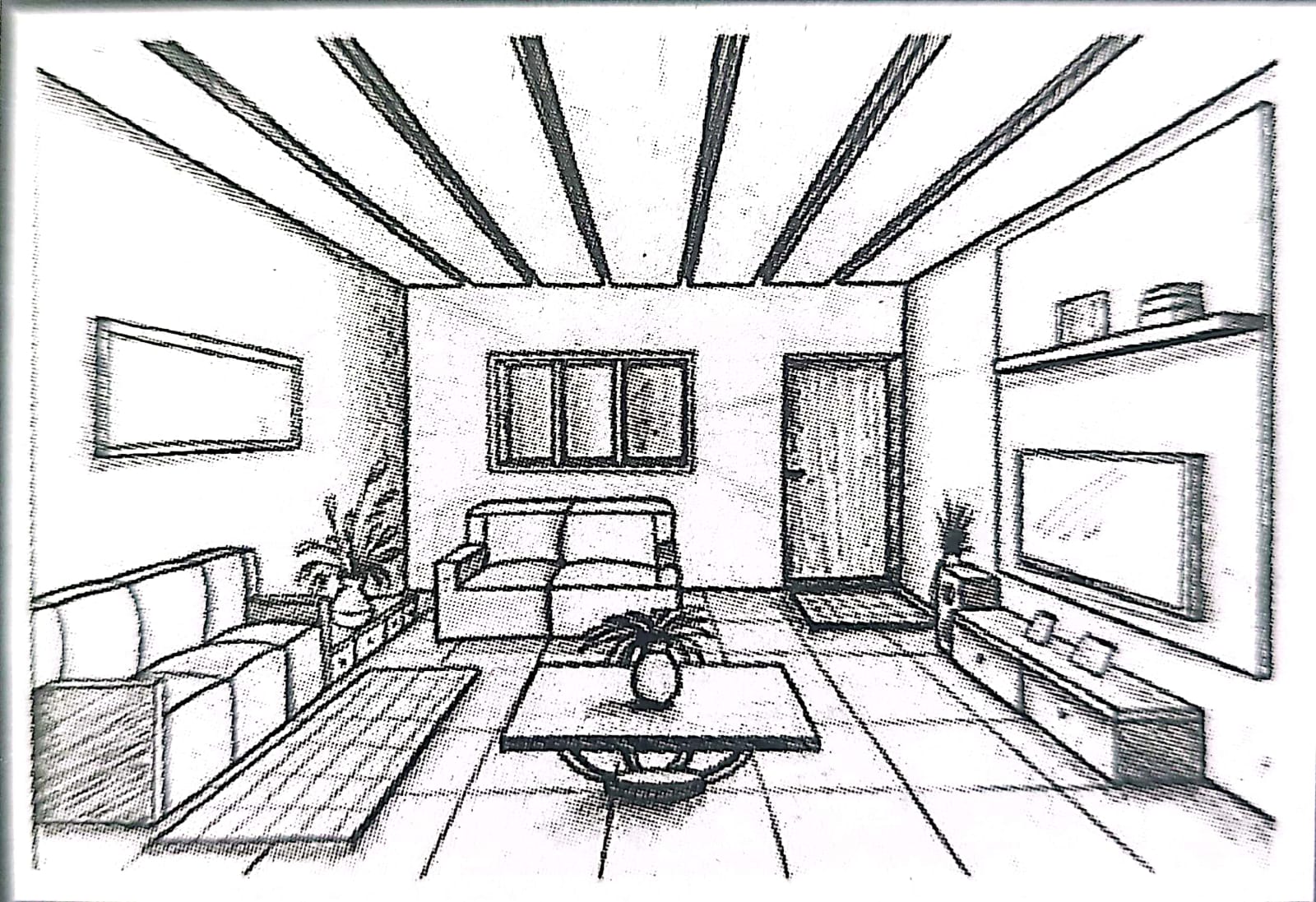
When NID asks this: Room interiors, corridors, straight streets, a front view of a stage or storefront, or any scene where one face is parallel to the picture plane.
How to draw (step-by-step):
1. Read prompt - identify eye level / viewpoint (standing, sitting).
2. Draw the horizon line (eye level).
3. Place single VP on the horizon (usually centre if head-on).
4. Lightly sketch the nearest plane facing the viewer (e.g., back wall).
5. Project lines from edges of the back wall to the VP to create floor, ceiling and side walls.
6. Add main objects that would complete a scene like desk, door, shelves, etc. by drawing their front faces first, then projecting rest of the edges and faces using lines from Vanishing Point.
7. Insert human figures in correct scale.
8. Shade / hatch to indicate depth; erase unnecessary construction lines.
Factors that will help you score more:
- Correct placement of horizon line and vanishing point
- Straight receding lines meeting the VP
- Proper scale of elements (human figure proportion)
- Clean presentation, good line quality and relevant details
Practice Questions for 2027:
1. Draw 6 quick one-point sketches (say interior scenes) in 20 minutes.
2. Click photos of your rooms and then try to convert them into one-point sketches.
3. Create your own prompts for practice purpose. For example - sketch a study room showing a desk facing the window using single-point perspective.


2) Two-point Perspective
Two vanishing points on the horizon line. Verticals remain vertical; horizontal edges recede to left or right VPs. Used when viewing a corner or rotated object/building.
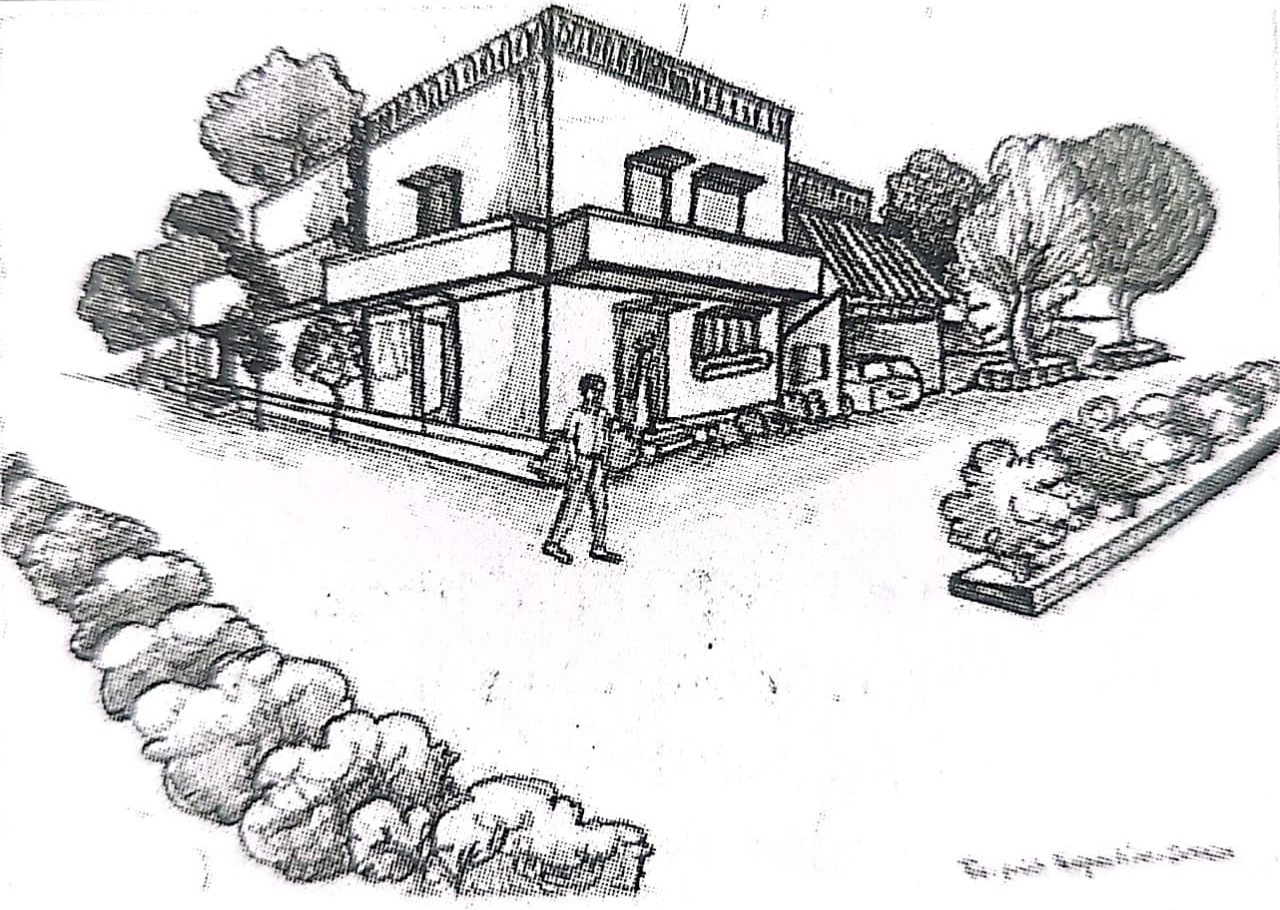
When NID asks this: Buildings at a corner, streets where you see two facades, furniture at angle, product placed at rotated angle - very common in urban or exterior scenes.
How to draw (step-by-step):
1. Decide horizon line (eye level)
2. Then draw a vertical line through the centre of the horizon line. Its the vertical edge (the corner) between VPs, this is the closest vertical to the viewer.
3. Place two points on horizon line (left and right of vertical line) and two points on vertical line (top and bottom of horizon line)
4. Connect the vanishing points and the two points on the vertical line, creating a diamond shape. (These are just guidelines, will be erased later).
5. Draw vertical lines intersecting horizon line on either sides of the centre.
6. Now draw diagonals through each intersecting point of these vertical lines with the diamond formed earlier. This is how you can form building faces.
7. Then add windows or doors by creating rectangles on these building faces. You can get coordinates of edges with the help of receding lines from appropriate Vanishing Point.
8. Finally insert foreground elements (like lamppost, bench, etc.) with the help of vertical lines and guiding lines from focal points.
9. Then add figures in correct scale based on their distance from the view point along with their shadows.
What examiners look for:
- Correct verticals (must stay vertical)
- Clean diagonals from correct Vanishing Point
- Good sense of depth and overlap of elements (foreground > midground > background)
Practice Questions for 2027:
- Sketched 2-point boxes and arrange groups of boxes to form streets.
- Draw the corner of a street with two shopfronts meeting at an angle, show a street vendor at the corner.
If you're unsure how to draw faces as part of a scene, see how to draw facial features for design entrance exams.
3) Three-point perspective / bird’s-eye / worm’s-eye
Adds a third vanishing point (usually above or below the horizon) to create dramatic height or depth (looking up or down at tall structures). Useful for strong vertical foreshortening.
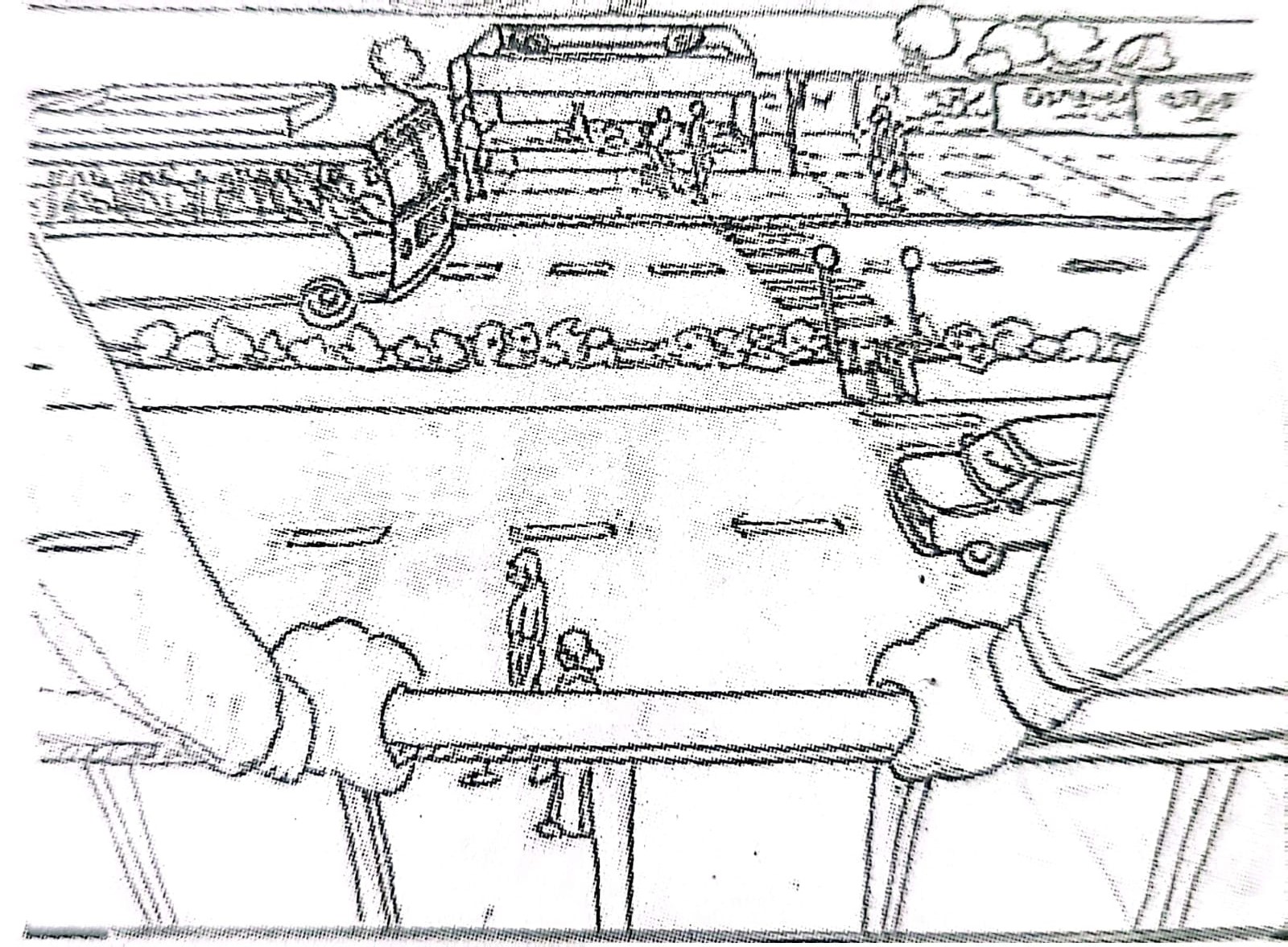
Special cases of 3 point perspective:
- Bird’s-eye view is a high aerial viewpoint (plan + perspective)
- Worm’s-eye view is very low, looking up.
Both accentuate scale and are powerful for architectural dramatization.
When NID asks this: Dramatic exterior views, tall buildings from street level (worm’s-eye) or aerial views of plazas/rooftops (bird’s-eye).
Tips:
- Bird’s-eye reduces vertical visibility - emphasize plan-like layouts with perspective depth.
- Worm’s-eye compresses ground distance; ensure foreground elements are large and dramatic.
How to draw (step-by-step):
- Choose horizon and two horizontal VPs (left & right) as in 2-point.
- Add the third VP either high above the page (worm’s-eye) or below (bird’s-eye).
- Start with a vertical edge and project to left/right VPs for horizontal edges and to third VP for vertical edges.
- Build volumes, then add details and figures (figures will be foreshortened dramatically).
What examiners look for:
- Control over foreshortening and proportion
- Convincing scale differences (why top looks narrower)
- Clean, readable composition despite complexity
Practice Questions for 2027:
- Draw simple boxes from high and low vantage points.
- Convert 2-point street sketch into 3-point by adding top or bottom VP.
Three-point views are high-risk, high-reward, so include them later in your prep - our section-wise NID preparation plan shows where perspective fits alongside the rest of the CAT.
4) 5 point perspective (fish-eye-view)
Five-point perspective, often called the fish-eye view, is a curvilinear system that captures a 180° panoramic scene using five vanishing points - one at the centre and four at the ends of a circular field of view (left, right, up, down).
It mimics how a fish-eye lens bends straight lines into curves while maintaining spatial accuracy.
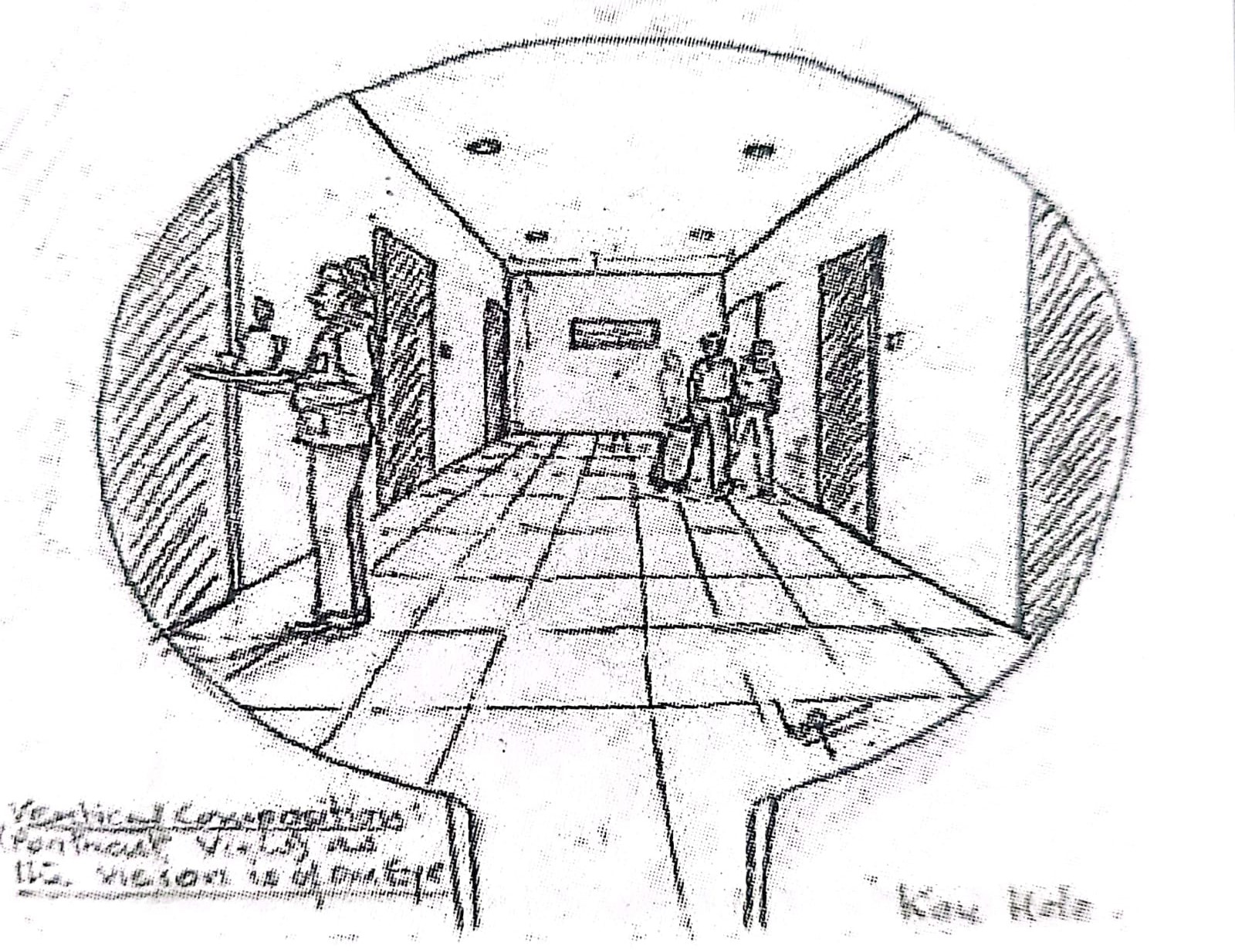
When NID May Ask This:
- Creative prompts like “Draw a city street from the viewpoint of a security camera lens”
- Visualize a market scene from a spherical reflection on a glass ball.
When to Use Five-Point Perspective in NID Answers:
- When you want to show drama or movement in your scene.
- For panoramic interiors/exteriors (cafeteria, plaza, city square).
- To express creative or imaginative views (e.g., inside a droplet, reflection).
- Use it only if you’re confident - clarity matters more than spectacle.
Save fish-eye for questions that either specifically ask you to draw in 5-point or where you feel the need (like in 'scene from a keyhole' type questions). Because, most scenes in the NID CAT question set can be solved cleanly in one- or two-point perspectives.
How to Approach NID Perspective Questions 2027: Step-by-Step
Here’s a proven step-by-step method to approach 2027 NID perspective questions in exam:
1. Read the Prompt Carefully
- Identify what needs to be drawn: room, street, object in scene.
- Note any special viewpoint to use in the question (bird’s eye, ground level).
- Note scale hints (doors, humans, furniture) given or assumed.
2. Decide Vanishing Point(s)
- Choose one-point if face is frontal.
- Choose two-point if edges are turned.
- Decide the horizon line’s placement (eye-level, high, low).
3. Sketch Light Construction Lines
- Draw horizon line.
- Mark vanishing point(s).
- Draw basic box or volume lines receding to vanishing point(s).
- Use light lines - this is the skeleton.
4. Block Major Forms
- Block walls, floor, ceiling, buildings, objects in the background/foreground.
- Determine relative scaling.
To make windows, doors, pillars and surface details believable, use the shading method in how to draw wall textures for design entrance exams.
5. Refine & Add Details
- Add windows, doors, pillars, trees, people, texture lines.
- Shade lightly for volume.
- Ensure verticals stay vertical (for 2-point).
6. Add labels to Elements for Clarity (if needed)
- Use arrows to showcase depth.
- You can include labelling for 'eye level,' 'vanishing point,' or 'foreground object' in the drawing for examiner's clarity.
- If the question asks, also add short notes about the drawing.
7. Finalize with Clean Lines
- Erase unnecessary lines you may have used while drawing
- Darken final edges, show contrast for clarity.
8. Review
- Check for distortions (parallel lines meeting at VP).
- Check proportions of objects/humans.
- Ensure horizon & VP align with prompt.
Sample NID Perspective Questions with Solutions for 2027 Prep
Below are a couple of sample prompts inspired by actual NID perspective questions and answers (as per the latest NID exam pattern), along with brief sketches of how you’d approach them (in text form).
Q.1. Draw a busy street market scene using one-point perspective. Show people walking, vendors selling goods, and surrounding elements like trees, stalls, and buildings that give a sense of depth and daily life.
Solution:
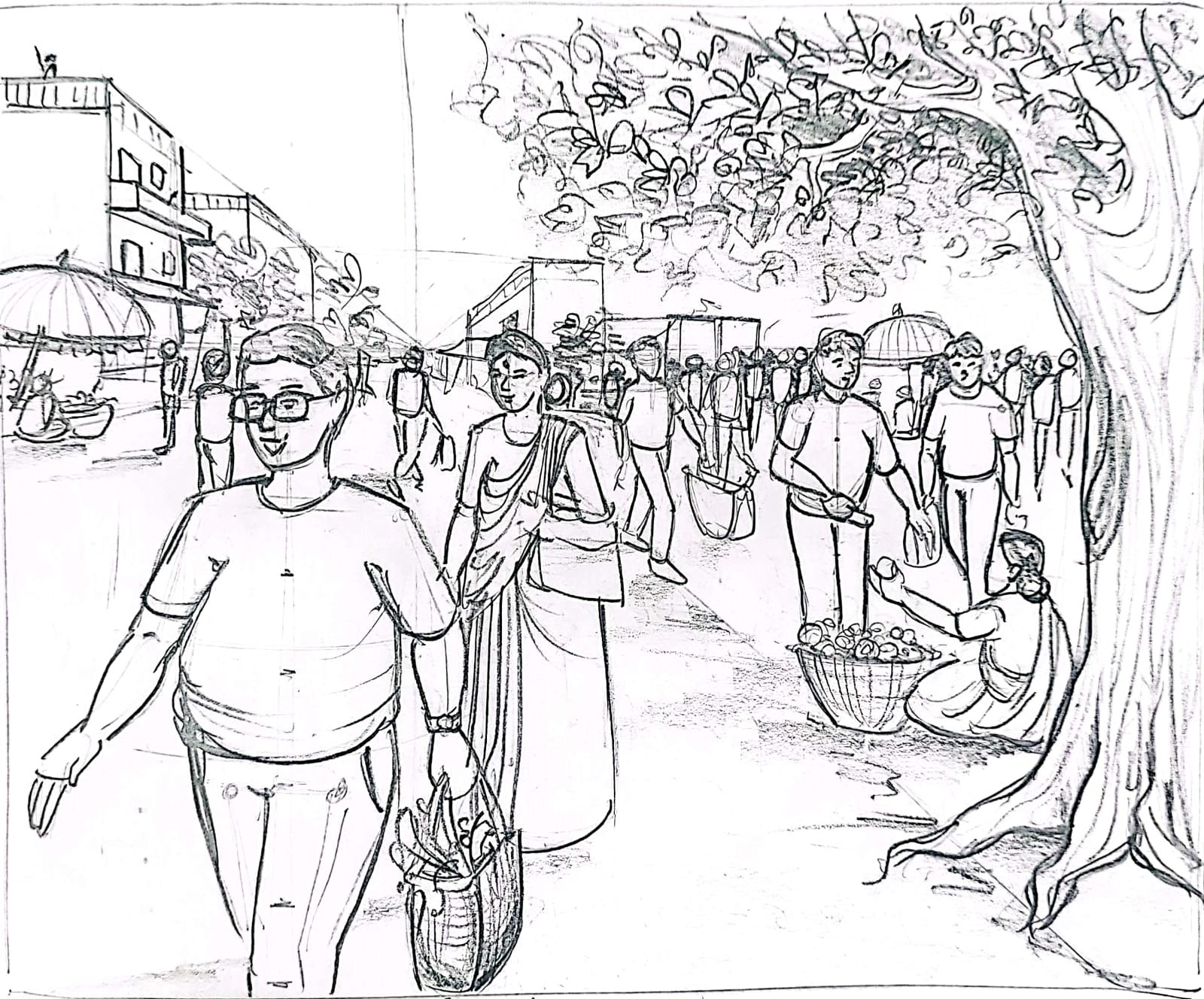
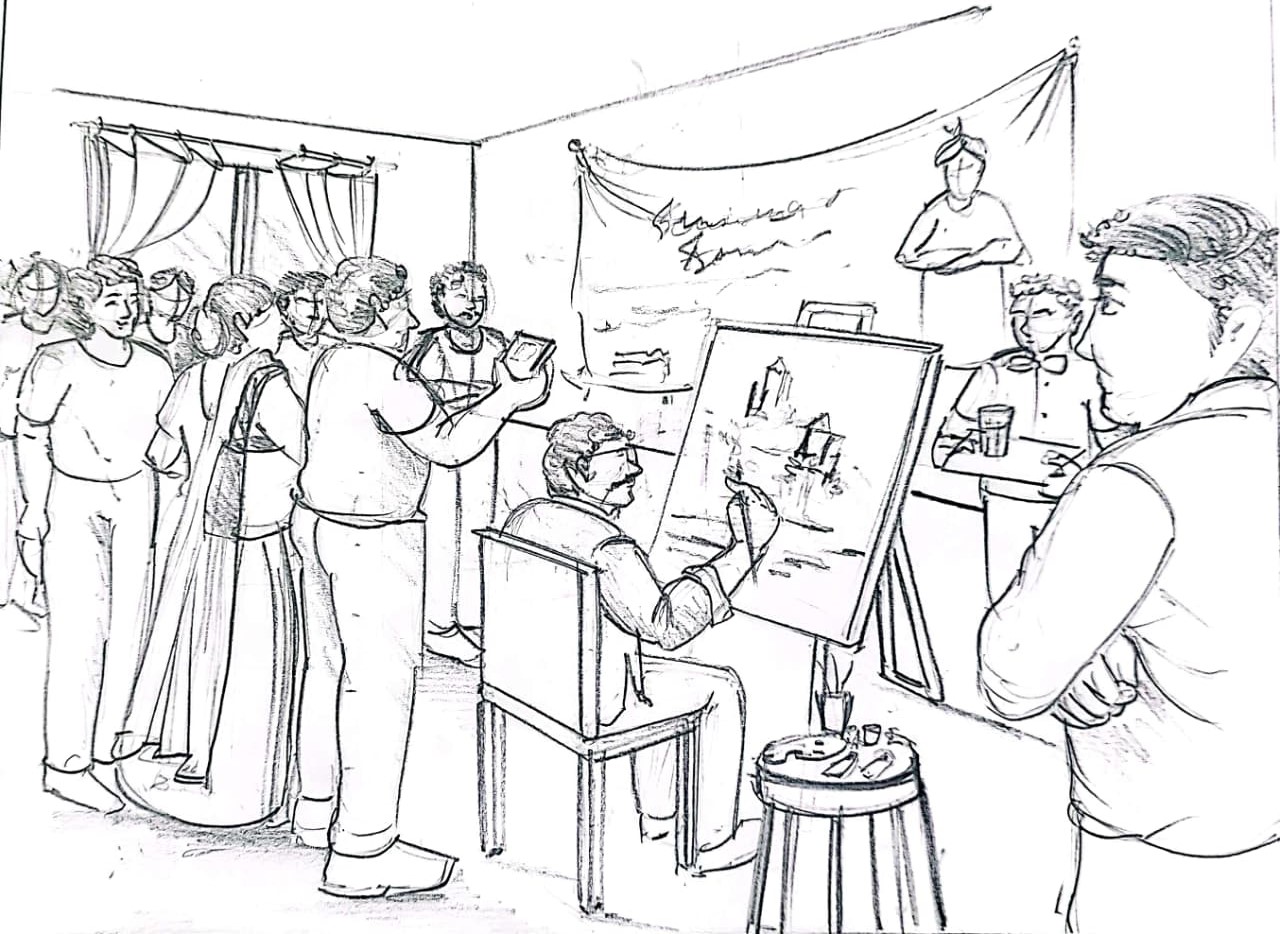
Q.2. Draw a two-point perspective scene showing an art exhibition or live painting session. Depict a person working on a canvas and a crowd discussing artworks in exhibition. You are a part of this crowd and observing the scene. Include elements like furniture, display setup, and lighting to enhance the realism. Draw from a two-point perspective.
Solution:
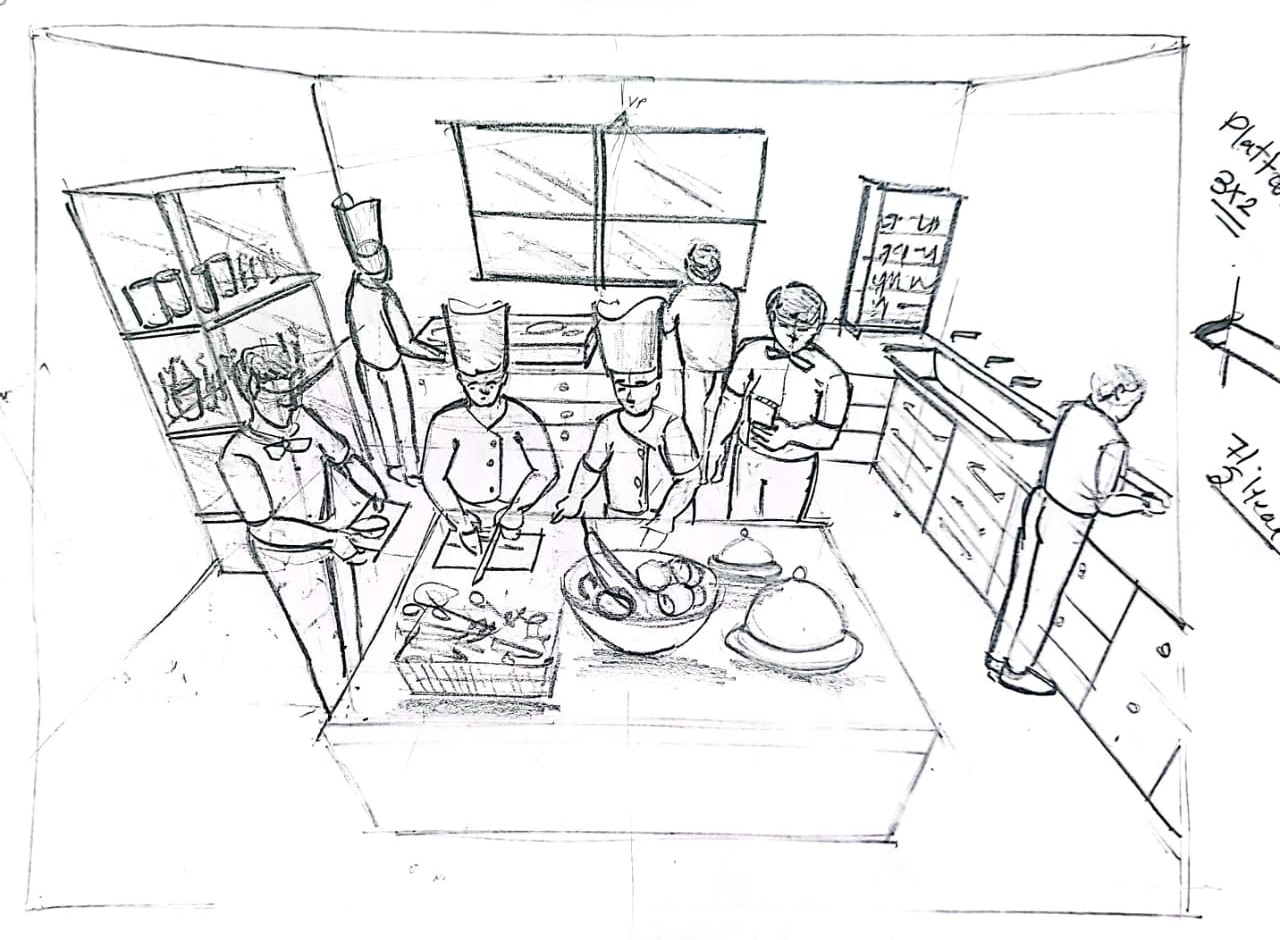
Q.3. Draw a three-point perspective view of a professional kitchen where multiple chefs are busy preparing food. Include realistic details like cooking counters, utensils, wall shelves, and people engaged in different tasks.
Solution:
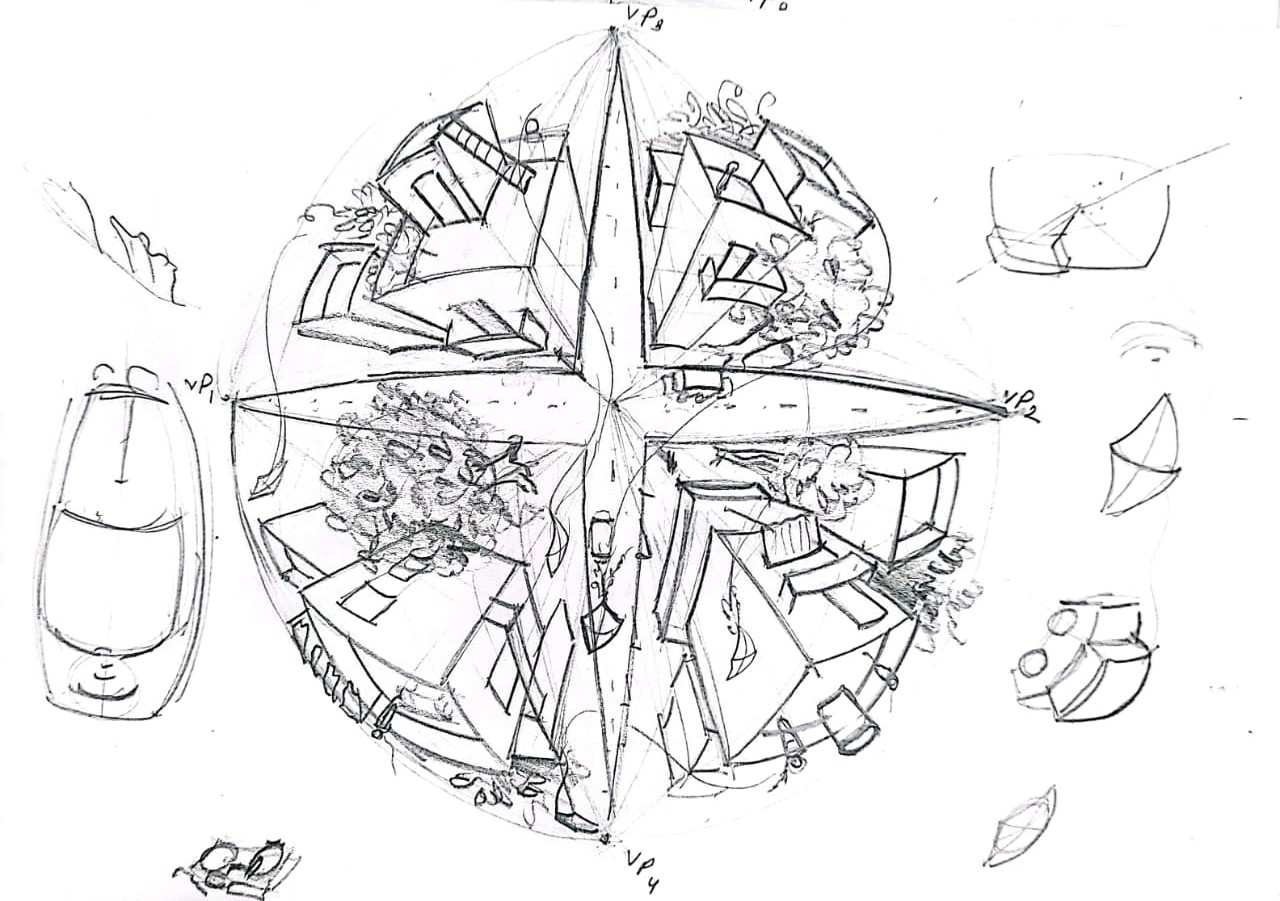
Q.4. Draw a 180-degree panoramic street scene using five-point perspective (fish-eye view). Depict buildings, roads, trees, and vehicles curving around the central viewpoint to give a sense of total spatial enclosure.
Solution:
Q.5. Your friend has come to visit you. He is looking from the window outside and your hall shown in the image (x) given below. Visualize and draw what he is seeing from his point of view.
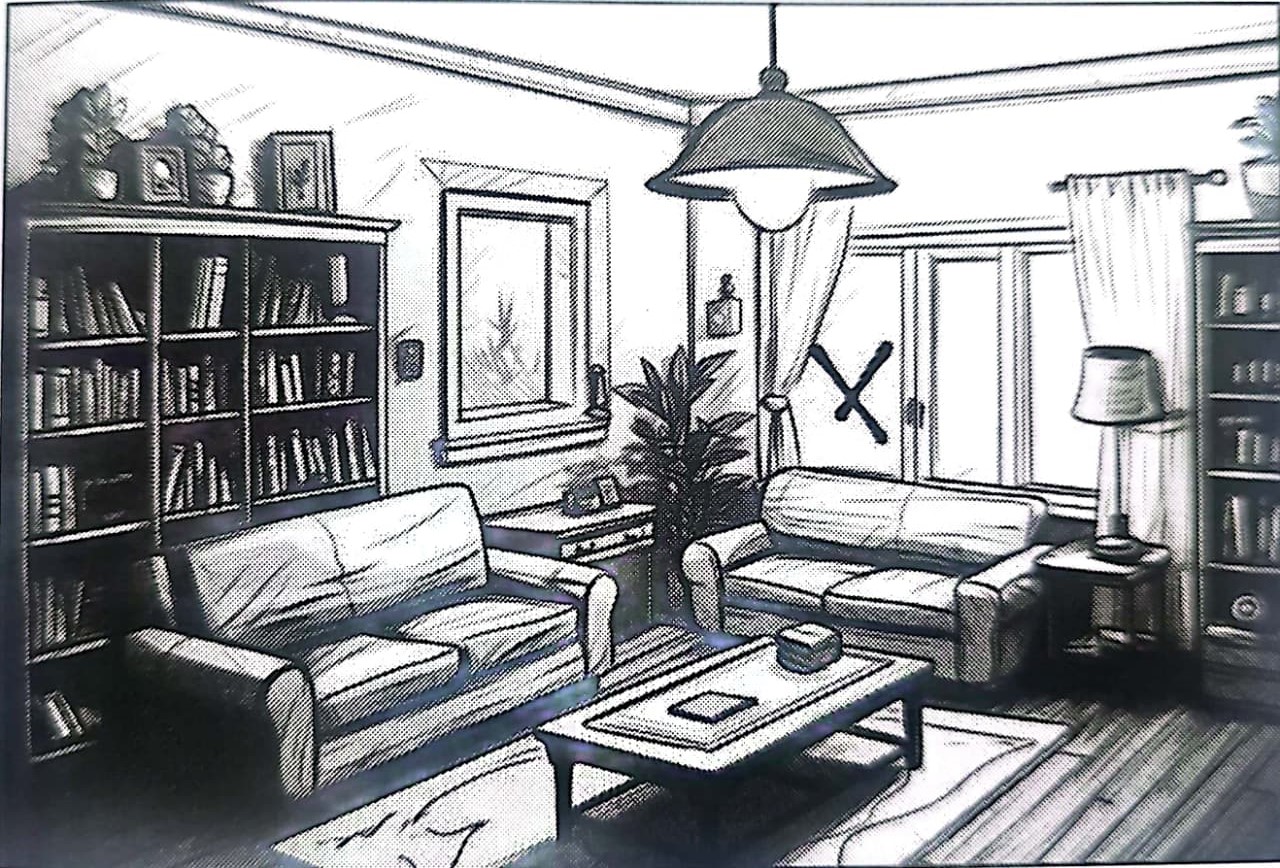
Solution:
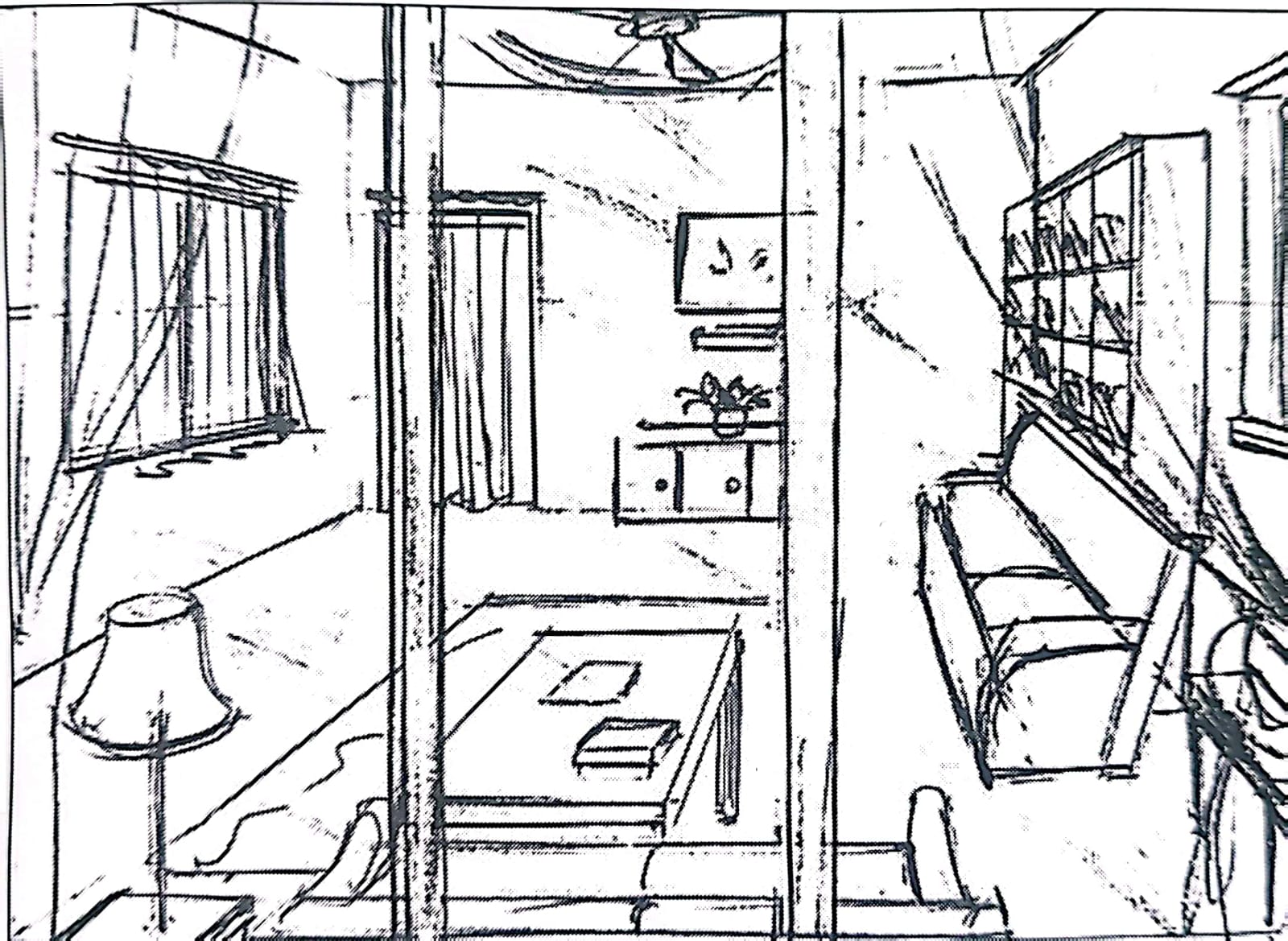
How NID Perspective Questions are Scored?
Perspective rarely comes as a standalone question - it's the backbone of your scene, product and storytelling sketches, and it shows up in two places:
- CAT (Prelims): a qualifying, subjective drawing test of NID entrance exam (CAT-only since 2026, no negative marking). Clean perspective here helps you clear the cut-off and reach Mains.
- Studio Test (Mains): hands-on drawing, model-making and observation tasks - and since 2026, this stage carries 100% of your final merit. This is where strong perspective can genuinely help you win a seat in NID colleges.
When mentors evaluate a perspective sketch, five things are looked for the most (roughly 20% each)- perspective accuracy, composition, originality, detailing, and neat presentation.
A technically perfect looking box that tells no story will score almost same as a dynamic scene but shaky lines, you need both.
Mistakes to Avoid with NID Perspective Questions 2027
1. Using wrong vanishing point count (applying two-point when face-on)
2. Not aligning receding lines to the VP - Skewed or distorted objects
3. Ignoring scale (human figure too big/small)
4. Students often leave construction lines as it is and forget to erase them during the finishing phase
5. Overcrowding details in background causing confusion
Most perspective marks are lost basic avoidable errors. Fix these first, then sharpen your line quality with these NID drawing improvement tips.
Effective Preparation Strategy for NID Perspective Questions 2027
1. (10-15 minutes a day)
- Focus on honing the basics of perspective drawing before moving to complex compositions
- Draw simple geometric shapes daily (boxes, cubes, cylinders, cones) in 1-point, 2-point, and 3-point perspectives.
- Mark horizon lines and vanishing points consciously to understand depth.
- Indulge in quick line practice - straight lines, ellipses, parallel strokes - to improve control.
The goal is to train your hand and eye coordination to think in 3D and visualize objects accurately.
2. Progress from Objects to Spaces
Understand how objects interact spatially within a scene - a skill NID examiners look for.
- Once you’re comfortable with simple forms, start placing them inside scenarios and environments.
- First create boxes and then combine them to form furniture, tables, or building blocks.
- Create room interiors or street corners using 1-point and 2-point setups.
- Gradually add scale figures (people, trees, vehicles) to show proportion and depth.
3. Study Real-Life References
Train your visual memory with real objects/products/scenarios- NID subjective questions often ask you to draw realistic scenes from imagination.
- Observation is key to strong perspective drawing.
- Look at photographs, street scenes, or indoor setups and mentally identify their perspective lines.
- Trace over reference photos to identify horizon and vanishing points.
- Visit markets, classrooms, or parks and sketch quick 2-3 minute thumbnails capturing perspective.
4. Practice with NID Previous Year Papers
It's important to get familiar with NID’s drawing style and question phrasing, so you decode questions quicker and manage time better in exam. One or two point perspective-based questions appear every year.
- Use NID previous year question paper subjective sets and sample perspective prompts to understand exam-level expectations.
- Attempt older perspective-based tasks like ‘draw a street market scene,’ ‘room interior,’ or ‘school corridor.’
- Time your NID perspective questions - spend no more than 30-35 minutes per sketch.
- Compare your answers to reference solutions or mentor evaluations.
5. Increase Complexity Gradually
Don’t jump directly to five-point perspective.
Follow these steps:
|
Timeline |
What to Do |
|
Week 1 |
Start with one-point perspective first. Try drawing rooms and corridors using vanishing points and basic guiding lines. |
|
Week 2 |
Next move to two-point perspective. Practice drawing buildings, streets, outdoor stalls with two vanishing points. |
|
Week 3 |
After perfecting 1, 2 points, then move to 3-point perspective. Practice with aerial view, bird’s eye view, worm’s eye views of everyday scenes. |
|
Week 4 |
Move to advanced styles only when you are confident about 1/2/3 point perspectives. Practice drawing scenes from fish eye view or keyholes. |
The goal is to build muscle memory through structured repetition, not random sketches.
6. Add Human Figures for Scale and Story
Examiners appreciate when you are able to add life, relatability, and narrative depth to your compositions.
- Perspective drawings in NID aren’t about buildings and streets alone - they’re storytelling tools. Always include humans, animals, or objects to define proportion.
- Practice gesture drawing - quick 30-second to 1-minute sketches of people walking, sitting, or interacting.
- Blend these figures naturally into your perspective scenes.
7. Work on Shadows, Light, and Composition
This will make your drawing look finished, dynamic, and professional - not just technically correct.
- A technically correct sketch can still look flat without tonal depth or light direction.
- Choose a light source in your drawing and shade consistently.
- Practice shadow projection based on perspective - it adds realism.
- Use composition rules (like the rule of thirds, balance, and focal point placement) for visual flow.
8. Feedback & Analysis
- Improvement comes from feedback.
- Review your own drawings or get them checked by mentors.
- Check- are all lines meeting at the vanishing points? Are proportions believable? Is there a clear foreground, midground, and background?
- Redraw parts that look out of place.
Turn errors into learning patterns instead of repeating them unknowingly.
9. Create a Personal Perspective Bank.
- Maintain a sketchbook or folder with your best perspective drawings.
- Divide it by perspective type (1-point, 2-point, etc.).
- Label each with notes: number of VPs, angle of horizon, and main learning points.
- Over time, you’ll have a personal visual library to reference before the exam.
This will help in visual recall during exam.
10. Attempt Timed Mock Tests
- Simulate the real NID exam at least once a week.
- Assign 30-40 minutes for each NID perspective question and try to reduce the time and increase the accuracy with each mock.
- Use previous year questions or exam-like sample questions.
Evaluation Breakdown as per NID Trends:
- Perspective accuracy (20%)
- Composition (20%)
- Originality (20%)
- Detailing (20%)
- Presentation neatness (20%)
Develop speed, focus, and compositional confidence under time pressure.
NID Free Mock Test Series - Attempt mocks and get complete video analysis, see where you stand in your prep now!
11. Experiment with Creativity
- Once you’ve mastered accuracy, start adding imagination.
- Convert a regular room into a futuristic control room.
- Transform a city street into a flooded or floating marketplace.
- Add narrative twists - what if it’s raining? or what if seen from an insect’s eye?
12. Stay Consistent
- Perfecting perspective drawing is not about talent but discipline.
- Practice at least 3-4 NID sketching questions in a week. Focus equally on both interior scenes and exterior scenes.
- Track your progress at the end of every week - note improvement in proportions, line quality, and imagination.
- Review whether you are still making the mistakes you used to make before a month of practice.
To score maximum marks in NID perspective questions 2027, you'll have to learn to balance technical precision with creativity and imagination. Practice regularly, observe real environments and objects, study past papers, practice to evolve from simple boxes to full storytelling scenes.
The best scene creations or perspective drawings in NID exam 2027 don't look 'accurate'- they feel alive, believable, and visually engaging.
Conclusion
Perspective is what makes a NID sketch believable. Get the horizon line, vanishing points, scale and clean line-work right, and even a simple room looks like a real believable space.
Learn the four types of perspective, know when each one fits a given question, and practice from real life until 3D thinking feels automatic.
Then let a story in- the sketches that score maximum are clean and tell a story.
If you want step-by-step walkthroughs, mentor feedback on your perspective sketches, or a curated set of perspective prompts + model answers, join Creative Edge NID online coaching and we’ll guide you to excel in NID CAT section.
You can enroll in offline NID batches at your nearest centres also!



Frequently Asked Questions
Are perspective questions common in NID DAT?

Do I need color in perspective drawings?
How many vanishing points should I use in NID perspective questions in 2027?
Can I practice NID perspective questions for 2027 exam without good enough drawing skills?
Where to find nid perspective questions and answers?
Vineeta Agrawal
Communications Executive
SHARE