
1723534562.png)

NID Subjective Questions 2027 PDF Download [Sample Questions]
July 2, 2026
Quick Answer: NID subjective questions refer to creative, open-ended design tasks asked in the NID DAT Mains (Studio Test) that assess a candidate’s visualization, ideation, material handling, model-making, and problem-solving skills. These questions go beyond written tests to evaluate hands-on creativity, spatial thinking, and design sensibility required for admission into NID’s design programmes.
Key Highlights - NID Subjective Questions
- NID subjective questions are primarily asked in the NID DAT Mains (Studio Test) stage and evaluate practical design ability, not just theoretical knowledge.
- These questions include model making, observation-based sketching, product design, 3D composition, functional design tasks, and human-centric problem solving.
- Candidates are tested on idea generation, creativity, material usage, and execution clarity, which are essential for design education.
- Unlike objective prelims, subjective questions require hands-on work, presentation skills, and storytelling through visuals and prototypes.
- Practising past NID subjective questions helps aspirants build design thinking, time management, and visual communication skills.
Before 2026, CAT (subjective questions) and GAT (objective questions had a weightage distribution of around 60% and 40% respectively in the NID exam. However, the exam pattern for NID 2027 changed drastically in 2026, marking complete removal of GAT (GK + Reasoning + Aptitude) thereby making Prelims a qualifier only round for Mains.
In this blog, we explore everything about NID subjective questions: what types are asked, how they are evaluated, sample solved questions, strategies, preparation tips, and how to get familiar with real NID previous year question paper subjective examples.
You will learn:
- What are NID subjective questions and why they matter
- Types & Pattern for 2027 exam: Prelims vs Mains subjective tasks
- Sample problems and step-by-step approach
- How to practice from NID previous year question paper with solutions pdf
- Tips to score high on subjective section
- Mistakes to avoid
By the end, you’ll have a clear roadmap to tackle subjective questions of NID 2027 with confidence.
Table of Contents
What Are NID Subjective Questions?
While NID’s DAT (Prelims) 2027 includes objective sections (GAT, etc.), subjective questions of NID 2027 generally fall under the Creative Ability Test (CAT) and in the Mains / NID Studio Test rounds. These question types require open responses: sketches, design ideation, storyboarding, model proposals, visual interpretation, and more.
These subjective tasks test:
- Creativity & originality
- Visual thinking & imagination
- Drawing skills (composition, perspective, proportion)
- Clarity in concept & expression
- Problem-solving in design contexts
In short, subjective questions of NID 2027 give you a chance to 'show your design mind' rather than just answer fixed choices.
Why NID Subjective Questions Are Important?
When preparing for the NID entrance exam 2027, many students focus equally on objective sections (General Ability Test - GAT) and subjective sections (Creative Ability Test - CAT). But in reality, NID subjective questions carry far greater weight and impact on your final score.
Here’s why they are so important:
1. High Weightage in the Exam
In NID DAT Prelims 2027, the subjective/creative ability section typically carries 60-70% of the total marks, while GAT accounts for the rest.
In the Mains (Studio Test + Interview), evaluation is almost entirely subjective - model-making, drawing, storyboarding, or situational design tasks.
This means that even if you score average in GAT, strong performance in subjective tasks can secure your admission.
2. True Test of a Designer’s Mind
Objective questions of the NID syllabus 2027 check memory, awareness, and logic. They have definitive answers. But NID subjective questions evaluate creativity, originality, and problem-solving through design. Examiners score you based on following factors:
- Can you visualize unique solutions?
- Can you communicate concepts clearly through sketches?
- Can you balance aesthetics with functionality?
These are the qualities NID is searching for - and subjective questions of NID 2027 are the best way to judge them.
3. Differentiator Between Top Ranks & Average Scores
In GAT (NID aptitude and NID GK or current affairs), many students end up scoring within a close range. But subjective answers separate the toppers because evaluators can see the difference in idea clarity, neatness, and storytelling.
Past year results suggests that strong subjective performance is often the deciding factor between being able to secure a seat at NID Ahmedabad or settling for a lower-ranked design school.
4. Practice for Studio Test & Real Design Work
The skills developed while solving subjective questions of NID 2027 directly prepare you for the Mains Studio Test, where you’ll face material-based and 3D design tasks.
In the long run, the ability to ideate, visualize, and communicate through sketches is what you’ll use as a professional designer.
5. Creative Freedom & Risk-Taking
Unlike objective MCQs, NID subjective questions give you space to show originality. You can propose bold, sustainable, or socially impactful ideas. Evaluators appreciate unique perspectives when they’re well presented.
Want to Know the NID Exam Pattern? Solve Previous Year Question Papers First
| NID 2026 Question Paper | NID 2025 Question Paper |
| NID 2024 Question Paper | NID 2023 Question Paper |
| NID 2022 Question Paper | NID 2021 Question Paper |
Pattern & Types: Prelims vs Mains NID Subjective Questions 2027
To use subjective questions of NID 2027 effectively in your prep, first understand how they differ by stage:
For example, in DAT Prelims, one may be asked: “Design a bicycle for a delivery person in a crowded city.” Or to “Sketch a scene where a street vendor is interacting with a child.” In Mains, you may face “Design a compact modular furniture system for small urban flats” or “From a given material (e.g., bent plywood), design a sculptural form that doubles as public seating.”
Because subjective questions of NID 2027 are varied, your preparation must cover multiple design modes: 2D sketching, 3D concept ideation, materials, storytelling, etc.

Examples & Solved Sample NID Subjective Questions for 2027 Prep
Below are a couple of example prompts and step-wise strategies. These are inspired by NID previous year question paper subjective sets, design sample papers, and creative prompts often seen in NID’s qualitative tests.
Example 1 (Sketch + Concept)
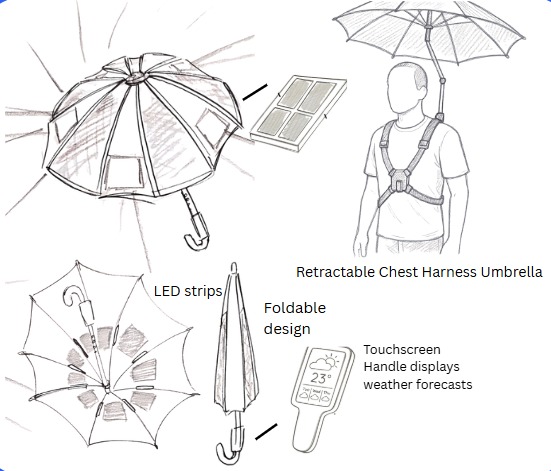
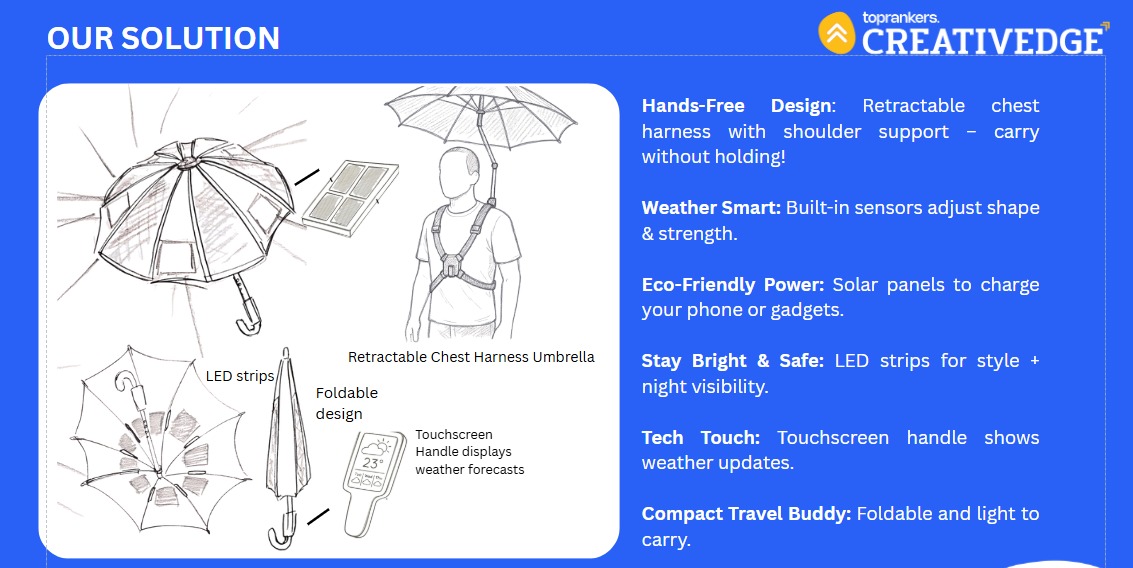
Prompt: Monsoon season brings the constant struggle of carrying umbrellas, especially in crowded streets and public transport. The biggest problem? The long handle makes it clumsy to store, carry, and manage when wet.
Your task: Design an umbrella without a traditional handle that solves this problem while remaining functional in heavy rain.
How to approach:
1. Identify the core problems: long handle, storage, wetness, crowding.
2. Brainstorm quick ideas (wearable, strap-based, backpack integrated, inverted fold, etc.)
3. Select the most practical + innovative solution
4. Sketch multiple views (open/closed, usage)
5. Add clear labels for materials, mechanism, drainage
6. End with 2-3 bullet features + one-liner benefits
A good answer will show clarity of concept, usable form, and neat presentation.
Solution:
Example 2 (Storyboarding / Scenario + Visual Interpretation)
Prompt:
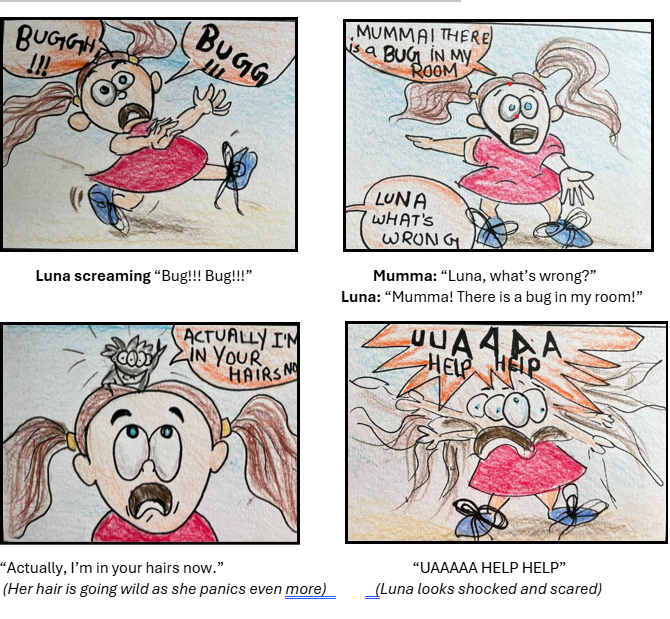
One day, Luna saw a bug in her room and screamed in panic. As she ran around shouting, the bug sneakily landed in her hair! Luna freaked out even more, calling for help. Her mom rushed in, confused, while Luna kept yelling about the creepy intruder in her hair!
Frame a story in 4 frames also mention the title and moral of the story.
How to approach:
1. Break story into 4 clear frames : panic screaming bug, bug! -> Mom enters, Luna mom interaction -> bug hides in hair -> Luna freaks out even more.
2. Plan frame compositions with expressive faces + motion lines.
3. Keep backgrounds minimal; focus on characters and action.
4. Add short captions (approx. 6-8 words)
5. Title + moral: concise, positive, easy to grasp.
Solution:
These types of NID subjective questions test your visualization, narrative building, and design communication skills.
_(1)1754636837.webp)
1756536783.webp)
How to Use NID Previous Year Question Paper Subjective Sets for 2027 Exam Prep
Working with past papers is one of the most reliable ways to master nid subjective questions. Here’s how to use them effectively:
1. Collect subjective questions of NID DAT Prelims / Mains from past year papers: CreativEdge's NID previous year question papers book is the best way to practice NID previous year question paper subjective sets.
It has 11 years of fully solved NID past papers with QR-based step-by-step video solutions of each and every drawing question, by India’s top NID mentors.
2. Simulate exam conditions: Set a timer and attempt creative tasks without external help.
3. Review & self-evaluate: Compare with good reference solutions or mentor feedback.
4. Identify patterns: Repeated prompts like “design for children,” social issues, sustainable design show up often.
5. Adapt your sketching style: Notice what style, presentation, line quality gets good scores.
6. Gradually reduce time: Initially take more time; later try finishing tasks in shorter durations.
By actively solving subjective questions of NID from past papers, you reduce surprises and build a mental library of design ideas.
Check: NID Study Plan & Expert Preparation, Tips
Preparing for NID Subjective Questions 2027: Strategy & Tips
To master NID subjective questions 2027, you need both ideation and execution. Here’s a comprehensive strategy:
1. Daily Sketch Warm-ups
Spend 15-20 minutes daily drawing objects from your surroundings (cup, plant, bicycle). This improves observational clarity.
2. Mix of Themes
Practice prompts across domains - environment, public utilities, social issues, product+furniture design, architecture scenes, etc.
3. Perspective + Proportion Practice
Master one-point and two-point perspective, human proportions, foreshortening, and overlap. Many nid subjective questions expect these fundamentals.
4. Storytelling & Layout
Work on flow in visual storytelling - sequence, composition, and logic. Even your first frame should make narrative sense.
5. Time drills
Once comfortable, practice finishing sketches and concept write-ups in limited time (20, 30, or 45 minutes) to build speed.
6. Design Awareness Integration
Some subjective prompts include background or context (culture, sustainability, tech). Read design magazines, watch videos, and note imaginative examples to incorporate.
7. Feedback cycles
This is one of the most underrated, yet most important part of preparing for NID Subjective Questions 2027. Show your sketches to mentors or peers and ask for critiques. Understand which parts lost clarity, proportion, or concept. Iterate.
Preparing for NID 2027? Want to get feedback on your sketches and creative work? Join our CreativEdge Telegram Channel today!
Also Read: Time Management Tips for NID 2027
How NID Subjective Questions Are Evaluated (Grading Insights)
Understanding the evaluation criteria of NID drawing questions in 2027 exam can help you tailor your answers. While NID doesn’t publish full details, from analysis and mentor inputs we know evaluators prioritize:
1. Clarity of concept - does your idea make sense?
2. Originality & imagination - avoid cliché.
3. Presentation & legibility - neat lines, readable labels, proper shading.
4. Proportion, perspective & spatial logic
5. Relevance & context - your sketch should match the prompt scenario.
6. Time management - finish core idea first, leave details later
When you practice subjective questions of NID 2027 with these criteria in mind, your sketches begin to align with examiners expectations.
Also solve: NID CAT Questions 2027: Important Questions
Mistakes to Avoid in NID Subjective Questions 2027
1. Over-Detailing Before Concept is Clear:
Many students start shading, coloring, or detailing early without finalizing the idea. This wastes time and sometimes leaves incomplete answers. And incomplete answers lose more marks than less-detailed but complete ones.
Tip: Always finalize a rough outline of the concept first, then add details if time allows.
2. Ignoring the Prompt’s Context
If the question asks for 'a public space design', some students sketch just an object or unrelated concept. Missing context = low marks, even with neat drawings.
Tip: Underline keywords in the prompt (who, where, why) before sketching.
3. Messy or Overcrowded Sketches
- Cluttered pages with too many lines confuse evaluators.
- A busy sketch with no focal point weakens communication.
Tip: Use clean, confident lines. Leave white space. Add only meaningful details.
4. Incorrect Proportions and Perspective
- Human figures drawn too small/large compared to objects.
- Wrong vanishing points in perspective drawings.
Tip: Always add a reference human figure or object to show scale. Practice 1-point and 2-point perspectives regularly.
5. Skipping Labels and Annotations
- A neat sketch without labels often leaves the examiner guessing.
- Marks are lost because the idea isn’t self-explanatory.
Tip: Add short arrows and 2-3 word labels (e.g., “foldable joint,” “LED strip,” “recycled material”).
6. Lack of Originality (Copy-Paste Ideas)
Common clichés like “flying cars,” “regular chairs with minor tweaks,” or repetitive lamp designs reduce uniqueness.
Tip: Use observations from daily life. Even simple but practical ideas are valued over flashy but impractical ones.
7. Overwriting Descriptions
Long paragraphs explaining the design eat up time and space. Examiners don’t have time to read essays.
Tip: Write in short bullets, crisp, visual language.
8. Ignoring Time Management
Spending too long on one sketch leads to unfinished answers.
Tip: Divide time per question. If 4 questions, give ~30 minutes each. Stop and move on once time is up.
9. Weak Storytelling in Narrative Questions
For storyboards, many students make frames without clear continuity. Missing captions or abrupt endings weaken the story.
Tip: Think in beginning-middle-end. Use short captions to guide flow.
10. Not Reviewing the Final Answer
Small errors: missing title, spelling mistakes in moral, unlabeled sketches. These small things reduce impression.
Tip: Keep last 3-5 minutes for review, adding labels, arrows, or neat borders.
Improve your Drawing: Tricks to Improve drawing skills for NID Exam 2027
Step-by-step Process to Solve NID Subjective Questions for 2027 (Explained with Example)
Here’s one of the subjective questions of NID 2027 type that's usually asked in NID with a rough walkthrough:
Prompt:
“Design a bench for an urban plaza that can also act as a planter. Sketch two views + a usage scenario. Write 3 key features in bullets.”
Walkthrough:
- Brainstorm: bench + planter hybrid - seating edges, integrated planter boxes, modular segments.
- Sketch front elevation + top view (plan).
- Add usage scenario - family sitting, children watering plants, night lighting.
- Features: “Self-watering system,” “Modular detachable seats,” “LED strip under rim.”
- Label, add shadows, show scale (a human figure).
This practice helps you get comfortable solving any NID subjective questions within the time.
Check: Best Books For NID 2027 Preparation
Conclusion
Understanding and mastering NID subjective questions is non-negotiable for excelling in NID’s DAT and Mains stages for 2027 exam. With regular sketch practice, solving NID previous year question paper subjective sets, getting feedback, and refining your style, you can convert creativity into high scores.
If you want a curated collection of NID drawing questions solved, step-by-step mentor walkthroughs, or personalised critique on your drawings, reach out to CreativEdge - we’re here to guide you to your design dreams.
Preparing for NID 2027? We can help you with exact strategic roadmap, study material and crucial feedback required to ace this exam.
Join CreativEdge, India’s leading NID online coaching and coaching for other design/architecture exams like NIFT, UCEED, CEED, NATA & JEE B.Arch, and get expert guidance on all NID 2027 subjects.
You can enroll in offline NID batches at your nearest centres also!



Attempt a Free NID Mock Test
Fill your details
Frequently Asked Questions
How many subjective questions does NID ask?

Do subjective questions of NID 2027 carry more weight than objective ones?
Are there negative marks for subjective tasks in NID 2027?
Where to get NID previous year question paper subjective sets?
How do I practice NID Subjective Questions daily?
Do I need to color my answers in NID subjective section 2027?

Vineeta Agrawal
Communications Executive
SHARE