
1723534562.png)

UCEED 2017 Question Paper PDF Download + Official Answer Key
August 19, 2026
The UCEED 2017 question paper was a 3-hour computer-based exam (85 questions, 300 marks) with three sections: NAT (20 Q, 80 marks), MSQ (25 Q, 100 marks), and MCQ (40 Q, 120 marks). Only MCQs carried negative marking (−1 each).
MSQs were scored all-or-nothing - no partial marks. It was Part A only; the drawing-based Part B did not exist yet. You can download the official paper and answer key from the direct links below or free from IIT Bombay website.
UCEED 2017 Question Paper PDF Download
Here are the direct download links sourced from the official website for you:
|
Resource |
Format |
Source |
Link |
|
UCEED 2017 Question Paper |
|
IIT Bombay (Official) |
|
|
UCEED 2017 Answer Key |
|
IIT Bombay (Official downloads) |
|
|
Other year papers (2015-2026) |
|
IIT Bombay |
To get the official PDF from the UCEED website:
- Open the UCEED website (uceed.iitb.ac.in), go to Downloads, and pick "UCEED 2017 Question Paper" and "UCEED 2017 Answer Key."
- That gives you both the UCEED 2017 question paper and answer key PDF
Solving a single paper in isolation teaches you less than solving in sequence. Download UCEED 2017 paper alongside every other year papers from the UCEED previous year question papers hub.
Key Highlights: UCEED 2017 Question Paper
- Date: 22 January 2017 | Duration: 3 hours | Total: 85 Q / 300 marks
- Structure: NAT + MSQ + MCQ, all computer-based
- Negative marking: MCQ only (−1); NAT and MSQ were penalty-free
- Difficulty: Generally rated easy-to-moderate, with a heavy dose of art, culture and problem-solving based questions
- No Part B: No sketching/drawing section in the 2017 exam
Table of Content
What Makes the UCEED 2017 Paper Worth Solving Today?
If you're preparing for UCEED 2027 exam, a paper from 2017 might feel ancient. It isn't. The 2017 paper is one of the clearest windows into UCEED's design personality - the way IIT Bombay thinks about testing a future designer.
Solve it and you'll notice that UCEED has never been a pure "maths and rotation" exam.
The 2017 paper asked you to identify a Gandhara-style sculpture, to choose the most humane way to communicate health information to a low-literacy nomadic community, and to read poems and passages for tone - all alongside the cube-slicing and figure-counting you'd expect.
That blend of empathy, cultural awareness, observation, and visual logic is the real UCEED, and it's on full display in the 2017 exam.
So don't treat this just as an old download. It can genuinely help you with UCEED-style practice firsthand.
Are you a beginner preparing for UCEED? Skim the UCEED syllabus and important topics first, then come back and solve 2017 - you'll spot the pattern instantly.
The UCEED 2017 Structure and Marking, in One Look
Instead of memorizing three separate tables, here's everything about the paper's format and scoring in a single view - plus what each section actually rewarded.
|
Section |
Type |
Questions |
Marks |
Negative? |
What it rewarded |
|
A (Q1-20) |
NAT |
20 |
80 |
No |
Careful counting, geometry, 3D visualization |
|
B (Q21-45) |
MSQ |
25 |
100 |
No |
Complete, all-or-nothing judgement across options |
|
C (Q46-85) |
MCQ |
40 |
120 |
Yes (-1) |
Quick, confident single-answer decisions |
Two rules changed how a smart 2017 candidate attempted the paper:
- NAT and MSQ were free to attempt. With no penalty, leaving them blank was pure lost opportunity. Even a reasoning-backed guess on a NAT would have cost nothing.
- MSQ was all-or-nothing. You scored 4 marks only by selecting every correct option and no incorrect one. One extra wrong tick wiped the whole question.
This pattern rewarded restraint - pick only what you're sure of. (Note- more recent UCEED papers award partial MSQ marks, so don't carry a 2017 pattern habit into a latest pattern based mocks blindly.)
The −1 in Section C is where marks quietly slip.
Read how to avoid negative marking in UCEED and check the current UCEED marking scheme before your next attempt.
3 Real UCEED 2017 Questions, Fully Explained
The best way to understand a paper is to actually think through its questions. Here are three genuine 2017 questions, each teaching a different UCEED skill.
#1. The painted-cube problem (NAT) - visual logic.
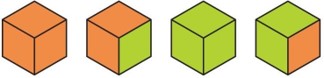
Q. A 12cm x 12cm x 12cm wooden cube is painted and its four views are shown below. This cube is sliced into 64 smaller equal sized cubes of 3cm x 3cm x 3cm. How many of these small cubes will have exactly one green face and exactly one orange face in the same cube?
Answer: 12
These "two-colour edge" cubes sit only on edges where an orange face meets a green face - and there are 6 such edges. Each edge of the big cube has 4 small cubes, but the 2 corner cubes don't count, leaving 2 per edge. So 6 edges × 2 = 12 cubes.
#2. The Gandhara sculpture question (MSQ) - cultural literacy.
Q. Which of the sculpture(s) given below belong(s) to the Gandhara style?
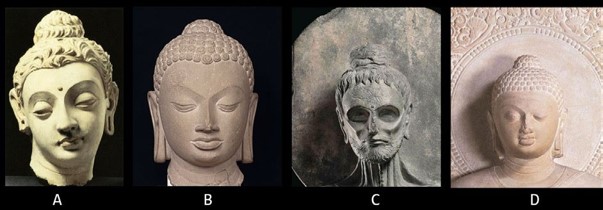
Answer: C
Gandhara art (roughly 1st–5th century CE, in present-day Pakistan/Afghanistan) is a Greco-Buddhist fusion - Buddhist subjects rendered with Greco-Roman realism, drapery and features.
#3. The maternal-health design question (MSQ) - empathy and context.
Q. Consider a scenario in India in the year 2000: Women from several nomadic tribes are in danger of having complicated pregnancies. At times, they have little or no knowledge of pregnancy or childbirth related ailments, interventions and government schemes. The problem is worsened by the fact that women’s literacy within these communities is low and since they keep moving from place to place, access to electricity is low. An NGO decides to address this problem and hopes to improve maternal health in this community through information dissemination.
Which of the following could be effective in communicating this information to this community?
I. Smartphone applications
II. Smart watches with health monitoring sensors
III. Camps and workshops
IV. Folk songs
V. Radio
VI. Folk theatre
VII. Pregnancy tracking websites
VIII.Posters
IX. Printed booklets
- I, II, VII
- IV, VI
- V, III
- VIII, IX
Answer: B,C,D
The "obvious" high-tech options - smartphone apps, smartwatches with sensors - quietly fail here, because they assume literacy, devices and power that the community lacks.
The humane, effective answers are the oral and local ones: folk songs, folk theatre, radio, and community camps.
Sharpen these separately:
|
Drill counting and 3D sets |
Practice Important GK |
Strengthen spatial skills |
Which UCEED 2017 Question Types Still Appear in Recent Papers?
Here's the insight that makes a nine-year-old paper worth solving- UCEED reuses its core question types.
The images and numbers change every year, but the underlying archetypes repeat with striking consistency. So a pattern you learn to recognize in 2017 is one you'll almost certainly meet in 2027.
To prove it, we mapped four signature 2017 questions against the official 2018 and 2025 papers.
|
Recurring Question Types |
How it looked in UCEED 2017 |
Where it reappeared |
What it trains |
|
Painted-solid slicing & counting |
A 12 cm cube cut into 64 smaller cubes, counting two-color faces (Q1) |
2018 figure-counting sets; 2025 magic-square and elimination counting |
Systematic 3D counting |
|
Art movement / style identification |
Spot the Gandhara-style sculpture (Q21) |
2018 art-movement matching and Picasso chronology; 2025 "who painted a moustache on the Mona Lisa?" → Dadaism (Q45) |
Art history & design movements |
|
Empathy-led design scenario |
Choosing how to reach a low-literacy nomadic community (Q22) |
The very core of today's Part B drawing prompts - real-life scenes to visualize for a specific person |
User-context design thinking |
|
Reflect / fold / count shapes |
Reflect a shape across an axis and count the rectangles |
2018 solid nets (Q38, Q42) and paper-fold cut-outs (Q61) |
Symmetry & spatial transformation |
Beyond these four, other 2017 staples run straight through to the 2025 paper too: number-and-pattern series, materials-and-process questions (think lost-wax casting or metal finishing), and "match the leaf to its plant" nature observation.
Understanding this profile is more useful than any weightage percentage, because it tells you how to become the kind of thinker UCEED rewards - see how these map to UCEED subjects.
The Smartest Way to Use a 9-Year-Old UCEED 2017 Paper
A single old paper, used well, beats ten papers skimmed carelessly. Try this contrast drill, which is far more revealing than solving 2017 alone:
1. Solve UCEED 2017 in real exam-like conditions
Under a strict 3-hour clock, applying its real marking (partial marking for MSQ, −1 on MCQ).
2. Immediately solve a recent year's Part A
For example, pick the UCEED 2026 question paper Part A questions - under the same timer.
3. Compare the two
Note where the difficulty level rose, which question types appears most frequently, and where partial MSQ marking changes your strategy.
This "old paper vs new paper" comparison shows you exactly how UCEED has evolved - knowledge no single-year practice can give you.
Slot it into a proper UCEED study plan and pair it with quality UCEED books.
4. List your recurring weak spots
Carefully observe where you loose marks across both papers, not just in one.
5. Fix one weakness fully
Work on one weakness before moving on until you are confident, then repeat with another year.
Solve timed free UCEED mock test, then benchmark against the UCEED cut-off.
Conclusion: Make the 2017 UCEED Paper Earn Its Place in Your Prep
The UCEED 2017 question paper is valuable for one reason above all: it shows you how UCEED thinks - part visual logician, part culture buff, part empathetic designer. So don't just download it and tick answers.
Here's your move: solve it once under real timing and real 2017 rules, then solve a recent year back-to-back and list every weakness that shows up in both. That side-by-side gap is your personalised syllabus.
Do three things this week - solve 2017 timed, run the old-vs-new comparison, and take one full mock to pressure-test the fix - and a nine-year-old paper becomes one of the sharpest tools you own for 2027–2028.
Download UCEED Question Papers: (Year-Wise Papers & Their Deep Analysis)
For more details on each UCEED Previous Year Question Paper, check the year-wise paper blogs:
Prefer guided prep? Book a free demo class through our UCEED courses and get a personalized study plan from mentors who've helped students crack IIT design programs.


Attempt a Free UCEED Mock Test
Fill your details
Frequently Asked Questions
Where can I download the UCEED 2017 question paper with answers PDF?

Did UCEED 2017 have a Part B or drawing section?
Was there negative marking in UCEED 2017?
How difficult was the UCEED 2017 question paper?
How many questions were in UCEED 2017 and what were the total marks?
Is the UCEED 2017 question paper still useful for 2027 or 2028 preparation?
Where can I find the UCEED 2017 question paper with solution, not just answers?
Vineeta Agrawal
Communications Executive
SHARE