
1723534562.png)

UCEED NAT Questions with Solutions PDF Download for 2027 Preparation
July 1, 2026
Summary: Learn how to master UCEED NAT Questions 2027 with proven strategies, difficulty insights, common mistakes to avoid, and a weekly preparation plan. This guide covers all types of NAT question in UCEED, pattern analysis, scoring hacks, and essential tips to help you improve accuracy and score higher in the NAT section effectively.
The UCEED NAT questions (Numerical Ability Questions) are one of the most scoring yet tricky parts of the exam. NAT is one of the three main sections of UCEED 2027 exam, the other two being MCQs and MSQs. However, unlike MCQs and MSQs, there are no options in NAT questions, and even a minor calculation, observation, or interpretation error can cost you marks. But at the same time, there's no fear of negative marking like in the case of the other two.
With the right strategy, pattern understanding, and consistent practice, you can score exceptionally high in the NAT part.
This detailed guide covers everything, from what UCEED NAT is & most frequently asked NAT question types to how to prepare for UCEED NAT questions, how to avoid common mistakes, how to practice with UCEED previous year papers, and expert-level hacks to score full marks in NAT Questions in UCEED.
Note: This video is about UCEED 2026, but it's relevant for 2027 aspirants as well.
What is NAT in UCEED?
NAT stands for Numerical Answer Type questions, an important part of Part-A of the UCEED 2027 syllabus. These questions require you to enter a numeric value in the answer box. Unlike MCQs (MSQ & MCQ), UCEED NAT questions do not provide answer choices making them purely logic- and accuracy-driven. In this section you'll encounter different types of questions math-based or logic-based that will have a numeric value as an answer.
These questions might require geometrical calculations, visualization, solving puzzles or counting surfaces, diagonals or any other elements in a given figure.
Key features of NAT Questions in UCEED 2027:
- Answers can be integer or decimal.
- No negative marking
- No options → pure accuracy test
- Focus on visual reasoning, spatial awareness, logic, geometry, puzzle solving
- Very high scoring if you approach them smartly
Because there is no negative marking, you should attempt 100% NAT Questions in UCEED.
Why NAT Questions in UCEED 2027 Matter So Much
The UCEED NAT questions form one of the most crucial scoring segments in the entire exam. According to the official UCEED marking scheme, the NAT section alone carries 56 marks out of 200, which means 28% of the entire UCEED question paper is purely numerical and accuracy-based.
This makes NAT the single highest-weightage component of Part A.
Total Number of NAT Questions in UCEED:
|
Section |
Question Type |
No. of Questions |
Marks per Question |
Total Marks |
|
Part A |
NAT (Numerical Answer Type) |
14 questions |
4 marks |
56 marks |
Why This Weightage Is Game-Changing:
1. Nearly One-Third of Part A
As per UCEED 2027 exam pattern, Part A is 300 marks on paper but normalized to contribute 60% of your score.
Within this:
- NAT = 56 marks
- MSQ = 72 marks
- MCQ = 72 marks
This makes NAT the foundation layer of Part A performance.
2. No Negative Marking = Guaranteed Scoring Opportunity
NAT questions have zero negative marking, unlike MSQs.
This means:
- You can attempt all 14 questions without fear
- Even approximate answers can fetch marks
- Intelligent guessing is possible
- Not attempting = wasting free marks
A student who attempts all 14 NAT questions strategically can boost their score significantly.
Read more: UCEED 2027 Question Papers
3. NAT Marks Decide Cut-Off Movement
Over the years, UCEED trends show that students who score 35-45+ in Numerical ability scetion almost always clear:
- Category cut-offs
- Rank list inclusion
- Part B shortlisting
Why? Because NAT questions are:
- Less guessable
- Less attempted by average students
- High-scoring for prepared students
This creates a score-gap advantage.
4. NAT Section Is Predictable in Question Types
Unlike MSQ/MCQ where topics vary widely, NAT Questions in UCEED 2027 follow a stable, repeating pattern every year:
- Cube & cuboid counting
- Rotational questions
- Geometry-based reasoning
- Pattern decoding
- Isometric view visualisation
- Symmetry
- Surface calculation
This means consistent practice guarantees growth.
5. NAT Accuracy Boosts Your Total Rank Dramatically
Here’s how:
- Scoring 40/56 in NAT = stronger than 80% of test takers
- Scoring 50+/56 = top 10% performance
- Scoring 56/56 = possible with enough pattern practice
Because NAT has no negative marking and predictable difficulty level, top rankers maximize their score here.
Check: Expert Tips on How to Avoid Negative Marks

Most Commonly Repeated UCEED NAT Questions for 2027 Prep
Based on analysis of previous years' UCEED NAT questions, the most frequently repeated categories include:
1. Spatial and 3D Reasoning
|
Count cubes in 3D forms |
Cut Solids and count surface |
|
Find hidden surfaces |
Maximum number of figures in another figure |
|
Rotations and mirror views |
Net folding questions |
Example Question:
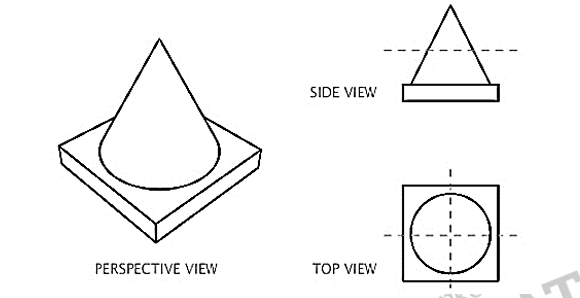
A perspective view of a solid object is shown on the left. The object is cut simultaneously along THREE perpendicular planes as shown on the right. How many surfaces will the resulting pieces have in total (i.e. sum of the surfaces of all pieces)?
FREE Resource: UCEED Marks vs Rank 2027 - Analysis & Admission Insights
2. Geometry-Based Visual Problems
|
Area, perimeter, volume, radius |
Radius, vertices of polygons |
|
Rotational symmetry |
Dice and predictability |
|
Shape transformations |
Pattern prediction |
Example Question:
Shown below is an image of a circle and six equilateral triangles. The circumference of the circle is 18.85 cm. What is the area of ONE equilateral triangle in cm2? Assume √3 = 1.732 and π = 3.14.

3. Pattern, Sequence & Logic
|
Find next in sequence, shape sequence repetition |
Coding/decoding |
|
Missing value puzzles |
Spot the differences |
|
Odd-one-out (numeric) |
Number of font types |
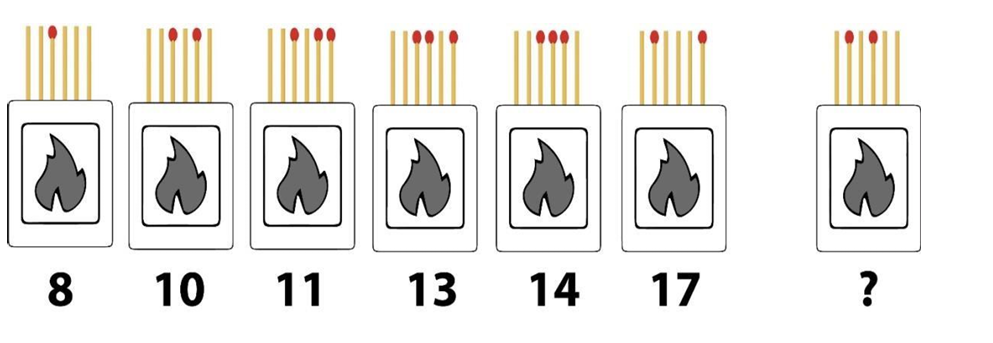
Example Question:
Read more: UCEED Exam Analysis
4. Image-Based Puzzles
|
Counting elements/surfaces/shapes |
|
Identifying distortions |
|
Comparing visual changes |
Example Question:
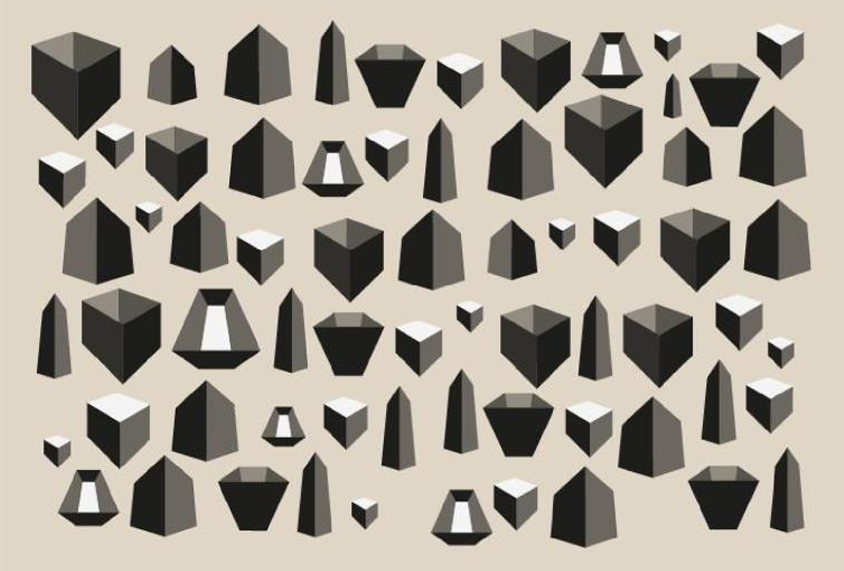
Objects made out of cardboard are shown in the image below. Count the number of objects shown as open containers in this image.
5. Analytical Mathematics (Easy to Moderate)
|
Ratio/proportion |
Speed, distance, time |
|
Approximation |
Dates & calenders |
|
Basic algebra embedded in visuals |
Progression and series |
|
Time & clock |
Example Question:
Tim cycled from his house to his friend John’s house and then on to his (Tim’s) school without stopping. The average speed for his entire journey was 26 km/hr. The distance from John’s house to Tim’s school is 0.3 times the distance from Tim’s house to John’s house. Tim’s speed from John’s house to Tim’s school was twice that of Tim’s speed from Tim’s house to John’s house. What was Tim’s average speed from John’s house to Tim’s school in km/hr?
Also Check: Best books for UCEED Preparation


What Preparing Well for UCEED NAT Questions Means for Your Overall UCEED 2027 Result?
1. Higher Part A Score
Since NAT accounts for 56 marks, even moderate improvement creates a massive rank shift.
Example:
If you improve your NAT score from 20 → 40, your total rank can jump by 600-1200 positions, based on past-year trends.
2. Better Stability in Score
MSQ and MCQ involve negative marking. But NAT gives you:
- Stability
- No marks lost
- Full control over accuracy
This stabilizes your Part A even if MSQ gets tough that year.
3. Stronger Chance to Qualify for Part B
Cut-offs depend heavily on Part A performance. A strong UCEED numerical ability score ensures you're comfortably above:
- Opening UCEED cut-offs
- Closing cut-offs
- Rank-list eligibility
4.Competitive Edge Over “Average Preparers”
Most students fear NAT because:
- No options
- Visual-heavy problems
- Calculations needed
This fear works in your favour when you master NAT.
5. A Clear Path Toward Top 200 Ranks
If you aim for IIT Bombay, IIT Delhi or IIT Hyderabad, NAT mastery is a must.
Consistent NAT accuracy = Top-tier rank improvement.
Read More: Best Tips to Tackle Trick Questions in UCEED
How to Approach NAT Questions in UCEED 2027 (Step-by-Step Strategy)
Mastering NAT Questions in UCEED is not about memorizing formulas, it’s about developing a structured way of thinking that helps you interpret visuals, break down geometric relationships, and derive accurate numerical answers.
Below is a proven 7-step framework that top UCEED rankers use to solve NAT questions smoothly and quickly.
1. Read the Question Twice - Spot Keywords & Conditions
Most mistakes happen because students MISS a small word that changes the entire meaning.
Look for keywords such as:
- minimum / maximum
- exactly / at least / at most
- visible / hidden
- rotation direction
- ratio / scale factor
2. Convert Visuals Into Mental Models (or Quick Sketches)
Most NAT questions require you to visualise shapes, rotations, dimensions, or hidden surfaces.
When to Sketch:
- Figure counting
- Net folding
- Fix the puzzle
- Rotational problems
- Pattern mapping
- Object views
Sketching reduces mental load and increases accuracy.
Example:
A cube with 3 painted faces is cut into smaller cubes. A quick sketch will immediately show:
- Corner cubes
- Edge cubes
- Face-centre cubes
- Inner cubes (unpainted)
Without a sketch, mistakes are common.
Check: Time Management During UCEED Exam 2027
3. Break the Problem Into Smaller, Solvable Parts
UCEED NAT questions 2027 are complex only if you try to solve them in one go. Break questions into parts:
- Identify known values
- Mark what's missing
- Establish relationships
- Simplify into smaller units
Example
Question: A pattern increases by 1 unit on each iteration. What is the number of triangles in the 7th iteration?
Instead of drawing the full pattern:
- Look for the pattern in the first 3 iterations.
- Identify the formula (ex: n(n+1)/2).
- Substitute n = 7.
You cut down a 3-minute question into 20 seconds.
4. Use Systematic Rotation / Transformation Logic
Rotation questions require methodical thinking, not random guessing. Here’s a hack:
Always rotate: 90°, 180°, 270°, Full 360°. And track changes step-by-step.
Don’t imagine continuous smooth rotation → this confuses most students.
Example: A fan rotates 120° clockwise per second. Find the orientation after 4 seconds.
Correct approach:
Each second = 120°
4 seconds = 480°
480° mod 360° = 120°
Answer = 120°
A stepwise approach prevents confusion.
5. Eliminate Impossible Values (Even Without Options!)
Just because NAT has no options doesn't mean elimination doesn’t help.
Eliminate values that are:
- Negative
- Geometrically impossible
- Larger/smaller than visual limits
- Breaking pattern rules
6. ALWAYS Attempt Every NAT Question
This is the most important rule.
Zero negative marking = every unanswered NAT question is a lost opportunity
If your answer is between:
45 and 50 → try 48
1.2 and 1.5 → try 1.35
10 and 12 → try 11
A smart approximation can still get full marks.


Hacks to Improve Your UCEED NAT Questions 2027 Score Fast
NAT Questions in UCEED 2027 may feel tricky because there are no options, but the truth is they’re the easiest section to score fast, clean, and high marks if you follow the right techniques. The hacks below are designed to help you reduce calculation time, improve visual interpretation accuracy, and avoid the most common mistakes students make.
Hack #1: Re-draw the Diagram in a Simplified Form
UCEED visuals are often intentionally complex. Your job? De-clutter them.
How this helps:
- Reduces confusion
- Makes counting faster
- Helps find hidden blocks or surfaces
- Avoids missing small elements
Example:
A cube with stripes / cuts / patterns can distract you. Redraw as a clean cube → mark only essential elements → count accurately.
Hack #2: Use the “Net Method” for Difficult Cube Questions
Instead of imagining the cube in 3D (which is hard), convert it into a 2D net.
Why this works:
- Makes adjacency relationships clear
- Helps identify which faces touch
- Reduces mistakes in painted-surface question
Example: If asked - “How many small cubes have exactly 3 faces painted?”
Draw the cube net → identify corner areas → multiply.
Even complex painted cubes become easy.
Hack #3: Don’t Rotate the Object - Rotate Your Page Instead
This is a common trick used by architecture and design students. Instead of mentally rotating a shape by 90° or 270°, simply tilt the page the same way.
Your brain instantly sees the orientation without mental load.
Example: If a question asks -
What will be the position of the shape after a 90° clockwise rotation?
Tilt your page 90° anticlockwise → the shape “appears” rotated clockwise.
Hack #4: Use Symmetry to Reduce Work by 50%
If a shape is symmetrical, solve for one side and multiply.
Example: A mandala-like figure has 8 identical sectors.
If one sector contains 6 lines → total lines = 6 × 8 = 48.
This hack turns a 2-minute task into 15 seconds.
Also Check: What is a Good Score in UCEED 2027?
Hack #5: Reduce Visuals to Primitive Shapes
No matter how complex the shape looks, reduce it to:
- Squares
- Rectangles
- Circles
- Triangles
- Cubes
- Cylinders
Why this works:
All complex UCEED figures are combinations of these primitives.
Hack #6: Use “Anchor Values” to Avoid Overthinking
Anchor values = fixed reference points you must know.
Examples:
- Cube with 3 faces painted = 8 corner cubes
- Regular hexagon interior angle = 120°
- Area ratio scales with square of factor
- Volume ratio scales with cube of factor
Knowing these increases speed.
Hack #7: Attempt NAT Questions First
As compared to other sections of UCEED Part A like MSQs and MCQs where wrong answers can result in negative marking, NAT with no negative marking is usually a good idea to start your uceed exam paper with.
Plus they are easier to get almost correct and they boost your confidence early. Starting your paper with NAT helps build momentum.
Hack #8: Practice 10 UCEED NAT Questions Daily that Matches the Real Exam's Difficulty Level
Consistency is everything. A daily dose of NAT problems builds:
- Visual speed
- Analytical strength
- Accuracy
- Pattern recognition
In 30 days, NAT becomes your strongest section.
Examples of UCEED NAT Questions With Step-by-Step Solutions PDF
A dice throw can result in the numbers 2,3,5 or 6. Every 4th throw will result in 3. What is the minimum number of times the dice has to be thrown for the pawn to move from zero to reach exactly at 100? (2023)
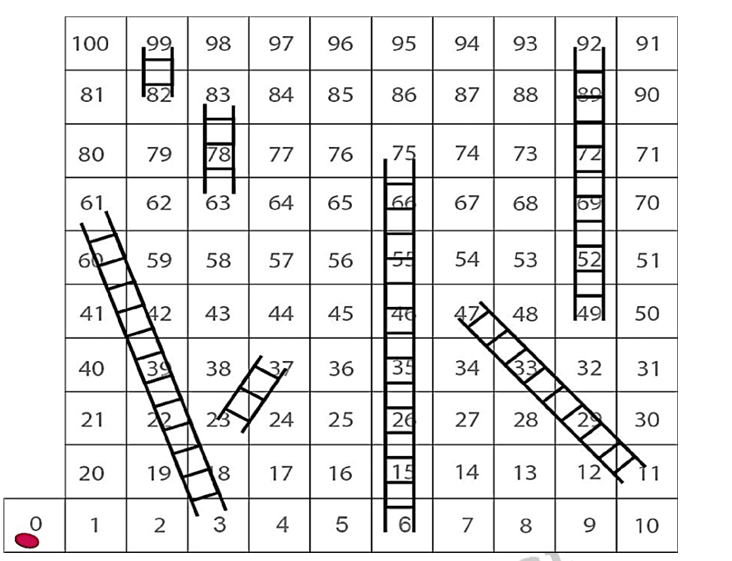
Step-by-step Solution:
Step-1> As dice can throw the numbers 2,3,5 or 6. Since 1 is not there in this scenario, it’s not possible to go from 99 to 100. Therefore, the 82 – 99 ladder is of no use.
Step-2> To come to 23 from 0, there’s no shortcut. Which in turn mean that we’ll already need several chances to be able to use the 23 to 37 ladder.
Step-3> Similarly in case of 6 to 75 ladder, say you get 6 in the first chance itself and reach 75, again after that there’s no other shortcut to reach 100. So this ladder is also of not much use.
The only other scenario that can work is:

Step-4> Start with a 5, then a 6 and reach 47 from 11. Then a 2 will take to 92. As per pre-defined requirements, 4th turn will be a 3. Which means now we are at 95, and next or final (5th) turn will give a 100.
So answer of this question is 5.
To access more such UCEED NAT questions with Step-by-step solutions PDF, click the button below!
Difficulty Level of Different NAT Questions in UCEED 2027 (Tabular Format)
The NAT section of UCEED contains a mix of easy, moderate, and difficult questions. Understanding this difficulty distribution helps students prioritize preparation and maximise scoring.
Difficulty-Level Analysis of NAT Questions in UCEED
|
Type of NAT Question |
Difficulty Level |
Why It Falls in This Category |
Skills Required |
Example |
|
Basic Counting / Simple Visual Questions |
Easy |
Direct observation, minimal calculation, straightforward visuals. |
Observation, basic sketching |
Count the number of triangles in a simple pattern. |
|
2D Geometry (Area, Perimeter, Basic Shapes) |
Moderate |
Simple formulas but requires clean reading of dimensions. |
Geometry basics, mental math |
Find the area of an irregular shape formed by rectangles. |
|
3D Cube & Cuboid Counting |
Moderate |
Needs accurate visualisation and layer-wise thinking. |
3D reasoning, layer counting |
Number of unpainted cubes after cuts. |
|
Pattern Growth / Sequence NATs |
Moderate |
Requires identifying growth logic in visuals. |
Pattern recognition |
Next figure in a dot expansion pattern. |
|
Symmetry & Mirror/Nets Folding |
Moderate-Difficult |
Challenging when visuals are complex or asymmetrical. |
Spatial reasoning |
Predict the folded shape from a net. |
|
Rotational & Orientation Problems |
Moderate-Difficult |
Mental rotation is harder for many students; tricky angles. |
Stepwise rotation logic |
Orientation after 120° rotations repeated 6 times. |
|
Scale Transformation (Ratio-Based Geometry) |
Moderate |
Requires understanding scale factors + geometry + ratios. |
Ratio and proportional reasoning |
A square scaled 1.5× - find new area/perimeter. |
|
Complex 3D Visualisation / Hidden Surfaces |
Difficult |
Hardest category; requires deep 3D imagination and careful sketching. |
Advanced visualisation |
Count visible + hidden cubes in an irregular stack. |
|
Puzzle-Based NATs (Mixed Concepts) |
Difficult |
Combine geometry, logic, patterns & spatial reasoning in one problem. |
Multistep logic, accuracy |
Floor tile arrangement puzzles with constraints. |
Must Read: How to Prepare for UCEED 2027 in 2 Months
Download UCEED Previous Year Question Papers PDF [2025-2021]
| UCEED Previous Year Question Papers | UCEED PYQ PDF Links |
| UCEED Question Paper 2025 | |
| UCEED 2024 Question Paper | |
| UCEED 2023 Question Paper | |
| UCEED 2022 Question Paper | |
| UCEED 2021 Question Paper |
FREE Resource: The Ultimate UCEED Study Material Kit 2027

1757510491.webp)
Download UCEED Previous Year Question Papers Answer Key PDF
| UCEED Previous Year Question Paper Answer Key | PDF Links |
| UCEED 2025 Answer Key | |
| UCEED 2024 Answer Key | |
| UCEED 2023 Answer Key | |
| UCEED 2022 Answer Key | |
| UCEED 2021 Answer Key |
Importance of Solving PYPs for UCEED NAT Questions Preparation for 2027
Solving UCEED Previous Year Papers (PYPs) is the most powerful method to strengthen your command over NAT Questions in UCEED 2027. PYPs give you real exam exposure, help you decode the examiner’s approach, and build the visual reasoning skill required to solve NAT questions with speed and accuracy.
Below are the key reasons why practicing UCEED PYPs is essential for NAT mastery:
1. NAT Question Patterns Repeat Almost Every Year
UCEED heavily repeats question formats, even though exact questions don’t repeat.
Common repeated NAT patterns include:
- Shape cuts, flipping, rotation, top/side views
- Cube rotation & painting
- Hidden faces
- Counting shapes, objects and surfaces (high repetition rate)
- Rotations and orientation (high repetition rate)
- Speed, distance, time
- Dice and probability
- Sequence and Series completion
- Area, volume, side of shapes/polygons (very high repetition rate)
- Shape scaling and transformation
- Geometry-based UCEED reasoning questions
- Pattern recognition
If you solve several PYPs or attempt exam-level UCEED mock test series, these patterns become predictable, reducing solving time dramatically.
2. Improves Accuracy by Reducing Silly Errors
Most NAT marks are lost due to small mistakes:
- Misreading instructions
- Missing hidden parts
- Incorrect visual estimation
- Misinterpreting rotations
Regular exposure to PYP-style visuals helps you catch these errors early and improve your precision.
3. Builds Strong Visual Thinking & Interpretation Skills
NAT questions rely on:
- Visual analysis
- Spatial thinking
- Perspective understanding
- Geometric breakdown
UCEED preparation with PYPs expose you to real exam-level visuals, diagrams, and patterns, strengthening your visual processing speed and reducing mental load.
4. Teaches You the Exact Difficulty Level of NAT Questions
PYPs show you the real:
- Length of questions
- Type of visuals used
- Level of geometry required
- Calculation intensity
- Traps set by examiners
This helps you avoid over-studying irrelevant topics and focus only on what the exam repeatedly tests.
5. Helps You Practice Timing & Speed
Many students struggle with time management in NAT because they:
- Overdraw
- Overthink
- Use slow methods
- Get stuck visualizing
PYP practice helps you learn:
- When to sketch
- When to approximate
- When to move on
- How long each NAT question should ideally take
Plus, speed improves naturally with repeated exposure.
6. Helps You Build NAT “Templates” in Your Mind
After solving multiple PYPs, you start recognizing the logical structures behind questions.
You subconsciously develop templates such as:
- 'This is a rotation type - find angle first.
- 'This cube cut matches the 2021 pattern.'
- 'This scaling problem works like 2020 NAT question.'
This pattern recognition significantly increases solving speed.
7. Reveals Your NAT Weaknesses Early
PYPs show you exactly where you struggle:
- Cube visualization
- Rotations
- Perspective-based geometry
- Pattern growth
- Ratios and scaling
This helps you create a targeted improvement plan rather than studying randomly.
8. Helps You Predict NAT Question Count & Marks Distribution
Only UCEED PYP analysis can confirm:
- Changes or consistency in the number of questions
- Number of marks each NAT question carry
- Total NAT weightage
- Zero negative marking
This helps you structure your Part A exam strategy effectively.
10. Helps You Prepare Strategically for Exam Day
By solving PYPs, you learn:
- Which NAT questions to attempt first
- Which ones to skip initially
- How to allocate time per question
- How to manage long visual-based NATs
- How to balance NAT with MSQ/MCQ sections
This becomes your personal solving framework for exam day.
Also Check: Why Students Across India Trust CreativEdge for UCEED Coaching
Last-Minute Preparation Tips to Score High in UCEED NAT Questions 2027
|
Tip |
What to Do (Practical Preparation Advice) |
Why It Boosts NAT Score |
|
1. Revise All Repeated NAT Patterns |
Go through cube counting, hidden surfaces, rotations, symmetry, scaling, and pattern-growth questions from PYPs. |
NAT types repeat almost every year. Revising patterns gives instant familiarity and faster solving. |
|
2. Practice 20-25 Mixed NAT Questions Daily |
In the last week, solve a small daily set of mixed-level NAT questions without a timer. |
Builds steady visual reasoning and keeps your NAT-solving muscles active. |
|
3. Do a Focused Revision of Geometry Basics |
Quickly revise angles, area formulas, perimeter, nets, projections, and ratio → scale relationships. |
60-70% of NAT questions involve basic geometry; revising this boosts accuracy immediately. |
|
4. Re-solve Last 3 Years of UCEED NAT Questions |
Instead of new questions, re-solve only the last 3 years’ NAT section. |
Helps your brain build question template. Crucial for quick recognition in the actual exam. |
|
5. Strengthen Visualisation Through Quick Sketch Drills |
Spend 15 minutes daily drawing cubes, rotating shapes, unfolding nets, and breaking shapes into primitives. |
Improves your mental imaging capacity, which is the backbone of NAT accuracy. |
|
6. Create a “NAT Shortcut Sheet” |
Prepare one-page notes with formulas, rotation rules, cube tricks, scale factors, symmetry rules. |
Reviewing this daily builds automatic recall, reducing cognitive load during solving. |
|
7. Analyse Your Mistakes From Past Practice |
Go through mistakes: misreading, wrong visualisation, calculation errors, unit mismatch, skipped constraints. |
Prevents repeat mistakes. This alone can raise NAT marks by 10-15 easily. |
|
8. Practice Approximation & Mental Math |
Do quick drills for ratios, simple areas, multiplication shortcuts, and decimal approximations. |
NAT requires accuracy + speed; strong mental math helps answer without long steps. |
Refer: Designing Sketches and Human Figures for UCEED 2027
Weekly Preparation Plan for UCEED NAT Questions 2027
|
Day |
Focus Area |
Tasks to Complete |
Outcome Expected |
|
Day 1 |
Basics + Visual Foundation |
Revise 2D geometry basics (area, perimeter, angles). Do 20 simple NATs (triangles, squares, sequences). |
Foundation clarity, warm-up for NAT logic. |
|
Day 2 |
Cube & Cuboid Mastery |
Learn cube painting rules, layer counting. Solve 15 cube NATs from PYPs. |
Strong command on the most repeated NAT type. |
|
Day 3 |
Symmetry, Nets & Folding |
Practice nets → folded shape → final orientation. Do 20 symmetry NATs. |
Improved spatial reasoning for mid-level NATs. |
|
Day 4 |
Pattern Growth & Logic |
Solve 15-20 pattern-based NATs (visual sequences, iterations). Study 2–3 solved examples. |
Ability to decode visual patterns quickly. |
|
Day 5 |
Rotations & 3D Visualisation |
Practice stepwise rotations (90°, 120°, 180°). Solve 15 rotation NATs from PYPs. Sketch every problem. |
Accuracy in orientation and rotation-type NATs. |
|
Day 6 |
Mixed NAT Practice (Timed) |
Solve 25 mixed-level NATs in 45-50 minutes. Analyse mistakes. |
Real exam endurance, timing, accuracy improvement. |
|
Day 7 |
PYP + Mistake Analysis |
Solve NAT questions from last 3 years. Create a short notes list of repeated patterns and errors. |
Final polishing + recognition of templates + last-minute improvement. |
Also Check: UCEED Study Plan 2027
Common Mistakes Students Make in UCEED 2027 NAT Questions (With Fixes)
|
S.No. |
Common Mistake |
Why It Happens |
How to Fix It (Practical Solution) |
|
1. |
Misreading Key Words (exactly, minimum, hidden, visible) |
Students skim questions and skip crucial qualifiers. |
Slow down for the first 5 seconds. Underline key terms. Re-read the final line before solving. |
|
2. |
Not Drawing a Sketch for 3D/Rotation Problems |
Students assume they can visualise mentally and try to save time. |
Make small, quick, functional sketches. Prioritize layer-wise or stepwise diagrams. No artistic drawing needed. |
|
3. |
Overcomplicating the Diagram |
Students try to draw neatly, shade surfaces, or add unnecessary details. |
Keep sketches minimal: only edges, layers, and important markers. Avoid clean lines and decorations. |
|
4. |
Incorrect Geometry or Unit Conversion Errors |
Missing decimals, wrong formula recall, mixing cm, mm, m. |
Review basic formulas weekly. Always convert units before solving. Quickly double-check final units. |
|
5. |
Poor 3D Visualisation (especially hidden cubes) |
Inexperience with cubes, nets, or isometric views. |
Practice layer-by-layer cube counting. Use nets to understand adjacency. Solve 15 cube NATs weekly. |
|
6. |
Not Checking the Logical Range of Answers |
Students rush to enter answers without “sanity checking.” |
Quickly ask: “Does this number make sense? Too big? Too small?” Validate with visual estimation. |
Read More: Common Mistakes to Avoid While Preparing for UCEED 2027
Conclusion
Scoring high in UCEED 2027 NAT Questions isn’t about cramming formulas; it’s about understanding patterns, sharpening your visual reasoning skills, and practicing smart. With 14 questions carrying 56 marks, the NAT section alone can dramatically shift your overall performance and give you the rank boost you need for IIT Bombay, IIT Delhi, or IIT Hyderabad.
By focusing on the most repeated UCEED NAT questions, practising regularly with NAT questions in UCEED with answers, revising core geometry concepts, and solving UCEED previous year papers, you build the accuracy, speed, and intuition required to approach NAT confidently. These questions reward clarity of thought, quick sketching, logical breakdown, and smart approximation-skills that every serious aspirant can develop with consistent last-minute preparation.
If you apply the strategies, hacks, and preparation tips shared in this guide, cracking the NAT section becomes far less intimidating and far more score-boosting. Whether you're looking for UCEED 2027 NAT Questions with solutions PDF, last-minute tips, or a structured approach to complex visual problems, remember this: strong NAT preparation is one of the most reliable ways to secure a top UCEED rank.
Push yourself in these final days. Practice wisely. Analyze your mistakes. And walk into the exam with the confidence that comes from mastering the most impactful scoring section in UCEED.
Preparing for UCEED 2027? We can help you with exact strategic roadmap, study material and crucial feedback required to ace this exam.
Join best UCEED Crash Course by CreativEdge and get expert guidance on all UCEED 2027 subjects.



Attempt a Free UCEED Mock Test
Fill your details
Frequently Asked Questions
What are NAT Questions in UCEED 2027?

How many NAT Questions are asked in UCEED?
Are NAT Questions in UCEED tough?
Do NAT Questions have negative marking in UCEED 2027?
What topics are most important for UCEED 2027 NAT Questions?
How should I prepare for NAT Questions in UCEED 2027?

Vineeta Agrawal
Communications Executive
SHARE