
1723534562.png)

UCEED 2015 Question Paper with Answer Key Free PDF Download
August 13, 2026
The UCEED 2015 question paper is the very first UCEED paper ever set - the exam was conducted by IIT Bombay on 31 May 2015. You can download the official UCEED 2015 question paper with answer key PDF free from the direct links below or from the official UCEED website.
The 2015 paper had 3 sections, 100 questions and 300 marks, was fully computer-based and objective (no drawing/Part B), and used −1 negative marking.
Because the exam has changed a lot since, treat 2015 as a historical paper - useful for aptitude practice, but not a mirror of the current pattern.
Key Highlights: UCEED 2015 Question Paper
- Historic first: UCEED 2015 was the inaugural UCEED, launched when IIT Bombay's IDC opened its B.Des program.
- Exam date: Sunday, 31 May 2015, computer-based, 3 hours.
- Structure: 100 questions, 300 marks, 3 sections, entirely objective (MCQ-type). No pen-and-paper drawing section - unlike today's Part B.
- Marking: −1 for each wrong answer (the marking scheme has since changed).
- Official PDF: both the UCEED 2015 question paper with solutions PDF and the UCEED 2015 answer key are still hosted on IIT Bombay's official site - free.
- Should you solve it in 2027? Yes for aptitude and observation practice - but solve recent papers (2023-2026) first, because they match the current Part A + Part B format.
Download the official UCEED 2015 question paper + answer key PDF (IIT Bombay) →
|
UCEED 2016 Resource |
What's Inside |
Download |
|
UCEED 2016 question paper PDF |
All 80 questions - NAT (Q1–20), MSQ (Q21–40), MCQ (Q41–80) |
|
|
UCEED 2016 answer key PDF |
Official answer key with expert solutions |
Looking for any other UCEED paper? Grab the full UCEED past year question papers set (2015-2026) with answer keys.
You can also download this paper from IIT Bombay’s official UCEED website. To get the UCEED 2015 question paper with answers PDF:
- Go to the official UCEED downloads page on uceed.iitb.ac.in.
- Scroll to "Previous Question Papers."
- Click "UCEED 2015 Question Paper" for the paper, and "UCEED 2015 Answer Key" for the official answers.
Table of Contents
- UCEED 2015 Exam Pattern & Marking Scheme
- How Is the UCEED 2015 Paper Different From the Current Exam?
- What Topics Were Tested in UCEED 2015?
- How Difficult Was the UCEED 2015 Question Paper?
- Should You Solve the UCEED 2015 Paper for UCEED 2027 or 2028?
- Common Mistakes Students Make With Old UCEED Papers
- How to Use the UCEED 2015 Answer Key Effectively
What Was the UCEED 2015 Exam Pattern and Marking Scheme?
UCEED 2015 was a 3-hour, computer-based test with 100 questions for a total of 300 marks, split across three sections. Every question was objective - there was no drawing or subjective Part B in that first year. Here's the structure:
|
Feature |
UCEED 2015 |
|
Exam date |
31 May 2015 |
|
Mode |
Computer-based (online) |
|
Duration |
3 hours |
|
Total questions |
100 |
|
Total marks |
300 |
|
Sections |
3 (all objective) |
|
Drawing / Part B |
None |
|
−1 per wrong answer |
The paper tested the core UCEED aptitudes that still matter today- visualization and spatial ability, observation and design sensitivity, environmental and social awareness, analytical and logical reasoning, and language and creativity- but it did so entirely through on-screen objective questions.
UCEED 2015 Marking Scheme
|
Section |
Type of Questions |
No. of Questions |
Marks for Correct Answer |
Marks for Incorrect Answer |
Total Marks for Each Section |
|
A |
20 |
+3 |
−1 |
60 |
|
|
B |
MSQ (Multiple Select Questions) |
30 |
+3 |
No negative or partial marking |
90 |
|
C |
MCQ (Multiple Choice Questions) |
50 |
+3 |
−1 |
150 |
|
Total |
— |
100 |
— |
— |
300 |
How Is the UCEED 2015 Paper Different From the Current Exam?
This is the part most download pages skip - and it's the thing that actually affects your preparation.
UCEED exam today is not structured like the 2015 paper. The exam introduced a subjective drawing component and reworked its marking over the years, so a 2015-only practice session can give you a misleading picture of the real test.
|
Aspect |
UCEED 2015 |
Later Editions |
UCEED now (recent editions of 2025 & 2026) |
|
Parts |
Single objective paper |
Part A objective + Part B subjective (introduced in 2020) |
Part A (objective) + Part B (pen-and-paper drawing) |
|
Question types |
MCQ-type only |
NAT + MSQ + MCQ in Part A, plus drawing in Part B |
NAT + MSQ + MCQ in Part A, plus drawing in Part B |
|
Drawing test |
None |
1 question on perspective scene sketching |
2 questions (scene creation + design aptitude) |
|
Marking |
−1 for wrong answers |
Section-specific marking (NAT, MSQ, MCQ handled differently) |
Section-specific marking (NAT, MSQ, MCQ handled differently) |
|
Total marks |
300 |
300 (Part A - 240 & Part B - 60) |
300 (Part A - 200 & Part B 100) |
The takeaway:
The 2015 paper captures UCEED's foundation - the core aptitude areas (visualization, observation, logic, awareness) that have survived every revision. What it doesn't capture is the drawing section and the varied Part A marking introduced later.
So, use 2015 to build fundamentals, but always confirm the current structure from the official UCEED brochure and practice recent papers for an accurate feel of the exam you'll actually sit.
See how the paper looks today: current UCEED exam pattern →
What Topics Were Tested in UCEED 2015?
Even though the format has evolved, the aptitude areas 2015 exam tested are still the backbone of the UCEED syllabus. Mapping the old paper to today's skills tells you exactly what's still worth practicing:
|
2015 aptitude area |
Still relevant in 2027? |
How to use it |
|
Highly relevant |
Practice directly - this skill is timeless in UCEED |
|
|
Observation & design sensitivity |
Highly relevant |
Great warm-up material |
|
Relevant |
Good for speed/accuracy drills |
|
|
Environmental & social awareness |
Relevant |
Update with current examples |
|
Language & creativity |
Partly relevant |
Style has shifted; use lightly |
|
Drawing (Part B) |
Not in 2015 |
Practice from recent papers instead |
So, the 2015 paper is a solid objective-aptitude workout, but it leaves a gap exactly where the modern exam is hardest - the drawing section.
Sample Questions from UCEED 2015 Question Paper
Q) Shown here are different types of leaves. Count how many types of leaves there are.
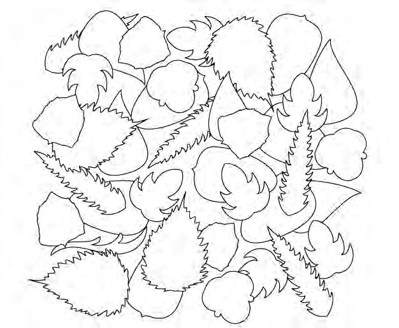
Ans: 8
Q) Shown here are letters of an alphabet, from A to Z. How many of these letters, if flipped along the horizontal axis, can still be read as capital letters?

Ans: 14
Q) Shown below are three types of interlocking rods. There are total 12 rods, of which 6 are type A, 2 are type B and 4 are type C respectively. What is the maximum length that can be achieved by connecting the rods appropriately?
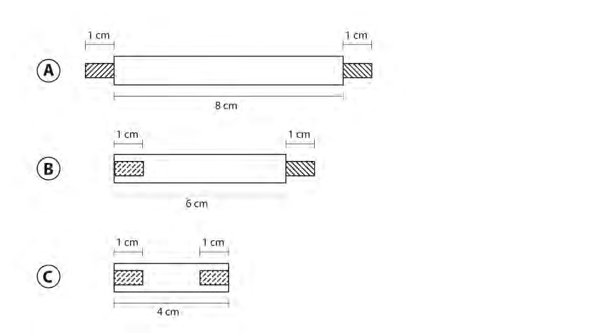
Ans: 70
Q) Two views of the same solid object are shown below. Count the number of surfaces the solid object has.
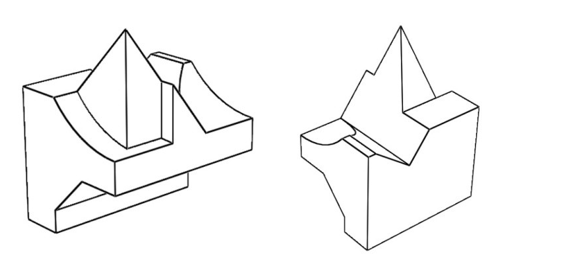
Ans: 18
Q) A person has six daughters, P, Q, R, S, T and U, who live in four metros. They are a Pilot, Accountant, Diplomat, Banker, Commando, and Teacher.
Three daughters are married.
S, who lives in Mumbai, is a Diplomat.
Those staying in Kolkata are the Commando and the Accountant.
One of the two Mumbaites is married, while two of the unmarried ones live in Kolkata and Delhi respectively.
The Teacher lives in Chennai. T, the Accountant, is married.
U lives in Mumbai and P, in Delhi.
Q is a Commando, and Commandos do not marry.
Which of the following assertions is/are TRUE?
- If the Banker is unmarried, then the pilot is P.
- R is the teacher, and lives in Chennai.
- Q is unmarried.
- If the Diplomat is married, then so is the Banker.
Ans: B,C
Q) Which of these paintings is/are by Paul Klee?
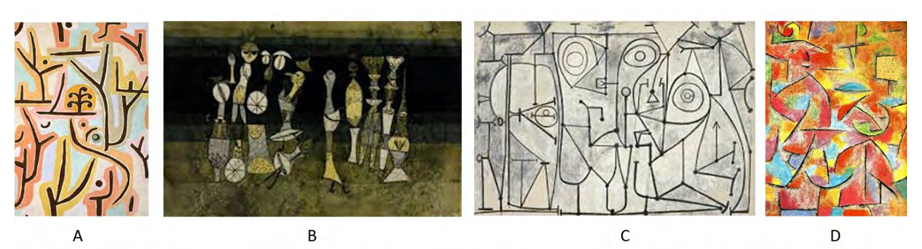
Ans: A,B,D
How Difficult Was the UCEED 2015 Question Paper?
There's no official difficulty rating for UCEED 2015, and because it was the very first UCEED, first-hand cutoff and score data from that year is limited.
So rather than assign a made-up "difficulty score," here's what the paper's actual structure tells you about how tough it was to crack - which is more useful for your preparation anyway.
|
Factor |
UCEED 2015 |
What it meant for difficulty |
|
Questions vs. time |
100 questions in 180 minutes |
~1.8 min per question - a speed test, not a slow reasoning test |
|
Negative marking |
−1 per wrong answer |
Raised the risk of guessing; punished careless attempts |
|
Question style |
Objective only (no drawing) |
Removed subjective-scoring pressure, but demanded fast, accurate aptitude |
|
Skill spread |
Visualisation, observation, logic, awareness, language |
Rewarded all-round aptitude over any single strength |
|
Novelty factor |
First-ever UCEED, no past papers to practice from |
Genuinely harder for 2015 students - you have an advantage they didn't |
Should You Solve the UCEED 2015 Paper for UCEED 2027 or 2028?
Short answer- yes, but strategically. The 2015 paper is worth an hour of your time as an aptitude drill and as a piece of UCEED history - it shows you how the exam began. But it should be one of the last papers you touch, not the first.
Here's the most sensible order for a 2027/2028 aspirant:
1. Start with the most recent papers (2026, 2025, 2024) - these match the current Part A + Part B pattern and marking.
2. Work backwards (2023 → 2018) to see how question styles evolved.
3. Finish with the early papers (2015-2017) as pure aptitude practice, knowing the format is dated.
Solving 2015 first would train you for an exam that no longer exists in that form. Solving it last, as revision, sharpens your fundamentals without distorting your expectations.
Once you've reviewed 2015, test yourself on the current pattern with a free UCEED mock test →
Common Mistakes Students Make With Old UCEED Papers
A few traps to avoid when you practice a paper as old as 2015:
Treating the pattern as current
The 2015 marking (−1) and structure aren't today's - don't calibrate your strategy to it.
Ignoring Part B
No amount of 2015 practice prepares you for the UCEED drawing questions. Budget separate time for sketching.
Memorizing GK answers
Environmental/awareness questions from 2015 are dated; learn the type of thinking, not the specific facts.
Skimming the answer key
Don't just check right/wrong - understand why the visualization and logic answers work; that reasoning is what carries into 2027.
How to Use the UCEED 2015 Answer Key Effectively
Downloading the UCEED 2015 answer key is step one; using it well is what improves your score. After you attempt the paper under timed conditions:
- Mark your objective answers against the official key and log every mistake by aptitude area (visualization, logic, observation).
- For each wrong answer, write one line on why the correct option works - this builds pattern recognition.
- Track your time per section; the 2015 paper is a good speed test even if the format is dated.
- Revisit weak areas using recent papers, where the same skills appear in the current format.
Check: CEED year-wise exam analysis
Download UCEED Question Papers: (Year-Wise Papers & Their Deep Analysis)
For more details on each UCEED Previous Year Question Paper, check the year-wise paper blogs:
| UCEED 2023 Question Paper | |||
| UCEED 2019 Question Paper | |||
|
- |
- |
Conclusion
The UCEED 2015 question paper holds a special place as the very first UCEED ever conducted on 31 May 2015. Both the official question paper and answer key are available in this article, so you can download, attempt and self-score it in full.
The 2015 paper is a genuine IIT Bombay paper and an excellent workout for timeless aptitude skills - visualization, observation, logic and design sensitivity.
But its format predates today's exam: there's no Part B drawing section, and the marking has since changed. So use it as a fundamentals drill and a piece of UCEED history, not as a mirror of the current pattern and always practice recent papers first to prepare for the exam you'll actually sit in 2027 or 2028.
Ready to practise on the current pattern? Attempt a free UCEED mock test
Preparing for UCEED 2027 or 2028? We can help you with exact strategic roadmap, study material and crucial feedback required to ace this exam.
Explore Creative Edge UCEED online coaching and get expert guidance on all UCEED 2027 subjects.



Attempt a Free UCEED Mock Test
Fill your details
Frequently Asked Questions
Is the UCEED 2015 question paper available with solutions?

How can I download the UCEED 2015 question paper PDF for free?
Was 2015 the first UCEED exam?
How many questions were in the UCEED 2015 paper?
Is the UCEED 2015 paper useful for UCEED 2027 preparation?

Vineeta Agrawal
Communications Executive
SHARE