
1723534562.png)

CAT 2027 Syllabus: Complete Guide to VARC, DILR & QA Topics
April 1, 2026
Overview: Understanding the CAT 2027 Syllabus is the single most important step before you begin your MBA entrance exam preparation. The Common Admission Test (CAT) is conducted annually by the Indian Institutes of Management (IIMs) and is the most competitive management entrance exam in India. Whether you are starting fresh or retaking the exam, a thorough grasp of the CAT 2027 Syllabus ensures you allocate your study time wisely, target high-weightage topics first, and walk into the exam hall with full confidence.
This guide covers the complete CAT Syllabus 2027 section-wise topics, expected question types, difficulty levels, changes over the last five years, and a structured 3-month week-wise preparation plan. Bookmark this page for your entire CAT 2027 journey.
What is the CAT 2027 Syllabus? [Quick Answer]
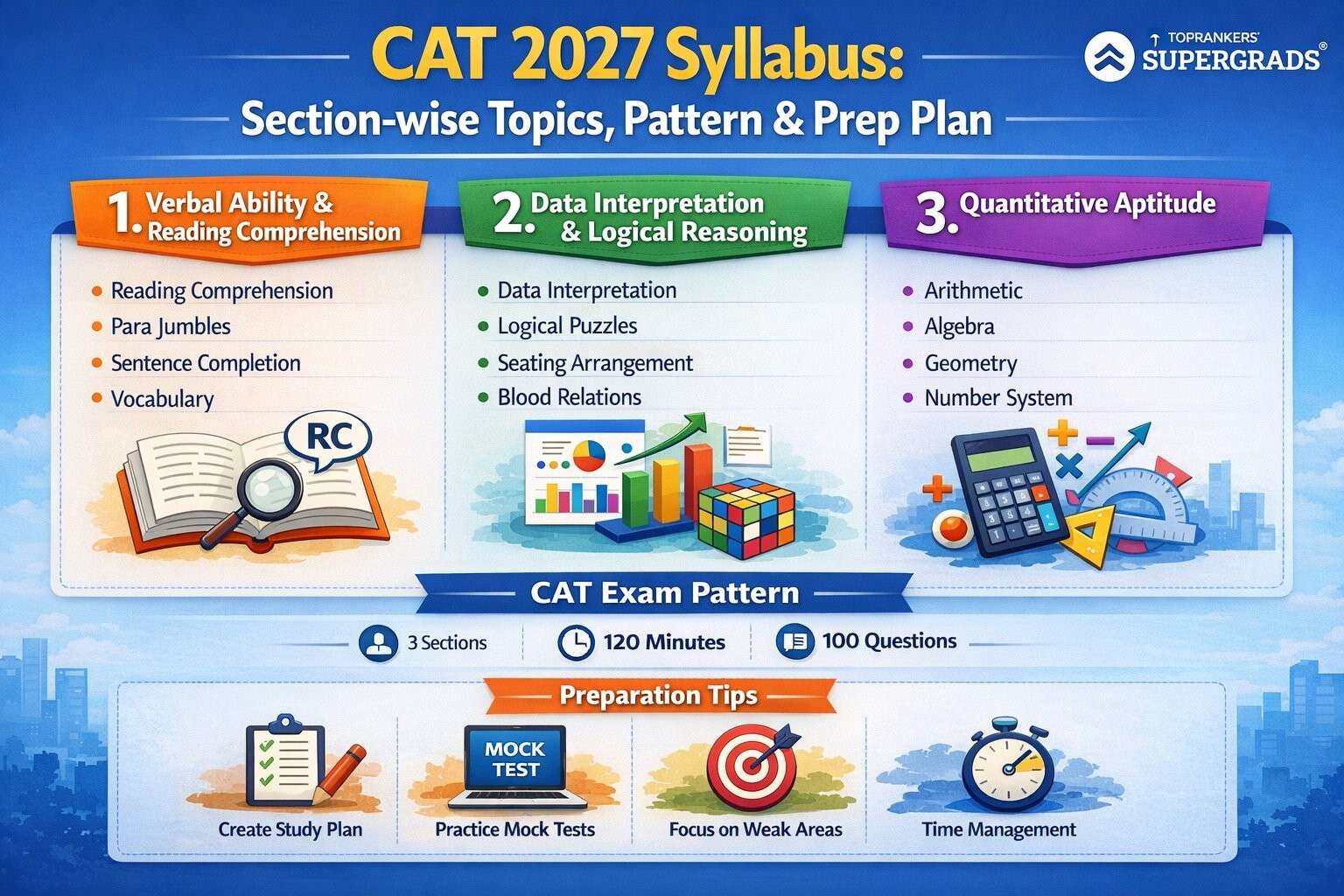
The CAT 2027 Syllabus is divided into three sections:
- VARC (Verbal Ability & Reading Comprehension) — 24 questions, 40 minutes
- DILR (Data Interpretation & Logical Reasoning) — 20 questions, 40 minutes
- QA (Quantitative Ability) — 22 questions, 40 minutes
The CAT exam is 120 minutes long with a total of 66 questions. Each correct MCQ answer carries +3 marks, incorrect MCQs carry a -1 penalty, and TITA (Type in the Answer) questions have no negative marking. The CAT 2027 Syllabus does not include specific prescribed topics the exam tests conceptual clarity and reasoning ability across the three sections listed above.
CAT 2027 Syllabus: Exam Structure at a Glance
Before diving into each section of the CAT 2027 Syllabus, here is the high-level structure of the exam:
|
Section |
Full Form |
No. of Questions |
Time Limit |
|
VARC |
Verbal Ability & Reading Comprehension |
24 Questions |
40 Minutes |
|
DILR |
Data Interpretation & Logical Reasoning |
20 Questions |
40 Minutes |
|
QA |
Quantitative Ability |
22 Questions |
40 Minutes |
|
Total |
66 Questions |
120 Minutes |
Note: Scoring is +3 for correct MCQ answers and -1 for wrong MCQs. TITA questions carry no negative marking. Section order may vary across slots.
Explore Other Important Links
| CAT 2026 Question Paper | CAT 2025 Question Paper | CAT 2024 Question Paper |
| CAT 2023 Question Paper | CAT 2022 Question Paper | CAT 2021 Question Paper |
| CAT 2020 Question Paper | CAT PYQs | CAT Exam Study Plan |
Section 1: VARC — Verbal Ability & Reading Comprehension
The VARC section of the CAT 2027 Syllabus tests your ability to read, comprehend, and analyse complex passages, as well as your grasp of English grammar and verbal reasoning. With 24 questions in 40 minutes, this section demands both speed and accuracy. Reading Comprehension (RC) dominates this section, with 16 out of 24 questions typically based on 4 passages.
CAT VARC Syllabus Breakdown
|
Topic |
Sub-topics |
Expected Questions |
|
Reading Comprehension |
Inference, Tone, Main Idea, Vocabulary in Context |
16 Questions |
|
Sentence Rearrangement (TITA) |
2–3 Questions |
|
|
Para Summary |
Best Summary of a Paragraph |
2 Questions |
|
Sentence not fitting in a set |
1–2 Questions |
|
|
Fill in the Blanks |
Grammar-based, Vocabulary-based |
1–2 Questions |
Types of Questions in CAT VARC
Within the CAT Syllabus 2027, the VARC section includes:
- MCQ-based Reading Comprehension: Inference, Central Idea, Author's Tone, Vocabulary in Context
- TITA Para Jumbles: Arrange 4–5 sentences in the correct logical sequence
- TITA Para Summary: Select the best one-line summary from four options
- Odd Sentence Out (TITA): Identify the sentence that does not logically fit
- Sentence Completion: Fill blanks using appropriate vocabulary or grammar rules
Difficulty Level & Importance
CAT VARC is considered moderately difficult but can be the most time-consuming section. RC passages in recent years have featured dense, academic prose on topics like philosophy, economics, science, and social sciences. Students who read extensively find this section more manageable. The CAT 2027 Syllabus for VARC rewards consistent readers over last-minute crammers.
CAT VARC Preparation Tips
- Read 1–2 quality articles from The Hindu, The Economist, or Aeon daily
- Practice RC with a strict 12-minute timer per passage (3 minutes reading, 3 minutes per question)
- Solve at least 15 para jumbles per week to build logical sequencing skills
- Focus on eliminating wrong options in MCQs rather than finding the 'perfect' answer
- Attempt all verbal ability questions (para jumbles, odd one out) as these carry no negative marking
Important Preparation Resources
| CAT Exam Preparation | CAT Study Plan | CAT Prep for Beginners |
| CAT Preparation at Home | Time Required for CAT Prep | How to Crack CAT |
| CAT 10-Month Strategy | CAT Prepare in 1 Year | CAT Prepartion in 7 Months |
CAT DILR 2027 — Data Interpretation & Logical Reasoning
The CAT DILR section is arguably the most unpredictable part of the CAT 2027 Syllabus. With 20 questions spread across 4–5 sets, this section tests your ability to extract meaning from data and apply logical reasoning under time pressure. There is no fixed topic list — a set can combine DI and LR in unexpected ways, making it essential to build strong analytical foundations.
CAT DILR Syllabus Breakdown
|
Topic |
Sub-topics |
Difficulty Level |
|
Tables & Caselets |
Tabular DI, Data Analysis |
Moderate |
|
Bar & Line Graphs |
Comparative DI, Trend Analysis |
Moderate–High |
|
Logical Reasoning Sets |
Arrangements, Blood Relations, Games & Tournaments |
High |
|
Puzzles & Networks |
Route Maps, Venn Diagrams, Binary Logic |
High |
|
Clocks & Calendars |
Time-based Reasoning |
Moderate |
Types of Questions in CAT DILR
The CAT Syllabus 2027 DILR section includes the following question types:
- Caselet-Based DI: Paragraph-based data that must be converted into a table before solving
- Graph-Based DI: Bar, line, pie, or combination charts requiring trend analysis
- Arrangement-Based LR: Linear, circular, and matrix-based seating arrangements
- Constraint-Based Puzzles: Conditions and rules applied to scheduling or grouping problems
- Games & Tournaments: Knockout/round-robin formats with incomplete information
- Binary Logic: True/False alternating patterns used to solve interconnected conditions
Difficulty Level & Importance
CAT DILR is rated high difficulty and is the primary differentiator for 99+ percentile scorers. The CAT 2027 Syllabus does not specify which LR or DI type will appear — so preparation must be broad. In recent CAT papers, abstract puzzle sets with unusual constraints have appeared, catching many aspirants off guard. Consistent set-solving practice across diverse types is the only reliable strategy.
CAT DILR Preparation Tips
- Solve 2 full DILR sets daily — one DI and one LR — with strict 20-minute time limits
- Practice 'set selection': Learn to identify solvable sets within the first 2 minutes of reading
- Focus on Caselets and Arrangement sets, which appear most frequently in recent CATs
- Revisit incorrect sets after solving to identify where your reasoning went wrong
- Attempt 3–4 full DILR section mocks weekly in the final month to build speed
CAT QA 2027 — Quantitative Ability
The QA section of the CAT 2027 Syllabus tests mathematical aptitude across Arithmetic, Algebra, Geometry, Number Systems, and Modern Maths. With 22 questions in 40 minutes, QA demands both conceptual understanding and calculation speed. Approximately 6–8 questions in this section are TITA, making accuracy especially important. Non-engineering students often find this section challenging, but with targeted practice, it is very scorable.
CAT QA Syllabus Breakdown
|
Topic Area |
Key Sub-topics |
Weightage |
|
Arithmetic |
Percentages, Profit & Loss, Time-Speed-Distance, Ratios, Mixtures |
~35% |
|
Algebra |
Linear & Quadratic Equations, Inequalities, Functions |
~20% |
|
Geometry & Mensuration |
Triangles, Circles, Coordinate Geometry, Areas & Volumes |
~20% |
|
Number Systems |
Divisibility, HCF/LCM, Remainders, Surds & Indices |
~15% |
|
Modern Maths |
Permutation & Combination, Probability, Set Theory, Progressions |
~10% |
Types of Questions in CAT QA
The CAT Syllabus 2027 QA section includes these question formats:
- Direct Formula Application: Straightforward calculations using standard formulas
- Multi-concept Problems: Questions that blend two or more topics (e.g., Geometry + Algebra)
- TITA Questions: Open-ended answers with no negative marking — attempt these aggressively
- Data Sufficiency (occasionally): Assess whether given information is sufficient to solve a problem
Difficulty Level & Importance
QA difficulty ranges from easy to high depending on the slot. Engineering graduates typically score above 90 percentile in this section, while arts or commerce students may find it tougher. The CAT 2027 Syllabus for QA rewards those who master Arithmetic early, as it carries the highest weightage (~35%) and also provides the foundation for other topic areas.
CAT QA Preparation Tips
- Master all Arithmetic formulas first — Percentages, P&L, TSD are always high-weightage
- Solve 25–30 QA questions daily with a mix of difficulty levels
- Learn multiple approaches to solve a problem (formula method, approximation, options-based)
- For TITA questions, attempt even if unsure — there is no penalty for wrong answers
- Revise Number System properties and Geometry theorems weekly to keep them sharp
CAT Syllabus Changes Over the Last 5 Years
The CAT 2027 Syllabus is expected to follow the stable format established since 2021. Here is a clear summary of how the CAT Syllabus 2027 compares to previous years, which is crucial for aspirants to understand trends and avoid over-preparing obsolete patterns:
|
Year |
Total Questions |
Key Change |
Impact on Aspirants |
|
2022 |
66 Questions |
Reduced from 76 to 66 |
Less time pressure; quality over quantity |
|
2023 |
66 Questions |
DILR set count stabilized at 4–5 sets |
Higher emphasis on accuracy per set |
|
2024 |
66 Questions |
More abstract DILR puzzles introduced |
Increased analytical reasoning demand |
|
2025 |
66 Questions |
RC passages increased to 4; VARC reading load higher |
Speed reading became critical for VARC |
|
2026–27 |
~66 Questions (expected) |
Format likely stable; IIM may adjust section order |
Consistent pattern; preparation strategy unchanged |
Key Takeaway: The CAT 2027 Syllabus is not expected to change significantly in structure. IIMs have maintained the 66-question, 120-minute, three-section format consistently. However, the style and complexity of questions — especially in DILR has increased. Aspirants should focus on building reasoning skills rather than memorising CAT exam patterns.
3-Month Week-wise Preparation Strategy for CAT 2027 Syllabus
A structured plan is the most effective way to conquer the CAT 2027 Syllabus. Below is a detailed 12-week preparation schedule that covers all three sections systematically. This plan assumes you are starting from scratch and targeting a 95+ percentile.
Month 1: Building Foundations (Weeks 1–4)
The first month of your CAT 2027 Syllabus preparation should be entirely devoted to concept-building and identifying your weak areas.
|
Week |
Focus Area |
Daily Tasks & Goals |
|
Week 1 |
QA: Arithmetic Fundamentals |
Study Percentages, Ratio-Proportion, Time-Speed-Distance. Solve 30 QA questions daily. Identify weak areas. |
|
Week 2 |
VARC: RC Foundation + QA Algebra |
Read 2 RC passages daily. Study Linear Equations, Functions in QA. Attempt 1 sectional mock. |
|
Week 3 |
DILR: DI Basics + QA Geometry |
Practice 2 DI sets (tables, graphs) daily. Study triangles, circles in QA. Begin DILR sets. |
|
Week 4 |
Full Review + First Full Mock |
Take full-length CAT mock. Analyze each section. Score target: 55–65 percentile. |
Month 2: Deepening Practice (Weeks 5–8)
In the second month, you should move beyond basic concepts and apply your knowledge to complex problems. Begin integrating mock tests into your routine. This phase is critical for the CAT Syllabus 2027 aspirant who wants to bridge the gap between knowledge and performance.
|
Week |
Focus Area |
Daily Tasks & Goals |
|
Week 5 |
VARC: Para Jumbles + Verbal Logic |
Practice 10 para jumbles/para summary daily. Study sentence correction. RC: inference-based questions. |
|
Week 6 |
DILR: LR Sets + QA Number Systems |
Solve 3 LR sets daily (arrangements, blood relations). Practice HCF/LCM, remainders in QA. |
|
Week 7 |
DILR Advanced + VARC RC Speed |
Complex LR puzzles (binary logic, games). Increase RC to 3 passages daily. Time yourself strictly. |
|
Week 8 |
Mock Analysis + Accuracy Drills |
2 full-length mocks this week. Analyse errors. Reduce silly mistakes in QA. Accuracy target: 80%+. |
Month 3: Mock-Driven Mastery (Weeks 9–12)
The final month should be dominated by full-length mocks, thorough analysis, and refining your exam-day strategy. By now, you should be comfortable with the entire CAT 2027 Syllabus and focused on maximising accuracy and speed.
|
Week |
Focus Area |
Daily Tasks & Goals |
|
Week 9 |
Speed + Stamina Building |
3 full mocks. Focus on 40-minute section management. Build test-taking stamina with back-to-back sections. |
|
Week 10 |
Weak Area Elimination |
Identify lowest-scoring topics from mock history. Dedicate 2 hours daily to those specific topics. |
|
Week 11 |
Mock Marathon + Strategy Lock |
Daily mocks or sectional tests. Finalise your question-attempt strategy per section. Revise formulas. |
|
Week 12 |
Final Revision + Exam Mindset |
Light practice. Revise key formulas, RC shortcuts, DILR strategies. Rest before exam week. |
Weekly Routine Template (All 12 Weeks)
- Monday–Friday: 3–4 hours of study (concept + practice + 1 sectional test)
- Saturday: Full-length CAT mock (180 minutes) + detailed analysis (2 hours)
- Sunday: Revision of the week's topics + formula drilling + 1 light sectional test
Best Resources to Cover CAT 2027 Syllabus
Choosing the right CAT study materials is as important as following the CAT Syllabus 2027 itself. Here are the most recommended CAT Books resources:
|
Section |
Books & Materials |
Online Resources |
|
VARC |
How to Read Better & Faster by Norman Lewis; RC 99 by Aristotle Prep |
The Hindu, Aeon.co, SuperGrads VARC Mocks |
|
DILR |
How to Prepare for Data Interpretation by Arun Sharma |
CAT previous year papers; SuperGrads DILR Sets |
|
QA |
Quantitative Aptitude by Arun Sharma; NCERT Maths (Class 9–10) |
SuperGrads QA topic tests; CAT OfficialIIM mock |
Conclusion
The CAT 2027 Syllabus may seem vast, but it is entirely conquerable with the right strategy, consistent effort, and smart resource selection. By understanding the structure of each section — VARC, DILR, and QA — you can create a personalised study plan that maximises your strengths and systematically eliminates your weaknesses.
Remember, the CAT 2027 Syllabus does not reward rote learning. It rewards conceptual clarity, analytical thinking, and time management. Use the 3-month week-wise plan in this guide as your roadmap, attempt regular mocks, and analyse every test thoroughly.
SuperGrads is here to support your entire CAT Syllabus 2027 journey — from concept videos and practice sets to personalised mentoring and live doubt sessions. Start your preparation today and take one step closer to your dream IIM seat.

Smart Prep for CAT: Join Our Free Demo Class
Fill your details
Frequently Asked Questions
Is the CAT 2027 Syllabus different from CAT 2026?

How many questions are there in CAT 2027?
Does the CAT 2027 Syllabus include specific topics?
Is there negative marking in CAT 2027?
How many months are needed to cover the CAT 2027 Syllabus?
What is the best way to start preparing for CAT 2027 Syllabus?

Admin
Subject Matter Expert


SHARE