


CAT 2020 Question Paper PDF (Slot-wise) – Download Slot 1, 2 & 3
November 4, 2026
You can download the CAT 2020 question paper for all three slots (Slot 1, Slot 2 and Slot 3) from the links given below. The papers will help you understand the types of questions asked in the exam. You can also check the answer keys and solutions to review your performance and get a better idea of the CAT Exam.
The CAT 2020 paper had three sections: VARC, DILR and QA. All three slots followed the same exam pattern, but the difficulty level was not exactly the same. Slot 3 was reported to be more difficult than the other two slots.
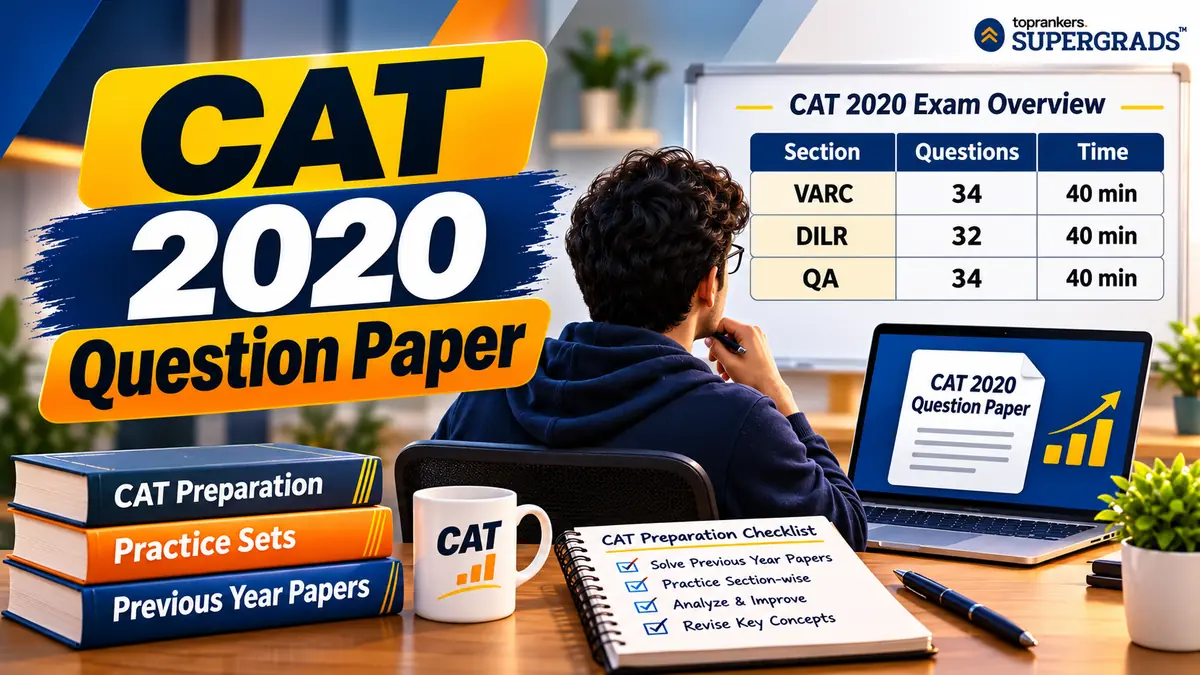
Table of Contents
- Download CAT 2020 Question Papers PDF
- CAT 2020 Question Paper: What Was the Exam Pattern?
- How Difficult Was the CAT 2020 Question Paper?
- What Was the Section-wise Analysis of CAT 2020?
- How Did CAT 2020 Slots Differ From Each Other?
- How Can the CAT 2020 Paper Help in 2026 Preparation?
- Key Takeaways
Download CAT 2020 Question Papers PDF
| CAT 2020 Question Paper Slot 1 | |
| CAT 2020 Question Paper Slot 2 | |
| CAT 2020 Question Paper Slot 3 |
Other Important Links
| CAT 2026 Question Paper | CAT 2025 Question Paper | CAT 2024 Question Paper |
| CAT 2023 Question Paper | CAT 2022 Question Paper | CAT Previous Year Question Paper |
Practice Sample CAT 2020 Question Paper with Answers
1. If x² - 5x + 6 = 0, what is the value of x + 1/x?
B) 4
C) 3
D) 6
B) 10%
C) 12.5%
D) 15%
3. In how many ways can 5 books be arranged on a shelf?
B) 120
C) 24
D) 720
4. If the sum of the first 10 positive integers is 55, what is the sum of the first 10 even positive integers?
B) 110
C) 120
D) 90
5. The number of students in Class B who passed Maths is 50, which is 80% of the total students. How many students appeared in Class B?
B) 60
C) 62.5
D) 50
6. A puzzle has 6 people standing in a line. If A is immediately left of B, how many distinct arrangements are possible?
B) 240
C) 120
D) 720
7. In a bar graph showing sales, Product X sold 20% more than Product Y, and Y sold 50 units. How many units did X sell?
B) 75
C) 80
D) 85
8. In the sentence “Although he was tired, he continued working,” the phrase “Although he was tired” is an example of:
B) Dependent clause
C) Absolute phrase
D) Appositive
9. In a passage about climate change, if the main idea is that human activity accelerates global warming, a question asking why scientists believe this is testing:
B) Main idea
C) Inference
D) Grammar
10. Arrange the jumbled sentences to form a coherent paragraph:
2) Then he left for the meeting.
3) After getting the invitation, he prepared the documents.
4) He was confident about the presentation.
A) 3‑1‑4‑2
B) 1‑3‑2‑4
C) 3‑4‑1‑2
D) 4‑3‑1‑2
CAT 2020 DILR Total Questions and Sets
The DILR section in CAT 2020 followed a structured yet challenging format. Understanding this structure is crucial for CAT preparation.
CAT 2020 DILR Total Questions and Sets
| Total Questions | 24 |
| Total Sets | 5 |
| Time Limit | 40 minutes |
CAT 2020 Question Paper: What Was the Exam Pattern?
Answer: CAT 2020 was conducted in three slots, each lasting 120 minutes and containing 76 questions. The paper had three sections: VARC, DILR, and QA.
- Duration: 120 minutes
- Total Questions: 76
- Sections: 3
| CAT 2020 Paper Sections | Questions | Time (min) | Type |
|---|---|---|---|
| VARC (Verbal Ability & Reading Comprehension) | 26 | 40 | MCQs & Non-MCQs |
| DILR (Data Interpretation & Logical Reasoning) | 24 | 40 | MCQs & Non-MCQs |
| QA (Quantitative Ability) | 26 | 40 | MCQs & Non-MCQs |
Marking Scheme: +3 for correct, -1 for MCQ wrong, 0 for non-MCQ wrong
How many slots in CAT 2020?
CAT 2020 was conducted in 3 slots.
Morning slot: 8:30 AM – 10:30 AM
Afternoon slot: 12:30 PM – 2:30 PM
Evening slot: 4:30 PM – 6:30 PM
This was a change from earlier years (which had 2 slots), mainly due to COVID-19 precautions.
How Difficult Was the CAT 2020 Question Paper?
Answer: CAT 2020 was slightly tougher than CAT 2019. Slot 3 was the hardest, Slot 2 was moderate, and Slot 1 was relatively easier.
Details: Slot-wise Difficulty:
| CAT 2020 Slots | Difficulty Level |
|---|---|
| CAT 2020 Slot 1 | Slightly easier than the previous year |
| CAT 2020 Slot 2 | Moderate, tougher than Slot 1 |
| CAT 2020 Slot 3 | Most challenging, especially DILR & VARC |
Section Observations:
- VARC: Tricky RC passages and critical reasoning questions
- DILR: Tough sets, time-consuming puzzles
- QA: Moderate to difficult; arithmetic, algebra, geometry tested
What Was the Section-wise Analysis of CAT 2020 Exam Paper?
Answer: CAT 2020 had 26 VARC, 24 DILR, and 26 QA questions, with some Non-MCQs in each section. Difficulty varied by section and slot.
| Section | Total Qs | Non-MCQs | Topics | Ideal Attempt for 99+ Percentile |
|---|---|---|---|---|
| VARC | 26 | 5 | RC, Critical Reasoning, Vocabulary | 18–20 |
| DILR | 24 | 6 | DI Sets, Logic Puzzles, Venn Diagrams | 9–11 |
| QA | 26 | 6 | Arithmetic, Algebra, Geometry, Mensuration | 17–19 |
CAT 2020 Question Paper: Total number of VARC questions in CAT 2020
- 5 Non-MCQs included
- RC passages: 450–500 words each
- Questions: Critical reasoning, inference, vocabulary
- Ideal attempt for 99+ percentile: 18–20 correct
CAT 2020 Question Paper: Total number of DILR questions in CAT 2020
- 6 Non-MCQs included
- 5 sets: HI-LO, People & Area, Venn Diagram, Orders
- Ideal attempt for 99+ percentile: 9–11 correct
CAT 2020 Question Paper: Total number of QA questions in CAT 2020
- 6 Non-MCQs included
- Topics: Arithmetic, Algebra, Geometry, Mensuration, Coordinate Geometry
- Ideal attempt for 99+ percentile: 17–19 correct
How Did CAT 2020 Slots Differ From Each Other?
Answer: Slot 1 was the easiest, Slot 2 was slightly tougher, and Slot 3 was the most challenging. All slots followed the same pattern.
Slot-wise Observations:
| Slot | Difficulty | Key Highlights |
|---|---|---|
| Slot 1 | Easier | More manageable DILR sets |
| Slot 2 | Moderate | Slightly tougher VARC passages |
| Slot 3 | Hardest | Tricky DILR sets & complex QA questions |
Percentile vs Raw Score for 99%ile (Approx.):
| Slot | 99%ile Score Range |
|---|---|
| Slot 1 | 105–108 |
| Slot 2 | 100–102 |
| Slot 3 | 100–102 |
How Can the CAT 2020 Paper Help in 2026 Preparation?
Analyzing CAT 2020 helps understand CAT Exam Pattern, difficulty levels, and question types, allowing aspirants to strategise better for CAT 2026.
Key Benefits of Analyzing CAT 2020 for CAT 2026 Preparation
1. Get Familiar with the Exam Pattern
CAT 2020 helps you understand how the exam is structured. It had three sections: VARC, DILR and QA, with a mix of MCQ and non-MCQ questions. Practising these papers gives you an idea of the question types and how to approach them.
2. Know Which Topics to Focus On
Going through the CAT 2020 paper can help you identify the topics that were asked in each section.
-
VARC: Reading Comprehension passages, Critical Reasoning and Vocabulary
-
DILR: HI-LO, Venn Diagrams, Ordering, People and Area-based sets
-
QA: Arithmetic, Algebra, Geometry, Mensuration and Coordinate Geometry
3. Compare the Difficulty Level of Different Slots
CAT 2020 had three slots with different difficulty levels. Slot 1 was considered the easiest, Slot 2 was moderate, while Slot 3 was the toughest. Comparing these papers can help you prepare for both easy and difficult questions.
4. Set a Clear Target for Your Preparation
Previous year papers give you an idea of how many questions you should aim to attempt in each section. You can use this analysis to set realistic targets for your attempts and accuracy, especially if you are aiming for a 99+ percentile.
5. Improve Your Speed and Time Management
Practising CAT 2020 and other CAT previous year papers helps you learn how to manage your time in each section. You can understand which questions to attempt first, when to skip a difficult question and how to avoid spending too much time on a single question. This will help you manage the 40-minute sectional time limit more effectively.
Conclusion
The CAT 2020 exam had the same pattern across all three slots, with 26 questions in VARC, 24 in DILR and 26 in QA. All three sections also included non-MCQ (TITA) questions, where candidates had to enter their answers instead of choosing an option. In terms of difficulty, Slot 1 was the easiest, Slot 2 was moderate, and Slot 3 was the toughest.
A raw score of around 100–108 was expected to fetch a 99 percentile, depending on the slot. Going through the CAT 2020 paper and understanding its trends can help candidates get a better idea of the exam and plan their CAT 2026 preparation accordingly.

Smart Prep for CAT: Join Our Free Demo Class
Fill your details
Frequently Asked Questions
How many questions were in CAT 2020?

What was the duration of CAT 2020?
Which slot was the toughest in CAT 2020?
How can CAT 2020 paper help in CAT 2026 preparation?
Is the CAT 2020 question pattern relevant for future exams?

Jainab Alvi
Content Writer | MBA & CAT Preparation
SHARE