
1723534562.png)

CAT Syllabus 2026 (VARC, DILR, QA): Topic List, Weightage Trends + PDF
June 25, 2026
Quick Answer: CAT Syllabus 2026 covers three sections VARC (24 Q), DILR (22 Q), and QA (22 Q) totalling 68 questions in 120 minutes (40 min per section). The exam carries +3 for correct answers, –1 for wrong MCQs, and no penalty for TITA. IIMs do not publish an official syllabus; topics below are compiled from the last 5 years of CAT papers.
IIM does not publish an official topic-wise syllabus; topics are derived from previous CAT papers. Key topics include Reading Comprehension, Para Jumbles, Data Interpretation sets, Arrangements, Arithmetic, Algebra, Geometry, Number Systems, and Modern Maths.
The Common Admission Test (CAT) is a crucial examination for aspiring MBA candidates in India. To excel in this highly competitive test, a thorough understanding of the CAT syllabus is paramount.
This comprehensive guide provides an in-depth look at the CAT 2026 syllabus, covering all three sections: Verbal Ability and Reading Comprehension (VARC), Data Interpretation and Logical Reasoning (DILR), and Quantitative Aptitude (QA). We'll delve into topic-wise breakdowns, weightage trends, and essential preparation strategies to help you navigate your CAT journey effectively.
CAT 2026 Syllabus At-a-Glance
|
Section |
Full Name |
Questions |
Time |
Marks (max) |
|
VARC |
Verbal Ability & Reading Comprehension |
24 |
40 min |
72 |
|
DILR |
Data Interpretation & Logical Reasoning |
22 |
40 min |
66 |
|
QA |
Quantitative Aptitude |
22 |
40 min |
66 |
|
Total |
— |
68 |
120 min |
204 |
Key Takeaways
- CAT has no official syllabus; topics are based on previous year trends
- Exam has 3 sections: VARC, DILR, and Quantitative Ability
- VARC mainly tests Reading Comprehension, plus para-jumbles and summaries
- DILR focuses on DI sets, arrangements, puzzles, and logical grouping
- QA includes Arithmetic, Algebra, Geometry, Number Systems, and Modern Math
- Preparation should be priority-driven, focusing on high-weight topics and mock practice
What You’ll Get in this blog
- Section-wise CAT syllabus breakdown
- Topic-wise priority and weightage tables
- Month-wise and final 30-day revision plan
- Preparation tips and mistakes to avoid
- Free CAT syllabus and study resource links
What is the Syllabus of CAT 2026?
The MBA CAT exam syllabus covers quantitative ability, data interpretation and logical reasoning, verbal ability and reading comprehension. It assesses mathematics, logical thinking, reading, and language abilities. The test consists of 68 questions in 120 minutes.
To do well on this competitive admission exam, you must be well-prepared and manage your time. You can download the CAT Syllabus 2026 PDF and prepare for the important topics for CAT 2026.
Learn More: Logical Reasoning Questions and Answers for CAT
Read the CAT exam pattern and syllabus here and download the CAT syllabus for MBA 2026 PDF below!
CAT does not release an official topic-wise syllabus PDF. So this CAT Syllabus 2026 guide is compiled from the latest pattern and recent paper trends to help you prioritise what matters most in VARC, DILR, and QA. Use the snapshot + topic priority below, then download the section-wise PDF for quick revision.
Download the CAT Syllabus PDF to get a clear, section-wise overview of VARC, DILR, and QA topics for effective exam preparation.
Tip: Treat this page as your syllabus + priority list. Use the detailed topic tables below to plan week-wise practice.
Read More | CAT Admission Process 2026
CAT Syllabus 2026: Overview
The CAT 2026 exam assesses candidates on their quantitative, verbal, and reasoning abilities through three main sections: VARC, DILR, and QA. It is designed to evaluate a candidate’s problem-solving skills, analytical thinking, and proficiency in basic mathematics and language.
| Sections | CAT Exam Syllabus Key Topics |
|---|---|
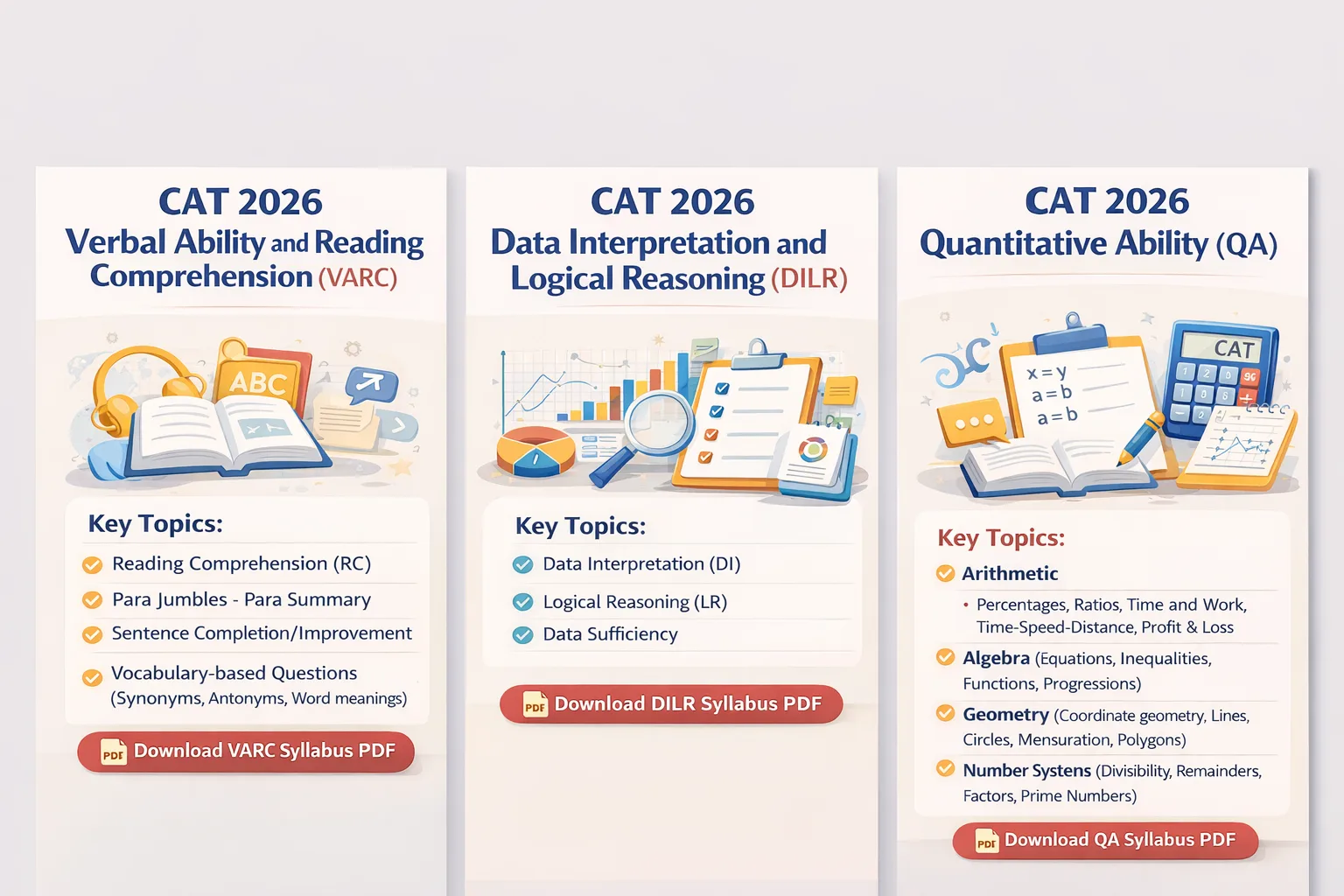
| Verbal Ability and Reading Comprehension (VARC) |
|
| Data Interpretation and Logical Reasoning (DILR) |
|
| Quantitative Ability (QA) |
|
Download Subject-wise CAT 2026 Syllabus PDFs
| Subject wise Syllabus | PDF Links |
| CAT QA Syllabus | |
| CAT DILR Syllabus | |
| CAT VARC Syllabus |
CAT 2026 Topic Priority: What to Study First (Based on Recent Trends)
Quick note: CAT doesn’t have an official topic-wise CAT exam syllabus PDF. The priority below is compiled from recent CAT patterns and topic-weightage trends so you can focus on the most recurring + high-return areas first.
1) VARC Priority (24 Questions): RC is the game
| Topic | Typical Weightage | What to Practise |
|---|---|---|
| Reading Comprehension (RC) | ~60–70% | Inference, tone, central idea, paragraph function, vocabulary-in-context |
| Para Summary | ~10–15% | Main idea + elimination-based options |
| Para Completion / Odd Sentence Out | ~5–10% | Logical flow + theme detection |
2) DILR Priority (22 Questions): Sets decide your percentile
| Topic | Typical Weightage | What to Practise |
|---|---|---|
| Puzzles & Arrangements | ~50–60% | Linear/circular/grid sets, distribution, ranking, hybrid logic |
| Tables & Charts DI | ~40–50% | Tabular DI, bar/line/pie, mixed chart sets, caselets |
| Games & Tournaments | ~10–20% | Round-robin/knockout, points table logic |
3) QA Priority (22 Questions): Arithmetic + Algebra first
| Topic | Typical Weightage | What to Practise |
|---|---|---|
| Arithmetic | ~35–50% | Percentages, ratios, TSD, time & work, averages, P&L, SI/CI, mixtures |
| Algebra | ~25–35% | Equations, inequalities, functions, sequences & series, logs |
| Geometry & Mensuration | ~10–15% | Triangles, circles, 2D/3D mensuration, coordinate basics |
| Number System + Modern Maths | ~5–10% each | Divisibility/remainders + P&C/probability/sets basics |
How to use this priority (simple rule)
- First 60% of prep time → RC + DILR sets + Arithmetic/Algebra (highest repeat zones).
- Next 30% → Geometry + DI chart variety + VA (summary/completion/odd one).
- Last 10% → low-frequency topics (but keep them warm with weekly mixed practice).
Why this matters: CAT moved back to 68 questions in recent years with DILR at 22 questions, so set-selection and high-yield topic mastery have become even more important.
CAT Syllabus 2026 [Section-Wise]
The CAT Syllabus 2026 covers three main sections: Verbal Ability, Data Interpretation & Logical Reasoning, and Quantitative Ability. Questions will be based on concepts from class 8 and above, designed to test a candidate’s analytical, reasoning, and problem-solving abilities.
CAT 2026 Syllabus for Verbal Ability & Reading Comprehension (VARC)
The CAT VARC syllabus 2026 mainly tests Reading Comprehension and Verbal Ability. Most aspirants score higher here by strengthening RC speed + accuracy and practising para-based VA questions regularly.
- Reading Comprehension (RC): fact/inference-based questions, tone & idea, paragraph purpose, vocabulary-in-context
- Verbal Ability (VA): parajumbles, paragraph summary, odd sentence out, sentence completion
- Grammar & usage (as applied): error spotting (limited), phrase usage (mostly inside RC/VA)
Also Read: CAT QA Question with Answers
Is CAT syllabus easy?
The CAT syllabus is conceptually simple, mostly school-level topics, but the questions are tricky and time-pressured, making it difficult to crack. Success depends on strong basics + smart practice.
CAT 2026 Syllabus: VARC Topics & Weightage
The CAT VARC section comprises four key areas: Reading Comprehension, Parajumbles, Verbal Ability, and Sentence Completion.
The format and composition of the VARC section typically remain consistent each year. Based on last year's CAT paper, the weightage and difficulty levels of these areas can be summarised as follows:
|
VARC Topics for CAT |
Number of Questions in the CAT Exam |
Level of Difficulty |
|
Reading Comprehension |
16 |
Moderate to Difficult |
|
VA-Para jumbles |
3 |
Moderate to Difficult |
|
VA-Odd Sentence |
2 |
Easy to Moderate |
|
VA-Summary |
3 |
Easy to Moderate |
|
Overall |
24 |
Moderate to Difficult |
CAT RC Passage Types
|
Passage Type |
Description |
Typical Frequency |
|
Argumentative |
Author presents a thesis or contested position; inference-heavy |
1–2 passages/paper |
|
Descriptive / Informative |
Explains a concept or phenomenon; fact-based questions |
1 passage/paper |
|
Comparative / Contrasting |
Two viewpoints or theories juxtaposed |
1 passage every 2–3 papers |
|
Narrative / Anecdotal |
Story or example illustrating a wider idea |
Rare — 1 in 4 papers |
Know More| CAT Exam Fees for Different Categories
CAT DILR Syllabus 2026
The CAT DILR syllabus 2026 focuses on solving caselet-style sets using logic, data reading, and smart selection. Accuracy matters more than attempting everything—choose sets strategically.
To get a good score in the DILR section, take a look at the important topics for CAT 2026
- Data Interpretation (DI): tables, bar/line charts, pie charts, mixed graphs, calculation-based sets
- Logical Reasoning (LR): arrangements, grouping & distribution, selections, routes & networks, puzzles
- Games & sets: tournaments, scheduling, ranking, constraints-based sets
- Venn/sets & reasoning: set-based questions, condition-based reasoning
DILR priority: Arrangements/Grouping > DI Tables/Charts > Games & Tournaments.
Check: CAT Previous Year Cut-off Marks
CAT DILR Syllabus 2026: Important Topics & Weightage
Data Interpretation (DI) questions focus on tables and graphs, while Logical Reasoning (LR) encompasses a variety of topics, including verbal, non-verbal, and abstract reasoning.
Below is the basic structure of the DILR section of CAT, along with the difficulty levels from previous papers, aligned with the CAT syllabus 2026 PDF
|
Section |
No. of Questions |
Level of Difficulty |
|
Data Interpretation |
4 |
Easy |
|
Data Interpretation |
6 |
Moderate |
|
Logical Reasoning |
6 |
Moderate to Difficult |
|
Logical Reasoning |
6 |
Easy to Moderate |
|
Overall |
22 |
Moderate to Difficult |
Check: CAT Exam is for What Purpose
CAT Quantitative Aptitude Syllabus 2026
The CAT Quantitative Aptitude syllabus 2026 is built around Arithmetic, Algebra, Geometry, Number System, and Modern Maths. Most toppers prioritise arithmetic first, then build speed in algebra and geometry.
Here are some of the major topics of the CAT Quantitative Aptitude Syllabus 2026
- Arithmetic: percentages, profit & loss, ratios, averages, mixture/alligation, time-speed-distance, time & work, SI/CI
- Algebra: linear & quadratic equations, inequalities, logarithms (basic), sequences & series, functions (basic)
- Geometry & Mensuration: triangles, circles, polygons, coordinate geometry basics, areas & volumes
- Number System: divisibility, remainders, factors, LCM/HCF, primes, cyclicity
- Modern Maths: permutation & combination, probability, set theory basics
QA priority: Arithmetic > Algebra > Geometry > Numbers > Modern Maths.
Also check: How to download the CAT Admit Card
CAT Quantitative Aptitude Syllabus 2026: Topic-Wise Weightage
CAT topic-wise weightage is always indicative because IIMs do not publish a fixed topic-wise CAT exam syllabus or official weightage. Still, CAT follows strong trends based on previous year papers. Use the weightage tables below to prioritise preparation, not to predict exact questions.
How to use CAT weightage smartly:
- Master high-frequency topics first (your safest ROI).
- Practise mixed sets for DILR and RC-heavy drills for VARC.
- Use weightage to decide sequence of topics, not to skip topics.
| Section | High-priority topics | What to prioritise first |
|---|---|---|
| VARC | Reading Comprehension, Parajumbles, Summary, Odd sentence | RC accuracy + para-based VA practice |
| DILR | Arrangements, Grouping, DI Tables/Charts, Games & Tournaments | Set selection + 4–6 core set types |
| QA | Arithmetic, Algebra, Geometry, Number System, Modern Maths | Arithmetic first, then Algebra + Geometry |
Key takeaway: If you’re short on time, prioritise RC (VARC), Arrangements/Grouping sets (DILR), and Arithmetic (QA) before moving to the next layers.
Can I cover the CAT syllabus in 2–3 months?
Yes, if your basics are decent and you study daily with a strict plan focusing on high-weightage topics and timed practice. In 2–3 months, prioritise mock tests, analysis, and targeted revision over “covering everything”.
CAT + OMETs Demo Classes
| Take DILR Demo Classes by Supergrads | |
| Take VARC Demo Classes by Supergrads | |
| Take QA Demo Classes by Supergrads |
CAT Quantitative Aptitude Syllabus 2026: Section wise Breakdown
CAT exam Syllabus for Arithmetic
The Arithmetic section of the CAT syllabus 2026 pdf free download encompasses fundamental mathematical operations and their applications.
Key topics include
1) Percentages: (profit/loss, discounts, simple/compound interest),
2) Ratios and proportions: (mixtures and allocations, partnerships),
3) Averages
4) Time and work, time, speed, and distance: (including trains, boats, and streams), and
5) Basic number properties relevant to arithmetic calculations.
A strong foundation in these areas, coupled with efficient calculation techniques and problem-solving strategies, is crucial for success in this component of the Quantitative Aptitude section. Emphasis is placed on applying these concepts to real-world scenarios and solving word problems.
CAT exam Syllabus for Algebra
The Algebra syllabus for CAT covers a range of topics from basic linear equations and inequalities to more advanced concepts.
Key areas include:
- Linear Equations and Inequalities
- Quadratic Equations
- Polynomials
- Logarithms
- Functions and Graphs
- Sequences and Series
- Basic Concepts of Set Theory
Understanding algebraic identities, solving systems of equations, and manipulating algebraic expressions are essential skills.
The focus is on applying these concepts to solve abstract problems and understanding the underlying principles. Familiarity with different types of functions and their properties is also important.
CAT Syllabus for Geometry
The Geometry section in the CAT 2026 syllabus tests spatial reasoning and knowledge of geometric figures and their properties. Important topics include:
- Lines and Angles
- Triangles
- Properties
- Congruency
- Similarity
- Quadrilaterals
- Parallelograms
- Rectangles
- Squares
- Rhombuses
- Trapeziums
- Circles
- Chords
- Tangents
- Arcs
- Sectors
- Coordinate Geometry
- Distance Formula
- Section Formula
- Equations of Lines
- Mensuration (2D and 3D Geometry)
- Area and Perimeter of 2D Shapes
- Surface Area and Volume of 3D Shapes
- Cubes
- Cuboids
- Cones
- Cylinders
- Spheres
Mensuration, dealing with areas and volumes of 2D and 3D shapes (cubes, cuboids, cones, cylinders, spheres), is also a significant part.
A strong grasp of theorems and the ability to visualise and apply geometric principles are crucial for solving problems in this area.
CAT Syllabus for Number System
The Number System syllabus for CAT focuses on the properties and relationships of different types of numbers.
Key topics include:
- Divisibility Rules
- Factors and Multiples
- Prime and Composite Numbers
- Highest Common Factor (HCF)
- Lowest Common Multiple (LCM)
- Remainders and Modular Arithmetic
- Properties of Integers
- Number Base Systems
CAT Syllabus for Modern Maths
The Modern Maths section of the CAT syllabus 2026 pdf free download typically includes topics that are relatively newer additions to the standard curriculum.
Key Areas in Permutations, Combinations & Probability for CAT:
- Permutations and Combinations
- Fundamental Counting Principles
- Arrangements (Permutations)
- Selections (Combinations)
- Probability
- Basic Probability Concepts
- Conditional Probability
- Set Theory (occasionally tested here)
- Basic concepts (also covered under Algebra)
- Useful for solving problems involving overlapping sets or events
Explore: CAT Exam Centres
How difficult is the CAT syllabus?
The CAT syllabus is not very large, as it mainly covers basic topics from English, mathematics, and logical reasoning. However, the exam is considered moderate to highly difficult due to the way questions are framed.
CAT tests application of concepts, speed, accuracy, and decision-making under time pressure, rather than advanced subject knowledge. The difficulty varies across sections—DILR is often the most unpredictable, followed by Quantitative Aptitude, while VARC depends heavily on reading comprehension skills.
Overall, CAT is challenging not because of the syllabus, but because of high competition, limited time, and tricky question patterns, making consistent practice and mock tests
How Many TITA Questions in CAT
|
Section |
MCQ (with –1) |
TITA (no penalty) |
Total |
|
VARC |
20 |
4 |
24 |
|
DILR |
12 |
10 |
22 |
|
QA |
14 |
8 |
22 |
|
Total |
46 |
22 |
68 |
CAT 2026 vs CAT 2025 Syllabus Comparison
|
Parameter |
CAT 2025 |
CAT 2026 (expected) |
|
Total Questions |
68 |
68 |
|
VARC / DILR / QA split |
24 / 22 / 22 |
24 / 22 / 22 |
|
Total Duration |
120 min |
120 min |
|
Sectional Time |
40 min (strict) |
40 min (strict) |
|
Conducting IIM |
IIM Kozhikode |
IIM Indore (expected) |
|
Negative Marking |
–1 for MCQ |
–1 for MCQ |
|
TITA Penalty |
Nil |
Nil |
|
Official Syllabus PDF |
Not released |
Not expected |
Marks-to-Percentile Estimator
|
Percentile |
Approx Total Marks |
VARC Cutoff |
QA + DILR Cutoff |
|
99.9+ |
115–125 |
50+ |
60+ |
|
99 |
95–105 |
40+ |
50+ |
|
95 |
75–85 |
32+ |
40+ |
|
90 |
60–70 |
26+ |
32+ |
|
80 |
45–55 |
20+ |
24+ |
CAT 2026 Exam Pattern & Marking Scheme
The CAT exam pattern 2026 includes three sections (VARC, DILR, QA) with a sectional time limit. The total exam duration is 120 minutes (40 minutes per section). CAT questions are a mix of MCQs and TITA (non-MCQ). The marking scheme is typically +3 for every correct answer and -1 for every incorrect MCQ (no negative marking for TITA).
- Total sections: 3 (VARC, DILR, QA)
- Total duration: 120 minutes
- Sectional time limit: 40 minutes per section
- Question types: MCQ + TITA (Non-MCQ)
- Marking scheme: +3 for correct; -1 for incorrect MCQ; 0 for incorrect TITA
Key highlights of CAT 2026 exam pattern:
- Exam name: Common Admission Test (CAT)
- Conducting body: IIMs (CAT is conducted by one of the IIMs every year)
- Sections: VARC, DILR, Quantitative Aptitude
- Total questions: 68 (MCQs + TITA may vary slightly year to year)
- Total duration: 120 minutes (40 minutes per section)
- Marking scheme: +3 for every correct answer; -1 for incorrect MCQs; no negative marking for TITA
| Section | Time Limit | What you’ll see |
|---|---|---|
| VARC | 40 minutes | Reading Comprehension + Verbal Ability (MCQ + TITA) |
| DILR | 40 minutes | Data Interpretation sets + Logical Reasoning sets (MCQ + TITA) |
| Quantitative Aptitude | 40 minutes | Math-based questions across arithmetic/algebra/geometry etc. (MCQ + TITA) |
Note: Each correct answer carries 3 marks. Incorrect MCQs carry a penalty of –1 mark, while TITA (non-MCQ) questions do not have negative marking.
Note: IIMs do not publish a fixed topic-wise CAT syllabus; this PDF is based on previous year CAT papers and the latest pattern.
How to Prepare for CAT DILR 2026?
Having the tips and strategy to prepare for the CAT DILR section can help you score high in the main examination. This section includes solving questions based on tables, graphs, charts and series.
To help you out, we have mentioned some of the key tips that are easy to follow:
1. Memorise Tables up to 25
Learning and memorising tables up to 25 will help you solve square, cube, square roots and other mathematical values to speed up your calculations.
2. Strengthen your Calculation Part
Data interpretation largely depends on your mathematical ability. You should be proficient in mathematical calculations.
3. Keep Practising Mocks
Solving mocks is one of the best practices to improve your marks and CAT percentile. Download the previous year's papers for the CAT exam or solve full-length mock tests to boost your prep.
How to Prepare for CAT Quantitative Aptitude 2026?
The CAT exam syllabus PDF quantitative aptitude (QA) section is one of the scoring sections. Good preparation can help you get good marks. Here are the key preparation tips for the CAT Quantitative Aptitude section:
1. Practice Formulas and Theorems
Be smart if you want to get good marks on the CAT exam. Try to memorise all the formulae and theorems of algebra, geometry, arithmetic and trigonometry.
2. Start practising the Mock Test
The CAT exam is all about speed and accuracy, so invest your time in solving full-length mock tests in real exam conditions.
3. Solve Previous Year's Papers
A good and effective way to improve your speed and accuracy is to solve the CAT previous year papers. This will give you an idea of the exam pattern and the difficulty level of the questions asked.
4. Divide Practice Session
Practice by dividing your session into easy, moderate, and high levels. Start solving easy CAT questions first, then move to moderately high and tough questions.
5. Solve as much as you can
The more you solve, the more you get clarity about the question. Try to solve the question at least three times. It will improve your speed and accuracy.
Use SuperGrads Free Resources 2026 Strategically
| CAT VARC Mock Test 2026 | |
| CAT DILR Mock test 2026 | |
| CAT QA Mock Test 2026 | |
| CAT VARC Prep Videos 2026 | |
| CAT DILR Prep Videos 2026 | |
| CAT QA Prep Videos 2026 | |
| CAT Syllabus 2026 PDF | |
| CAT PYQs | |
| CAT VARC Questions |
Free Resources For CAT 2026 Preparation
To excel in your CAT exam 2026 with good marks and a high percentile, it is essential to have a well-prepared strategy and effective CAT study materials.
Here are some good free resources that you can choose from to boost your preparation:
- Exclusive video lectures from our best CAT mentors
- High-quality study materials and formula booklets
- Full-length mock tests and previous year exam papers
- Basic and advanced tests for each topic in all three sections
- Expert-led knowledge and mentorship sessions
Check | CAT 2026 Maths Syllabus
Books and Study Materials as Per CAT 2026 Syllabus
Here is the list of books for the CAT exam Syllabus:
CAT VARC Prep Books 2026
For Verbal Ability and Reading Comprehension (VARC), focus on building strong reading habits and improving comprehension skills. Some recommended books include:
- How to Prepare for Verbal Ability and Reading Comprehension for the CAT by Arun Sharma and Meenakshi Upadhyay
- Verbal Ability and Reading Comprehension for the CAT by Nishit K. Sinha
- Word Power Made Easy by Norman Lewis
- High School English Grammar and Composition by Wren and Martin
Supplement these with regular reading of newspapers (editorials), magazines, and online articles on diverse topics to enhance reading speed and comprehension.
CAT DILR Prep Books 2026
Data Interpretation and Logical Reasoning (DILR) requires a mix of analytical thinking and practice with different types of question sets. Consider these books:
- How to Prepare for Data Interpretation for CAT by Arun Sharma
- Logical Reasoning and Data Interpretation for the CAT by Nishit K. Sinha
- How to Prepare for Logical Reasoning for CAT by Arun Sharma
Practice with previous years' CAT question papers is highly recommended to understand the exam pattern and difficulty level.
CAT QA Prep Books 2026
Quantitative Aptitude (QA) preparation involves mastering mathematical concepts and practising problem-solving. Some useful CAT preparation books are:
- How to Prepare for Quantitative Aptitude for the CAT by Arun Sharma
- Quantitative Aptitude for the CAT by Nishit K. Sinha
- Quantitative Aptitude Quantum CAT by Sarvesh Verma
- Quantitative Aptitude for Competitive Examinations by R.S. Aggarwal
NCERT Mathematics books (especially Classes 9 and 10) can be beneficial for understanding basic concepts. Consistent practice is key to excelling in this section.
CAT 2026 Syllabus Coverage Timeline (Month-Wise Plan)
Here is the month-wise plan that you can follow to cover CAT exam syllabus
|
Week(s) |
Overall Goal |
VARC Weekly Goals |
DILR Weekly Goals |
QA Weekly Goals |
|
Week 1-2 |
Build a strong base in core concepts |
Improve reading speed & comprehension, Main idea & arguments |
Basic DI (tables, bar, pie); Simple LR (arrangements, blood relations) |
Number Systems, Basic Algebra, Ratio & Proportion, Percentages; Understand 'why' |
|
Week 3-4 |
Reading comprehension practice: Identifying the main idea & supporting details |
Basic DI practice; Simple LR puzzle-solving |
Profit & Loss, Simple & Compound Interest, Averages, Time & Work; Basic problem-solving |
Fundamentals |
|
Week 5-6 |
Develop proficiency in core topics |
Reading Comprehension practice (varied topics); Identifying inferences |
Advanced DI (case lets, multiple graphs) introduction; Moderate LR (seating, selections) |
Geometry (lines, angles, triangles), Mensuration; Formula application |
|
Week 7-8 |
Reading Comprehension practice (analysing tone & purpose); Vocabulary building |
Advanced DI practice; Moderate LR puzzle solving |
Time, Speed & Distance, Permutations & Combinations, Probability (basic) |
Practice & Application |
|
Week 9-10 |
Cover complex topics & apply concepts |
Critical Reasoning (arguments, assumptions); Identifying logical fallacies |
Complex LR (network diagrams, Venn diagrams) introduction; Time-bound sets |
Coordinate Geometry, Functions & Graphs, Inequalities; Application-based problems |
|
Week 11-12 |
Critical Reasoning practice: Drawing inferences & conclusions |
Complex LR puzzle solving; Strategy development for LR sets |
Logarithms, Sequences & Series; Problem-solving shortcuts |
Speed & Accuracy |
|
Week 13-14 |
Assess preparation, identify weaknesses, and develop a strategy |
First 1-2 full-length mock tests; Analyse VARC performance |
First 1-2 full-length mock tests; Analyse DILR performance |
First 1-2 full-length mock tests; Analyse QA performance |
|
Week 15-16 |
Review VARC concepts & practice weak areas |
Review DILR concepts & practice weak areas |
Review QA concepts & practice weak areas |
Weak Area Improvement |
|
Week 17-18 |
Consolidate learning, revise important concepts |
Section-wise revision of VARC topics; Practice a variety of questions |
Section-wise revision of DILR topics; Practice a variety of sets |
Section-wise revision of QA topics; Practice a variety of problems |
|
Week 19-20 |
2-3 mock tests; Focus on VARC speed & accuracy; Analyze performance |
2-3 mock tests; Focus on DILR speed & accuracy; Analyze performance |
2-3 mock tests; Focus on QA speed & accuracy; Analyze performance |
Skill Refinement |
|
Week 21-22 |
Simulate exam environment, refine strategy |
Regular mock tests (simulate exam); Review key VARC concepts |
Regular mock tests (simulate exam); Review key DILR strategies |
Regular mock tests (simulate exam); Review key QA formulas |
|
Week 23-24 |
Focus on strengths; Minimise silly mistakes; Light VARC revision |
Focus on strengths; Minimise silly mistakes; Light DILR revision |
Focus on strengths; Minimise silly mistakes; Light QA revision |
Final Preparation |
How to Revise the CAT Exam Syllabus in the final 30 Days?
1. Focus on Your Strengths
Don't try to master everything new in the last month. Concentrate on the topics you are already good at. This will boost your confidence and help you score better in those areas.
2. Prioritise Important Topics
Identify the high-weightage topics from each section (Verbal Ability and Reading Comprehension - VARC, Data Interpretation and Logical Reasoning - DILR, and Quantitative Aptitude - QA). Focus your revision on these areas as they contribute more to your overall score. You can usually find this information from previous years' CAT analyses.
3. Mock Tests are Key
Take at least 2-3 full-length mock tests every week. This will simulate the actual exam environment, help you manage your time effectively, and identify your weak areas.
4. Analyse Your Mock Tests
Simply taking mocks isn't enough. Spend significant time analysing your performance. Identify the questions you got wrong, understand the concepts behind them, and figure out why you made those mistakes.
5. Sectional Tests are a Useful Tool
Along with full-length mocks, take sectional tests to focus on specific areas where you feel less confident. This will help you improve your speed and accuracy in those sections.
6. Review Important Formulas and Concepts
Go through all the important formulas, theorems, and concepts, especially in QA and DILR. Make short notes or flashcards for quick revision.
7. Practice Different Question Types
Ensure you are comfortable with various types of questions within each section. For VARC, practice different reading comprehension passages and question formats. For DILR, practice different types of sets (tables, graphs, puzzles). For QA, practice a variety of arithmetic, algebra, and geometry problems.
8. Time Management is Crucial
Practice time management during your mock tests and sectional tests. Learn to allocate time effectively to each section and each question. Don't get stuck on a single question for too long.
9. Stay Calm and Positive
It's natural to feel stressed during this time, but try to stay calm and positive. Believe in your preparation. Avoid comparing your progress with others.
Read More: CAT Slot Timings
Does CAT Syllabus Change Every Year?
No, the CAT syllabus doesn’t officially change; the core sections and topics remain the same every year. Only the question patterns, difficulty, and topic weightage vary based on the exam year.
Mistakes to Avoid While Covering the CAT Exam Syllabus 2026
Several pitfalls can hinder the effective preparation of a CAT syllabus 2026 PDF.
- Ignoring weak topics is a significant error. Focusing on strengths might boost confidence initially, but neglecting weak areas can lead to lower overall scores.
- Allocate sufficient time to understand and practice challenging topics, as the CAT tests a broad range of skills.
- Another crucial mistake is a lack of alignment between mock tests and syllabus coverage.
- Taking mocks without adequate preparation on core concepts provides little diagnostic value.
- Mocks should be strategically taken after covering a significant portion of the CAT syllabus 2026 pdf free download to assess understanding and identify areas needing further attention.
- Poor time allocation per section during preparation is also detrimental.
- Spending disproportionately more time on one section while neglecting others can lead to an imbalanced performance.
- Understand the weightage and your relative strengths and weaknesses to allocate study time effectively across VARC, DILR, and QA.
- A balanced approach ensures comprehensive preparation and maximises your potential score.
You may refer to the official link for the Official CAT syllabus Link
Conclusion
Finally, knowing the CAT syllabus 2026 PDF and sectional topics will help you prepare accordingly. The CAT 2026 syllabus for all three sections is vast and needs a proper study plan to prepare for the main exam day.
We have listed the significant topics of the CAT exam syllabus PDF for MBA and their weightage. You can make a good study plan based on it. Good luck with your exam!

Smart Prep for CAT: Join Our Free Demo Class
Fill your details
Frequently Asked Questions
Are there any changes in the CAT syllabus for non-engineering students?

What is the level of difficulty of the CAT syllabus?
How is the Data Interpretation and Logical Reasoning (DILR) section structured in the CAT exam?
Which books are recommended for preparing for the CAT syllabus?
What topics are covered under the Quantitative Aptitude (QA) section?
How can I prepare for the CAT syllabus?
Is the CAT syllabus fixed or does it change every year?
What subjects are included in the CAT syllabus?

Lalita Vishwakarma
Content Writer


SHARE