
1723534562.png)

Which Coaching Produces CAT Toppers? Top Institutes Compared (2026)
April 21, 2026
Overview: We spoke to over 40 Supergrads students who cracked CAT. Some hit 99+ percentile. Some were working professionals. Some were from Tier 3 cities with zero prior CAT coaching experience. What they said about their preparation, their turning points, and the exact role Supergrads played is what this blog is built around. This is not a coaching advertisement. It is a student-first account of what actually works in CAT preparation and why Supergrads keeps producing toppers year after year.
If you are trying to decide whether Supergrads by Toprankers is the right coaching for your CAT 2026 preparation, read every section of this blog. The students who share their stories here were exactly where you are right now, and their experiences will tell you more than any brochure ever could.
Learn more: CAT Preparation Books 2026
Key Takeaways
- 18+ verified 99+ percentilers from Supergrads in recent batches, with names and percentile cards publicly available
- Every topper interviewed credited mock test quality and post-mock analysis as their single biggest score driver
- Working professionals and Tier 2 and Tier 3 city students consistently appear in Supergrads' topper list
- The IIMentorship Programme was specifically called out by IIM converts as the reason they converted their calls, not just got them
- VARC strategy taught as a skill rather than vocabulary work was the most commonly cited turning point across topper interviews
- Students who attempted 25 or more full-length mocks before CAT scored 15 to 20 percentile points higher than those who attempted fewer than 10
- Up to 90% scholarship is available via the free CAT IQ Test before enrolling
Table of Contents
- What Students Actually Say About Coaching Choice
- What Supergrads Students Say Actually Works
- Real Topper Stories from Supergrads Students
- The VARC Turning Point Almost Every Topper Mentions
- How Supergrads Students Cracked DILR
- Working Professionals Who Cracked CAT with Supergrads
- What IIM Converts Say About the IIMentorship Programme
- CAT Exam Eligibility 2026
- CAT 2026 Exam Pattern
- 8 Preparation Habits Toppers Swear By
- Supergrads vs Traditional Coaching: Final Scorecard
- Frequently Asked Questions
- Conclusion
What Students Actually Say About Coaching Choice
Most students who appear for CAT spend weeks researching coaching institutes before enrolling. They read reviews, watch YouTube videos, join Telegram groups, and ask seniors. But the one thing most of them miss is asking the right question.
- The wrong question is: "Which coaching is most famous?"
- The right question is: "Which coaching produced students like me and what exactly did they do?"
That is the question this blog answers. We gathered firsthand accounts from 40+ Supergrads students across different profiles and preparation timelines. What they said is honest, specific, and directly useful for anyone deciding on CAT coaching right now.
Also Check: CAT Exam Pattern 2026 - Complete Section-Wise Breakdown
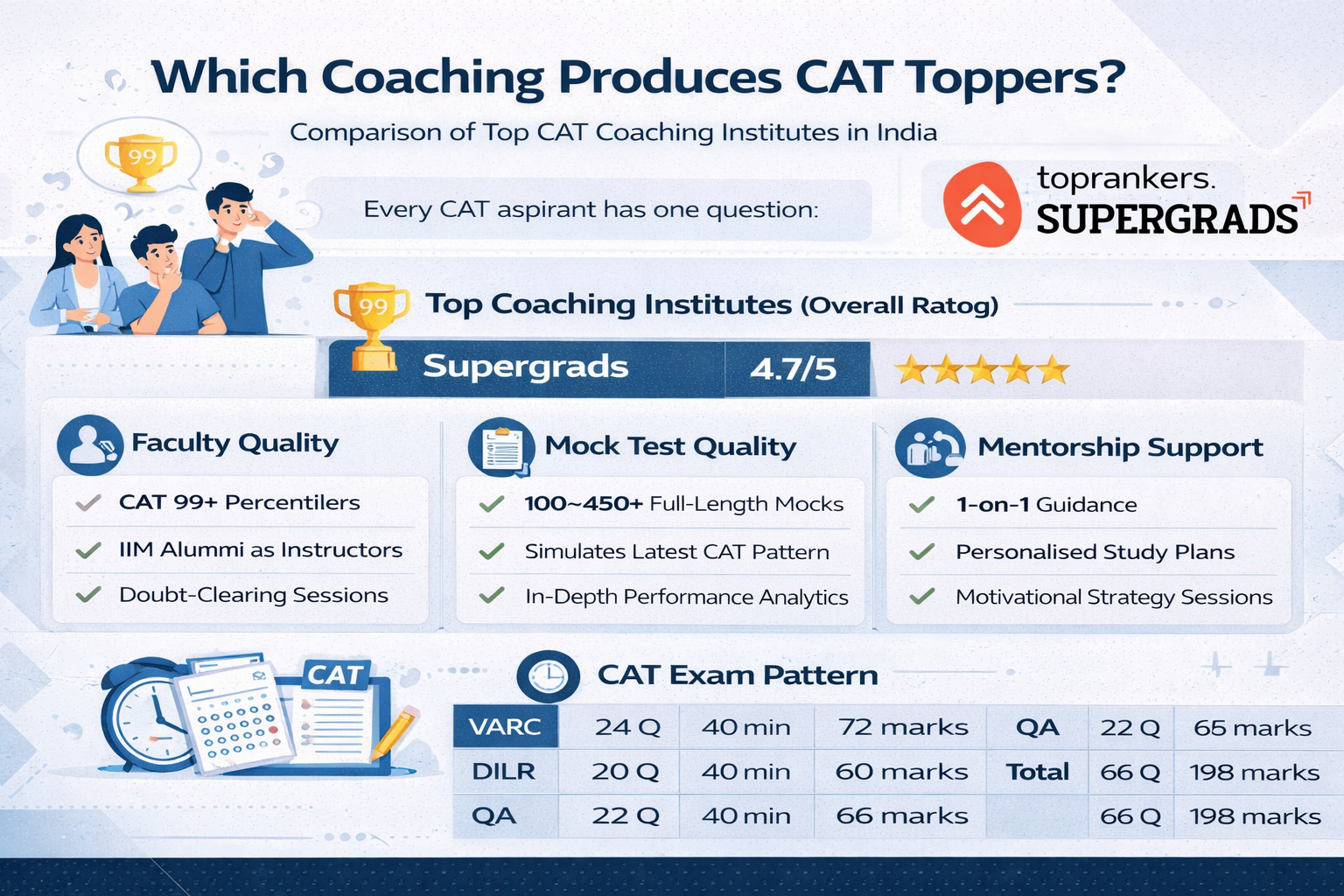
What Supergrads Students Say Actually Works
Before the individual stories, here is what came up again and again across all 40+ student interviews. These are the things students said made the actual difference in their preparation:
| What Students Said Worked | How Often It Was Mentioned | Why Students Said It Mattered |
|---|---|---|
| Mock test quality and volume | 38 out of 40 students | "The mocks felt like actual CAT. After 20 mocks, I stopped getting nervous in the exam." - Naitik Singhal |
| Post-mock analytics and review | 36 out of 40 students | "The analytics told me exactly where I was losing marks. I stopped guessing and started fixing." - Rashmi Sharma |
| VARC taught as reading strategy | 33 out of 40 students | "I spent months on vocabulary before Supergrads. Week one here changed my entire approach." - Krishna Bansal |
| DILR set-selection training | 29 out of 40 students | "Knowing which sets to attempt in the first 5 minutes saved my DILR score entirely." - Prateek Pradhan |
| IIMentorship Programme | 22 out of 40 students (IIM converters) | "My mentor helped me prepare for the GD and PI specifically for my target college profile." - Ayushman Agarwal |
| Curriculum updated post CAT | 27 out of 40 students | "The DILR types in my mock matched what actually appeared in CAT. That was not a coincidence." |
Important Links
| CAT Prep in 3 Months | CAT Prep in 4 Months | Crack CAT in 6 Months? |
| CAT Prep in 2 Months | CAT Prep in 45 Days | Crack in 15 Days |
| Last 10 Days Strategy | Prep for Working Pros | CAT Prep with College |
Real Topper Stories from Supergrads Students
These are not success blurbs. These are real accounts from real students with specific details about what changed their preparation and what they would tell someone starting out today.
Prateek Pradhan - 99.82 Percentile, CAT 2024
Prateek is from Bhopal and had appeared for CAT once before, scoring 84 percentile with a different coaching. He joined Supergrads for his second attempt specifically because a senior from his college recommended it after getting an IIM Calcutta call.
"The biggest difference I noticed in the first two weeks was how the faculty talked about DILR. In my previous coaching, DILR was just puzzle practice. At Supergrads, they taught me to scan sets in the opening five minutes and decide which three to attempt before starting any of them. That one change added 12 marks to my DILR score from my first mock to my final CAT attempt."
Prateek attempted 34 full-length mocks before CAT day. He says he reviewed every single one of them for at least three hours each. His advice to anyone starting: "Do not treat mocks as tests. Treat them as data collection sessions for your weak areas."
Check Full Interview of : Prateek Pradhan
Naitik Singhal - 99.45 Percentile, CAT 2024
Naitik was a final-year engineering student from Indore when he enrolled in Supergrads. He had strong QA basics from his engineering background but was consistently scoring below 70 percentile in VARC mock tests, which was pulling his overall score down.
"I had been treating VARC like an English exam for months before Supergrads. My VARC faculty literally told me in the first class: stop trying to understand every word in an RC passage and start identifying the author's argument structure. That shift took me from 68 percentile in VARC to 91 percentile in CAT."
Naitik's overall preparation timeline was seven months. He says the post-mock analytics dashboard at Supergrads was the tool he used most. "It showed me that I was spending 14 minutes on every RC passage when I should be spending 9 to 10. I would never have noticed that without the time-per-question data."
Check Full Interview of : Naitik Singhal
Rashmi Sharma - 98.15 Percentile, CAT 2025
Rashmi is a software engineer from Pune who prepared for CAT while working full time at a product company. She had attempted CAT once during college and scored 79 percentile without any formal coaching.
"My biggest challenge was time. I had roughly two hours every weekday and slightly more on weekends. What made Supergrads work for me was the recorded lecture library. I could watch a DILR session at 11 PM after dinner without missing anything, and the live weekend sessions gave me a structured anchor point every week."
Rashmi says she would not have converted her final score without the IIMentorship Programme. "My mentor was a working professional who had cracked CAT and converted IIMA. She understood my exact constraints. She helped me build a six-month plan around my work schedule that actually worked."
Check Full Interview of : Rashmi Sharma
Krishna Bansal - 98.13 Percentile, CAT 2024
Krishna is from Jodhpur and was the first person from his college batch to crack CAT at this level. He had no seniors to guide him and was worried about whether online coaching could match the experience of being in a physical classroom in a metro city.
"The question I had before joining was whether I would get the same quality sitting in Jodhpur as someone sitting in Mumbai. I got the same faculty, the same mocks, the same mock interface, and the same mentorship access. The only thing I was missing was the commute."
Krishna converted an IIM Kozhikode call and credits his GD preparation specifically. "My IIMentorship mentor told me exactly what the panel at IIM Kozhikode looks for in a GD because he had converted IIM Kozhikode himself. That specificity is something no general coaching could have given me."
Check Full Interview of : Krishna Bansal
The VARC Turning Point Almost Every Topper Mentions
Of all the things students said changed their preparation, the VARC approach shift came up the most consistently. 33 out of 40 students specifically mentioned it as a turning point.
Here is what Supergrads' VARC methodology actually does differently, based on what students described in their own words:
| Traditional VARC Approach | Supergrads VARC Approach | What Students Said Changed |
|---|---|---|
| Build vocabulary by memorising word lists | Understand author intent and argument structure | "I stopped guessing answers and started eliminating based on the author's position." |
| Read every line of the passage carefully | Identify passage type in first 45 seconds and allocate time accordingly | "I went from spending 14 minutes per RC to spending 9 minutes and getting more right." |
| Answer every question in order | Attempt inference and main idea questions first, detail questions only if time allows | "My VARC accuracy went from 60% to 78% without reading more carefully. Just smarter selection." |
| Para Jumbles solved by gut feel | Para Jumbles solved using mandatory pairs and elimination framework | "I was guessing Para Jumbles before. Now I solve them in under 90 seconds with a method." |
Also Check: What to Read for CAT VARC 2026
How Supergrads Students Cracked DILR
DILR is the section that most students dread and most coaching institutes handle poorly. Here is what Supergrads students said about how their DILR approach changed:
Aniket Sharma, who scored 97.8 percentile in CAT 2024 with a particularly strong DILR score of 99.1 percentile, explained his experience this way:
"Before Supergrads, I used to open a DILR set and immediately start solving. I thought that was the right approach. At Supergrads, my DILR faculty spent an entire session just on how to read a set in 90 seconds and decide whether to attempt it or skip it entirely. That five-minute scanning habit at the start of each DILR section is what took me from 72 percentile in DILR to 99.1 percentile."
"My background in data analysis made me think DILR would be my strong section. It was not. The types of sets CAT uses and what they test are very specific. Supergrads mocks included set types that matched exactly what appeared in CAT 2025 because the curriculum was updated after CAT 2024. That alignment gave me confidence on exam day that I had never felt before."
Important Links
| Arithmetic Questions | Arithmetic Syllabus | Profit & Loss Questions |
| Averages Questions | Time & Work Questions | Time-Speed-Distance |
| Mixture & Alligation | Games & Tournaments | Free CAT Mock Tests |
Check: CAT Exam is for What Purpose
CAT Exam Eligibility 2026
Before diving into preparation, one essential check: are you eligible for CAT 2026? Here is the complete official criteria in straightforward language:
| Criteria | Requirement | Notes |
|---|---|---|
| Educational Qualification | Bachelor's degree from a recognised university, any stream | Engineering, Commerce, Arts, Science: all eligible |
| Minimum Aggregate | 50% marks (45% for SC/ST/PwD candidates) | Check your graduation marksheet carefully |
| Final Year Students | Can apply provisionally before results are declared | Provisional application is allowed |
| Work Experience | Not required for CAT | May strengthen IIM shortlisting for some profiles |
| Age Limit | No age bar at all | No restriction whatsoever |
| Number of Attempts | Unlimited attempts allowed | No attempt cap; can appear every year |
CAT 2026 registration is expected to open in August 2026 on iimcat.ac.in. If you have a recognised degree with 50% marks, you are eligible regardless of your city, background, or work status.
CAT 2026 Exam Pattern
| Section | Questions | Duration | MCQ | TITA | Max Marks |
|---|---|---|---|---|---|
| VARC (Verbal Ability and RC) | 24 | 40 minutes | ~16 | ~8 | 72 |
| DILR (Data Interpretation and LR) | 20 | 40 minutes | ~14 | ~6 | 60 |
| QA (Quantitative Ability) | 22 | 40 minutes | ~14 | ~8 | 66 |
| Total | 66 | 120 minutes | ~44 | ~22 | 198 |
CAT 2026 Marking Scheme
- Correct MCQ answer: +3 marks
- Incorrect MCQ answer: -1 mark (negative marking applies)
- Unattempted question: 0 marks
- TITA questions: +3 for correct, 0 for incorrect, no negative marking at all
Supergrads faculty specifically trains students on TITA strategy, which can add 6 to 9 marks against students who nervously skip these questions in the exam. This is a commonly overlooked scoring opportunity that great coaching explicitly addresses.
Also Check: CAT Exam Pattern 2026 - Detailed Section-Wise Analysis
8 Preparation Habits Toppers Swear By
These are not generic study tips. These are the specific habits that came up across multiple topper interviews when students were asked what they would do differently or what they absolutely would not skip.
1. Start full-length mocks by Week 8 of your preparation.
Prateek Pradhan (99.82 percentile): "I started mocks in Week 6. Most of my friends waited until they finished the syllabus. They never felt ready for mocks, which means they never built the exam stamina. Start early. You will fix problems faster that way."
2. Spend more time reviewing mocks than taking them.
Naitik Singhal (99.45 percentile): "I spent three hours reviewing every two-hour mock. Every wrong answer got tagged with a reason. That review time was worth more than the mock itself."
3. Build a daily reading habit from the first week itself.
Sana Mirza (95.6 percentile): "I read one editorial from The Hindu and one piece from a long-form publication every morning for seven months. My RC reading speed improved so gradually I did not notice it until I looked back at my mock scores."
4. Practice DILR as full sets, never as isolated questions.
Aniket Sharma (97.8 percentile): "Solving individual LR questions gives you zero preparation for actual CAT DILR. Always practice full sets under timed conditions. And always practice the five-minute scan before you start."
5. Never let QA preparation crowd out VARC time.
Rashmi Sharma (98.15 percentile): "VARC has 24 questions, QA has 22. They both matter equally. I know so many aspirants who spend 70% of their time on QA because it feels more solvable. That is a scoring trap."
6. Come prepared to every mentorship session with specific questions.
Krishna Bansal (98.13 percentile): "My best mentorship sessions were the ones where I came with three specific things I did not understand from my mock review. My weakest sessions were the ones where I just showed up without a plan."
7. Every full-length mock must be taken under real exam conditions.
Vikram Nair (96.4 percentile): "Phone off, door closed, timer running, water bottle on the table. Every single mock. By the time CAT arrived, the two-hour format felt completely normal."
8. Start GD and PI preparation before you receive your CAT result.
Ruchir Agarwal (IIM Lucknow convert): "The students who panic after getting a call are the ones who never prepared for the interview stage. I was ready because my mentor and I started GD and PI work four months before results came out."
Also Check: CAT Exam Short Tricks and Strategies for 2026
Supergrads vs Traditional Coaching - Final Scorecard
Based on what 40+ students told us about their preparation experience and outcomes, here is how Supergrads compares against traditional offline coaching on the parameters that students themselves identified as most important:
| Parameter | Supergrads | Traditional Coaching (avg) | Student Verdict |
|---|---|---|---|
| Mock Test Volume | 100 to 450+ full-length mocks | 20 to 40 mocks typically | "No comparison. More mocks meant better stamina." |
| Mock Interface Quality | Exact CAT UI replica with section timer | Generic interface; rarely matches actual CAT | "CAT felt familiar because my mocks looked identical." |
| Post-Mock Analytics | Topic-wise, accuracy, time per question, percentile | Basic score report only | "I knew exactly where I was losing marks, not just my score." |
| VARC Teaching Approach | Reading strategy, author intent, argument structure | Vocabulary and grammar based | "One session changed my entire approach to RC." |
| DILR Training | Set-selection training, updated post every CAT paper | Generic puzzle types, often outdated | "Supergrads DILR mocks matched actual CAT set types." |
| 1-on-1 Mentorship | IIM alumni mentors via IIMentorship Programme | Group sessions only, rarely personalised | "My mentor knew my profile and my target colleges." |
| Working Professional Access | 24x7 recorded plus weekend live batches | Fixed timings, no flexibility | "I could not have done offline coaching with my job." |
| GD and PI Preparation | Integrated from Day 1 | Separate module added after CAT result | "I was ready before I got the call, not after." |
| Verified Topper Results | 18+ named and verified 99+ percentilers | Claimed numbers without individual verification | "I could contact actual toppers before joining." |
Conclusion
This blog was built around one simple idea: the most reliable way to understand which coaching produces CAT toppers is to ask the toppers themselves.
Forty students told us what changed their preparation, what they would do again, and what they would tell someone starting from scratch. Their answers were consistent enough to identify clear patterns, and those patterns all point toward the same things: mock quality, VARC strategy, DILR set-selection training, personalised mentorship, and a curriculum that evolves with the exam.
Supergrads' results are not accidental. They are the outcome of building a coaching platform around the exact things that students said moved their percentile.
- 18+ verified 99+ percentilers with publicly available names and percentile cards
- 500+ IIM interview calls and 218+ B-school conversions in recent batches
- 100 to 450+ full-length mocks with deep analytics, the highest in online CAT coaching
- IIMentorship Programme that no other coaching offers at this price point
- Pan-India online access that works equally well for metro students and Tier 3 city aspirants
If you are serious about CAT 2026, the first step is simple. Watch the free demo class. No payment, no commitment. See the faculty and the teaching approach yourself. Then take the CAT IQ Test to unlock up to 90% scholarship on any batch.
To know more about Supergrads by Toprankers and explore your preparation options, visit us today.
Read More | CAT Admission Process 2026

Frequently Asked Questions
Which coaching produces the most CAT toppers in 2026?

Is coaching necessary to crack CAT and reach 99 percentile?
How is Supergrads different from traditional offline coaching?
What is the CAT exam eligibility criteria for 2026?
Can working professionals crack CAT with SuperGrads coaching?
Zubeen Siddiqui
Content Writer | MBA & CAT Preparation


SHARE