
1723534562.png)

CAT Preparation Tips for Working Professionals (Study Plan, Routine & Strategy)
August 3, 2026
Overview:
Yes, you can crack CAT while working full-time - on 2 to 2.5 focused hours on weekdays and 5 to 6 at weekends. CAT 2026 is on Sunday, 29 November 2026, which is exactly 17 weeks away, and registration closes on 15 September 2026.
Below is a dated week-by-week plan built for that window, three daily routines for different job types, a 45-minute mock analysis method for weeks when work spikes, and what your work experience is actually worth to an IIM. If 17 weeks is too tight alongside your role, there's a CAT 2027 path at the end.
What you will learn in this blog: How working professionals can prepare for the CAT exam effectively by balancing study with a job, including a practical study routine, phased plan with mock tests, and time-management tips to improve accuracy and performance.
Key Takeaways
- Who this is for? Full-time professionals (9–6 or rotational shifts) with limited weekday hours
- Time needed for preparation? 2–2.5 hrs weekdays | 5–6 hrs weekends (≈20 hrs/week)
- Your window? 3 August to 29 November 2026
Table of Contents
- CAT Preparation Tips for Working Professionals 2026 - Study Plan
- Section-wise Strategy for Working Professionals (2-Hour Weekday Plan)
- Daily Routine Templates for Working Professionals
- CAT Mock Analysis for Working Professionals (45-Minute Weekday Method)
- How Many CAT Mocks Should Working Professionals Take?
- CAT Preparation Tips for Working Professionals 2026
- Pitfalls to Avoid During CAT 2026 Preparation for Working Professionals
- Conclusion
When considering CAT preparation for working professionals, the first thing that comes to mind is which is the best CAT study plan for working professionals, or what is the best CAT preparation plan for working professionals?
A well-structured and result-oriented study plan, combined with regular progress tracking and mock tests, will help you identify areas for improvement.
CAT Preparation Tips for Working Professionals 2026 - Study Plan
Following is the well-bifurcated study plan for the CAT Preparation strategy for Working Professionals:
|
Weeks |
Weekdays (2–3 hrs/day) |
Weekends (5–6 hrs/day) |
|
Week 1–2 |
• Take 1 Full CAT Diagnostic Test • Analyse strengths & weaknesses • Understand CAT Exam Pattern & Sectional Timing • Go through the complete CAT Syllabus |
• Deep analysis of diagnostic test • Identify strong, moderate & weak topics • Create a personalised subject priority plan • Start basic Arithmetic revision |
|
Week 3–4 |
• Quantitative Ability (Arithmetic focus – Percentages, Ratio, Profit & Loss, Time & Work) • 15–20 questions daily practice • Start Vocabulary + Reading Comprehension (1 RC daily) |
• Advanced QA practice (mixed Arithmetic sets) • 2–3 RCs with deep analysis • Sectional mini-test (QA + VARC) |
|
Week 5–6 |
• Algebra fundamentals (Equations, Inequalities, Functions) • Daily 1 RC + 5 VA questions • Maintain formula notebook |
• Algebra mixed practice sets • RC practice (diverse topics: Philosophy, Economics, Science) • 1 Sectional Mock (VARC) + Analysis |
|
Week 7–8 |
• Data Interpretation basics (Tables, Charts, Caselets) • Solve 1 DI set daily • Continue QA revision (alternate days) |
• 4–5 DI sets (timed practice) • Start Logical Reasoning basics (Arrangements, Puzzles) • Sectional Mock (DILR) |
|
Week 9–10 |
• Logical Reasoning advanced sets (Games, Venn Diagrams, Networks) • Timed practice (20–25 mins per set) • VARC mixed practice |
• 6–8 DILR sets (varied difficulty) • Learn time allocation strategy for DILR • 1 Full-Length Mock + Detailed Analysis |
|
Week 11–12 |
• Subject Revision (Arithmetic + Algebra + DI Basics) • 1 Sectional Test every 3 days • Error Log Maintenance |
• 1 Full-Length Mock per weekend • 3–4 hours Mock Analysis • Identify accuracy issues |
|
Week 13–14 |
• Strengthen weak topics • Mixed practice (All 3 sections daily) • Focus on the question selection strategy |
• 1 Full-Length Mock • Strategy refinement • Improve attempt planning per section |
|
Week 15–16 |
• 2 Full-Length Mocks per week (mid-week + weekend) • Deep performance tracking • Speed + Accuracy drills |
• Mock Analysis • Revise formula notebook • Work on weak LR/DI sets |
|
Week 17 |
• Final Subject Review (High-weightage topics only) • Solve Previous Years’ CAT Papers (Section-wise) |
• 1 Full-Length Mock • PYQ Analysis • Focus on confidence building |
|
Week 18 (Last 7–10 Days) |
• Light Revision Only • Review formulas, shortcuts, RC approach • No new topics |
• 1 Final Mock (7 days before exam) • Relaxation & Stress Management • Sleep discipline & healthy routine |
Section-wise Strategy for Working Professionals (2-Hour Weekday Plan)
If you’re working full-time, your weekday prep should be short, repeatable, and timed. The goal is to build skill without draining energy. Use the section-wise approach below and rotate it through the week.
VARC (Reading + Accuracy First)
- Daily (30–45 mins): 1 RC passage (timed) + 5–8 VA questions
- Reading habit: 15 mins/day (editorial/long-form)
- Weekly target: 6–8 RC passages + 1 sectional
- Working-pro hack: Read during commute/lunch; solve RC at home
LRDI (Set Selection > Solving Everything)
- Alternate days (35–45 mins): 1 LRDI set (timed)
- After every set: 10 mins review: Where did time leak?
- Weekly target: 5–6 sets + 1 sectional
- Non-negotiable: Practice picking the “right” set fast
QA (Topic Order + Timed Drills)
- Daily (45–60 mins): 1 topic drill (15–25 questions)
- Every 3rd day: Mixed QA set (timed)
- Weekly target: 2 topics + 1 mixed test
- Revision rule: 15 mins formula + error-log review on 2 weekdays
Daily Routine Templates for Working Professionals
Choose a template that matches your work schedule. Don’t overcomplicate it. Consistency beats intensity when you’re managing a job.
Plan 1: 9 - 6 Job (2 - 3 Hours a Day)
| Time Slot | What to Do |
|---|---|
| Morning (30 - 45 mins) | 1 RC passage + 5–8 VA questions (timed) |
| Post-work (60 - 75 mins) | QA: 1 topic drill OR 1 mixed practice set |
| Night (30 - 45 mins) | LRDI: 1 set + 10 mins error-log review |
Plan 2: Rotational Shifts (Flexible Blocks)
For shift workers, anchor your prep to 2 fixed study blocks rather than fixed clock times.
- Block A (45 - 60 mins): VARC
- Block B (60 - 75 mins): QA (topic drill / timed practice)
- Optional (30 - 40 mins): LRDI (1 set) OR revision
Shift hack: On low-energy days, do only VARC + revision. Never skip the habit entirely.
Plan 3: “Crazy Work Week” (Minimum Viable Plan)
This plan prevents you from falling off-track when work spikes.
- Weekdays (45 - 60 mins total): 1 RC + 15 QA questions (timed)
- Weekend (4 - 6 hours): 1 sectional + analysis + 2 weak-topic drills
Rule: If you can’t do a full study session, do a “starter task” (1 RC). Momentum matters.
How to use your existing weekly plan table: Keep your table as the “weekly structure”, and treat these phases as the “monthly direction”.
Weekend Rule: Mock + Analysis
Working professionals typically lose marks not because of a lack of effort, but because mock analysis gets skipped. Keep your weekend structure simple:
- Saturday: Take 1 mock (or 2 sectionals if you’re in the early phase)
- Sunday: Analyse mistakes + redo the toughest 2–3 sets/questions
- Weekdays: Fix weak areas identified in analysis (short drills)
CAT Mock Analysis for Working Professionals (45-Minute Weekday Method)
As a working professional, you won’t always get 3 - 4 hours to analyse every mock. So use a two-step system: Deep analysis on weekends and quick analysis on weekdays. This keeps you improving without burning out.
Weekend Deep Analysis (90 - 150 mins)
- Mark every question as: Correct / Wrong / Guess / Skipped
- Identify the top 5 time-wasters
- Write the “why” for each wrong answer (concept/method/time/panic)
- Redo the toughest 10–15 questions without a timer
- Set 2 weak topics to fix in the coming week
Weekday Quick Analysis (45 mins)
- 10 mins: Review wrong + guessed questions only
- 15 mins: Note the mistake pattern (see list below)
- 15 mins: Redo 5 - 7 similar questions (targeted drill)
- 5 mins: Update error log + tomorrow’s micro-task
How Many CAT Mocks Should Working Professionals Take?
Mocks are useful only when you can analyse them. Use this simple progression:
| Phase | Mock Frequency | What Matters More |
|---|---|---|
| Foundation | 1 sectional/week | Basics + accuracy |
| Practice | 1 mock every 10–14 days | Timing + question selection |
| Mocks | 1 mock/week → 2 mocks/week | Analysis + fixing weak areas |
CAT Preparation Tips for Working Professionals 2026
Here are the key tips for the working professional to follow during CAT exam preparation:
1. Make a Complete and Effective Study Plan
The first problem you'll encounter is balancing your employment with effective preparation for the CAT exam 2026. To overcome this:
- Begin your preparation early and design a customised study plan based on your work schedule.
- Focus on your fundamentals in mathematics, logical reasoning, and English from the beginning.
- Take practice examinations regularly as part of your CAT preparation for working professionals to evaluate your progress and determine areas for improvement.
2. Prepare Under Expert Guidance
Given your hectic schedule, self-study may appear challenging. Enrolling in a CAT 2026 online coaching programme, on the other hand, can help you prepare faster. Coaching programmes provide a planned syllabus, relevant resources, and expert guidance, saving time spent on preparatory organisation.
Connecting with other working professionals preparing for the CAT is a valuable option. It fosters a community that offers mutual support and motivation, making you feel part of a larger, supportive network.
3. Maintaining Work-Study-Life Balance
As you begin your CAT preparation tips for working professionals, remember the importance of establishing a work-study-life balance. It's easy to become overwhelmed and stressed out by your professional obligations and CAT preparation.
To avoid this, manage your time wisely, including breaks, relaxation, and leisure activities, to keep yourself motivated and energised
4. Create a study plan
A well-structured study plan is the foundation of efficient preparation. Divide your study material into manageable sections and stick as closely to your schedule as possible. A well-planned schedule lets you cover the course systematically while still giving you enough time for revision.
Use Supergrads Free Resources 2026 Strategically
| CAT Full Length Mock Test-1 | |
| CAT Full Length Mock Test-2 |
5. Use Online Resources, Study Materials, Mock Tests
The Internet is an excellent resource for CAT 2026 preparation books. To support your preparation, use internet resources such as CAT mock tests, sample question papers, and e-books. These materials are flexible and can be accessed at any time and from any location.
6. Prioritise Your Tasks
Due to limited time, it is critical to prioritise your tasks by importance. Concentrate your efforts and resources on areas that require significant improvement.
7. Utilise Weekends and Holidays
Make the most of your weekends and holidays by scheduling thorough study sessions and practice tests. This is the time to make up for missed study hours and explore challenging topics in depth.
8. Join an Online or Offline Study Group
A study group can provide much-needed motivation, clarify doubts, and track progress. Discussions with other CAT aspirants might generate new ideas and perspectives on various problems.
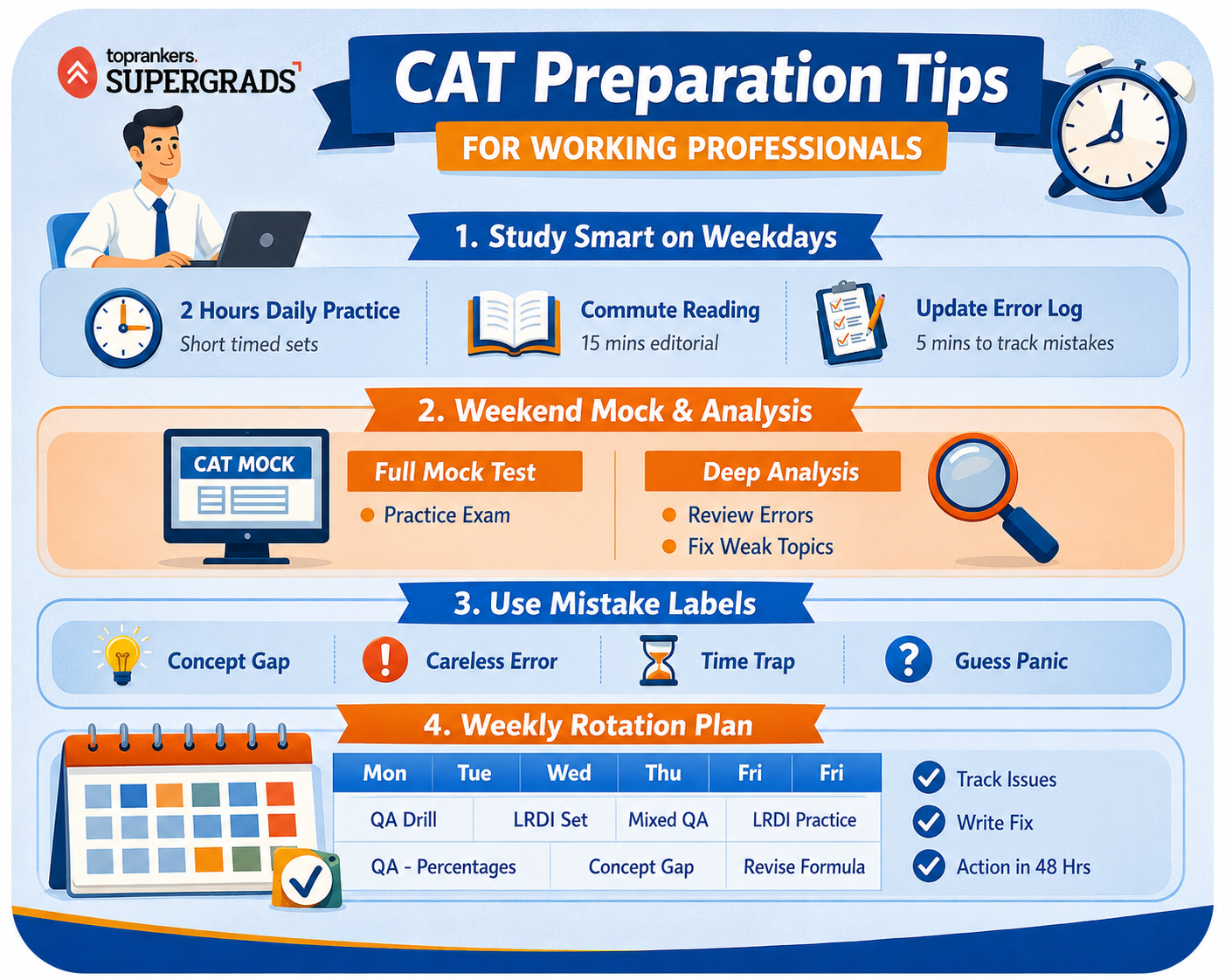
Pitfalls to Avoid During CAT 2026 Preparation for Working Professionals
While preparing for the CAT 2026 entrance exam, especially understanding the CAT exam pattern, certain pitfalls working professionals should avoid:
1. Try to Avoid Procrastination
Start your preparation early instead of delaying it. Manage your time wisely to cover all essential CAT topics.
2. Don't Ignore Your Job
While CAT preparation is necessary, don't let it compromise your job performance. Strive for a balanced strategy that emphasises your work and CAT preparation.
3. Theory Isn't Everything
While theoretical knowledge is essential, it's also important to be familiar with the exam pattern and to constantly track your progress. Use previous years' question papers and mock tests to put theory into practice.
4. Don't Compare with Everyone
Everyone has their own pace and way of preparation. Instead of comparing yourself to others, concentrate on your progress and preparation strategy.
Key takeaways for working professionals
- Weekdays: short timed practice; weekends: mock + analysis
- Use an error log to improve accuracy without increasing hours
- Rotate sections across the week to avoid burnout
Conclusion
To summarise, CAT Preparation Tips for Working Professionals, a CAT study plan for working professionals can be difficult, but with the appropriate strategy and a balanced approach, you can tackle the difficulties.
Passing the CAT exam requires ongoing learning, motivation, and efficient time management.

Smart Prep for CAT: Join Our Free Demo Class
Fill your details
Frequently Asked Questions
How can I balance my job and CAT 2026 preparation effectively as a working professional?

Is self-study feasible for working professionals preparing for CAT 2026?
How can I maintain a work-study-life balance during CAT 2026 preparation?
What are some practical tips for CAT 2026 preparation as a working professional?
Should I join a study group for CAT 2026 preparation?
How to manage time for CAT 2026 preparation?

Zubeen Siddiqui
Content Writer | MBA & CAT Preparation
SHARE