
1723534562.png)

CAT Exam is for What Purpose? Why Give CAT?
July 27, 2026
Overview: The CAT exam is for one purpose: to give business schools a single, comparable measure of aptitude across candidates from completely different academic backgrounds. It is a filter, not a job test and not an admission in itself.
- CAT (Common Admission Test) is the entrance exam used by the 21 IIMs and more than 1,200 other institutes to shortlist candidates for MBA and PGDM programmes.
- CAT 2026 is on Sunday, 29 November 2026, conducted by IIM Indore across roughly 170 test cities.
- Registration runs 3 August to 15 September 2026. Fees are ₹2,700 for General, EWS and NC-OBC candidates and ₹1,350 for SC, ST and PwBD candidates.
- It tests aptitude, not syllabus knowledge - Quantitative Ability, Verbal Ability and Reading Comprehension, and Data Interpretation and Logical Reasoning.
- A CAT score gets you an interview call, not a seat. WAT, GD and Personal Interview rounds decide the final list, alongside your academics, work experience and profile diversity.
- CAT 2026 scores stay valid until 31 December 2027, which is why a first attempt while still in college carries limited downside.
Key Takeaways
- CAT's purpose is standardisation. It lets institutes compare an engineer from Kanpur, a commerce graduate from Kolkata and a four-year working professional on one scale.
- CAT is not a recruitment exam. It does not lead to a job. It leads to a management programme, which is where the career outcome actually comes from.
CAT 2026 at a Glance
| Particular | Detail |
|---|---|
| Exam date | Sunday, 29 November 2026, in three sessions |
| Conducting IIM | IIM Indore |
| Notification released | 25 July 2026 |
| Registration window | 3 August 2026 (10:00 AM) to 15 September 2026 (5:00 PM) |
| Application fee | ₹2,700 General/EWS/NC-OBC · ₹1,350 SC/ST/PwBD |
| Test cities | Approximately 170 |
| Mode | Computer-based test |
| Sections | VARC, DILR, QA - 40 minutes each |
| Total | 68 questions, 204 marks, 120 minutes |
| Marking | +3 correct, −1 incorrect MCQ, no penalty on TITA |
| Score validity | Until 31 December 2027 |
| Eligibility | Bachelor's degree with 50% (45% for SC/ST/PwBD). Final-year students may apply |
| Official website | iimcat.ac.in |
Confirm every detail against the official notification before applying. Full process at CAT 2026 registration, and the complete criteria at CAT exam eligibility.
What is CAT Exam 2026?
So, CAT exam is for what purpose exactly? The CAT exam (Common Admission Test) is a national-level entrance test used for admission into postgraduate management programmes — MBA, PGP and PGDM — offered by the 21 IIMs and over 1,200 other management institutes across India.
It is conducted once a year, in November, by one of the older IIMs on a rotational basis. IIM Indore conducts CAT 2026. IIM Kozhikode conducted CAT 2025.
The exam runs for 120 minutes across three sections with a strict 40-minute lock on each, which means you cannot return to a section once its time expires. That single design choice tells you a lot about what the exam is measuring about the full structure at CAT exam pattern, and topic coverage at CAT syllabus.
What Is the Purpose of the CAT Exam?
Ask what the purpose of the CAT exam is, and the answer starts with a problem business schools have to solve: how do you compare candidates whose marksheets are not comparable? A 78% from one university may be exceptional; the same figure elsewhere may be ordinary. Everything about the exam follows from that problem.
1. Standardised comparison across backgrounds
Marks are not comparable across universities, streams or grading systems. A single aptitude test gives every institute one common yardstick, applied on one day, under identical conditions.
2. Testing aptitude, not syllabus knowledge
CAT deliberately avoids testing management theory, because candidates have not studied it yet. It measures quantitative reasoning, reading comprehension and structured thinking under time pressure — the skills the first year of an MBA actually demands. See CAT subjects for what each section covers.
3. Shortlisting rather than selecting
This distinction is the most widely misunderstood part of the process, and worth stating plainly. A CAT score gets you an interview call. It does not get you a seat. Institutes then apply their own weightings to academics, work experience, and academic and gender diversity, and the CAT admission process concludes with WAT, GD and Personal Interview rounds. Two candidates with identical percentiles routinely receive different call lists.
4. Managing scale
CAT 2025 saw 2.95 lakh registrations, of which 2.58 lakh candidates appeared. Against a few thousand seats across the IIMs, no interview-based process could function without a first filter. The CAT marking scheme - three marks for a correct answer, minus one for a wrong MCQ - exists to make that filter discriminating enough to separate candidates at the top.
5. Building genuinely diverse cohorts
Because CAT tests aptitude rather than domain knowledge, institutes can admit engineers, commerce graduates, doctors, lawyers and armed-forces personnel into the same classroom. That mix is a deliberate design outcome, not a side effect, and several IIMs award explicit diversity points for it.
6. Signalling to recruiters
The percentile is a screening credential that survives beyond admission. Some recruiters, particularly in consulting and finance, continue to reference CAT scores during campus placements years after the exam.
Take Charge of Your Self-Prep - Join the CAT & OMETs DIY Batch
Why Give CAT: Benefits of the CAT Exam
Once you understand what the CAT exam is for, the benefits of the CAT exam follow logically rather than reading as a list of promises.
One exam, many institutes. A single CAT score is accepted by the IIMs, FMS Delhi, SPJIMR, MDI, IMI, IMT and hundreds of others. You write once and apply widely, unlike systems requiring a separate test per institute.
The only route to the IIMs. No other entrance exam substitutes. If FMS Delhi or an IIM is on your list, this is the exam.
Open to freshers and working professionals alike. Final-year students can apply, and many institutes actively weight work experience of one to five years. Working candidates should read CAT preparation tips for working professionals before planning a timeline.
No stream restriction. Any bachelor's degree qualifies, and professional qualifications such as CA, CS and CMA are also accepted.
Reservation benefits apply. Seats and relaxed criteria exist for SC, ST, NC-OBC, EWS and PwBD candidates - see reservation in CAT exam.
Transferable preparation. The quantitative, verbal and reasoning work carries substantially into XAT, SNAP, NMAT and CMAT. The comparison at CAT vs XAT vs SNAP vs NMAT shows where the overlap ends and separate preparation begins.
Skills that outlast the exam. Reading dense text quickly, interpreting data under pressure and choosing which problems to abandon are genuinely useful capabilities, whatever the result.
Use SuperGrads Free Resources 2026 Strategically
| CAT Full Length Mock Test 1 | |
| CAT Full Length Mock Test 2 | |
| CAT Full Length Mock Test 3 |
What Is CAT Exam Used For Beyond IIM Admission?
Asking what is CAT exam used for beyond the IIMs is worthwhile, because a strong score opens doors that are not obvious from the admission brochure.
- Merit scholarships and fee waivers. Several institutes and external trusts offer these, though thresholds vary widely. Some tie waivers to percentile, others to the interview stage or to financial need. Check each shortlisted institute's scholarship page directly, since criteria and deadlines are set individually and are rarely published on the admission page.
- International exchange programmes. Top B-schools maintain exchange tie-ups with overseas institutions, and admission to those programmes typically begins with getting into the institute in the first place.
- Specialised programmes. Higher scores widen access to niche options - business analytics, luxury brand management, sports management, agri-business - that admit smaller cohorts and close earlier.
- Executive and one-year MBA routes. Some institutes accept CAT for their executive programmes, which matters if you have five or more years of experience.
- A two-year window. With validity to 31 December 2027, a CAT 2026 score can be applied across two admission cycles.
Should You Actually Take CAT in 2026? An Honest Assessment
Most pages answering "CAT exam is for what purpose" list only benefits. Here is the fuller picture, which is more useful if you are still deciding rather than looking for confirmation.
The numbers worth knowing first
- Around 2.58 lakh candidates appeared for CAT 2025 against a few thousand IIM seats. The top-tier funnel is narrow, and your plan should reflect that.
- Percentile is not conversion. Even at 99+, a call from IIM Ahmedabad, Bangalore or Calcutta depends on your tenth and twelfth results, graduation marks and work profile as much as on your score. Check realistic thresholds at CAT cut off for IIM.
- The application fee is ₹2,700, but the real cost is four months of study time. Price that honestly.
CAT is likely worth it if
- You want a management career and your target institutes accept CAT. For the IIMs there is no alternative.
- You are in your final year and can attempt at low opportunity cost, given the two-year validity.
- You have one to five years of experience and have hit a ceiling that a functional move alone will not clear.
- You can protect roughly 10 to 15 hours a week for four months or more.
Reconsider, or wait for CAT 2027, if
- You are pursuing an MBA mainly because peers are. The programme is expensive and demanding, and ambivalence usually surfaces in the interview.
- Your target roles do not require an MBA. Several analytics, product and specialist engineering paths reward experience and certifications more than a general management degree does.
- You cannot protect study time this cycle. A rushed attempt produces a low percentile that adds nothing, and CAT 2027 remains open.
- Your shortlist consists only of institutes that do not accept CAT. Check first - CMAT or another entrance may serve you better.
Do the arithmetic before you commit
Take your target institute's total fee, add roughly two years of forgone salary, and compare that against its published median salary - not the average, and never the highest package. If the payback period runs beyond four to five years, examine that specific programme harder. This takes ten minutes and is more useful than any ranking table.
Who Can Give CAT 2026?
- A bachelor's degree with at least 50% aggregate, or 45% for SC, ST and PwBD candidates.
- Final-year students may apply, subject to producing a completion certificate later.
- Professional qualifications including CA, CS and CMA are accepted.
- No age limit and no cap on attempts.
- Degrees must be from a recognised university or an institution declared deemed-to-be-university.


CAT 2026 or CAT 2027: Which Cycle Should You Target?
| Your situation now | Target cycle | Reasoning |
|---|---|---|
| Final-year student, graduating 2027 | CAT 2026 | You can apply as a final-year candidate, and the score stays valid to December 2027. Low downside. |
| Second-year undergraduate | CAT 2027 | You cannot apply yet with a completion timeline that works. Build fundamentals now using the CAT preparation for beginners roadmap. |
| Working professional, ready to commit 12+ hours a week | CAT 2026 | Four months from registration is a workable runway for a disciplined first attempt. |
| Working professional with an unpredictable schedule this quarter | CAT 2027 | A half-prepared attempt burns the year without producing a usable score. |
| Repeater who scored 85–95 in 2025 | CAT 2026 | Your syllabus base is intact. The gap is usually strategy - start with how to analyse CAT mock tests. |
| Starting from zero in October 2026 | CAT 2026 as practice, CAT 2027 as the target | Sit the exam for exposure, then prepare properly across a full year. |
CAT Exam is for What Purpose: Additional Opportunities with a Good CAT Score
Knowing what is CAT exam is used for? Let you understand the opportunities with a good CAT score. Here are some great options you will have after clearing the CAT exam with a good percentile:
1. Provides you with Scholarships
A stellar CAT performance can reduce the financial burden of an MBA. Many institutions offer scholarships, grants, or fee waivers based on CAT scores, enabling students to pursue their dreams without monetary constraints.
2. Gives you International Exposure
Top B-schools often have tie-ups with international institutions for student exchange programs. A good CAT score can be your ticket to global exposure, offering insights into global markets, cultures, and business practices.
3. Specialised MBA Courses
A high CAT score allows students to choose niche MBA specialisations like Business Analytics, Luxury Brand Management, or Sports Management, allowing them to tailor their MBA experience according to their passions and interests.


Conclusion
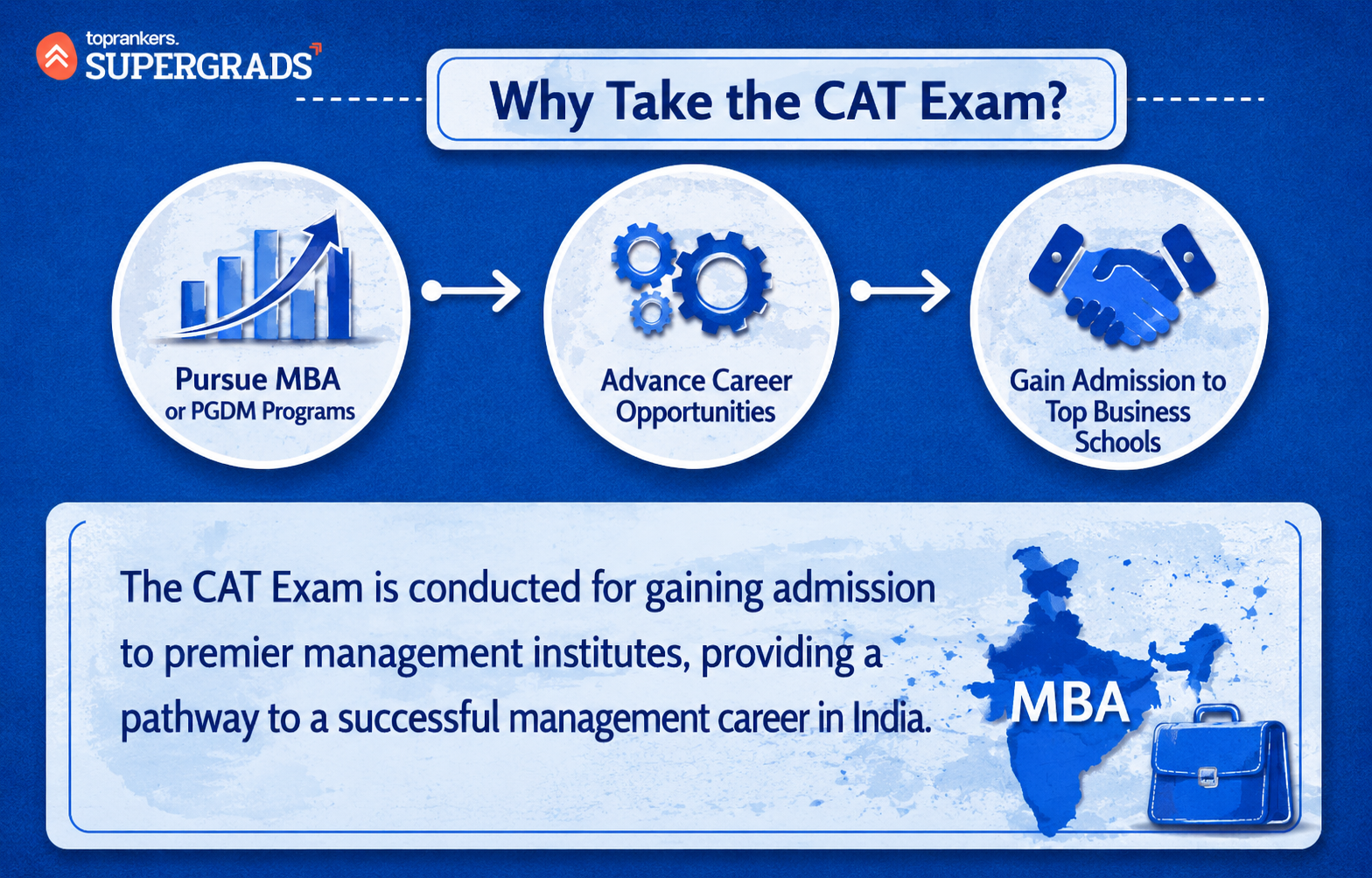
Finally, CAT Exam for what purpose? Or more specifically, what is CAT exam used for? The answer is that the CAT exam serves multiple significant purposes: facilitating admission to premier management institutions, assessing core aptitude skills, identifying future leaders, ensuring a fair selection process, and encouraging holistic development.
Understanding these purposes explains why the CAT exam is crucial for aspiring management professionals.

Smart Prep for CAT: Join Our Free Demo Class
Fill your details
Frequently Asked Questions
How does a CAT MBA program cater to current industry trends and demands?

Are there specialized courses available within CAT MBA programs?
How does a CAT MBA compare in terms of return on investment (ROI)?
Does a CAT MBA only benefit those looking for corporate jobs?
How does a CAT MBA enhance career prospects?
What is the purpose of CAT exam?
Who can write CAT exam?
Why and how is CAT exam conducted?
CAT exam is for what purpose in MBA admission?
CAT exam is for what purpose apart from IIM admissions?

Zubeen Siddiqui
Content Writer | MBA & CAT Preparation


SHARE