
1723534562.png)

Idiom and Proverb for CLAT 2027: List of Important Idioms with Meaning
June 24, 2026
Reader's Digest: The CLAT Exam is one of the most renowned exams in the country, and it evaluates a good grasp of the English language. The English language section weighs 20% of the CLAT paper marks, which shows its significance.
Idioms and Phrases is one such part of the CLAT English section. Knowledge of this topic is part and parcel of the CLAT exam to give an upper hand among other law aspirants.
Idioms and Phrases beautify the writing and make it more eye-catching to the reader.
This post will explain the definitions of idioms and phrases, the differences between them, and the questions asked in various Law entrance exams.
To help you with the same, we have curated a list of the most important phrases and idioms to help you crack the English Section of CLAT 2027.
What is an Idiom?
An idiom is defined as a phrase that has its own meaning. The meaning of an idiom is difficult to understand. Idiom has a non-literal meaning. Take a look at the examples below to understand better.
- We'll cross that bridge when we come to it - Let's not talk about that problem right now
- You can say that again - That's true, I agree
- to rub someone the wrong way - to irritate someone
- Wrap your head around something - Understand something complicated
- In a flutter - Excited
What is a Proverb?
A proverb is a short sentence generally given as a piece of advice. Proverbs are easy to understand. The literal meaning of a proverb makes sense on its own, but the real point of the proverb is understood when applied to the broader set of situations.
- Early to bed and early to rise, makes a man healthy, wealthy, and wise
- It's no use locking the stable door after the horse has bolted.
- Don’t cry over spilled milk
- A stitch in time saves nine
Also Check: Important CLAT English Vocabulary Questions
Difference between an Idiom and a Proverb
In Law entrance Exams like CLAT, AILET, the English Language section has significant importance. Hence, it becomes crucial to understand and learn all the concepts.
Here is the list of basic differences between idioms and proverbs.
| IDIOMS | PROVERBS |
| An idiom is defined as a phrase that consists its own meaning but cannot be understood easily. | A proverb is defined as a short saying or sentence that is used to give advice to another person. |
| An idiom has a non-literal meaning used in reading, writing, and speaking. | A proverb has a literal meaning that applies in various stages of life. |
| Idioms are mainly used in poetry. | Proverbs are used in daily lives. |
| Idioms are used to express an idea or thought. | Proverbs are used to give suggestions to other people. |
Read More - Legal Reasoning Questions for CLAT 2024
Most Commonly Asked Idioms and Proverbs in CLAT
Here, we'll explore some of the most commonly asked idioms and proverbs in CLAT, helping you prepare effectively for this vital aspect of the exam:
| LIST OF IDIOMS | MEANING |
| A Blessing in Disguise | It was a good thing that we thought was bad at first. |
| Beating around the Bush | Avoid saying what one actually means because it is uncomfortable. |
| Better Late Than Never | Coming a little late than not to arrive at all. |
| Getting out of hand | Things getting out of control. |
| Getting your act together | Work hard or better leave. |
| Break a Leg | Wishing Good Luck. |
| Giving the benefit of the doubt | Trusting someone |
| Miss the boat | It's too late |
| No pain, no gain | Work hard to get what you want. |
| Pulling someone's leg | To make fun of someone. |
| PROVERBS | MEANING |
| A cat has nine lives. | A cat can survive many fatal accidents. |
| Actions speak louder than words. | Actions are better representative of one's character than words. |
| Adversity and loss make a man wise | Wisdom is gained faster in challenging times. |
| A fool and his money are soon parted. | Foolish people do not know how to handle their money. |
| A journey of thousand miles begins with a single step. | No matter how complicated a task is, it always starts with a single step. |
| All good things come to an end. | Good experiences often come to an end. |
| All's well that ends well. | As long as the result is good, the number of problems in the way doesn't matter. |
| All that glitters is not gold. | Things or people that look good on the outside might not be as valuable or good. |
| All is fair in love and war. | One can break the rules in love or war to achieve a good result. |
| Always put your best foot forward. | Give your best and try hard as you can. |
Also Check: Important English Language Questions for CLAT and AILET
Idioms asked in CLAT Exam
Here are a few idioms and phrases asked in the previous year's CLAT Exam.
- To break the ice - to put people at ease
- Stand to one's guns - to remain firm with something
- In the nick of the time - at the exact time
- To blow the gaff - to reveal the secret
- Play fast and loose - Behave immorally
- Come off with flying colors - To be successful
- Hand in glove - in close collusion
- To speak by the book - to tell with precision
- At one's beck and call - to be dominated by someone
- To beat the air - to make efforts that are useless or vain
- Nip in the bud- to destroy in the very beginning
- By fits and starts- irregularly
- Open and above board- very clear
- Every cloud has a silver lining-Good things come after bad things
- The devil is in the details-It looks good from a distance, but when you look closer, there are problems
How to Memorise Idioms and Proverbs for CLAT
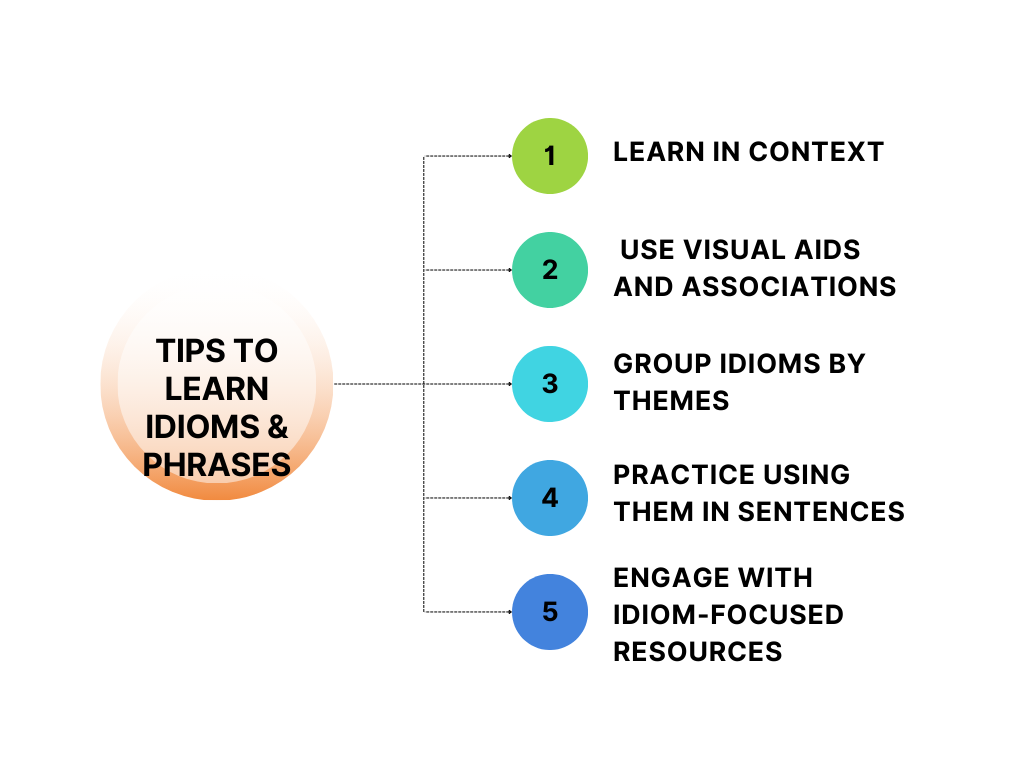
- Learn the meaning and usage, not just the words.
- Study 5–10 idioms/proverbs daily instead of cramming.
- Use them in your own sentences.
- Create flashcards for quick revision.
- Group them by themes like success, time, or relationships.
- Read newspapers and editorials to see them in context.
- Revise regularly using spaced repetition (1 day, 3 days, 7 days).
- Solve CLAT English practice questions to apply what you learn.
- Take a weekly quiz to test your memory.
CLAT Tip: Understanding the context in which an idiom or proverb is used is more important than memorising its exact definition.
Preparation Tips for Idioms and Proverbs for CLAT
- Learn meanings with examples to understand how they are used in sentences.
- Study a few idioms and proverbs daily instead of memorizing long lists at once.
- Maintain a vocabulary notebook and note down new idioms you come across.
- Read newspapers, magazines, and editorials to see idioms used in real contexts.
- Use flashcards for quick revision and self-testing.
- Group similar idioms and proverbs by themes such as success, failure, time, and relationships.
- Practice CLAT English questions involving vocabulary, sentence completion, and comprehension.
- Revise regularly using spaced repetition to improve retention.
- Create your own sentences using newly learned idioms and proverbs.
- Take weekly quizzes to assess your understanding and recall.
Pro Tip: Focus on understanding the meaning and context of idioms and proverbs rather than rote learning, as CLAT tests application-based language skills.

NLU Dream, Zero Cost Start: Free CLAT Demo
Fill your details
Frequently Asked Questions
What books to read in order to prepare the CLAT English Syllabus?

Is CLAT English Preparation possible in 1 month?
How to answer CLAT English Language Questions easily?
Is solving AILET Previous Year Paper is really beneficial to score good marks in the English Section?
Can I complete the AILET English syllabus in 3 months?

Samriddhi Pandey
Content Writer


SHARE