
1723534562.png)

XAT Verbal Ability Questions PDF Download (Topic-wise) with Answers
June 1, 2026
Overview: XAT Verbal Ability questions in the VALR section test more than vocabulary—they check reading depth, argument evaluation, and sentence logic. Below you’ll get topic-wise practice sets (RC, Critical Reasoning, Grammar, Vocabulary, Para Jumbles) with answers, explanations, and recent-year trends to prepare for XAT 2027.
XAT Verbal Ability Questions are an important part of the Verbal Ability & Logical Reasoning section of the XAT exam. These questions test your reading skills, grammar, vocabulary, sentence structure, and logical understanding of language.
Unlike CAT, where direct grammar and vocabulary questions are limited, XAT often includes a wider variety of verbal ability questions. This makes regular practice very important for students aiming to improve their VALR score.
In this blog, you will find the types of XAT VA questions, important topics, previous year trends, sample questions with answers, and useful tips to improve accuracy for XAT 2027 and XAT exam pattern.
Table of Contents
- What are XAT Verbal Ability Questions?
- Importance of XAT Verbal Ability Questions
- Topics Under XAT VA Questions
- XAT VALR Section Overview
- Types of XAT VA Questions
- Important Topics for XAT Verbal Ability
- Topic-wise Weightage of XAT VA Questions
- XAT Verbal Ability Questions from Previous Years
- Sample XAT Verbal Ability Questions with Answers
- XAT vs CAT Verbal Ability Questions
- Tips to Improve Accuracy in XAT VA Questions
- Common Mistakes Students Make
- Conclusion
What are XAT Verbal Ability Questions?
- XAT Verbal Ability Questions are questions asked in the VALR section of the XAT exam. These questions check how well you understand the English questions, grammar, vocabulary, reading comprehension, and verbal logic.
- XAT VA Questions are not only about memorising words or grammar rules. They test how well you can understand context, identify the correct meaning, arrange ideas logically, and answer questions based on passages.
- These questions are useful for both XAT and CAT aspirants because reading comprehension, vocabulary, and verbal reasoning are common areas in both exams.
Importance of XAT Verbal Ability Questions
- Helps improve your score in the VALR section.
- Builds strong reading and comprehension skills.
- Improves vocabulary and grammar usage.
- Helps solve RC and critical reasoning questions faster.
- Improves accuracy in language-based questions.
- Supports preparation for CAT and other MBA entrance exams.
All Topics Under XAT VA Questions
| Topic | Question Types |
|---|---|
| Reading Comprehension (RC) | Passage-based questions, inference, tone of the author, main idea, factual questions |
| Vocabulary | Synonyms, antonyms, contextual meaning, idioms and phrases, word usage |
| Grammar | Error spotting, sentence correction, subject-verb agreement, tenses, prepositions, modifiers |
| Para Jumbles | Sentence arrangement, paragraph completion, logical flow of ideas |
| Critical Reasoning | Assumptions, conclusions, inferences, strengthen/weaken arguments |
| Sentence Completion | Choosing the most appropriate phrase or sentence to complete a statement |
| Verbal Logic | Logical relationships between statements, argument-based questions |
| Analogy Questions | Identifying relationships between pairs of words or concepts |
| Fill in the Blanks | Vocabulary and grammar-based blank-filling questions |
| Odd One Out | Identifying the sentence or word that does not fit within a group |
XAT VALR Section Overview
| Particulars | Details |
|---|---|
| Section Name | Verbal Ability & Logical Reasoning |
| Question Type | MCQ-based Questions |
| Difficulty Level | Moderate to Difficult |
| Major Areas | Reading Comprehension, Grammar, Vocabulary, Critical Reasoning |
| Skills Tested | Reading Speed, Language Understanding, Logic, Accuracy |
Types of XAT VA Questions
1. Reading Comprehension Questions
Reading Comprehension is one of the most important parts of the XAT Verbal Ability section. These questions are based on passages from topics like business, philosophy, psychology, economics, literature, and social issues.
- Main idea-based questions
- Inference-based questions
- Tone of the passage
- Author’s opinion
- Fact-based questions
2. Vocabulary Questions
Vocabulary questions test your understanding of words and their usage in different contexts. These questions may ask you to identify meanings, synonyms, antonyms, or correct word usage.
- Synonyms
- Antonyms
- Contextual meaning
- Word usage
- Idioms and phrases
3. Grammar Questions
Grammar questions check your understanding of basic English rules and sentence structure. These questions are usually direct but require clarity of concepts.
- Error spotting
- Sentence correction
- Subject-verb agreement
- Tenses
- Prepositions
- Modifiers
4. Para Jumble Questions
Para jumble questions test your ability to arrange sentences in a logical order. To solve these questions, you need to identify the opening sentence, connecting ideas, and conclusion.
- Sentence arrangement
- Logical flow
- Coherence
- Idea connection
5. Critical Reasoning Questions
Critical Reasoning questions test how well you can understand arguments, assumptions, conclusions, and logical gaps. These questions are important because XAT often tests reasoning through language.
- Assumptions
- Inferences
- Strengthen the argument
- Weaken the argument
- Conclusion-based questions
Important Topics for XAT Verbal Ability Questions
| Topic | What to Prepare |
|---|---|
| Reading Comprehension | Passages, inference, tone, summary, central idea |
| Grammar | Error spotting, sentence correction, tenses, modifiers |
| Vocabulary | Synonyms, antonyms, word usage, contextual meaning |
| Para Jumbles | Sentence order, logical flow, paragraph formation |
| Critical Reasoning | Assumptions, arguments, conclusions, inference |
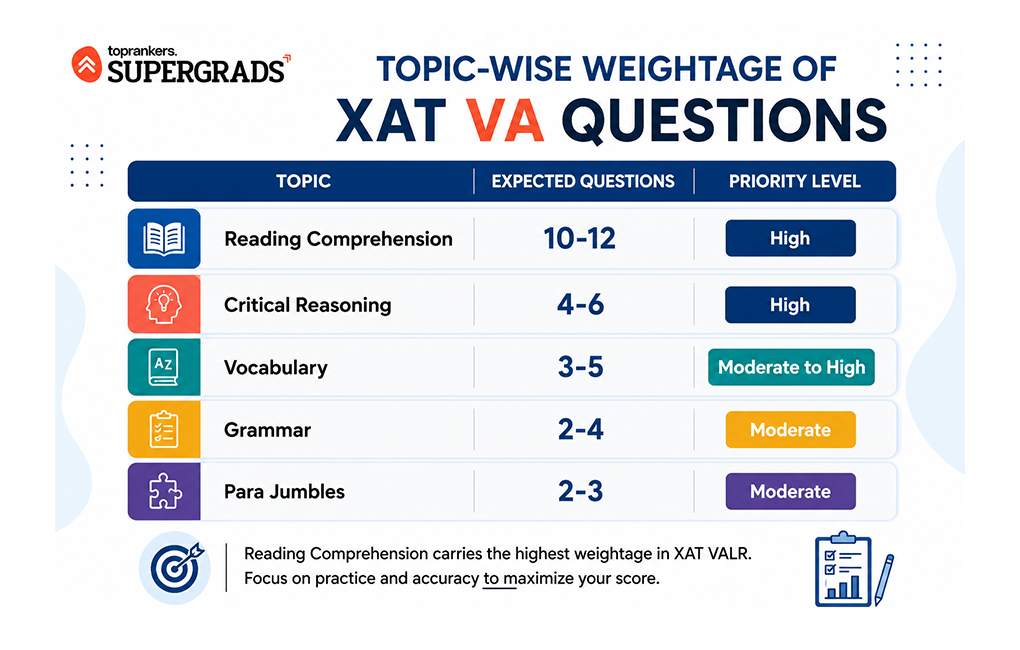
Topic-wise Weightage of XAT VA Questions
| Topic | Expected Questions | Priority Level |
|---|---|---|
| Reading Comprehension | 10-12 | High |
| Critical Reasoning | 4-6 | High |
| Vocabulary | 3-5 | Moderate to High |
| Grammar | 2-4 | Moderate |
| Para Jumbles | 2-3 | Moderate |
XAT Verbal Ability Questions from Previous Years
| Exam Year | Verbal Ability Section Analysis | Difficulty Level |
|---|---|---|
| XAT 2025 | Followed the recent XAT pattern with a strong focus on Reading Comprehension. Vocabulary and grammar-based questions were also included. | Moderate to Difficult |
| XAT 2024 | Included inference-based RC questions, vocabulary-based questions, and critical reasoning questions. Students with strong reading habits found the section more manageable. | Moderate to Difficult |
| XAT 2023 | Featured a balanced mix of Reading Comprehension, vocabulary, grammar, and reasoning-based questions, requiring both speed and accuracy. | Moderate |
Sample XAT Verbal Ability Questions with Answers
Reading Comprehension
Q1. What is the main purpose of a Reading Comprehension passage?
A. To test mathematical ability
B. To assess understanding and interpretation of text
C. To test memory
D. To test GK
Answer: B
Q2. Which of the following best describes an inference?
A. A directly stated fact
B. A conclusion drawn from evidence
C. A vocabulary word
D. A grammar rule
Answer: B
Q3. The author's tone can be:
A. Persuasive
B. Critical
C. Humorous
D. All of the above
Answer: D
Q4. Which question type is common in RC passages?
A. Main Idea
B. Author's Opinion
C. Inference
D. All of the above
Answer: D
Critical Reasoning
Q5. A statement that must be true for an argument to work is called:
A. Conclusion
B. Assumption
C. Inference
D. Judgment
Answer: B
Q6. A factor that makes an argument stronger is called:
A. Weakener
B. Assumption
C. Strengthener
D. Conclusion
Answer: C
Q7. A paradox is:
A. A contradiction that may contain truth
B. A grammar error
C. A vocabulary question
D. A reading passage
Answer: A
Q8. Cause and Effect questions test:
A. Word meanings
B. Logical relationships
C. Grammar rules
D. Reading speed
Answer: B
Para Jumbles & Verbal Ability
Q9. Para Jumble questions test:
A. Sentence arrangement skills
B. Grammar only
C. Vocabulary only
D. Arithmetic ability
Answer: A
Q10. Which sentence should usually come first in a paragraph?
A. Supporting detail
B. Example
C. Introductory statement
D. Conclusion
Answer: C
Q11. Odd Sentence Out questions require identifying:
A. The grammatically incorrect sentence
B. The unrelated sentence
C. The longest sentence
D. The shortest sentence
Answer: B
Q12. Para Completion questions assess:
A. Logical continuation of ideas
B. Grammar only
C. Vocabulary only
D. Mathematics
Answer: A
Vocabulary
Q13. Choose the synonym of "Abundant".
A. Scarce
B. Plenty
C. Empty
D. Weak
Answer: B
Q14. Choose the antonym of "Optimistic".
A. Hopeful
B. Cheerful
C. Pessimistic
D. Confident
Answer: C
Q15. "Break the ice" means:
A. Destroy something
B. Start a conversation
C. Feel cold
D. Break a rule
Answer: B
Q16. Choose the word closest in meaning to "Meticulous".
A. Careless
B. Detailed
C. Weak
D. Lazy
Answer: B
Q17. He was ______ for the delay.
A. Responsible
B. Responsibility
C. Responsibly
D. Responded
Answer: A
Grammar
Q18. Neither the students nor the teacher _____ present.
A. Were
B. Are
C. Was
D. Have
Answer: C
Q19. She _____ to the market yesterday.
A. Go
B. Went
C. Going
D. Gone
Answer: B
Q20. Identify the correct sentence.
A. He don't know the answer.
B. He doesn't knows the answer.
C. He doesn't know the answer.
D. He not know the answer.
Answer: C
Q21. Choose the correct article:
She bought _____ umbrella.
A. A
B. An
C. The
D. No article
Answer: B
Q22. The book belongs _____ me.
A. For
B. To
C. At
D. With
Answer: B
Logical Ability
Q23. Statement: All roses are flowers. Some flowers are red.
Conclusion: Some roses are red.
A. Definitely true
B. Definitely false
C. Cannot be determined
D. Both A and B
Answer: C
Q24. Fact-Inference-Judgment questions mainly test:
A. Vocabulary
B. Logical thinking
C. Arithmetic
D. Grammar
Answer: B
Q25. If all managers are leaders and some leaders are entrepreneurs, then:
A. All managers are entrepreneurs
B. Some managers may be entrepreneurs
C. No manager is an entrepreneur
D. Cannot be determined
Answer: B
XAT vs CAT Verbal Ability Questions
| Feature | XAT | CAT |
|---|---|---|
| Grammar Questions | Asked more often | Rarely asked directly |
| Vocabulary Questions | Frequently seen | Limited presence |
| Reading Comprehension | High weightage | Very high weightage |
| Critical Reasoning | Important | Moderate importance |
| Question Style | Direct + Application-based | Mostly RC and reasoning-based |
Tips to Improve Accuracy in XAT Verbal Ability Questions
| Tip | How It Helps |
|---|---|
| Read Editorials Daily | Improves reading speed, vocabulary, and comprehension. |
| Revise Grammar Rules | Helps solve sentence correction and error spotting questions. |
| Solve Previous Year Questions | Helps understand the actual XAT question pattern. |
| Practice RC Passages | Improves passage understanding and inference skills. |
| Analyze Mock Tests | Helps identify weak areas and improve accuracy. |
Common Mistakes Students Make in XAT VA Questions
- Ignoring vocabulary practice.
- Reading RC passages too quickly without understanding them.
- Not revising basic grammar rules.
- Skipping critical reasoning practice.
- Not analyzing wrong answers after mock tests.
- Depending only on shortcuts instead of understanding context.
Conclusion
XAT Verbal Ability Questions play an important role in improving your performance in the VALR section. A good XAT VA preparation plan should include Reading Comprehension, Grammar, Vocabulary, Para Jumbles, and Critical Reasoning.
To score well, focus on daily reading, solving XAT previous year questions, revising grammar rules, and analyzing mock tests. With consistent effort and the right approach, XAT VA Questions can become one of your strongest areas in XAT 2027.
Frequently Asked Questions
What types of Verbal Ability questions are asked in XAT?

Is the Verbal Ability section in XAT tougher than CAT?
How can I improve my score in XAT Verbal Ability Questions?
How many Verbal Ability questions are usually asked in XAT?
Are previous year XAT Verbal Ability Questions enough for preparation?
Which topics should I focus on the most for XAT Verbal Ability?

Zubeen Siddiqui
Content Writer | MBA & CAT Preparation


SHARE