
1723534562.png)

NATA 3D Composition Questions: Official Marks, Sample Questions & Practice Guide (2027)
September 1, 2026
If you're searching for nata 3d composition questions, you probably want two things - what this section actually involves and real questions to practice with.
Here's the direct answer - as per official NATA syllabus, 3D Composition is the ‘Question A3’ of the NATA Drawing Test (Part A). There are 3 questions in total worth 80 marks in this section and 3d composition is worth 30 marks (highest weightage of the three).
The other 2 questions being A1 - Composition and Color (25 marks) and A2 - Sketching & Composition (Black and White) (25 marks)
The official NATA exam structure of the latest cycle describes it as done "using the provided kit," which implies that it’s not purely a pencil sketch, rather physical materials will be provided at the test center.
This guide breaks down the exact marks, what previous 3D composition questions and answers looked like, and gives you a themed nata 3d composition questions pdf to practice with.
Only pencils, erasers, dry colours, and a scale up to 15 cm are allowed; no calculators or electronic devices are permitted anywhere in the exam.
Key Highlights- NATA 3D Composition Questions 2027
- 3D Composition is worth 30 marks - the highest-scoring question in Part A (Composition & Colour and Sketching & Composition each carry 25 marks).
- Part A (all three questions combined) is conducted offline in 90 minutes and is worth 80 marks out of NATA exam overall total 200 (Part A + Part B).
- The official syllabus mentions "provided kit" for 3D Composition – you can get more details about this via your admit card/test centre instructions, since this isn't specified particularly in the publicly available brochure.
- No calculators, mobile phones, or electronic devices are allowed; candidates may bring pencils, erasers, dry colors, and a scale up to 15 cm.
- Part B also tests your understanding of 3D shapes/compositions but separately as Visual Reasoning (the ability to "understand and reconstruct 2D and 3D composition). It’s a non-drawing skill worth building alongside NATA 3D Composition Question - A3 prep.
What Exactly Are NATA 3D Composition Questions 2027?
NATA 3D composition questions are Question A3 of the Drawing & Composition Test. As per the official brochure, the task is to create "an interesting 3D composition for the given situation using the provided kit."
In plain terms, you're given a scenario or theme, and you then create a three-dimensional arrangement with physical material that takes into account thinking about form, balance, proportion, and if the composition satisfies the brief.
This is different from A1 (Composition and Colour, a flat 2D design task) and A2 (Sketching & Composition, a black-and-white observational or memory sketch). Among NATA drawing questions overall, A3 is the one most directly testing spatial and structural thinking - the same instinct that later shows up in architectural model-making and massing studies.
How Many Marks Are NATA 3D Composition Questions Worth?
|
Part A Question |
Skill Tested |
Marks |
Duration Share |
|
A1 - Composition and Color |
2D visual composition, color harmony |
25 |
Shared within 90 min |
|
A2 - Sketching & Composition (B/W) |
Observational/memory sketching, shading, proportion |
25 |
Shared within 90 min |
|
A3 - 3D Composition |
Spatial composition, form, stability, shade & shadow |
30 |
Shared within 90 min |
|
Total Part A |
- |
80 |
90 minutes (offline) |
This table is drawn directly from the official 2026 NATA brochure - worth noting because several competitor pages list 3D composition at 25 marks instead of the correct 30. Since nata 3d composition questions carry the single highest weight in the drawing section, spending disproportionate practice time on it relative to A1/A2 is a reasonable prioritization if your time is limited.
Do NATA 3D Composition Questions Use a Physical Kit or Pencil Sketching?
This is one point most students searching for 3d composition questions for nata are commonly confused about and you must know what's verified versus assumed in this case.
The current official brochure states the task is completed "using the provided kit" – these words clearly describes physical materials supplied at the test centre, not a pencil-only rendering exercise.
3D Composition was introduced in Part A since 2024. Example question types include- draw a 3D composition using given material (x number of cubes, y number of cylinders, z number of cuboids, etc.) depicting themes like MOVEMENT, SYMMETRY, BRIDGE, and such.
These are genuine past questions and remain useful for building spatial-thinking skill. However, practicing pencil rendering of 3D shapes can help understand these shapes and possible compositions better.
What Do Previous Year NATA 3D Composition Questions and Answers Look Like?
Looking across previous year papers, NATA 3d composition questions consistently fall into a few recurring themes. Here are genuine examples that have appeared in past papers, useful for understanding the pattern even as execution format evolves:
- You are given three glass pyramids and two wooden cubes. Make an interesting three-dimensional composition that can be placed in the corner of a sit-out as an artifact.
- Draw an interesting 3D composition using two square boxes, one pyramid, and one rectangle that looks like a bridge.
- Use seven cylinders to make a stable composition and sketch it with suitable shade and shadow effects.
Across these NATA 3d composition questions and answers, three patterns repeat- the objects given are usually simple geometric solids or everyday items, the brief typically specifies dimensions of the solids and at times also give a light source direction.
The stability/balance of the arrangement is one thing that’s always tested in the NATA 3D Composition Questions. (can be asked directly or indirectly in the question).
Along with mastering 3D composition, strengthen your preparation with NATA aptitude questions. These appear as Part B section of the exam, is computer-based, total 120 marks paper with questions on Maths, General Knowledge, and Logical Reasoning.
NATA 3D Composition Questions PDF - Practice Set by Theme for 2027
Rather than practicing questions randomly, it helps to build skill theme by theme, since NATA composition questions tend to cluster into three recurring categories:
Theme 1 - Geometric Solids
Example: Compose an arrangement using two cubes, one cylinder, and one cone. Apply shade and shadow with light falling from the upper left.
It focuses on pure form relationships - practice varying size ratios and overlap to avoid a flat, evenly-spaced look.
Theme 2 - Everyday Objects
Example: Create a stable 3D composition using one teapot, two cups, and a tray.
Tests observational accuracy alongside composition; sketch real objects from multiple angles beforehand so proportions feel natural under time pressure.
Theme 3 - Abstract/Conceptual
Example: Using any three geometric forms, create a 3D composition representing "growth."
The hardest theme for most students, since it demands translating an idea into form - practice this by brainstorming 3-4 form ideas per concept before committing to one.
Actual Solved 3D composition questions for NATA 2027 Practice
Q) Create a sculptural composition from the given forms, suitable as a prototype for an interactive play installation which resembles a SPIRALING TOWER.
- 2 Cuboid frames (3 cm x 4 cm, Height :1.5cm) frame thickness 1 cm
- 2 Cubes (2.5 cm x 2.5 cm, Height :2.5cm)
- 2 Cylindrical frame (Dia: 4 cm, Height: 1.5cm) frame thickness 1 cm
- 2 Hexagonal prism (Each side: 3 cm Height :2 cm)
- 2 Pentagonal prism (Each side: 2.5 cm Height :4 cm)
- 2 Equilateral triangular prism (L: 3 cm, Height :3 cm)
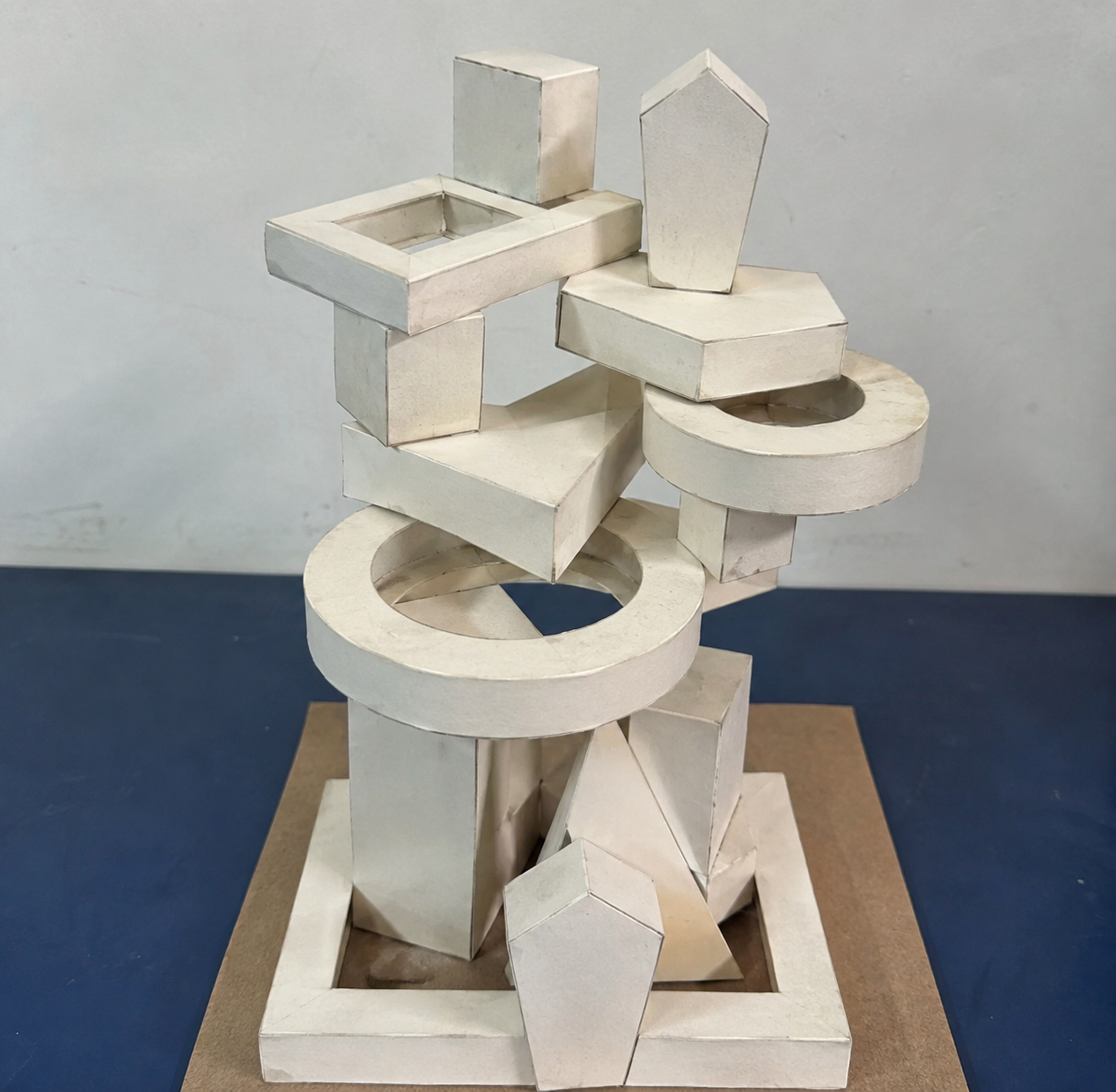
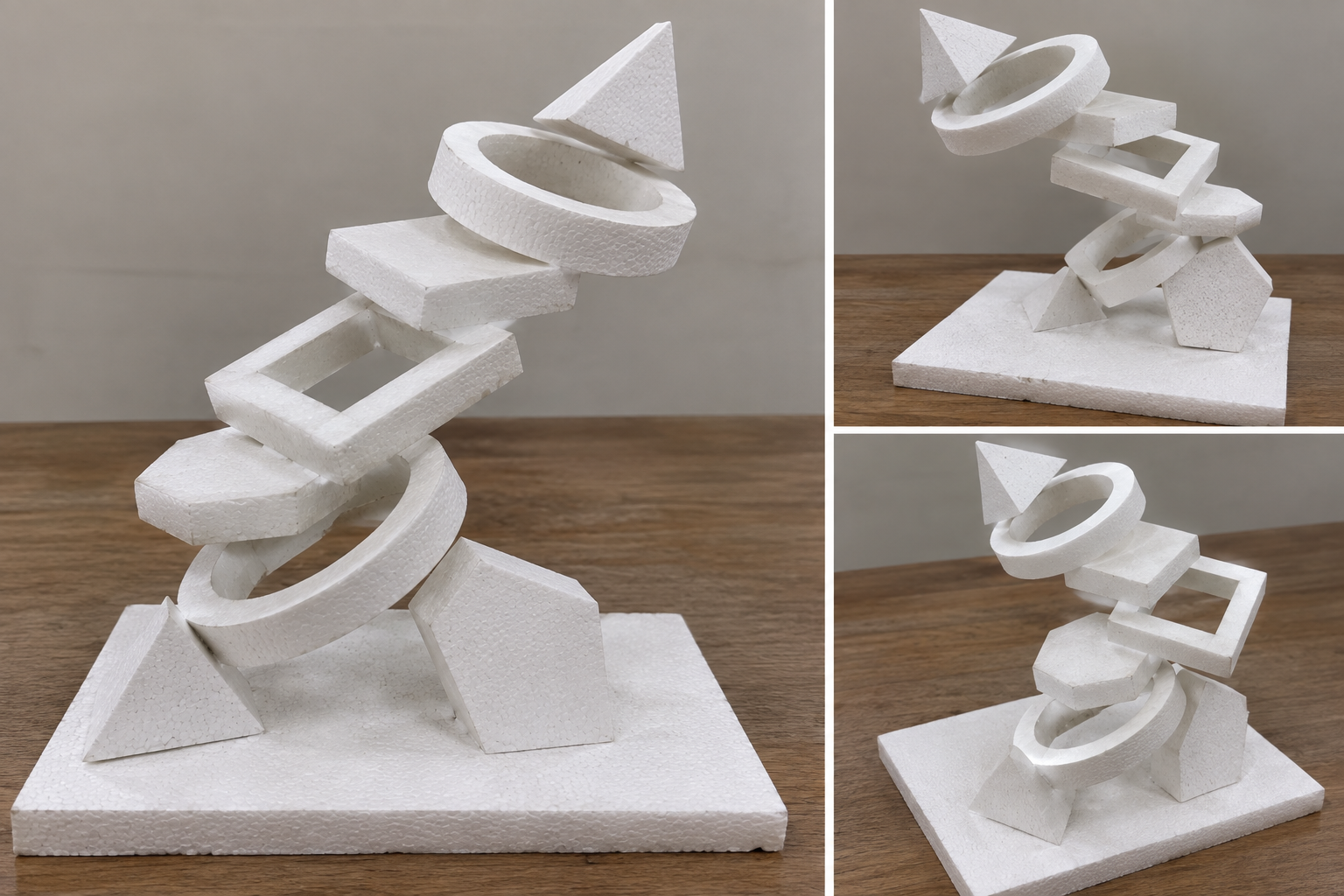
Q) Using the pieces given in the set, compose a 3D sculptural form depicting ‘MOVEMENT’
- 2 Cuboid Frames (4 cm x 4 cm, Height: 1 cm, Frame: 1.2 cm)
- 2 Cuboid (4 cm x 4 cm, Height: 1 cm)
- 2 Cylindrical Frames (Dia: 5 cm, Height: 1.5 cm, Frame: 1 cm)
- 2 Hexagonal Prism (Each side: 3 cm, Height :1 cm)
- 2 Pentagonal Prism (Each side: 4 cm, Height :1 cm)
- 2 Equilateral Triangular Prism (L: 3 cm, Height: 2.5 cm)
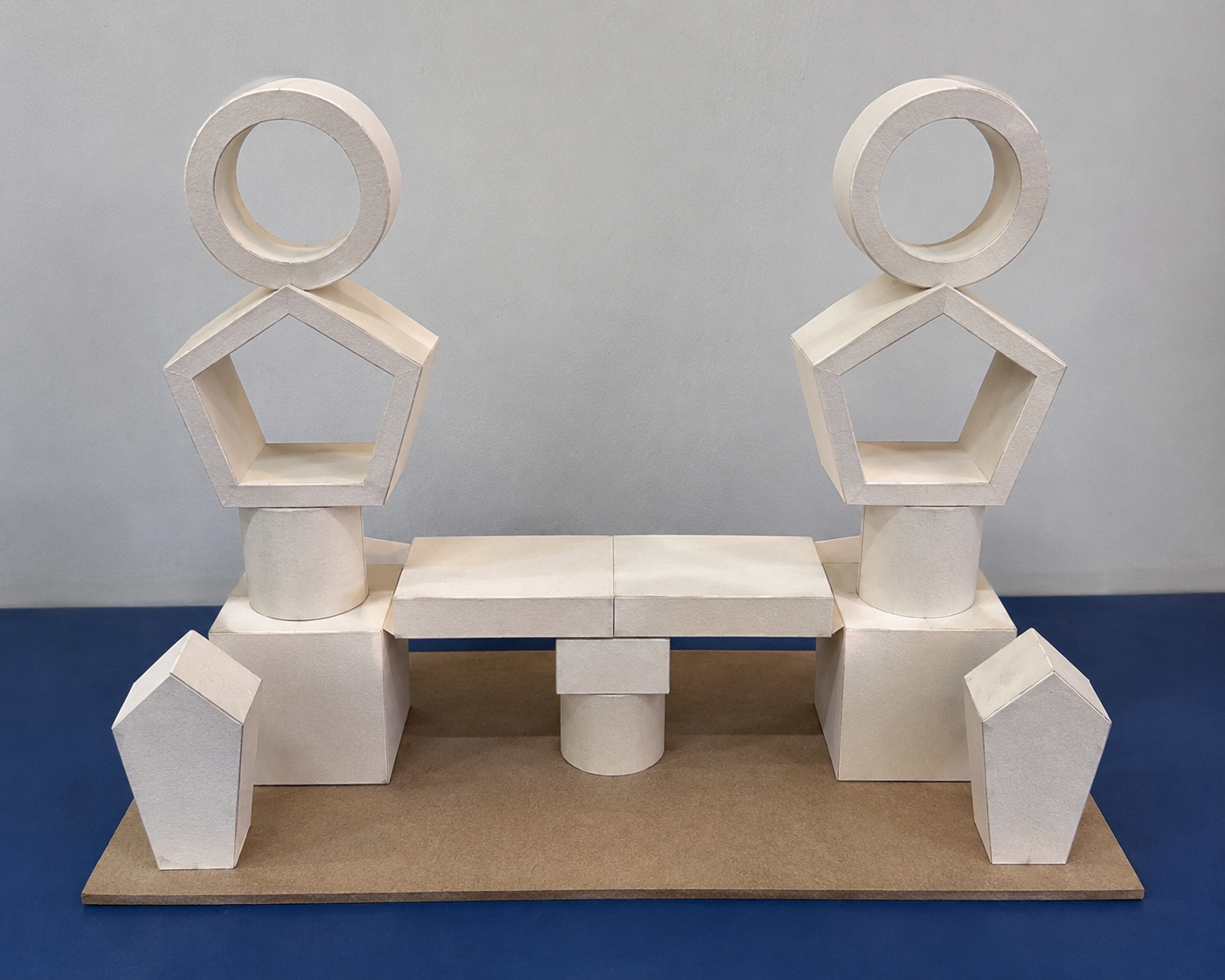
Q) Develop an ABSTRACT sculptural piece utilizing the given focus, for a playful installation depicting a BRIDGE.
- 2 Hexagonal Prism (Each side: 4 cm, Height: 1 cm)
- 2 Hexagonal Frame (Each side: 3 cm, Height: 1 cm, Frame: 1 cm)
- 2 Cylindrical Frames (Dia: 4.5 cm, Height: 1.5 cm, Frame: 1 cm)
- 2 Cylinder (Dia: 4 cm, Height: 1.5 cm)
- 2 Equilateral Triangular Prism (L: 4 cm, Height: 1 cm)
- 2 Equilateral Triangular Frame (L: 4 cm, Height: 1.5 cm, Frame: 1 cm)
What Do Examiners Actually Score in NATA 3D Model Questions?
Based on the skills explicitly named in the official syllabus - composition, proportion, scale, balance, etc. - here's what evaluators are realistically weighing when scoring NATA 3d model questions:
1. Compositional balance - does the arrangement feel intentional, not scattered or overcrowded?
2. Proportion and scale accuracy - do the relative sizes of objects make visual sense?
3. Stability - does the 3D form look like it could physically stand, structurally speaking?
4. Shade and shadow logic - is the light source direction applied consistently across every element?
5. Originality within the brief - does the composition go beyond the most obvious, literal interpretation of the prompt?
Most students lose marks not from poor drawing technique but from ignoring one of these - especially inconsistent shadow direction and cluttered, unbalanced arrangements.
Check: How to improve Your NATA Score
What Mistakes Do Students Make in 3D Composition Questions for NATA?
Overcrowding the composition
Using every possible angle to add "more" detail often result in cluttered model rather than appearing skilled. Strategic compositions usually score better than dense ones.
Ignoring the brief's context
A composition can be well-thought and made but still lose marks if it doesn't respond to the specific scenario given (e.g., "an artifact that depicts movement" implies that some kind of movement should be clearly visible like - flow, rotation, leap, jump, etc.).
Practicing only 2D thinking
Treating 3D composition like a flat layout with shading added, instead of genuinely thinking in three dimensions from multiple viewing angles might misfire and leave you underprepared for actual 3d tasks.
Running out of time due to over-complexity
Composition and form-building should be prioritized; rushed, incomplete models at the end might cost you marks.
Want to maximise your overall marks? Explore our guide on how to improve your NATA score with section-wise preparation strategies and expert tips.
How to Prepare for NATA 2027 3D Composition Questions in 8 Weeks?
|
Weeks |
Focus |
Goal |
|
Week 1-2 |
Practice basic solids (cubes, cylinders, cones, pyramids) from multiple angles |
Build confident spatial rendering |
|
Week 3-4 |
Theme 1 & 2 practice (geometric + everyday objects) with shade/shadow |
Apply consistent light-source logic |
|
Week 5-6 |
Theme 3 (abstract/conceptual) practice |
Train idea-to-form translation speed |
|
Week 7 |
Timed full-question practice (all 3 Part A questions in one 90-min block) |
Simulate real exam pacing across A1–A3 |
|
Week 8 |
Review with a mentor/peer against the examiner checklist above |
Fix recurring composition and shading errors |
Check: Expected NATA Cut Off
Which Materials Help Most for Practicing for NATA 3D Model Questions 2027?
|
Material |
Best For |
Note |
|
HB & 2B pencils |
Base sketching and outlines |
Carry both; NATA allows pencils but check permitted grades on your admit card |
|
Dry colour pencils/crayons |
Colour composition (A1) and shading depth |
Only dry colours are permitted, not paints |
|
15 cm scale |
Proportional accuracy |
Maximum permitted length per official rules |
|
Practice cubes/simple solids (for home practice) |
Building spatial/model-making intuition |
Not for the exam itself - a home study aid to internalize form and shadow logic |
How Do 3D Composition Questions Connect to Other NATA Drawing Questions?
3D composition doesn’t need to be seen or practiced in isolation - it shares core skills with the rest of Part A and even parts of Part B.
A1 question’s color and balance principles carry directly into how you compose 3D structure in A3 question.
A2 question’s shading, perspective, and proportion practice will help build core spatial and visualization skills required to excel in 3d composition and model making tasks.
As for Part B's Visual Reasoning section, which tests the ability to mentally reconstruct/rotate 2D and 3D compositions or shapes, adds to the same spatial thinking you’ll need to improve in 3d composition tasks.
Treating your NATA 2027 preparation for 3d composition questions as one connected skill set for the entire exam, rather than separate topics will produce faster, broader level improvement.
Conclusion
NATA 3d composition questions reward building composition instincts through practice. Start theme-based practice at least 8 weeks before exam. Since A3 carries the highest marks in Part A, treat balanced, uncluttered form as your two non-negotiables in every practice session.
Preparing for NATA 2027? We can help you with exact strategic roadmap, study material and crucial feedback required to ace this exam.
Join Creative Edge NATA Online Coaching and get expert guidance on all NATA 2027 subjects.
You can enroll in offline NID batches at your nearest centers also!


Attempt a Free NATA Mock Test
Fill your details
Frequently Asked Questions
How many marks do NATA 3D composition questions carry?

Is NATA 3D composition done with a physical kit or by pencil sketching?
Where can I find a free nata 3d composition questions pdf with answers?
What objects are commonly used in NATA 3D model questions?
How is NATA 3D composition different from 2D composition questions?
Can I practice NATA 3D composition questions without a physical kit at home for 2027?

Vineeta Agrawal
Communications Executive
SHARE