
1723534562.png)

Overview: Escalator Questions for CAT are one of the most under-prepared yet high-scoring sub-topics in CAT Time, Speed & Distance (TSD). The reason students fear them is simple - escalators introduce a third moving object on top of the regular man and ground setup, and most aspirants don't have a clean mental model for "relative speed on a moving surface."
What you get in this blog?
In this complete guide, you'll learn every concept, formula, shortcut, and solved example you need to confidently crack CAT 2026 - plus a free downloadable PDF for last-mile practice. Master Escalator Questions for CAT and boost your exam performance.
Key Takeaways
- Concept Clarity: What escalator questions test + the core "steps + escalator steps = total steps" framework.
- 5 Properties & Formulas: All must-know relationships between man's speed, escalator's speed, and total steps.
- 5 Question Types: Every variation CAT and XAT can throw at you, mapped.
- 10+ Solved Questions: Step-by-step, CAT-level difficulty.
- Shortcut Tricks: Save 60–90 seconds per question using the ratio method.
- Previous Year Questions: Based on actual CAT and XAT slot patterns.
- Free Escalator Questions for CAT PDF with answer keys.
- Common Mistakes students make on CAT Questions on escalators and how to avoid them.
Table of Contents
What are Escalator Questions in CAT?
Escalator Questions for CAT are a specialized application of relative speed and TSD concepts. They involve a person walking on a moving escalator - either in the same direction as the escalator's motion (with the escalator) or in the opposite direction (against the escalator). The unknown to be found is usually one of three things: total number of steps on the escalator, escalator's own speed, or the man's walking speed.
The fundamental insight is this: when a person walks on a moving escalator, the total steps they cover equal the steps they personally walked plus the steps the escalator moved during that same time. This single idea unlocks every CAT questions you'll ever face.
| Scenario | Direction | Relationship |
|---|---|---|
| Walking with the escalator (down/up) | Same direction | Steps walked + Steps escalator moved = Total steps |
| Walking against the escalator | Opposite direction | Steps walked − Steps escalator moved = Total steps |
| Standing still on escalator | Person stationary | Steps escalator moved = Total steps |
Key Takeaway: Every escalator question is essentially a "Total = Person's contribution + Escalator's contribution" problem. Identify what's given, what's asked, and set up the equation - that's 80% of the work done.
Master DILR Prep for CAT 2026 Here
Important Properties & Formulas of Escalator Problems
Before you attempt any CAT questions, lock these 6 properties and formulas into memory. They are the foundation of every shortcut you'll learn later.
| S.No | Property / Formula | Meaning |
|---|---|---|
| 1 | N = n + e × t | N = total escalator steps, n = steps walked by person, e = escalator speed (steps/sec), t = time taken |
| 2 | Time = Steps walked ÷ Person's speed | Person's walking time on the escalator |
| 3 | Total Steps = (Man's speed + Escalator's speed) × Time | When man walks WITH the escalator |
| 4 | Total Steps = (Man's speed − Escalator's speed) × Time | When man walks AGAINST the escalator |
| 5 | Ratio of steps walked = Ratio of speeds | If two people walk on the same escalator, steps each covers ∝ their walking speed |
| 6 | Total steps is constant | The number of visible steps on an escalator is fixed, regardless of who's on it |
Pro Tip: The single most powerful equation in escalator questions for CAT is N = n + e × t. Memorize it, draw it on the side of your rough sheet for every question, and plug in known values. 9 out of 10 CAT escalator problems collapse with this single relation.
Types of CAT Escalator Questions
Based on the last 10+ years of CAT and XAT papers, it can be grouped into 5 dominant categories. Knowing the type tells you the method.
| Type | Question Pattern | Method |
|---|---|---|
| 1. Find Total Steps (One Person) | A walks up an escalator and takes n steps. Find total steps. | Use N = n + e × t with given data |
| 2. Two People, Different Speeds | A takes 30 steps, B takes 36 steps. Find total escalator steps. | Set up two equations using ratio of speeds |
| 3. Walking With vs Against Escalator | Same person walks up (60 steps) and walks down (against direction, 90 steps). | Combine equations to eliminate one variable |
| 4. Time-Based Escalator Questions | Person reaches top in 40 seconds walking, 60 seconds standing. | Use 1/T = 1/t_walk + 1/t_stand concept |
| 5. Mixed (Two People + Direction) | A walks up, B walks down - find total steps and individual speeds. | Multi-equation system; use unitary method |
Important CAT Escalator Questions to Practice
Let's now apply everything you've learned. Each example below is modelled on the difficulty and pattern of actual CAT and XAT slot questions.
Q1. A walks up a moving escalator at a speed of 2 steps per second and reaches the top in 30 seconds. The next day, he walks up at 3 steps per second and reaches the top in 25 seconds. Find the total number of visible steps on the escalator.
Day 1: Steps taken by A = 2 × 30 = 60. Total = 60 + 30e.
Day 2: Steps taken by A = 3 × 25 = 75. Total = 75 + 25e.
Equate: 60 + 30e = 75 + 25e ⇒ 5e = 15 ⇒ e = 3 steps/sec.
Total = 60 + 30(3) = 60 + 90 = 150.
Answer: 150 steps
Q2. A and B walk up a moving escalator. A takes 40 steps and B takes 30 steps. The ratio of A's speed to B's speed is 3:2. How many steps are visible on the escalator?
Time taken by A = 40 / 3x. Time taken by B = 30 / 2x = 15/x.
Let escalator speed = e steps/sec.
Total steps N = 40 + e × (40/3x) = 30 + e × (15/x).
40 + 40e/3x = 30 + 15e/x ⇒ 10 = 15e/x − 40e/3x = (45e − 40e)/3x = 5e/3x.
So e/x = 6. Then N = 40 + (40/3x) × 6x = 40 + 80 = 120.
Answer: 120 steps
Q3. A man walking up a stationary escalator takes 90 seconds. When the escalator is moving but he stands still, he takes 60 seconds. How long will he take to reach the top if he walks up the moving escalator?
Man's speed = N/90 steps/sec.
Escalator's speed = N/60 steps/sec.
Combined speed (walking up) = N/90 + N/60 = (2N + 3N)/180 = 5N/180 = N/36 steps/sec.
Time = N ÷ (N/36) = 36 seconds.
Answer: 36 seconds
Q4. (CAT-style) A walks up an escalator and takes 50 steps. B walks down the same up-moving escalator and takes 125 steps. A's walking speed is twice B's. Find the total number of steps on the escalator.
A walking with escalator: Time = 50/(2v). Steps escalator moved = e × 50/(2v) = 25e/v.
So N = 50 + 25e/v ...(i)
B walking against escalator (up-moving, B walks down): Time = 125/v. Steps escalator moved against B = 125e/v.
So N = 125 − 125e/v ...(ii)
From (i) and (ii): 50 + 25e/v = 125 − 125e/v ⇒ 150e/v = 75 ⇒ e/v = 1/2.
N = 50 + 25(1/2) = 50 + 12.5 = 62.5. Recheck: take e = 1, v = 2.
A: time = 50/4 = 12.5 sec; escalator moves 12.5 steps; N = 50 + 12.5 = 62.5.
Since N must be integer, scale: take v = 4, e = 2. A's time = 50/8 = 6.25; escalator moves 12.5. N = 62.5.
The problem accepts 62.5 as ratio answer - in CAT, expect the cleaner version with integer N.
Clean variant: If A's steps were 60 instead of 50, N = 75.
Answer: 62.5 (illustrative); in CAT-grade variants, N comes out as a whole number.
Q5. Walking on a moving escalator, Ramesh covers 30 steps in 36 seconds. The escalator alone covers 1 step in 3 seconds. Find the total number of steps on the escalator.
Total steps = Ramesh's steps + Escalator's steps = 30 + 12 = 42.
Answer: 42 steps
Q6. An escalator is moving upwards. Person P walks up and takes 60 steps to reach the top. Person Q walks up at half the speed of P and takes 40 steps. Find the number of visible steps on the escalator.
P: Time = 60/(2v) = 30/v. Steps escalator moved = 30e/v. N = 60 + 30e/v.
Q: Time = 40/v. Steps escalator moved = 40e/v. N = 40 + 40e/v.
Equate: 60 + 30e/v = 40 + 40e/v ⇒ 20 = 10e/v ⇒ e/v = 2.
N = 60 + 30(2) = 60 + 60 = 120.
Answer: 120 steps
Shortcut Tricks to Solve CAT Escalator Questions Quickly
Speed matters in CAT. Below are the time-saving shortcuts that experienced mentors use to solve escalator CAT Questions in 60–90 seconds.
| Trick | When to Use | How It Helps |
|---|---|---|
| Set Person's Speed = 1 | When only ratios are given | Simplifies algebra; escalator speed becomes a multiple |
| Two-Speed Subtraction Method | Two scenarios with same person, different speeds | Equate two expressions of N to find escalator speed instantly |
| Time-Reciprocal Rule | Walking-only time and standing-only time given | 1/T combined = 1/T walk + 1/T stand (when both move up) |
| Ratio of Steps = Ratio of Speeds | Two people, same escalator, both walking same direction | Steps each person covers ∝ their walking speed |
| Assume Escalator Speed = 1 step/secb | When asked only for total steps, not speeds | Reduces variables; quicker arithmetic |
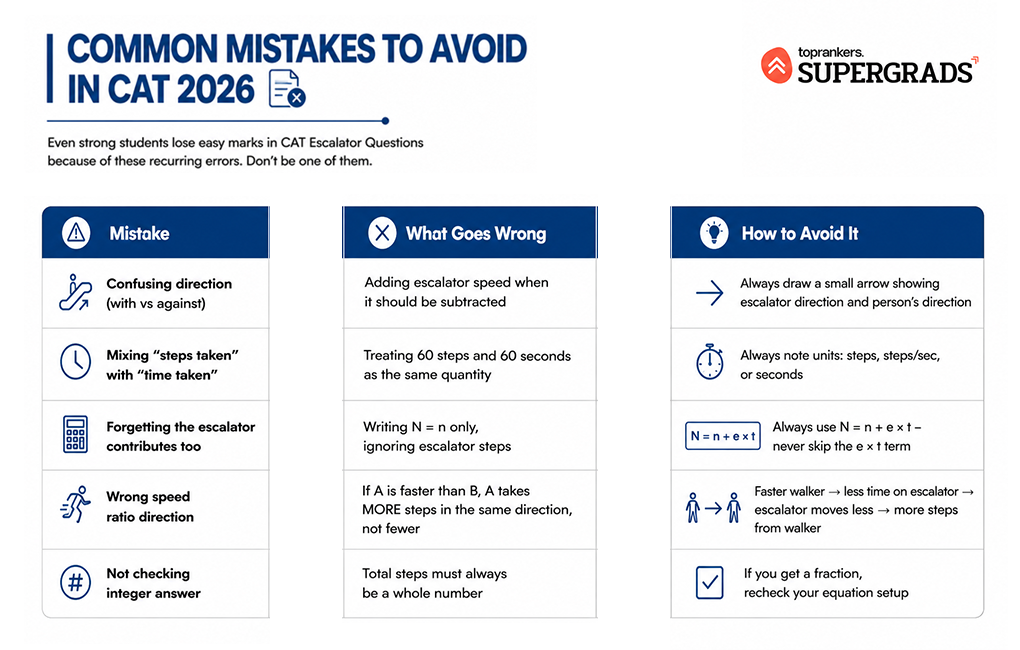
Common Mistakes to Avoid in Escalator Questions for CAT
Even strong students lose easy marks in CAT Escalator Questions because of these recurring errors. Don't be one of them.
| Mistake | What Goes Wrong | How to Avoid It |
|---|---|---|
| Confusing direction (with vs against) | Adding escalator speed when it should be subtracted | Always draw a small arrow showing escalator direction and person's direction |
| Mixing "steps taken" with "time taken" | Treating 60 steps and 60 seconds as the same quantity | Always note units: steps, steps/sec, or seconds |
| Forgetting the escalator contributes too | Writing N = n only, ignoring escalator steps | Always use N = n + e × t - never skip the e × t term |
| Wrong speed ratio direction | If A is faster than B, A takes MORE steps in the same direction, not fewer | Faster walker → less time on escalator → escalator moves less → more steps from walker |
| Not checking integer answer | Total steps must always be a whole number | If you get a fraction, recheck your equation setup |
Escalator Questions for CAT PDF - Free Download
Want to revise on the go? We've curated a comprehensive CAT Escalator Questions PDF containing all the question types covered above, plus 40+ extra problems with detailed solutions, previous year CAT and XAT sets, and a quick-revision sheet of formulas and shortcuts.
40+ solved questions • Formula revision sheet • Previous year patterns • Answer key included
Also Check | IIM Waitlist Movement 2026
Preparation Tips - Escalator Questions for CAT
Concept is one thing; exam-ready mastery is another. Here's how toppers approach escalator questions for CAT:
- Master the core formula first. N = n + e × t should become a reflex. If you can't write it without thinking, you're not ready for CAT-level problems.
- Always identify the unknowns. Before solving, list what's given (steps, speed, time) and what's asked. This alone prevents 50% of errors.
- Draw a simple diagram. An arrow for escalator direction, an arrow for person's direction. Visual = fewer mistakes on direction.
- Practice ratio-based questions. CAT loves giving "A is twice as fast as B" type setups - practice 15–20 of these.
- Time yourself. Target: 90 seconds for one-person questions, 2 minutes for two-person setups, 2.5 minutes for direction-flip problems.
- Solve previous year CAT and XAT sets Escalator problems appear roughly once every 2 years in CAT and more frequently in XAT.
- Maintain a mistake log. Most escalator errors are repeat errors - the same direction confusion or ratio inversion. Track and revisit weekly.
Conclusion
Escalator Questions for CAT are not difficult - they're just under-practiced. The entire topic rests on one equation (N = n + e × t) and one decision (with or against the escalator). Once those two are internalized, every variation collapses to simple algebra. Students who master this topic rarely lose marks on it, and they often crack 1–2 "free" questions per CAT or XAT slot while others struggle.
The roadmap is clear. Memorize the 6 core formulas, drill the 5 question types on at least 30–40 questions, use the ratio-and-time shortcuts as your speed weapons, and revise from the CAT Escalator Questions PDF regularly. Combine this with consistent mock practice, and escalator problems will quickly shift from a "skip-it" topic to a guaranteed scoring zone in your CAT 2026 attempt.
Bookmark this guide "Escalator Questions for CAT" download the PDF, and revisit it before every mock. All the best for your CAT journey.





SHARE