
1723534562.png)

Overview: CAT Progression Questions are among the most consistently tested concepts in the Quantitative Ability section of the CAT exam - in fact, every CAT slot between 2018 and 2025 has carried 2-7 questions on this single topic. The reason aspirants struggle with progression questions for CAT isn't that the topic is genuinely hard - it's that students try to memorize formulas without understanding when each one applies.
This guide is built to fix that. We'll walk through what CAT progression questions actually look like in the CAT exam, every formula and property you must memorize, the 6 most common question types asked, fully solved examples with step-by-step methods, shortcut tricks, common mistakes to avoid, the best CAT books to refer to for deeper practice.
Key Highlights of This Guide
- Concept Clarity: What AP, GP, and HP mean + the core summation formulas you need for CAT 2026.
- Topic Weightage: Real data from CAT 2018-2025 showing why progressions are a must-prep topic in Quantitative Ability.
- 6 Question Types: Every variation the CAT exam and XAT can throw at you, mapped.
- 10+ Solved Questions: Step-by-step, CAT-level difficulty for the Quantitative Ability section.
- Shortcut Tricks: Save 60-90 seconds per question using AM-GM-HM and pattern-substitution.
- Previous Year Style Questions: Based on actual CAT exam pattern and slot patterns.
- Free CAT Progression Questions PDF with answer keys.
- Recommended CAT Books for deeper progression and series practice.
- Common Mistakes students make on these series of questions and how to avoid them.
Table of Contents
- What are Progression Questions in CAT?
- CAT Progressions and Series Topic Weightage
- Important Properties & Formulas of Progressions
- Types of CAT Progression Questions
- CAT Progression Questions with Solutions
- Shortcut Tricks to Solve Quickly
- Common Mistakes to Avoid
- CAT Progression Questions PDF
- Preparation Tips for CAT 2026
- Conclusion
What are CAT Progression Questions?
Let's deal with three fundamental types of number sequences: Arithmetic Progression (AP), Geometric Progression (GP), and Harmonic Progression (HP). Closely linked to these is the concept of series - the sum of terms in a sequence. The Quantitative Ability section of the CAT exam tests whether you can identify the type of sequence, apply the correct nth-term or sum formula, and solve under time pressure. As per the current CAT exam pattern, such questions appear as both MCQs and TITA (Type-In-The-Answer) problems.
The fundamental insight is this: every Progression Questions for CAT can be reduced to either finding the nth term, finding the sum of n terms, or applying one of the AM-GM-HM inequalities. Once you know which of these is being asked, the formula picks itself. This single recognition skill unlocks every CAT progression questions you'll ever face in CAT 2026 or any other MBA entrance exam.
| Progression Type | Rule | Example |
|---|---|---|
| Arithmetic Progression (AP) | Each term differs from the previous by a constant (d) | 2, 5, 8, 11, 14, ... |
| Geometric Progression (GP) | Each term is the previous term multiplied by a constant ratio (r) | 3, 6, 12, 24, 48, ... |
| Harmonic Progression (HP) | Reciprocals of the terms form an AP | 1, 1/2, 1/3, 1/4, ... |
Types of CAT Progression Questions
Based on the last 10+ years of CAT and XAT papers, progression questions for CAT can be grouped into 6 dominant categories. Knowing the type tells you the method - a habit every CAT 2026 aspirant should build during prep.
| Type | Question Pattern | Method |
|---|---|---|
| 1. Find a Specific Term in an AP/GP | Given a few terms or sums, find Tn for a large n | Use Tn = a + (n-1)d or Tn = arn-1 |
| 2. Sum of n Terms | Find sum of first 30 terms / sum of all 3-digit terms in AP | Use Sn formula; identify first and last term |
| 3. Sum of Infinite GP | Sum of an infinite series where |r| < 1 | Apply S∞ = a/(1 - r) |
| 4. AM-GM-HM Inequality | Find min/max value of expression involving positive reals | Apply AM ≥ GM ≥ HM |
| 5. Common Terms in Two Sequences | Find common terms or sum of common terms between two APs | Common difference = LCM of two CDs; find first common term |
| 6. Recursive / Pattern-Based Sequences | Sequence defined by a recurrence like xn+1 = f(xn) | Compute first 4-5 terms; spot the cycle or pattern |
CAT Progression Questions with Solutions
Let's now apply everything you've learned. Each example below is modelled on the difficulty and pattern of actual CAT and XAT slot questions - the exact level you'll face in CAT 2026.
Q1. In an arithmetic progression, if the sum of the 4th, 7th, and 10th terms is 99, and the sum of the first 14 terms is 497, then the sum of the first five terms is:
(a + 3d) + (a + 6d) + (a + 9d) = 99 ⇒ 3a + 18d = 99 ⇒ a + 6d = 33 ... (i)
Sum of 14 terms = (14/2)(2a + 13d) = 497 ⇒ 2a + 13d = 71 ... (ii)
Solving (i) and (ii): a = 3, d = 5.
First five terms: 3, 8, 13, 18, 23. Sum = 65.
Answer: 65
Q2. For any natural number n, the sum of the first n terms of an arithmetic progression is (n + 2n²). If the nth term is divisible by 9, find the smallest possible value of n.
Tn = Sn - Sn-1 = (2n² + n) - [2(n-1)² + (n-1)] = 4n - 1.
Terms: 3, 7, 11, 15, 19, 23, 27, ...
First term divisible by 9 is 27, which is the 7th term.
Answer: n = 7
Q3. Find the sum of the first 3-digit terms of the arithmetic progression 38, 55, 72, ...
Smallest 3-digit term: 17n + 21 ≥ 100 ⇒ n ≥ 5 ⇒ T5 = 106.
Largest 3-digit term: 17n + 21 ≤ 999 ⇒ n ≤ 57.5 ⇒ T57 = 990.
Number of 3-digit terms = 57 - 5 + 1 = 53.
Sum = (53/2)(106 + 990) = 53 × 548 = 29044.
Average of these 53 terms = 548.
Answer: Sum = 29044; Average = 548
Q4. Let an be the nth term of a decreasing infinite geometric progression. If a1 + a2 + a3 = 52 and a1a2 + a2a3 + a3a1 = 624, find the sum of this infinite GP.
a(1 + r + r²) = 52 ... (i)
a²r(1 + r + r²) = 624 ... (ii)
Divide (ii) by (i): ar = 12 ⇒ a = 12/r.
Substitute back: (12/r)(1 + r + r²) = 52 ⇒ 3r² - 10r + 3 = 0 ⇒ r = 1/3 or 3.
Since the GP is decreasing and infinite, |r| < 1, so r = 1/3 and a = 36.
S∞ = a/(1 - r) = 36/(2/3) = 54.
Answer: 54
Q5. Find the number of common terms between the sequences 15, 19, 23, ..., 415 and 14, 19, 24, ..., 464.
Common terms: 19, 39, 59, ..., up to a value ≤ min(415, 464) = 415.
Tn = 19 + (n-1)20 ≤ 415 ⇒ n ≤ 20.8 ⇒ n = 20.
But we should also check it's ≤ 464 for the second sequence - 19 + 19×20 = 399 ≤ both, so n = 20.
Answer: 20 common terms
Q6. (AM-GM application) If the product of n positive real numbers is 1, then their sum is necessarily:
By AM-GM: (a1 + a2 + ... + an)/n ≥ (a1·a2·...·an)1/n = 1.
⇒ a1 + a2 + ... + an ≥ n.
Answer: Never less than n
Q7. The sum of the first 11 terms of an AP equals the sum of its first 19 terms. Find the sum of the first 30 terms.
11(2a + 10d) = 19(2a + 18d)
22a + 110d = 38a + 342d
-16a = 232d ⇒ 2a = -29d.
Sum of 30 terms = (30/2)(2a + 29d) = 15(2a + 29d) = 15(-29d + 29d) = 0.
Answer: 0
Key Takeaway: Every progression question is essentially "identify the type → apply the right formula → solve." Master this 3-step approach, and 80% of the work is done before you start writing.CAT Progressions and Series Topic Weightage (2018-2025)
Before diving into formulas, it's worth understanding just how important this topic is in the CAT exam. Progression Questions for CAT and series have appeared in every recent CAT slot - this is not a topic any serious CAT 2026 aspirant can skip.
| Year | Number of Progression Questions | Approximate Weightage |
|---|---|---|
| CAT 2025 | 5 | High |
| CAT 2024 | 5 | High |
| CAT 2023 | 7 | Very High |
| CAT 2022 | 5 | High |
| CAT 2021 | 5 | High |
| CAT 2020 | 2 | Moderate |
| CAT 2019 | 6 | Very High |
| CAT 2018 | 5 | High |
Important Properties & Formulas of Progressions
Before you attempt any progression questions for CAT, lock these formulas into memory. They are the foundation of every shortcut you'll learn later, and they apply across every CAT 2026 mock and previous year paper.
Arithmetic Progression (AP) Formulas
| S.No | Formula | Meaning |
|---|---|---|
| 1 | Tn = a + (n-1)d | nth term, where a = first term, d = common difference |
| 2 | Sn = (n/2)[2a + (n-1)d] | Sum of first n terms of an AP |
| 3 | Sn = (n/2)(first term + last term) | Alternate sum formula when last term is known |
| 4 | Number of terms = [(Last - First)/d] + 1 | Count of terms in an AP from first to last |
| 5 | Middle term = (a + l)/2 | Average of first and last term |
Geometric Progression (GP) Formulas
| S.No | Formula | Meaning |
|---|---|---|
| 1 | Tn = a · rn-1 | nth term, where r = common ratio |
| 2 | Sn = a(rn - 1)/(r - 1), if r > 1 | Sum of first n terms when ratio > 1 |
| 3 | Sn = a(1 - rn)/(1 - r), if r < 1 | Sum of first n terms when ratio < 1 |
| 4 | S∞ = a/(1 - r), where |r| < 1 | Sum of infinite GP - very important for CAT |
Harmonic Progression & AM-GM-HM
| S.No | Formula | Meaning |
|---|---|---|
| 1 | HP nth term: 1 / [a + (n-1)d] | The reciprocals form an AP |
| 2 | AM = (a + b)/2 | Arithmetic mean of two numbers |
| 3 | GM = √(a × b) | Geometric mean of two numbers |
| 4 | HM = 2ab/(a + b) | Harmonic mean of two numbers |
| 5 | AM ≥ GM ≥ HM | Inequality - critical for max-min CAT problems |
| 6 | GM = √(AM × HM) | Relation among the three means |
Standard Summation Formulas
| S.No | Formula | Use Case |
|---|---|---|
| 1 | 1 + 2 + 3 + ... + n = n(n+1)/2 | Sum of first n natural numbers |
| 2 | 12 + 22 + ... + n2 = n(n+1)(2n+1)/6 | Sum of squares of first n naturals |
| 3 | 13 + 23 + ... + n3 = [n(n+1)/2]2 | Sum of cubes of first n naturals |
| 4 | Sum of first n odd numbers = n2 | 1 + 3 + 5 + ... up to n terms |
| 5 | Sum of first n even numbers = n(n+1) | 2 + 4 + 6 + ... up to n terms |
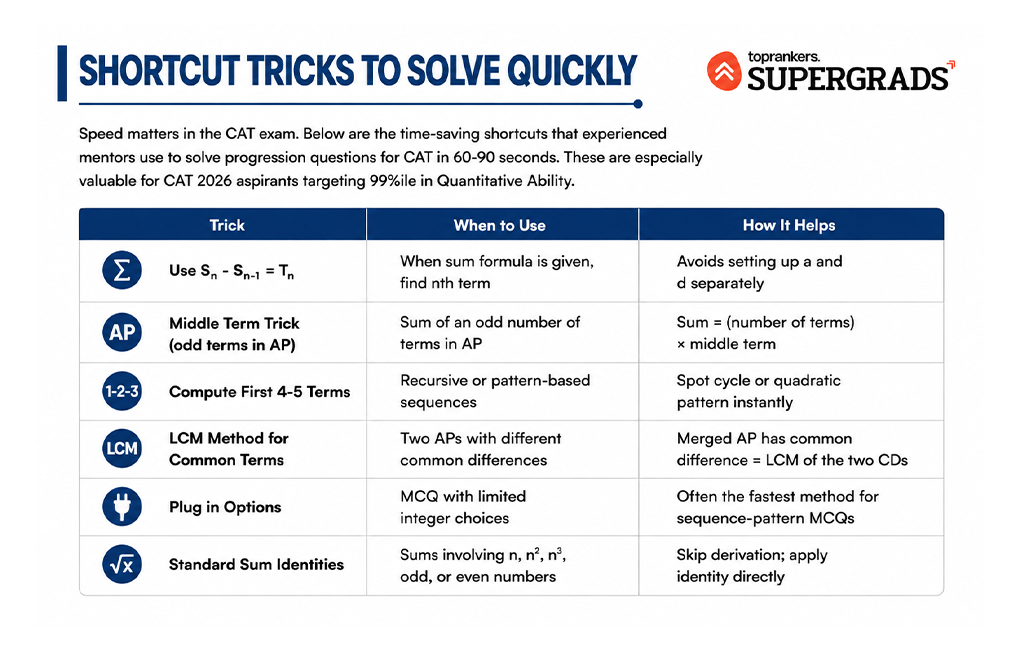
Shortcut Tricks to Solve CAT Progressions Questions Quickly
Speed matters in the CAT exam. Below are the time-saving shortcuts that experienced mentors use to solve progression questions for CAT in 60-90 seconds. These are especially valuable for CAT 2026 aspirants targeting 99%ile in Quantitative Ability.
| Trick | When to Use | How It Helps |
|---|---|---|
| Use Sn - Sn-1 = Tn | When sum formula is given, find nth term | Avoids setting up a and d separately |
| Middle Term Trick (odd terms in AP) | Sum of an odd number of terms in AP | Sum = (number of terms) × middle term |
| Compute First 4-5 Terms | Recursive or pattern-based sequences | Spot cycle or quadratic pattern instantly |
| LCM Method for Common Terms | Two APs with different common differences | Merged AP has common difference = LCM of the two CDs |
| Plug in Options | MCQ with limited integer choices | Often the fastest method for sequence-pattern MCQs |
| Standard Sum Identities | Sums involving n, n², n³, odd, or even numbers | Skip derivation; apply identity directly |
Exam Tip: In the CAT exam, if a progression question involves a recurrence relation, always compute the first 5-6 terms by hand. 90% of such problems reveal a repeating cycle or a quadratic pattern that makes the answer obvious.
Common Mistakes to Avoid in CAT Progressions Questions
Even strong students lose easy marks in progression questions for CAT because of these recurring errors. Don't be one of them - especially in a high-stakes CAT 2026 attempt where every mark impacts your final percentile and IIM admission chances. Check this to crack CAT 2026.
| Mistake | What Goes Wrong | How to Avoid It |
|---|---|---|
| Confusing Tn with Sn | Using sum formula when the question asks for a term, or vice versa | Underline the keywords "nth term" vs "sum of n terms" before solving |
| Wrong sign of common difference | Assuming d > 0 when the sequence is decreasing | Compare two consecutive terms before assigning d |
| Forgetting |r| < 1 for infinite GP | Applying S∞ = a/(1-r) when r ≥ 1 | Infinite GP sum exists only when |r| < 1 - always check first |
| Off-by-one error on number of terms | Counting 10 to 99 as 89 terms instead of 90 | Use n = (last - first)/d + 1; double-check with a small example |
| Misapplying AM-GM | Using AM-GM for negative numbers | AM ≥ GM holds only for non-negative reals - verify the sign first |
| Skipping pattern check on recursions | Trying to solve recursive problems algebraically without spotting the cycle | Always compute the first 5-6 terms; cycles are common in CAT |
Progression Questions for CAT PDF - Free Download
Want to revise on the go? We've curated a comprehensive PDF containing all the question types covered above, plus 50+ extra problems with detailed solutions, previous year CAT and XAT, and a quick-revision sheet of all AP, GP, HP, and AM-GM formulas - fully aligned with the CAT 2026 exam pattern.
CAT Progression Questions PDF (2026 Edition)
50+ solved questions • AP/GP/HP formula sheet • Previous year patterns • Answer key included
CAT 2026 Progression Questions for CAT Preparation Tips
Concept is one thing; exam-ready mastery is another. Here's how toppers approach progression questions for CAT during CAT 2026 preparation:
- Master the core formulas first. Tn and Sn for AP and GP should become reflexes. If you can't write them without thinking, you're not ready for CAT-level problems.
- Drill infinite GP problems. The CAT exam loves S∞ = a/(1-r). Practice 10-15 questions specifically on infinite GP.
- Internalize AM-GM-HM. Many max-min questions and seemingly "tough" algebra problems collapse to one line of AM-GM inequality.
- Practice recursive sequences. CAT 2023, 2024, and 2025 all featured questions defined by recurrences. Compute the first 5-6 terms and spot patterns.
- Time yourself. Target: 75 seconds for direct AP/GP questions, 2 minutes for AM-GM applications, 2.5 minutes for recurrence/pattern problems.
- Solve previous year CAT, XAT, and IIFT papers. Progressions appear 5+ times per CAT slot - this is the single highest-frequency topic in Quantitative Ability.
- Maintain a mistake log. Most progression errors are repeat errors - mixing Tn with Sn, off-by-one term counts. Track and revisit weekly.
Conclusion
CAT Progression Questions are not difficult - they're just formula-heavy. The entire topic rests on three sequence types (AP, GP, HP), a handful of summation formulas, and one inequality (AM ≥ GM ≥ HM). Once those are internalized, every variation - from recurrence relations to infinite GPs to AM-GM optimization - collapses to a few lines of algebra. Students who master this topic rarely lose marks on it, and they often crack 5-7 "free" questions per CAT exam slot while others struggle.
The roadmap is clear. Memorize all the AP, GP, HP, and AM-GM formulas, drill the 6 question types on at least 50-60 questions, refer to the right CAT books, use the shortcut tricks as your speed weapons, and revise from the PDF regularly. Combine this with consistent mock practice aligned to the CAT 2026 exam pattern, and progression problems will quickly shift from a "memorize formulas" topic to a guaranteed scoring zone in your CAT 2026 attempt - bringing you a step closer to your dream IIM admission.





SHARE