
1723534562.png)

CEED 2025 Question Paper PDF Download Part A & Part B
June 10, 2026
Quick Answer: The CEED 2025 question paper is the official entrance exam paper released by IIT Bombay for admission to Master of Design (M.Des) and related design programs.
Solving the CEED 2025 question paper PDF helps aspirants understand the latest exam pattern, question types, difficulty level, and the design thinking, observation, and creativity skills required to succeed in future CEED exam.
Key Highlights: CEED 2025 Question Paper
- CEED 2025 consisted of Part A (150 marks) and Part B (100 marks), with a strong emphasis on design aptitude, visual reasoning, and creativity.
- Part A featured 44 questions across NAT, MSQ, and MCQ formats, testing observation, spatial ability, logical reasoning, visualization, design awareness, and problem-solving.
- Visual reasoning dominated the paper with questions on cube folding, rotations, cross-sections, paper folding, projections, perspective views, shadows, and spatial transformations.
- Several questions combined design knowledge with analytical thinking, including manufacturing processes, product mechanisms, ergonomics, typography, and visual communication.
- Part A included animation-based and sequence-based questions, reflecting CEED's increasing focus on dynamic visual interpretation and observation skills.
- Part B tested five core design skills: Sketching, Creativity, Visual Sensitivity, Form Sensitivity, and Problem Identification.
- Major Part B tasks included perspective sketching, visual storytelling, icon design, product redesign, and identifying user problems in real-world contexts.
- The paper rewarded design thinking, communication, observation, and originality more than artistic perfection.
- CEED 2025 is one of the best benchmarks for understanding current IIT Bombay expectations around creativity, user-centric thinking, and design problem-solving.
- Solving the CEED 2025 question paper PDF helps aspirants improve visual reasoning, sketching, storytelling, and design aptitude for CEED 2026 and CEED 2027.
CEED 2025 Question Paper PDF Download
The CEED 2025 question paper PDF is one of the most valuable resources for understanding the latest exam pattern, question types, and IIT Bombay's evolving approach to design aptitude assessment.
Along with the question paper, aspirants should also review the answer key, solutions, and detailed question analysis to identify strengths and improvement areas.
|
Resource |
Download |
|
CEED 2025 Question Paper PDF |
|
|
CEED 2025 Answer Key |
Links to Other CEED Previous Year Question Papers:
CEED 2025 Exam Pattern at a Glance
|
Component |
Details |
|
Exam Mode |
Part A: Computer-Based Test (CBT) |
|
Total Duration |
3 Hours (Part A: 1 Hour + Part B: 2 Hours) |
|
Total Marks |
250 Marks |
|
Part A Marks |
150 Marks |
|
Part B Marks |
100 Marks |
|
Part A Question Types |
NAT (Numerical Answer Type), MSQ (Multiple Select Questions), MCQ (Multiple Choice Questions) |
|
Part A Questions |
44 Questions (8 NAT + 10 MSQ + 26 MCQ) |
|
Part B Questions |
5 Questions |
|
Part B Sections |
Sketching, Creativity, Form Sensitivity, Visual Sensitivity, Problem Identification |
|
Skills Tested |
Observation, Visual Reasoning, Spatial Ability, Design Aptitude, Creativity, Communication, Problem Solving, Sketching |
|
Shortlisting Criteria |
Only Part A marks are used for shortlisting candidates for Part B evaluation |
|
Final Score Calculation |
25% Part A + 75% Part B |
|
Conducting Body |
IIT Bombay |
The CEED 2025 question paper followed IIT Bombay's two-stage evaluation process, where Part A tested design aptitude, observation, and reasoning, while Part B carried higher weightage and assessed sketching, creativity, visual communication, and design thinking.
Since 75% of the final score comes from Part B, strong drawing and problem-solving skills remain crucial for achieving a top CEED rank.
Check: Complete CEED Syllabus for 2027 (Part A + Part B)
_(1)1764330056.webp)
CEED 2025 Part A Questions Analysis
|
Area |
Topics Asked (Actual Questions from CEED 2025) |
Difficulty |
|
Visual Reasoning |
Cube folding (Q12), Object rotation (Q24), Mirror image (Q31), Transparent sheet folding (Q33), Tile arrangement (Q26), Perspective and profile views (Q30, Q38), 3D object visualization (Q07, Q10) |
Moderate to Difficult |
|
Logical Reasoning |
Hero's journey graph interpretation (Q11), Pattern-based word analogy (Q22), Symbol equations (Q39), Sequence completion (Q27, Q28), Lip movement sequence (Q43) |
Moderate |
|
Design Aptitude |
Mechanism and linkage movement (Q13), Chair manufacturing and stackability analysis (Q14), Scissors ergonomics and usability (Q15), Dispenser working principles (Q17), Traditional wooden artifact manufacturing processes (Q23), Cinematography 180° rule (Q37) |
Moderate to Difficult |
|
Observation & Spatial Ability |
Identifying odd digit in a font family (Q01), Counting footwear pairs (Q04), Folded paper with pawns (Q03), Rotational symmetry (Q21), Black-and-white visual transformation (Q36), Shadow formation (Q29), Paper folding and cutting (Q40), Pyramid cut-out visualization (Q41) |
Easy to Moderate |
|
General Awareness & Visual Culture |
Indian classical dance forms identification (Q32), Typography recognition (Q19), Understanding character animation and motion paths (Q20, Q34, Q35) |
Easy to Moderate |
Key Insights from CEED 2025 Part A
- Visual Reasoning and Spatial Ability dominated the paper, accounting for nearly half of the questions.
- Several questions required mental rotation, folding, unfolding, and 3D visualization, indicating IIT Bombay's continued emphasis on spatial intelligence.
- Product and industrial design awareness appeared through questions on chairs, dispensers, scissors, mechanisms, and manufacturing processes, reflecting real-world design thinking.
- Unlike many previous years, General Awareness was limited and mostly integrated with visual interpretation rather than fact-based recall.
- Multiple questions tested observation under constraints, such as identifying correct shadows, profiles, rotations, and folded structures, rewarding careful analysis over memorization.
Check: CEED 2024 Sample Question Papers
CEED 2024 Sample Questions
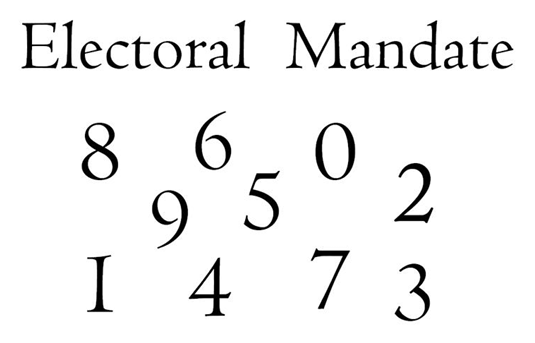
1. The words given below are written using a particular font. Identify the digit that does not belong to the same font?
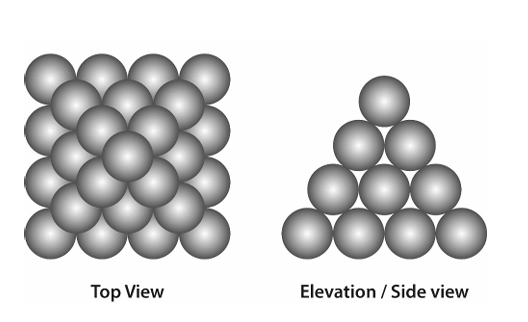
2. Shown below is an arrangement of closely stacked spheres. Assume each one to be in contact with its immediate neighbour. What is the total number of points where the spheres touch each other?
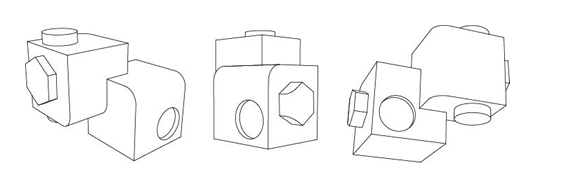
3. Shown below are three perspective views of a solid object. How many surfaces does the object have? Assume hidden surfaces to be flat.
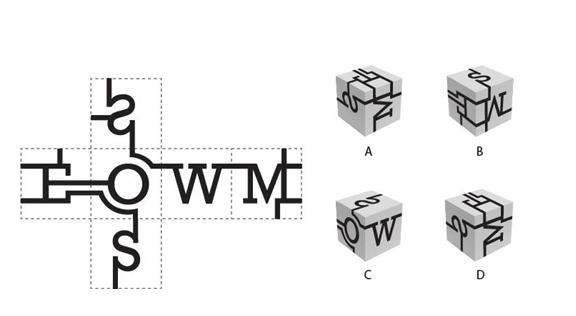
4. Shown on the left is the image of an unfolded cube. Which of the options represent(s) the folded cube?
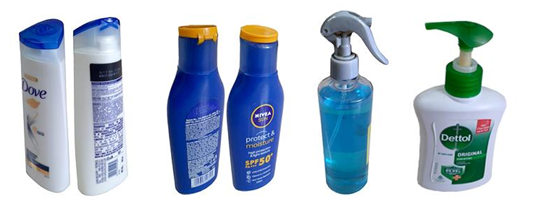
5. Shown below are images of four different models of dispensers. Which of the statements is/are TRUE?
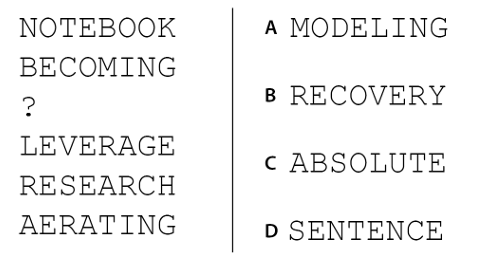
6. Which option will replace the question mark?
CEED 2025 Part B Questions Analysis
|
Question Type |
Actual Question Breakdown |
Skills Tested |
Difficulty |
|
Sketching |
Q1: Draw a scene where two children (Kaa and Kii) are being chased by a bear in a forest, viewed from the perspective of a fox watching the incident. Candidates had to depict emotions, action, environment, and an unusual viewpoint. |
Perspective drawing, storytelling through visuals, character expressions, scene composition, environmental sketching |
Moderate to Difficult |
|
Storytelling / Creativity |
Q2: Create a meaningful visual sequence using four frames containing a bulb, water tap, and mosquito. Additional characters and props could be added, and continuity had to be maintained across frames. |
Storytelling, imagination, sequencing, narrative development, visual communication |
Moderate |
|
Visualization / Communication Design |
Q3: Design four black-and-white zoo signage icons for Indian Grey Mongoose, Honey Badger, Indian Bison, and Indian Pangolin while maintaining a consistent visual language. |
Icon design, abstraction, visual simplification, consistency, communication design |
Moderate |
|
Form Sensitivity |
Q4: Reimagine a tea flask inspired by a character-based product shown in the question. Candidates had to translate the character's personality, form language, and details into a functional flask design. |
Product design thinking, form exploration, aesthetics, rendering, usability integration |
Difficult |
|
Design Problem Solving |
Q5: Identify five buyer problems and five seller problems related to a typical Indian vegetable cart. Then visually explain one buyer problem and one seller problem through sketches. |
Observation, empathy, user-centered design, problem identification, communication through visuals |
Difficult |
Check: CEED 2027 Expected Cut-off
CEED 2025 Difficulty Level Analysis
|
Section |
Difficulty |
Remarks |
|
Part A |
Moderate to Difficult |
Strong emphasis on visual reasoning, spatial ability, observation, paper folding, 3D visualization, product awareness, and design aptitude. Required careful analysis rather than rote knowledge. |
|
Part B |
Moderate to Difficult |
Focused heavily on creativity, storytelling, sketching, form development, icon design, and real-world design problem solving. Strong design thinking skills were rewarded. |
|
Visual Reasoning |
Difficult |
One of the most challenging areas, featuring cube folding, object rotation, top-view identification, paper folding, shadow analysis, profile views, and spatial visualization questions. |
|
Drawing & Sketching |
Moderate |
The sketching task itself was manageable, but the unusual fox-eye perspective and emphasis on storytelling, composition, and expressions increased complexity. |
|
Overall Paper |
Moderate to Difficult |
CEED 2025 balanced aptitude and creativity well. While Part A tested analytical and spatial thinking, Part B focused on design thinking, communication, and problem-solving, making it challenging for candidates with strengths in only one area. |
Also Check: CEED Books 2027
Top 10 Most Important Topics from CEED 2025
|
Rank |
Topic |
Evidence from Actual Paper |
|
1 |
Visual Reasoning |
More than 15 questions involving folding, rotation, tiles, patterns and transformations |
|
2 |
Observation Skills |
Footwear pairs, dispensers, scissors, chairs, dance forms |
|
3 |
Spatial Ability |
Cross-sections, projections, solids, views and rotations |
|
4 |
Problem Identification |
Dedicated 20-mark Part B question |
|
5 |
Design Thinking |
Buyer-seller problem analysis for vegetable carts |
|
6 |
Storytelling |
Four-frame visual sequence task |
|
7 |
Sketching |
Perspective-based forest chase scene |
|
8 |
Visual Communication |
Visual explanation of identified problems |
|
9 |
Product Understanding |
Manufacturing methods, mechanisms and usability questions |
|
10 |
Form Development |
Character-inspired tea flask redesign |
Toprankers CEED Preparation Tips 2026: Check Step Wise Preparation Strategy & Toppers tips
1757510491.webp)
CEED 2025 vs CEED 2026 Paper
|
Factor |
CEED 2025 |
CEED 2026 |
|
Overall Part A Difficulty |
Moderate to Difficult |
Difficult |
|
NAT Questions |
Mixed observation + geometry + counting + typography. Examples: footwear pairs, font identification, sphere contacts, paper folding. |
More mathematical and puzzle-oriented. Examples: path length calculation, ice cream volume & mass, folded paper area, board-game optimization. |
|
Visual Reasoning |
Strong focus on rotations, cube folding, profile views, perspective transformations. |
Even stronger. More advanced spatial manipulation, octahedron folding, distorted grids, object assembly, 3D matching. |
|
Observation Questions |
Relatively straightforward. Count footwear pairs, identify fonts, mirror images, profile views. |
Observation became trickier. Hidden pattern counting, image fragment matching, visual overlap puzzles. |
|
Design Thinking Questions |
Product analysis dominated (chairs, dispensers, scissors, manufacturing processes). |
Fewer direct product-design questions. More focus on mechanism understanding and structural reasoning (pruner, cardboard table, object assembly). |
|
General Knowledge / Design Awareness |
Present. Included Indian dance forms, traditional crafts, manufacturing operations. |
Much stronger. Included art movements (De Stijl, Impressionism, Pop Art, Art Nouveau, Baroque), regional typography/font recognition, product-feature mapping. |
|
Math Requirement |
Low to Moderate. Mostly counting and geometry. |
Significantly higher. Volume, area, optimization, path calculation, game strategy. |
|
Animation-based Questions |
Present but limited. Mouse path, bird animation. |
More heavily used. Rotating spheres, planetary motion, cube assembly animations. |
|
Pattern Recognition |
Moderate. Tile arrangement, sequence puzzles, font identification. |
Very high. Distorted grids, symbolic logic, image decomposition, pattern counting. |
|
Mechanical Aptitude |
Product usability-focused. |
Mechanism-focused. Students needed to understand springs, hinges, assemblies, motion. |
|
Time Pressure |
Manageable for prepared students. |
Higher. Several questions required multiple-step reasoning before solving. |
|
Guessability |
Relatively higher. Many questions could be eliminated through observation. |
Lower. Wrong reasoning often led to completely different answers. |
|
Most Challenging Area |
MSQ product-design and spatial reasoning questions. |
NAT and MSQ sections due to lengthy reasoning and calculations. |
|
Most Scoring Area |
Observation and design-awareness questions. |
Visual reasoning and pattern recognition if well-practiced. |
Must-know: What is the Difference Between UCEED and CEED?
CEED 2025 vs Previous Years (2022–2024)
|
Factor |
CEED 2022–2024 |
CEED 2025 |
|
Observation |
Strong focus on counting, hidden patterns, shape identification, visual matching. |
Much more sophisticated observation involving fonts, footwear pairing, sphere contacts, folded strips, manufacturing analysis. |
|
Visualization |
Mostly orthographic views, cube folding, rotations, shadow analysis, object reconstruction. |
Higher-level spatial reasoning involving perspective interpretation, cross-sections, profile views, object reconstruction and transformations. |
|
Design Thinking |
Present but limited to usability, ergonomics, accessibility, mechanisms and basic UX scenarios. |
Far more integrated into Part A through chairs, scissors, manufacturing methods, stackability, product analysis and design decisions. |
|
Creativity |
Creativity appeared indirectly through pattern generation and interpretation. |
Creativity shifted toward visual reasoning rather than imaginative thinking. |
|
Communication |
Story interpretation and user-context questions appeared occasionally. |
Narrative understanding appears through journey maps, information interpretation and visual communication questions. |
|
Problem Solving |
Logical puzzles and quantitative reasoning existed but were usually standalone questions. |
Problem solving became the backbone of the paper, especially in NAT and MSQ sections. |
|
Mathematics |
Moderate. Mostly geometry, ratios, counting, simple calculations. |
Noticeably higher. Geometry, surface calculations, combinatorics and multi-step reasoning increased. |
|
Product Understanding |
Limited. |
One of the strongest themes in the paper. |
|
Design Awareness |
Present but scattered. |
More structured and embedded into design-related contexts. |
|
Difficulty |
Moderate to Difficult. |
Difficult. Particularly for Part A. |
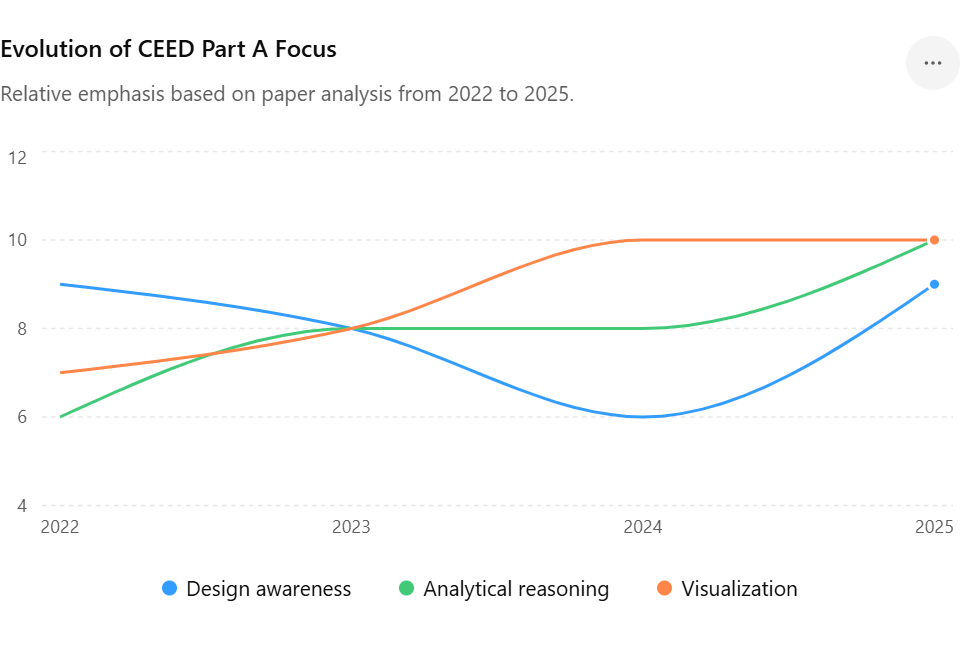
How the Exam Has Evolved?
The trend is clear:
- 2022: Design-heavy
- 2023: Design + Logic
- 2024: Visual Intelligence
- 2025: Visual Intelligence + Design Intelligence + Analytical Reasoning
Check: CEED Previous Year Question Papers with Solutions
How to Use the CEED 2025 Question Paper Effectively
|
What To Do |
Why It Helps |
|
Timed Solving |
Builds speed and helps you adapt to CEED’s time pressure, especially in Part A where 44 questions must be solved within 60 minutes. |
|
Mock Simulation |
Replicates actual exam conditions and improves decision-making, question selection, and time management. |
|
Error Analysis |
Identifies weak areas such as visual reasoning, observation, design aptitude, or spatial ability so you can improve systematically. |
|
Sketching Practice |
Strengthens Part B performance by improving visualization, communication, storytelling, perspective drawing, and design expression. |
|
Compare with Recent Papers |
Reveals evolving CEED trends and helps you understand how the exam has shifted from pure creativity toward observation, design thinking, and analytical reasoning. |
Pro Tip: Don't just solve the CEED 2025 question paper once. Revisit it after completing CEED 2024 and CEED 2026 papers.
Comparing all three papers provides a clearer understanding of IIT Bombay's current expectations and recurring question patterns.
Check: CEED Last Minute Preparation Strategy
What CEED 2025 Reveals About IIT Bombay's Selection Criteria
The CEED 2025 question paper clearly showed that IIT Bombay prioritizes design thinking, observation, visualization, and problem identification over artistic perfection.
|
Skill Area |
Evidence from CEED 2025 |
Importance |
|
Observation Skills |
Footwear pairs, chair manufacturing, dispenser mechanisms, dance forms |
Very High |
|
Visual Reasoning |
Cube folding, paper folding, rotations, tile arrangements, shadow questions |
Very High |
|
Spatial Ability |
3D objects, cross-sections, projections, transformations |
Very High |
|
Design Thinking |
Vegetable cart problem identification task |
Very High |
|
Creativity & Storytelling |
Four-frame visual narrative involving bulb, tap and mosquito |
High |
|
Communication |
Visual explanation of buyer and seller problems |
High |
|
Sketching |
Forest chase scene from the fox's point of view |
Moderate |
|
Design Awareness |
Manufacturing processes, ergonomics, product analysis |
Moderate |
Check: CEED 2027 Application Form Details
Who Should Solve the CEED 2025 Paper?
The CEED 2025 question paper is valuable for a wide range of aspirants because it reflects the latest IIT Bombay approach toward evaluating observation, visualization, design aptitude, creativity, and problem-solving skills.
|
Candidate Type |
How the CEED 2025 Paper Helps |
|
Beginners |
Helps understand the CEED exam pattern, question types, difficulty level, and the skills expected in Part A and Part B. |
|
CEED 2026 Aspirants |
Provides one of the most recent benchmarks for understanding current CEED trends, visual reasoning questions, and design aptitude expectations. |
|
CEED 2027 Aspirants |
Helps identify recurring concepts, build foundational skills early, and understand how CEED has evolved in recent years. |
|
Design Students |
Strengthens observation, visualization, sketching, storytelling, product thinking, and design communication skills beyond exam preparation. |
|
Self-Preparing Candidates |
Serves as an effective self-assessment tool to evaluate strengths, weaknesses, and readiness without coaching support. |
|
Repeat Aspirants |
Helps compare performance against previous attempts, improve exam strategy, and address recurring mistakes in aptitude or sketching. |
Check: CEED Books 2026: Best books for CEED Preparation
Final Takeaway
The CEED 2025 question paper offers valuable insights into the latest CEED trends, especially the growing importance of observation, visualization, design aptitude, and design thinking.
Solving the CEED 2025 question paper PDF helps aspirants understand IIT Bombay's expectations, improve problem-solving skills, and identify recurring question patterns.
For the best results, use CEED 2025 sample papers alongside recent CEED papers, mock tests, and sketching practice. Combining multiple years of papers provides a clearer understanding of evolving exam trends and helps build the skills required to perform well in future CEED exams.
Preparing for CEED 2027? We can help you with exact strategic roadmap, study material and crucial feedback required to ace this exam.
Join best CEED Online Coaching by CreativEdge and get expert guidance on all CEED subjects.

Frequently Asked Questions
Where can I download the CEED 2025 question paper PDF?

Was CEED 2025 difficult?
What questions were asked in CEED 2025?
Is CEED 2025 useful for CEED 2027 preparation?
What was asked in Part B in CEED 2025 Question Paper?
Where can I find CEED 2025 question and answers?
How different was CEED 2025 from CEED 2026?
Are CEED sample papers enough for preparation?
Vineeta Agrawal
Communications Executive


SHARE