
1723534562.png)

CEED Question Papers: Previous Year Papers (2010–2025) with Answer Keys
August 12, 2026
CEED question papers from 2010 to 2026 are available to download as free PDFs, along with official answer keys wherever released by IIT Bombay.
Each paper contains Part A (objective - MCQ, MSQ, NAT) and Part B (drawing and design). Solving CEED previous year question papers is the fastest way to learn the real exam pattern, question types, and difficulty level.
Download the year-wise papers in the table below, or access them from the official source, ceed.iitb.ac.in.
Download CEED Previous Year Question Papers (Free PDFs)
The candidates preparing for the CEED examination should resort to the CEED question papers with PDF for effective preparations. IIT Bombay has released all the CEED previous year question papers for the past years.
Check out the link for the previous year CEED question papers below:
| CEED Year Wise Question Papers | Download Link |
|
Download CEED 2026 Question Paper PDF |
|
| Download CEED 2025 Question Paper PDF | |
| Download CEED 2025 Answer Key | |
| Download CEED 2024 Question Paper PDF | |
| Download CEED 2024 Answer Key | |
| Download CEED 2023 Question Paper PDF | |
| Download CEED 2023 Answer Key | |
| Download CEED 2022 Question Paper PDF | |
| Download CEED 2022 Answer Key | |
| Download CEED 2021 Question Paper PDF | |
| Download CEED 2021 Answer Key | |
| Download CEED 2020 Question Paper | |
| Download CEED 2020 Answer Key | |
| Download CEED 2019 Question Paper PDF | |
| Download CEED 2018 Question Paper PDF | |
| Download CEED 2017 Question Paper PDF |
Read more: CEED Exam Preparation 2027
Key Highlights: CEED Question Papers
| Detail | Information |
|---|---|
| Exam name | Common Entrance Examination for Design (CEED) |
| Conducting body | IIT Bombay |
| Papers available | 2010 - 2025 (year-wise PDFs) |
| Answer keys | Available for recent years (official, where released) |
| Paper Pattern | Part A (objective, 1 hr) + Part B (drawing/design, 2 hrs) |
| Part A question types | MCQ, MSQ, NAT |
| Total marks | 200 (Part A: 100, Part B: 100) |
| Purpose of solving | Understand pattern, question types, timing, difficulty |
| Official source | ceed.iitb.ac.in |
| Cost | Free PDF download |
CEED Previous Year Question Papers - Part A Questions
Questions are divided into 3 forms- MCQ, MSQ, and NAT. As per official CEED syllabus following subjects are included:
1. Visual and Spatial Reasoning Questions
These questions test your ability to visualize objects in 2D and 3D space.
Common question types include:
- Cube folding and unfolding
- Mirror and water images
- Rotation of objects
- Identifying correct 3D views from given 2D drawings
These are high-frequency questions and often appear as MCQs or MSQs in CEED Part A.
Example CEED Question:
Shown below (on the left) is the top view of a 3D form. Identify the possible front view(s).
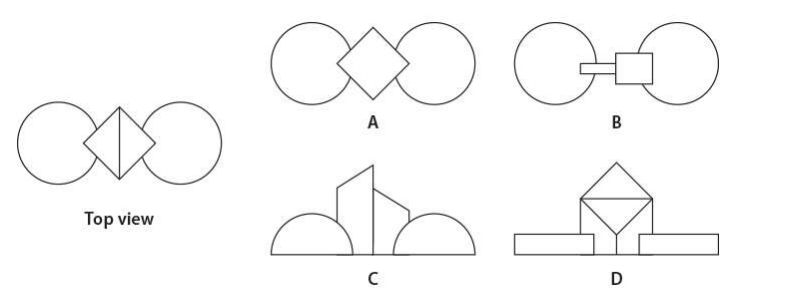
Ans: C,D
2. Logical Reasoning and Pattern Recognition
Logical reasoning questions in CEED focus heavily on visual logic rather than numerical logic.
Frequently asked formats:
- Visual sequences and series
- Odd-one-out based on shape, color, or logic
- Pattern completion using geometric forms
- Visual analogies
Previous year CEED question papers show that such questions are designed to test reasoning speed and accuracy.
Example CEED Question:
Which option will replace the question mark?

Ans: A
3. Analytical and Problem-Solving Questions
These questions assess your ability to analyze real-life situations and choose the most logical solution.
Typical examples include:
- Situational problem-solving
- Cause–effect based question
- Identifying constraints and best-fit solutions
- Design-related decision-making scenarios
These questions often blend logic with practical design thinking, making them scoring if approached calmly.
Example CEED Question:
A toy is shown on the left. When the wheels of this toy rotate, the fan is also required to spin. If one pair of gears is to be used exclusively, which option will make this possible?

Ans: C
4. Design Awareness and General Knowledge
CEED previous year question papers include design-centric GK, not general current affairs.
Topics commonly seen in CEED previous year papers:
- Famous designers and architects
- Design movements and principles
- Everyday product design and ergonomics
- Materials, tools, and manufacturing processes
- Sustainability and environmental awareness
These questions are usually direct and can fetch quick marks if prepared well.
Example CEED Question:
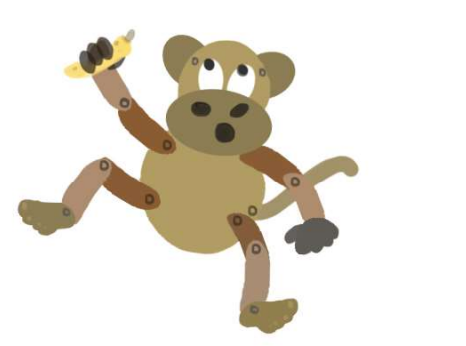
A professional animation studio has created a paper cut-out model with movable joints as shown below. This is to be used for an animation feature film. Which material(s) will the studio use for the joints?
A. Nylon Wire
B. Mouldable Clay
C. Eyelet Rivet
D. Chalk
Ans: A,C
5. Environmental and Social Awareness Questions
Another recurring pattern in CEED previous year question papers is questions based on social relevance and environmental sensitivity.
Examples include:
- Waste management concepts
- Sustainable design solutions
- Accessibility and inclusive design
- Urban and public space-related issues
Such questions test your awareness as a responsible designer, not factual memory alone.
Example CEED Question:
Sal tree seed moves in a particular manner, while free falling. Which toy(s) given below has/have a similar movement?

Ans: C,D
6. Numerical and Data Interpretation Questions
Although limited in number, CEED Part A also includes basic quantitative aptitude.
Commonly asked areas:
- Ratios and percentages
- Data interpretation through graphs or tables
- Logical calculations linked to real-life scenarios
- These questions are usually straightforward and reward clear thinking over complex calculation.
Example CEED Question:
Q.1. How many paper cups (of the dimensions shown below) can be made from one A4 paper?
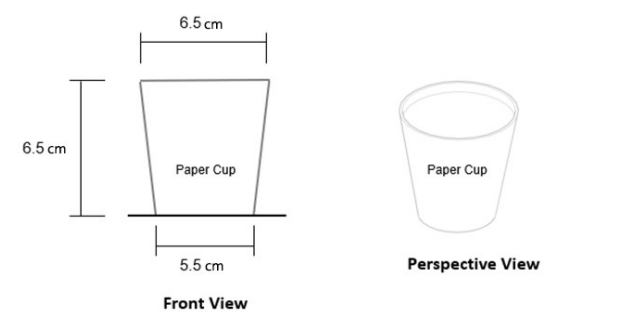
Ans: 3
For more practice questions for 2027 exam, download CEED sample questions with solutions PDF.
CEED Previous Year Question Papers - Type of Questions in Part B
1. Sketching and Drawing-Based Questions
One of the most common question types in CEED previous year question papers in Part B involves freehand drawing to communicate ideas.
Typical tasks include:
- Sketching objects or scenes from imagination
- Visualizing a concept through perspective drawings
- Depicting situations using human figures and surroundings
- Drawing with emphasis on proportion, clarity, and composition
These questions assess observation skills and visual clarity, not artistic perfection.
2. Design Problem-Solving Questions
CEED Part B frequently includes real-world design problems that require structured thinking.
Common formats:
- Designing a product for a specific user group
- Improving or redesigning an existing object
- Proposing solutions for everyday problems
- Addressing usability, ergonomics, and constraints
Previous year CEED papers show that these questions reward logical reasoning combined with creativity.
3. Visual Storytelling and Narrative-Based Questions
Another recurring pattern in CEED PYPs is storytelling through visuals, where candidates are asked to convey a situation, process, or sequence.
Examples include:
- Drawing a step-by-step process
- Creating a short visual story or scenario
- Illustrating cause-and-effect through sketches
- Depicting emotions or interactions
These questions test your ability to communicate ideas clearly without relying heavily on text.
4. Design Thinking and Concept Explanation
Many Part B questions in CEED 2026 exam require candidates to not only draw but also explain their design decisions.
Typical requirements:
- Writing a short concept note
- Explaining functionality, usability, or innovation
- Justifying material choice or form
- Describing the user experience
This evaluates how well you can articulate your design process, a key skill for postgraduate design programs.
5. Creativity and Ideation-Based Questions
CEED entrance exam often tests idea generation under constraints.
Question types include:
- Using a given object to create a new product
- Designing under specific limitations (space, cost, users)
- Combining unrelated elements creatively
- Abstract thinking and concept visualization
These questions assess originality, flexibility, and innovation, not drawing complexity.
6. Analytical and Visual Explanation Questions
Some CEED Part B questions focus on analysis rather than pure creativity.
Examples:
- Comparing two designs visually
- Identifying design flaws and proposing improvements
- Explaining a visual or diagram in your own words
- Interpreting images, layouts, or systems
- Such questions check your ability to observe critically and explain visually.
Check: CEED Exam Eligibility Criteria 2027
Sample CEED Previous Year Questions with Answers - Part B
Q.1. Two kids, Kaa and Kii, are on an adventure trip in a forest. While exploring, suddenly a bear emerges and starts chasing them. The kids start running in panic through the forest. A fox is watching the whole scene. Sketch this scene from the fox’s point of view. The sketch should be clear and visible.
Additional Instructions:
- Use only black/HB-series pencils
- Do not use other colors
- Draw only in the given space
Evaluation Criteria:
- Character and expressions
- Proportion and composition
- Quality of sketching
- Environment and props
Q.2. Inspired from the given three-dimensional form, conceptualize, sketch, and render a single seater furniture for a living room.

Evaluation Criteria:
- Consistency with the visual language of the form
- Form should complement function
- Relevant details of the product
- Surface shading
Q.3. Imagine the human head as a cube. With this scenario, illustrate the following interactions inside the given boxes (in the answer booklet) in this order:
1. Human-human
2. Human-animal
3. Human-environment
4. Human-object
Use only BLACK pencil/pen. Draw only within the boundaries of the boxes. Write the titles below the boxes, in the space provided.
Evaluation criteria:
- Uniqueness: Ability to create unusual images
- Diversity: Variation between each created image
- Clarity: Effective use of visual elements and titles
- Fun: Ability to use humor and surprise in the images and titles
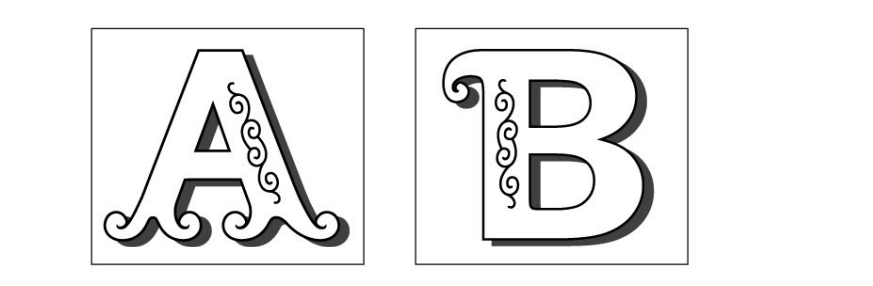
Q.4. Shown below are two letters A & B of an ornamental font. Using this font style create the word ‘Forest’ (the first letter in uppercase and the remaining in lowercase).
Q.5. You observe that many people using public buses in Indian cities struggle while boarding and alighting, especially during peak hours. Elderly passengers, people carrying bags, and persons with temporary injuries often face difficulty maintaining balance, locating handholds, or moving safely inside the bus.
Task:
1. Identify three key problems faced by users in this situation.
2. For each problem, briefly explain why it occurs.
3. Suggest one design opportunity that could improve the overall user experience inside public buses.
Use both sketches and short written explanations to clearly communicate your observations and ideas.
CEED Question Paper Pattern Analysis (2018-2026): What the Trends Reveal
As per CEED exam analysis of last several years, the exam has steadily shortened Part A, stabilized Part B into five fixed design competencies, and shifted its emphasis from factual design knowledge toward visual reasoning, observation, and real-world problem identification.
If you study the papers as a trend rather than one-off tests, three clear patterns emerge - and they tell you exactly where to focus.
Trend 1 - Part A got shorter and more reasoning-heavy
Part A has moved from ~45 questions to a stable 41 questions worth 100 marks, with less reliance on memorized general knowledge and more on visualization and logic.
|
Year |
Part A (approx. questions) |
Overall difficulty |
What stood out |
|
2018 |
~35–41 (NAT/MSQ/MCQ) |
Easier than prior year |
MCQ easiest section; Part A was a screening round |
|
2019 |
~45 (MSQ 10 / NAT 10 / MCQ 25) |
Moderate |
Photography, resolution, animation principles, mensuration |
|
2020 |
~42 |
Easy–moderate |
Shadow/light behavior, rotation puzzles, series |
|
2021 |
~41 |
Moderate–difficult |
Time pressure in Part A; NAT & MSQ tougher |
|
2022 |
~41 |
Moderate |
Negative marking on MCQ/MSQ, none on NAT |
|
2023 |
41 |
Moderate–difficult |
Part A "difficult," NAT tricky, lengthy paper |
|
2024 |
41 (NAT 8 / MSQ 10 / MCQ 23) |
Moderately difficult |
Settled into the current structure |
|
2025 |
41 |
Moderate |
MCQ easy, NAT/MSQ moderate; a few printing errors |
|
2026 |
41 |
Moderate–difficult |
Reported lengthy and time-consuming |
Per-question marks and negative marking have varied by year - always confirm the exact scheme in the current official CEED brochure.
Trend 2 - The same Part A question types repeat every year
While the exact questions change, the categories are remarkably stable across papers. High-frequency repeats:
| Question Category | What It Covers (Repeated Formats) |
|---|---|
| Visual & Spatial Reasoning | Cube folding/unfolding, rotation, mirror and water images, matching 2D views to 3D forms, shadow and light behaviour (sciography) |
| Logical & Pattern Reasoning | Series and sequences, odd-one-out, pattern completion, visual analogies |
| Design Awareness (Applied, Not Rote) | Design movements (e.g., Bauhaus and "form follows function"), famous designers, animation principles (squash and stretch), fonts, logos, ergonomics |
| Numerical / NAT | Counting (lines, intersections, triangles), mensuration, gears and ratios, anthropometry-based estimation |
Trend 3 - Part B moved from "pick your discipline" to five fixed skills
Older papers (around 2018–2019) offered discipline-specific choices - Industrial, Communication, Interaction, and Mobility/Vehicle Design - where you picked a problem matching your field.
Recent papers (2023 onward) instead test five common questions of 20 marks each, mapped to fixed competencies: Sketching, Creativity, Form Sensitivity, Visual Sensitivity, and Problem Identification.
Recurring Part B theme categories, with real examples from past papers:
|
Part B Theme Category |
Maps to Competency |
Example Questions from Past Papers |
|
Observational / perspective sketching |
Sketching |
Kitchen interior from a specific eye height; forest chase from a fox's point of view |
|
Form development from a given 3D form |
Form Sensitivity |
Single-seater chair inspired by a supplied abstract form |
|
Visual storytelling / narrative |
Visual Sensitivity |
Character (Maya) across two scenes; completing incomplete illustrations |
|
Creativity / ideation under constraints |
Creativity |
Combining given panels, shapes, or an ornamental font into a new composition |
|
Everyday problem identification |
Problem Identification |
Playground safety hazards; boarding difficulties on a public bus; a bus-stop problem scene |
What this means for your CEED 2027 preparation?
Concretely- build Part A speed on visualization and logic, and rehearse Part B by walking through everyday public spaces and asking "what's badly designed here, and how would I fix it?" That single habit maps directly onto the most repeated Part B pattern.
Ready to test where you stand against these patterns? [Attempt a free CEED mock test →]
Advantages of Solving CEED Previous Year Question Papers
Solving CEED exam question papers comes with several advantages; here are a few to name:
Practice Time Management: Solving last year's question paper of CEED will give you an idea of the time to solve each CEED Question Paper. This will help you improve your time management skills and attempt the CEED drawing questions within the given time frame.
- Solving CEED question paper pdfs helps one identify the relevant topics for the examination. Additionally, it helps one to focus on the preparations.
- CEED exam question paper should be solved regularly to enhance the overall skill set. These basic problems must be solved using a systematic approach, crucial for the examination.
- By solving the CEED Previous Year Question Papers, you can evaluate your performance and identify your strengths and weaknesses. This will help you determine your weak areas and improve your performance.
- Solving CEED previous year question papers with solutions pdf will help you to build confidence in your preparation. This will help you feel more comfortable and confident while attempting the exam.
Check: Difference between UCEED and CEED
How to Effectively Use the CEED Previous Year Question Papers?
Solving CEED question papers works best when you treat them as a staged tool - first to understand the exam, then to build speed, and finally to simulate the real test. Follow the approach below to get the most out of each paper.
| Stage | What to Do | Why It Works for CEED |
|---|---|---|
| 1. Understand the Pattern | Start with the 2-3 most recent papers. Read through both Part A and Part B without solving, and note the question types and marking scheme. | CEED reuses the same categories every year (visualisation, logic, problem identification), so recognising them early sharpens your focus. |
| 2. Solve Untimed First | Attempt one full paper without a timer. Focus on accuracy and understanding your approach, especially for Part A visual-reasoning questions. | Builds the correct method before speed - rushing Part A early only reinforces careless mistakes. |
| 3. Add the Clock | Re-attempt papers under real timing: 1 hour for Part A, 2 hours for Part B. Track how many you attempt versus how many you get right. | Time pressure in Part A is the single most reported challenge in recent CEED papers - practicing against the clock is essential. |
| 4. Review with the Answer Key | Check every answer against the official answer key. For wrong answers, write down why you missed it - concept gap, misread, or time. | Turns each paper into a diagnostic. Tagging your error type tells you exactly what to revise next. |
| 5. Practise Part B as "Design Empathy" | For Part B, don't just sketch - observe everyday public spaces (bus stops, playgrounds, kitchens) and practice identifying and solving real problems. | CEED Part B repeatedly asks you to observe a situation and frame problems, not just draw well. |
| 6. Analyse Your Weak Areas | After 3-4 papers, map your recurring weak spots (e.g., rotation puzzles, mensuration, ideation) and target them with focused practice. | Concentrated effort on your weakest repeated topics gives the highest score gain per hour of study. |
| 7. Simulate the Full Exam | In the final weeks, solve complete papers back-to-back under exam conditions, then move on to CEED mock tests. | Builds stamina for the full 3-hour paper and reduces exam-day anxiety. |
Tip: Always download CEED question papers from authentic sources, and attempt them in a quiet, distraction-free setting to mirror real exam focus.
How to Download CEED Previous Year Question Papers?
Practicing CEED previous year question papers is one of the most effective ways to understand the exam pattern, question difficulty, and marking scheme. Below are two simple and reliable ways to download CEED question papers for your preparation.
1. Download CEED Question Papers from the Links Given Above in This Article
For your convenience, we’ve already compiled direct download links to CEED previous year question papers within this article.
By using these links, you can:
- Access year-wise CEED question papers quickly
- Download papers in PDF format without navigating multiple pages
- Find Part A and Part B questions structured exactly as asked in the exam
- And access the year-wise answer keys as well, all at the one place.
This is the fastest and most student-friendly method, especially if you want all CEED papers in one place for regular practice.
2. Official CEED Website:
To download the CEED previous year question papers you can follow these steps:
- Visit the official CEED website: https://ceed.iitb.ac.in
- Look for the "Previous Year Question Papers" section, which is usually available under the "Downloads" or "Resources" tab.
- You can download the papers in PDF format from there.
Check: CEED Cut Off
CEED Preparation Tips
CEED is one of the most challenging examinations conducted in the country. The reason for this is that IIT Bombay holds it. Additionally, there is a limited number of seats, citing that the competition is top-notch. Here in the section, we have provided detailed preparation tips for the examination:
- Understand the CEED exam pattern and go through the CEED question papers and syllabus to understand the test pattern and structure. Use the topics mentioned in the syllabus to plan and prepare accordingly for the examination.
- Practice Sketching is one of the essential things to do when preparing for the CEED examination. One must be creative and possess exceptional drawing skills to excel on the test. Begin by practicing sketching objects, landscapes, still life, and so on.
- Solve the CEED Model Question Papers of CEED to get a better idea of the structure and difficulty level of the examination. Attempt these papers accordingly to understand your strengths and weaknesses.
- Work on improving your Analytical Skills, as this section will have questions. You can begin by solving puzzles, brain teasers, and other challenges to enhance your skill set.
- Resort to newspapers and daily editorials to enhance your General Awareness. You can use magazines and also attempt quizzes to revise the same.
Check: Job opportunities after CEED
CEED Exam Pattern 2027
According to the official notification, the CEED exam will be conducted in two parts, A and B:
|
Section |
Mode |
Marks |
Duration |
Purpose |
|
Part A |
Computer-based |
100 |
1 hour |
Tests aptitude, reasoning, visual & design sensitivity |
|
Part B |
Pen-and-paper (sketching) |
100 |
2 hours |
Tests drawing, creativity, design thinking |
|
Total |
— |
200 |
3 hours |
— |
CEED Marking Scheme 2027 Part-A:
|
Types of Questions |
Number of Questions |
Question Number |
Marking Scheme |
Total Marks |
|
NAT (Numerical Answer Type) |
8 questions |
1-8 |
+4 for correct answer 0 for wrong answer |
32 |
|
MSQ (Multiple Select Question) : Each MSQ may have one or more than one correct choice(s) out of the four given |
10 questions |
9-18 |
+ 4 If only (all) the correct options are correct & (NONE incorrect) |
40 |
|
+ 3 If all the four options are correct but ONLY three options are chosen. |
||||
|
+ 2 If three or more options are correct but ONLY two correct options are chosen (both of which are correct and NONE is incorrect) |
||||
|
+ 1 If two or more options are correct but ONLY one option is chosen and it is a correct option and NONE of the incorrect options is chosen. |
||||
|
0 if no option is chosen |
||||
|
-1 In all other cases (even for 1 incorrect option chosen) |
||||
|
MCQ (Multiple Choice Questions) |
26 questions |
19-44 |
+3 for each correct answer -0.5 for incorrect answer |
78 |
|
Total |
44 |
1-44 |
150 |
CEED Marking Scheme 2027 Part-B:
|
Section |
Number of Questions |
Question Number |
Partial Marks |
Negative Marks |
Marks |
|
Sketching |
1 |
1 |
Yes |
No |
20 |
|
Creativity |
1 |
2 |
Yes |
No |
20 |
|
Form Sensitivity |
1 |
3 |
Yes |
No |
20 |
|
Visual Sensitivity |
1 |
4 |
Yes |
No |
20 |
|
Problem Identification |
1 |
5 |
Yes |
No |
20 |
|
Total |
5 |
1-5 |
10 |
Start you preparation with the most regarded CEED Preparation books after understanding the exam structure.
Conclusion
CEED Previous Year Question Papers is a resource for potential candidates preparing for the Common Entrance Examination for Design. The paper contains a range of questions covering topics such as drawing skills, design aptitude and creative thinking to help evaluate the creative and analytical abilities of the candidates.
Preparing for CEED 2027? We can help you with exact strategic roadmap, study material and crucial feedback required to ace this exam.
Join best CEED Online Coaching by CreativEdge and get expert guidance on all CEED subjects.


Attempt a Free CEED Mock Test Now
Fill your details
Frequently Asked Questions
Where can I buy CEED preparation books?

Are CEED preparation books enough to crack the exam?
How many books do I need for CEED 2027?
Which book is best for CEED drawing?
Does IIT Bombay recommend official CEED books?
What are the best books for CEED preparation?
How should I use CEED Previous Year Question Papers to improve my score?
Are CEED Previous Year Question Papers enough for complete preparation?
Vineeta Agrawal
Communications Executive
SHARE