
1723534562.png)

CEED Sample Paper 2027: Solved Practice Questions for Part A & Part B
August 12, 2026
CEED sample papers are practice question sets with detailed, step-by-step solutions that mimic the actual CEED exam, covering both Part A (objective) and Part B (drawing and design). Unlike previous year papers, sample questions are curated to help you learn how to solve each question type - visual reasoning, design aptitude, sketching, and problem-solving - with full explanations.
Practice the solved CEED sample questions below to build accuracy and speed.
Looking for the actual year-wise CEED papers? Download official CEED question papers PDFs (2010-2025) with answer keys.
This page only focuses on solved sample questions for exam practice.
Key Highlights: CEED Sample Paper
| Detail | Information |
|---|---|
| What it is | Curated CEED practice questions with detailed solutions |
| Best for | Learning how to solve Part A & Part B question types |
| Coverage | Part A (MCQ, MSQ, NAT) + Part B (sketching, design) |
| Includes | Step-by-step explanations and correct answers |
| Topics | Visual reasoning, design aptitude, GK, creativity, problem-solving |
| Difference from PYQs | Sample = practice + solutions; PYQ = actual past papers |
| How to use | Solve, review the solution, identify weak areas, repeat |
| Next step | Attempt a free CEED mock test to simulate exam conditions |
| Actual past papers | Available on the CEED question paper page |
Click the button below to attempt CEED sample question paper NOW:
Use these questions to sharpen your approach and take your CEED preparation strategy to the next level. Get instant performance analysis to identify your strengths and weaknesses.
Sample Questions with Answers for CEED 2027 Practice
Q.1. A washbasin will be installed in a college canteen in India. Which option can help determine the appropriate height of the washbasin from the floor?
A. The average height of the adult Indian male and female population
B. The average height of the tallest 50% adult Indian female population
C. The average height of the shortest 5% adult Indian female population
D. The average height of the shortest 5% adult Indian male population
Answer: A
Explanation:
This approach ensures that the washbasin is positioned at a height suitable for the average height of both males and females, considering the general population. Options B, C, and D may not be appropriate as they only consider specific subsets of the population, such as the tallest 50% of the adult Indian female population or the shortest 5% of the adult Indian male or female population, which may not accurately represent the overall height distribution of the population.
Therefore, option A, the average height of the adult Indian male and female population, would be the most reasonable choice to derive the appropriate height of the washbasin from the floor in a college canteen in India.
Q.2. To fit a metal rim to the wooden wheel of a bullock cart, the metal rim is
__________, and placed on the wooden wheel and __________. This process works because _____
_______________________.
- Heated cooled, the metal expands as it cools
- Cooled, heated, the metal shrinks as it cools
- Heated, cooled, the metal shrinks as it cools
- Cooled, heated, the metal expands as it cools
Answer. A. Heated, cooled, the metal expands as it cools.
Explanation:
When fitting a metal rim to a wooden wheel of a bullock cart, the rim is heated first, causing it to expand. This expanded metal rim is then quickly placed onto the wooden wheel, which is cooler. As the heated metal rim comes into contact with the cooler wooden wheel, it begins to cool and contract, fitting tightly against the wooden wheel. This process is effective because metals expand when heated and contract when cooled, allowing the metal rim to tightly fit the wooden wheel as it cools to its original size.
Q.3. Given below is a quote from “The Book of Why” by Judea Pearl and Dana Mackenzie. “While probabilities encode our beliefs about a static world, causality tells us whether and how probabilities change when the world changes, be it by intervention or by an act of Imagination.”
Which of the options is/are implied by the quote?
- No matter how much the world appears to change, it is quite static.
- Changes in the world can be predicted using probabilities.
- Big data accurately predicts how a new design will influence society.
- Causality helps us make better predictions than probabilities.
Answer: D. Causality helps us make better predictions than probabilities.
Explanation: The quote from "The Book of Why" by Judea Pearl and Dana Mackenzie suggests that while probabilities are useful for encoding our beliefs about a static world, causality goes beyond that and helps us understand how probabilities change when the world changes. In other words, causality allows us to make better predictions by considering the cause-and-effect relationships among variables rather than relying solely on probabilities. This implies that causality provides a deeper understanding of how changes in the world can affect probabilities, enabling more accurate predictions than probabilities alone.
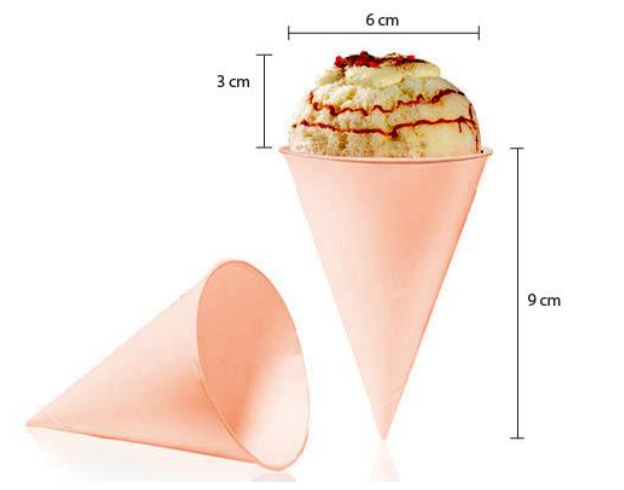
Q.4. Shown below is an ice-cream cone completely filled with ice-cream. The top portion (visible ice-cream) is a perfect hemisphere. Find the total mass of the ice-cream in grams. (Density = 0.9 g/cm³, π = 3.14)
Answer: 127.17 grams
Explanation:
The ice-cream has two parts - a hemisphere on top and a cone below. We find the volume of each, add them, and multiply by the density to get the mass.
Given:
- Diameter of top = 6 cm, so radius (r) = 3 cm (same radius for both the hemisphere and the cone opening)
- Height of cone (h) = 9 cm
- Density = 0.9 g/cm³ | π = 3.14
Step 1: Volume of the hemisphere
V = (2/3) × π × r³
V = (2/3) × 3.14 × (3 × 3 × 3)
V = (2/3) × 3.14 × 27
V = 56.52 cm³
Step 2: Volume of the cone
V = (1/3) × π × r² × h
V = (1/3) × 3.14 × (3 × 3) × 9
V = (1/3) × 3.14 × 81
V = 84.78 cm³
Step 3: Total volume of ice-cream
Total volume = 56.52 + 84.78 = 141.3 cm³
Step 4: Total mass
Mass = Volume × Density
Mass = 141.3 × 0.9
Mass = 127.17 grams
Key insight: The "3 cm" marked on the left is the height of the hemisphere, which equals its radius - a useful check that confirms r = 3 cm for both shapes. Questions like this test whether you can break a composite object into standard solids, a recurring skill in CEED Part A mensuration/NAT questions.
Q.5. How many unique patterns are there in the image?
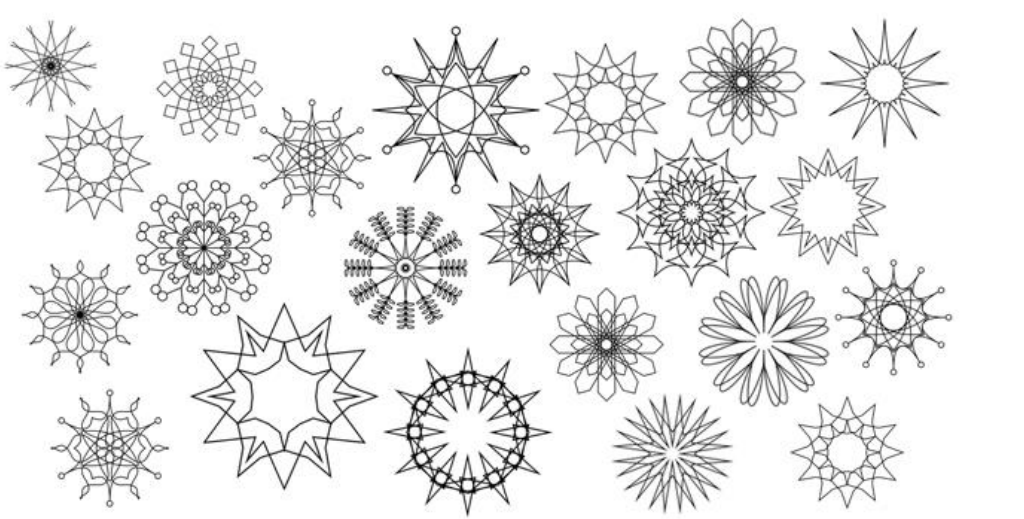
Answer: 21
Explanation:
This is an observation and visual-discrimination question - the kind of NAT/counting task CEED Part A uses to test how carefully you notice detail. There is no formula; the method is systematic comparison.
- Scan row by row, left to right, so you never lose your place or count the same figure twice.
- Compare each new pattern against the ones already counted - look at the number of arms/points, the centre motif, and the outer detailing.
- A pattern is "unique" only if no exact duplicate appears elsewhere in the grid. Two figures that merely look similar but differ in petal count, symmetry, or centre design are still two unique patterns.
- Counting this way, each of the 21 figures differs from the rest, giving 21 unique patterns.
Practice a CEED mock test to simulate the actual exam environment and build stamina.
Q.6. Which of the following Indian Designers is best known for textile revival and handloom promotion?
A. Ritu Kumar
B. Manish Malhotra
C. Sabayasachi Mukherjee
D. tarun Tahiliani
Ans: Ritu Kumar
Explanation: Ritu Kumar started in the late 1960s. She revived dying crafts through the Banaras Revival Project, elevating traditional Indian textiles to a contemporary global level of fashion.
Q.7. Which of the following design movements emphasised "form follows function"?
A. Bauhaus
B. Art Nouveau
C. De Stijl
D. Postmodernism
Ans: Bauhaus Movement.
Explanation: Bauhaus is an influential German art school from the early 20th century. The principle states that the shape of design should be based on its intended purpose, leading to minimalist aesthetics, clean lines, and practical applications in fields like architecture, product design, and graphic design.
Q.8. A watch shows the time as 6:15. The angle between the hour hand and the minute hand is:
A. 82.5 degree
B. 90 degree
C. 97.5 degree
D. 105 degree
Answer: 97.5 degree.
Explanation:
First calculate the angle of the minute hand:
The minute hand completes a full circle (360 degrees) in 60 minutes.
Therefore, its speed is 360/60 = 6 degrees per minute.
At 6:15, the minute hand is at the 15 minute mark, so its angle from 12 is calculated as 15 minutes × times 6 degrees per minute=90 degrees.
Now let’s calculate the angle of the hour hand:
The hour hand completes a full circle (360 degrees) in 12 hours. Therefore, its speed is 360 degrees/12 hours= 30 degrees per hour.
Additionally, it moves as the minutes pass, at a rate of 30 degrees/60 minutes = 0.5 degrees per minute.
At 6:15, the hour hand's angle is calculated based on the hour and the minutes: 6 hours *30 degrees per hour+(15minutes*0.5 degrees/minute)=180 degree+7.5 degree=187.5 degree.
Then determine the angle between the hands: The absolute difference between the angles of the hour and minute hands is calculated as:
187.5 degree - 90 degree=97.5 degrees
Final Answer: The angle between the hour and minute hand at 6:15, is 97.5 degrees.
Check: CEED preparation books
Q.9. Who is regarded as the father of Industrial Design?
A. Charles Eames
B. Raymond Loewy
C. Walter Gropius
D. Le Corbusier
Ans: Raymond Loewy
Explanation: Loewy's design philosophy, often summarized as "MAYA" (Most Advanced, Yet Acceptable), emphasized creating products that were innovative and functional while still being appealing and relatable to consumers. His design work included everything from household appliances and automobiles to corporate identities and spacecraft.
Q.10. A storybook is being illustrated that revolves around Maya, an adventurous young girl who loves to explore her surroundings. When she leaves home, Maya looks neat and tidy, wearing a hat and carrying her sketchbook. However, by the time she returns, her appearance reflects her love for adventure - muddy shoes, scrapes on her knees, and a big smile.
Create separate illustrations of Maya in the following two scenarios:
1. Maya climbs a tree to rescue a bird's nest while her sketchbook and hat lie on the ground. (10 marks)
2. Maya splashing through a puddle during a rainy afternoon, holding a paper boat in her hand. (10 marks)
You will be evaluated for:
1. Creativity and attention to detail in the illustrations.
2. The ability to convey the story through expressions and body language. 3. Composition and artistic style.

Q.11. Shown below is a picture of a playground in a community park. In the space provided in the answer booklet:
1. List down ten potential problems related to safety hazards that could pose a risk to children playing in the park. (5 marks)
2. Identify three problems you consider to be the most critical and clearly illustrate them with diagrams. You will be evaluated on: 1. The variety and depth of your observations. 2. Your ability to analyze and prioritize issues.
3. The clarity and creativity of your illustrations.

Model Answer:
Part 1 - Ten Potential Safety Hazards (5 marks)
- Large eroded pit/trench in the play area - children can fall in or get trapped.
- Exposed tree roots and loose rocks in the pit - tripping and injury risk.
- Unfenced drop/edge between the flat play zone and the pit - no barrier to stop a fall.
- Loose, detached ladder lying in the pit - unstable, sharp-edged, not fixed to any structure.
- Discarded metal grille/mesh on the ground - sharp edges and a trip hazard.
- Swings with no soft/impact surface beneath - hard ground increases fall injuries.
- Rusting or worn metal frames on swings and climbers - pinch points and tetanus risk.
- Slide ending directly onto bare, uneven soil - no safe run-off landing.
- Uncovered/overflowing waste bin near the path - hygiene hazard and sharp litter.
- No shade, seating boundary, or clear supervision zone - children spread out with limited adult sightlines to the pit.
(Other valid observations: proximity to the road/parked cars, no soft fencing around equipment, mixed age groups in one unzoned area.)
Part 2 - Three Most Critical Problems + Illustration Briefs
Prioritize by severity × likelihood - hazards that can cause serious injury and that children are most exposed to come first.
| Priority | Critical Hazard | Why It's Critical | What to Draw (Illustration Brief) |
|---|---|---|---|
| 1 | Open eroded pit with unfenced edge | High fall risk with serious injury potential; children are already inside it in the image. | Side-view (section) sketch of the pit showing the sharp drop, a child figure near the edge, and a labelled arrow: "no barrier." Add a small "before/after" inset showing a proposed low fence or filled/levelled ground. |
| 2 | Loose ladder & sharp metal grille in the pit | Unstable, sharp, and unsecured - direct cut and crush injury risk during play. | Close-up sketch of the loose ladder and grille with hazard call-outs (jagged edges, unfixed base). Show a "safe fix" version: items removed or the ladder bolted to a frame. |
| 3 | No impact-absorbing surface under swings/slide | Falls from equipment onto hard soil are the most common playground injury cause. | Elevation sketch of a swing/slide with the ground labelled "hard soil," then a solution inset showing rubber matting or sand under the equipment. |
Check: CEED Eligibility Criteria
Other Subject-wise Creative Edge CEED Study Material for 2027 Preparation
|
FREE CEED Study Material Name |
Link |
|
CEED Study Material for Drawing |
|
|
CEED Study Material for Creativity |
|
|
CEED Study Material for Form Sensitivity |
|
|
CEED Study Material for Visual Sensitivity |
|
|
CEED Study Material for Problem Solving |
|
|
CEED Study Material for Logical Reasoning |
|
|
CEED Study Material for Language and Creativity |
|
|
CEED Study Material for Aptitude |
|
Alongside consistent practice, check the expected CEED cut off to set a realistic target score for your preparation.
Tips To Solve CEED Sample Paper for 2027 Preparation
- Familiarize yourself with the CEED exam paper pattern and question types.
- Practice solving questions within the allotted time to improve time management skills.
- Analyze your performance after each sample paper to identify areas that need improvement.
- Review the solutions provided to understand the correct approach.
- Solve a mix of model CEED sample paper, solved CEED sample question papers with solutions pdf.
- Practice regularly to build confidence and improve problem-solving skills.
- Pay attention to design principles, drawing skills, visualization, and creativity.
- Practice sketching and rendering techniques to enhance your visual communication skills.
- Brush up on general knowledge, current affairs, and design history.
- Get & practice CEED sample paper pdfs and keep a track of latest design trends and technologies.
- Review and revise important concepts and formulas regularly.
- Seek guidance from experienced mentors or join a coaching institute for additional support.
- Stay calm and composed during the exam, and manage your time effectively.
- Practice CEED mock test pdf to simulate the actual exam environment.
- Stay positive and believe in your abilities.
Conclusion
If you're preparing for the CEED 2027 exam, incorporating CEED sample paper PDFs with solutions into your study routine alongside a thorough review of the CEED syllabus is crucial for maximizing your chances of success.
By practicing with CEED sample question papers, you can identify your strengths and weaknesses, refine your time management skills, and gain confidence in your CEED exam sample paper preparation.
Once you're confident with your practice, explore the design career opportunities after CEED to see where your preparation can lead.
Preparing for CEED 2027? We can help you with exact strategic roadmap, study material and crucial feedback required to ace this exam.
Join best CEED Online Coaching by Creative Edge and get expert guidance on all CEED subjects.



Attempt a Free CEED Mock Test Now
Fill your details
Frequently Asked Questions
What are CEED sample papers?

How can CEED sample papers benefit my exam preparation?
Are there any CEED model question papers available for practice?
Can I find CEED solved question papers online?
Where can I download CEED sample papers with answers for free?
What is the format of the CEED sample papers?
Where can I find CEED sample papers for practice?
How should I use CEED sample papers effectively?
Vineeta Agrawal
Communications Executive
SHARE