
1723534562.png)

How Toppers Prepared for NID DAT (CAT-Focused): Study Plan, Strategy & Mock Tips
June 23, 2026
Quick Answer: NID DAT toppers prepared by starting with previous years’ questions (PYQs) to understand patterns, followed by daily practice of sketching and idea generation.
They focused heavily on CAT (~80% weightage) and used a mock test + feedback loop to improve speed, creativity, and answer quality consistently.
Key Highlights – How Toppers Prepared for NID DAT?
- NID DAT toppers follow a PYQs-first strategy to understand question patterns and evaluation style
- Toppers now focus heavily on CAT (Creative Ability Test), especially after recent pattern shifts where CAT has become even more dominant
- Toppers prioritize design thinking and idea generation over just drawing skills
- Daily practice includes sketching, observation, and concept-building exercises
- Mock tests + feedback loops are the biggest drivers of improvement
- Toppers continuously analyze mistakes and refine their answers
- NID DAT preparation is system-driven, not random practice
- A realistic preparation timeline is 9-12 months with consistent daily effort
Table of Contents
- What do NID Toppers do Differently in their Preparation?
- What Makes NID DAT Different from Other Design Exams?
- Step-by-step Strategy of NID DAT Toppers
- Full List of NID DAT Toppers from Creative Edge
- Weekly Study Plan of NID Toppers
- How Toppers Manage NID Prep with School / Boards?
- What Did NID Toppers Actually Study?
- What is a Good Score in NID DAT?
- Can You Follow Topper Strategy Without Coaching?
- How Creative Edge Can Help You Follow Topper Strategy?
What do NID Toppers do Differently in their Preparation?
NID toppers don’t prepare more, they prepare differently. That’s the biggest difference most students miss.
Many aspirants spend hours:
- Doing random drawing practice
- Copying sketches
- Filling pages without direction
But still don’t see improvement.
Why?
Because NID is not testing how much you draw, it’s testing how you think, interpret, and communicate ideas.
NID toppers, on the other hand:
- Focus on idea generation, not just drawing
- Practice with purpose and feedback
- Continuously analyze and improve their approach
That’s what makes their preparation different and effective.
In this guide, we’ll break down:
Exactly how NID toppers at CreativeEdge prepared - and how you can follow the same strategy step-by-step.
Check: NID 2026 Toppers List
What Makes NID DAT Different (Context Before Strategy)
Before you try to follow topper strategies, you need to understand one thing clearly:
NID DAT is not a typical exam, it’s creativity + thinking + interpretation.
NID DAT Reality Check:
|
Aspect |
NID Reality |
|
Exam Structure |
Strongly CAT-focused (in 2026 Prelims, the paper was entirely CAT). While basic GAT awareness helps, 80-90% focus should be on CAT |
|
Pattern Nature |
Highly unpredictable - question types, formats, and themes can change every year |
|
What It Rewards |
Idea > Drawing - concept, logic, and originality matter more than perfect sketching |
|
Evaluation Style |
Subjective evaluation - answers are judged on creativity, clarity, and thinking, not fixed correctness |
Refer: Design Thinking Awareness Questions and Answers PDF
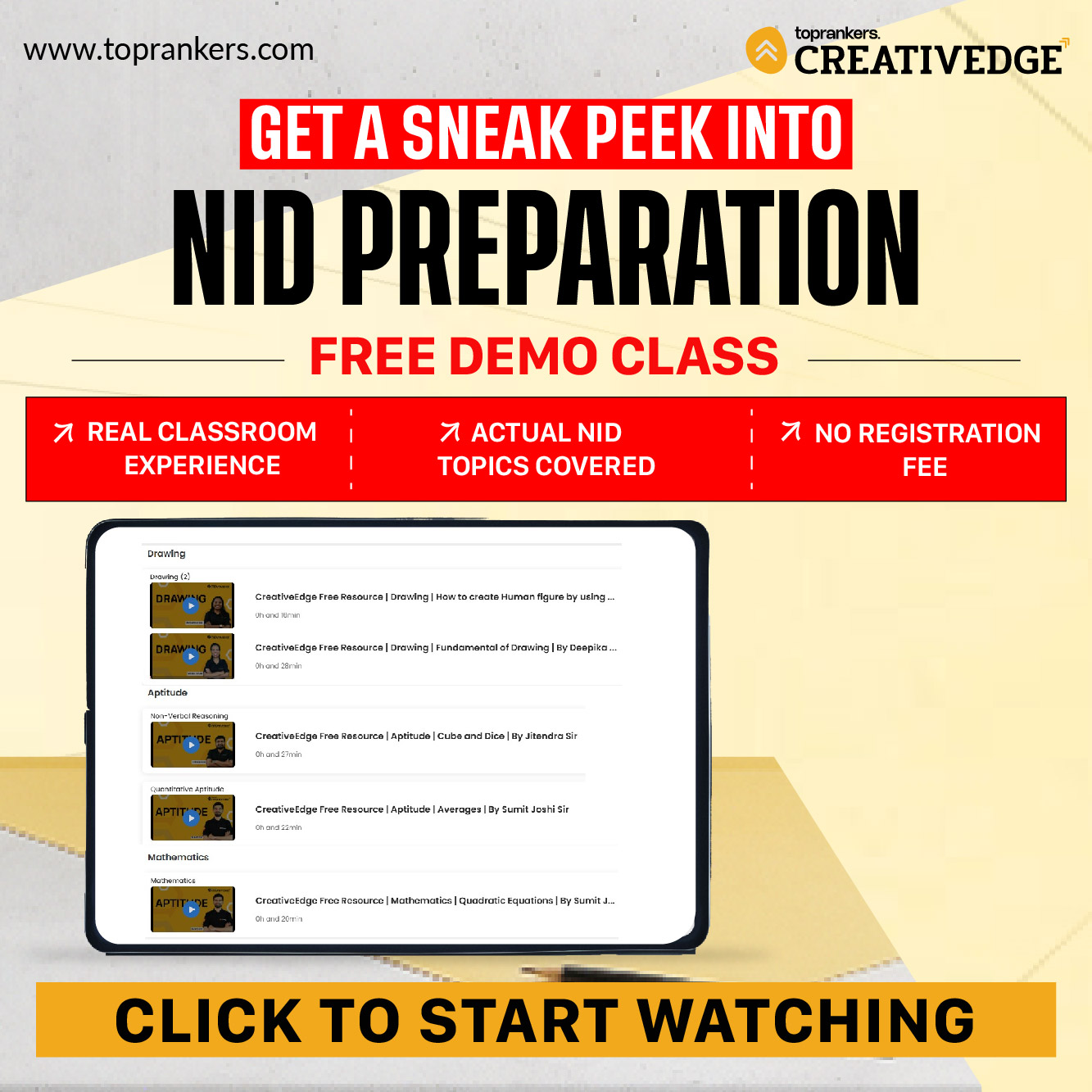
Use CreativEdge NID Free Resources for Effective Preparation
|
FREE NID Study Material Name |
Link |
|
NID Study Material for Drawing |
|
|
NID Study Material for Drawing |
|
|
NID Study Material for Quantitative Aptitude |
|
|
NID Study Material for Verbal Reasoning |
|
|
NID Study Material for Non-verbal Reasoning |
|
|
NID Study Material for Verbal Ability |
|
|
NID Study Material for General Awareness |
|


How Toppers Prepared for NID DAT? - Step-by-Step Strategy
What toppers do differently is not just more practice, it’s smarter, system-driven practice with feedback loops and thinking frameworks.
Here’s the exact step-by-step strategy, including insider-level insights most students miss:
NID Topper Strategy Breakdown:
|
Step |
What Toppers Do |
What Most Students Do |
Expert Insight (What Actually Makes the Difference) |
|
1. Start with PYQs |
Reverse-engineer past questions to understand evaluation |
Jump into random drawing practice |
Toppers don’t just solve NID previous year questions, they study why answers score |
|
2. Decode Question Intent |
Break questions into: problem, user, context |
Focus only on “what to draw” |
Every NID question has a hidden intent (problem-solving layer) |
|
3. Build Idea Frameworks |
Use repeatable frameworks (user + function + creativity) |
Depend on inspiration |
Toppers don’t wait for ideas, they generate ideas systematically |
|
4. Practice Idea First, Drawing Later |
Spend 30-40% time thinking before drawing |
Start drawing immediately |
Strong answers come from clarity before execution |
|
5. Train Observation Actively |
Observe real-life objects, spaces, interactions daily |
Practice only on paper |
Observation improves authenticity and originality in answers |
|
6. Time-Box Every Practice |
Practice under strict time limits from early stage |
Practice without timing |
NID is a performance exam, not a practice exam |
|
7. Use Mock Tests as Learning Tools |
Treat mocks as experiments + analysis sessions |
Treat mocks as tests only |
Toppers improve after mocks, not during mocks |
|
8. Build a Feedback Loop |
Get answers reviewed + reattempt weak questions |
Ignore feedback or just read it |
Improvement happens when you rework answers, not just review them |
|
9. Create “Answer Structures” |
Follow structured answers (clear idea → layout → execution) |
Random, unstructured answers |
Evaluators prefer clear, structured communication |
|
10. Practice Unpredictability |
Attempt unfamiliar, abstract prompts regularly |
Stick to comfortable topics |
NID rewards adaptability, not memorization |
|
11. Focus on Clarity Over Perfection |
Prioritize idea clarity over neat drawing |
Over-focus on shading/perfection |
A clear idea beats a beautiful but weak concept |
|
12. Refine Strategy, Not Just Skills |
Track improvement areas weekly |
Keep practicing same way |
Toppers continuously optimize their approach, not just output |
Check: NID DAT 2027 Syllabus
NID DAT Toppers from Creative Edge (2026, 2025 & Previous Years)
|
NID DAT 2026 Toppers List (FINAL) |
|||
|
All India Rank |
Candidate Name |
Programme (B.Des/M.Des) |
NID Topper Marks 2026 |
|
AIR 1 |
Ayush |
M.Des - Textile Design & Apparel Design |
51.50 out of 100 in DAT Mains |
|
AIR 2 |
Vikash |
M.Des - Animation Film Design |
57.10 out of 100 in DAT Mains |
|
AIR 3 |
Rutuja |
M.Des - Strategic Design Management |
49.70 out of 100 in DAT Mains |
|
AIR 1 |
TBA |
B.Des |
TBA |
|
AIR 2 |
TBA |
B.Des |
TBA |
|
AIR 3 |
TBA |
B.Des |
TBA |
|
NID DAT 2025 Toppers |
|||
|
Rank (AIR) |
Name |
Program |
Campus |
|
AIR 5 |
Ananya Dey |
PG |
NID Ahmedabad |
|
AIR 6 |
Priyal Soni |
PG |
NID Ahmedabad |
|
AIR 20 |
Aditi Shukla |
UG |
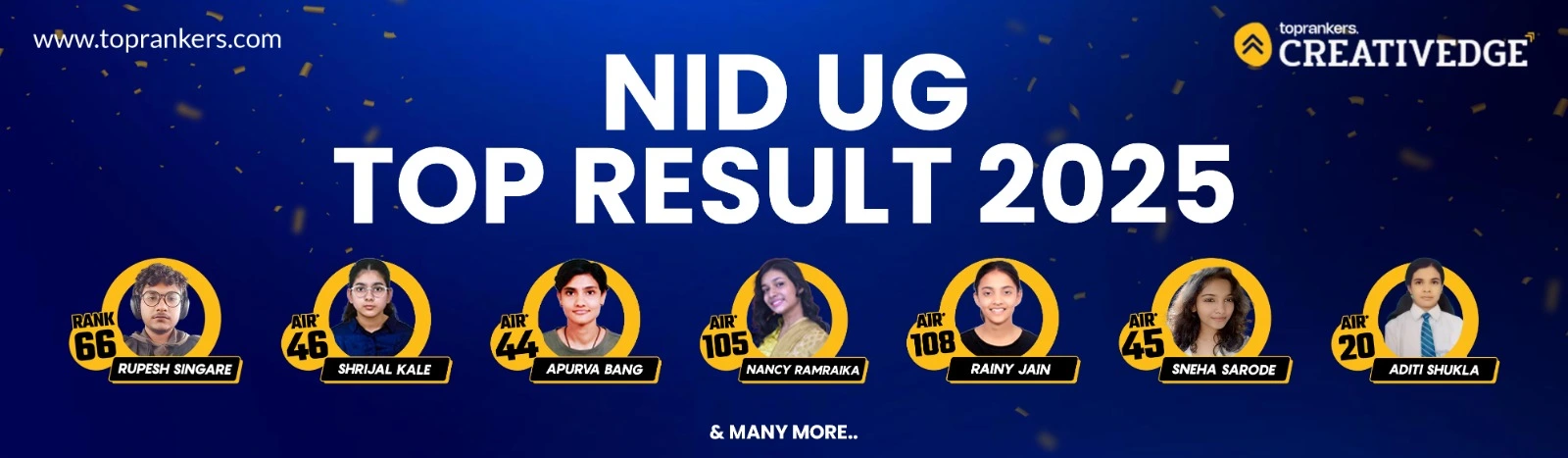
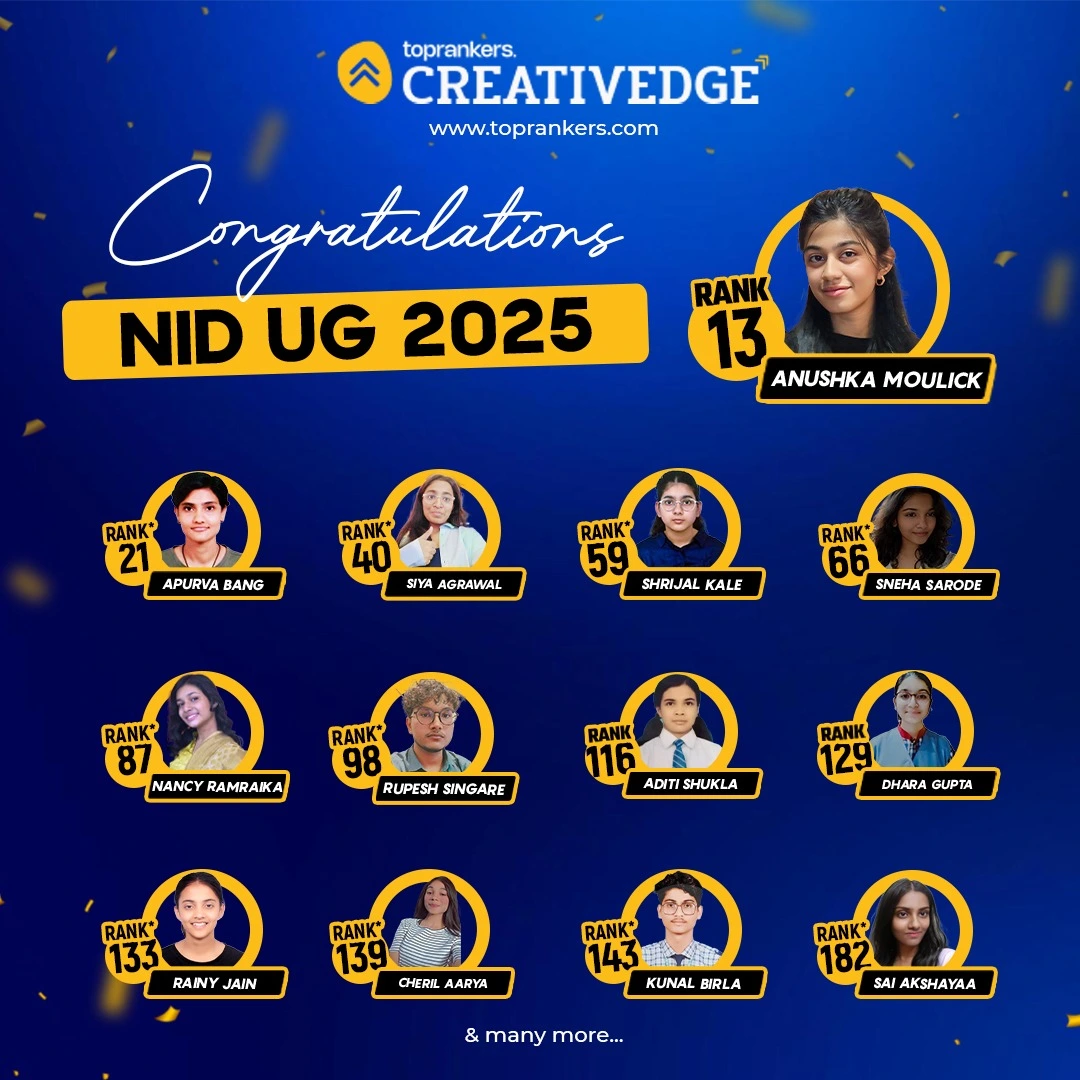
NID Ahmedabad |
|
AIR 46 |
Shrijal Kale |
UG |
NID Ahmedabad |
Other top selections:
- Sneha Sarode - NID Kurukshetra
- Navya Bhaskar - NID Bhopal
- Monisha Joshi - NID Jorhat
- Siddhi Kulkarni - NID PG
These results show strong presence in top AIR ranks + NID Ahmedabad selections.
Previous Years’ NID Achievers (Creative Edge)
From past achiever lists:
NID Ahmedabad Selections
- Ayushmaan Panika
- Aryanshi Singh
- Asmi Aginotri
- Ayush Rasal
- Shruti Verma
- Abhijeet Rana
- Anokhi Shah
- Divyanshi Khedakar
- Ajay Sapkale
- Aryan Gupta
Other NID Campuses
- Khushi Suryawanshi - NID Vijayawada
- Angel Topno - NID Gandhinagar
- Naitik Gupta - NID Bhopal
Check: Creative Edge Results 2026 - NID, NIFT, UCEED Toppers

What Weekly Study Plan do NID DAT Toppers Follow?
Toppers don’t follow a ‘long hours’ routine, they follow a high-quality, structured NID study plan that balances thinking, practice, and improvement.
Here’s what a realistic topper routine looks like:
NID Topper Weekly Plan:
|
Day |
Focus Area |
What to Do |
Why It Matters |
|
Monday |
PYQs + CAT Practice |
Solve 1-2 previous year questions (timed) |
Builds exam understanding from real questions |
|
Tuesday |
Skill Building |
Perspective / composition / storytelling practice |
Strengthens core fundamentals |
|
Wednesday |
CAT Practice Questions + Idea Training |
Solve new questions + idea exercises |
Improves creativity + thinking speed |
|
Thursday |
GAT (Light Prep) + Revision |
GK, reasoning, basic aptitude (1 hr) + revise weak areas |
Keeps GAT covered without over-investing time |
|
Friday |
Mixed Practice |
Solve 2 timed questions (different types) |
Builds adaptability for unpredictable paper |
|
Saturday |
Full-Length Mock Test |
Attempt full paper in exam conditions |
Builds stamina + real exam experience |
|
Sunday |
Mock Analysis + Reattempt |
Deeply analyze + redo weak answers |
This is where maximum improvement happens |
Refer: Highly recommended books for the NID exam
How Toppers Manage NID Prep with School & Boards?
This is what makes topper strategy practical:
|
Situation |
What Toppers Do |
|
During School Days |
2-3 hrs focused practice |
|
During Exams/Boards Prep |
Reduce NID load but stay consistent (60 to 120 mins/day) |
|
After Boards |
Increase NID mocks + full-length practice |
|
Near Exam |
Focus on speed, clarity, and revision |
What Did NID Toppers Actually Study?
This is where most students go wrong.
They try to ‘cover everything’ - while NID toppers focus on high-impact areas that directly improve their answers.
NID is not syllabus-heavy, it’s skill-heavy.
High-Weightage Topics for NID DAT (Based on Topper Prep)
|
Topic |
What It Includes |
Why It Matters |
Topper Insight |
|
Design Thinking & Problem Solving |
User-based solutions, functional ideas, innovation |
Core of most NID questions |
Toppers always think: “What problem am I solving?” |
|
Observation Skills |
Drawing from real life, detailing, memory-based sketching |
Makes answers realistic and original |
Observation > imagination alone |
|
Storytelling & Visualization |
Comic strips, sequences, situation-based questions |
Tests idea flow and clarity |
Strong stories = higher scores |
|
1-point, 2-point perspective, depth |
Improves spatial understanding |
Used subtly in most answers |
|
|
Composition & Layout |
Placement, balance, visual hierarchy |
Makes answers easy to understand |
Clean layout = better evaluation |
|
Human Figures & Proportion |
Basic anatomy, gestures, actions |
Helps in most real-life scenarios |
Not perfection, just clarity |
|
Creative Thinking Exercises |
Alternative uses, problem-solving prompts |
Boosts idea generation speed |
Trains brain for unpredictable questions |
|
Material & Situation Awareness |
Understanding objects, environments, usability |
Useful for studio test + CAT |
Practical thinking scores higher |
|
General Awareness (Basic) |
Design awareness, environment, society |
Helps in contextual answers |
Not heavy focus, but useful |
What is a Good Score in NID DAT?
There is no fixed 'cutoff score' in NID DAT, because the exam is subjective and rank-based. But based on past trends and selections, you can estimate what counts as a good score.
|
Category |
Expected Prelims Cut Off (Out of 100) |
Expected Shortlisting Range (for Mains) |
Remarks |
|
General |
50-60 |
Top 1.5× total seats |
Slightly lower than 2025 due to sudden change in NID exam pattern |
|
EWS |
53-58 |
Top 1.5× seats |
Will depend on total applications received |
|
OBC-NCL |
48-56 |
Top 1.5× seats |
Lower than 2025 due to lower overall cutoff expectations |
|
SC |
35-45 |
Top 1.5× seats |
Lower than 2025 due to lower overall cutoff expectations |
|
ST |
30-40 |
Top 1.5× seats |
Likely to remain close to 2025 trends |
|
PwD |
30-40 |
Top 1.5× seats |
Minor increase expected (Will also depend on number of applicants) |
Check: Detailed NID Cut Off Analysis
Can You Follow Topper Strategy Without Coaching?
You can follow topper strategies without coaching. But there’s a catch:
Toppers don’t just follow a plan, they follow a system of continuous improvement.
|
Requirement (What Toppers Do) |
Can You Do This Yourself? |
If Not, Coaching Helps |
|
PYQs-first approach |
Yes, if you analyze patterns deeply |
Coaching explains evaluation faster |
|
Idea generation frameworks |
Possible, but takes time to develop |
Structured guidance accelerates this |
|
Daily CAT practice (with purpose) |
Yes, if disciplined |
Coaching enforces consistency |
|
Mock test system |
Hard to build independently |
Ready-made mock ecosystem |
|
Feedback on answers |
Difficult to get quality feedback |
Expert review improves answers faster |
|
Mistake analysis + improvement |
Possible but often inconsistent |
Coaching ensures structured tracking |
|
Adaptability training (unpredictable questions) |
Needs exposure to variety |
Coaching provides curated practice |
Also Read: NID Tips to Improve Drawing Questions
How Creative Edge Can Help You Follow Topper Strategy?
By now, one thing is clear:
NID toppers don’t rely on talent. They rely on a system - PYQs → practice → mocks → feedback → improvement.
The challenge is not knowing this system…It’s actually following it consistently.
Where Most Students Struggle
Even after understanding topper strategies, students often:
- Practice without direction
- Don’t know how their answers are evaluated
- Skip mock analysis
- Don’t get quality feedback
- Stay inconsistent
That’s where a structured ecosystem makes a difference:
|
Strategy |
How Creative Edge Supports It |
|
PYQs-first approach |
Structured practice based on actual NID question patterns |
|
Idea generation & design thinking |
Guided frameworks to build concepts, not just drawings |
|
Daily practice with direction |
Planned assignments instead of random practice |
|
Mock tests |
Full-length mocks designed close to actual NID pattern |
|
Deep analysis |
Detailed performance breakdown after each mock |
|
Feedback loop |
Expert evaluation of answers with actionable improvements |
|
Consistency |
Structured schedule + mentorship keeps you on track |
|
Adaptability training |
Exposure to varied and unpredictable question types |
Must Read: Is Creative Edge Good for NID? - Courses, Results & More
Final Answer - How Toppers Prepared for NID DAT?
Not through random study and practice, but through:
- Focus on idea quality, not just drawing
- Improvement through mock analysis, not just more number of mocks
- Development of designer mindset
- A systematic plan that keeps them consistent
Are you preparing for NID 2027? We can help you with exact strategic roadmap, study material and crucial feedback required to ace this exam.
Join CreativEdge, India’s leading NID online coaching and get expert guidance on all NID subjects.
You can enroll in offline NID batches at your nearest centres also!




Vineeta Agrawal
Communications Executive
SHARE