
1723534562.png)

CLAT Syllabus 2027 (Updated): Section-Wise Topics, Weightage & Preparation Strategy
April 24, 2026
Reader's Digest: If you don’t understand the CLAT syllabus, you’re not preparing—you’re guessing. Every year, thousands of aspirants start CLAT prep by picking books.
But toppers start differently. They first understand the CLAT syllabus deeply, because that’s what decides:
- What to study
- What to skip
- And how to score in the 95+ percentile
This is your complete, updated guide to the CLAT syllabus 2027, broken down in the simplest way possible.
Check Out - CLAT 2026 Exam Analysis Live Updates By Legaledge Experts
Key Takeaways
- CLAT is skill-based, not memory-based – The CLAT 2027 syllabus focuses heavily on comprehension, reasoning, and application rather than rote learning.
- Three sections dominate the paper – Current Affairs, Legal Reasoning, and Logical Reasoning together make up nearly 70% of the exam, making them your top priority.
- Passage-based questions are everywhere – Almost every section is built around long passages, so reading speed and understanding are critical skills.
- Math is limited but important – Quantitative Techniques carry only 10% weightage, but strong basics (Class 10 level) can help you score easy marks.
- Knowing the syllabus = smarter preparation – A clear understanding of the CLAT 2027 syllabus helps you focus on high-impact areas, manage time better, and improve mock test performance.
CLAT Syllabus 2027 Overview
What is the CLAT Syllabus?
The Common Law Admission Test (CLAT) is a national-level entrance examination for admissions to undergraduate (UG) and postgraduate (PG) law programmes offered by 27 National Law Universities in India. Understanding the CLAT
syllabus is the first crucial step towards effective preparation. The exam assesses candidates on their aptitude for legal studies, English language proficiency, general knowledge, logical reasoning, and quantitative techniques.
CLAT Exam Pattern and Weightage
Before diving into the detailed syllabus, it's essential to understand the CLAT exam pattern and the weightage assigned to each section. This will help you strategize your preparation effectively.
The Quantitative Techniques section tests your ability to interpret numerical data, apply mathematical operations, and solve problems based on ratios, proportions, basic algebra, mensuration, and statistical estimation.
Decode: CLAT 2027 Eligibility Criteria
What are the Subjects in CLAT 2027 Syllabus [UG]
The CLAT syllabus 2027 covers five primary subjects:
- English Language: Focuses on comprehension and vocabulary.
- Current Affairs, including General Knowledge: Tests awareness of recent events and static GK.
- Legal Reasoning: Assesses the ability to apply legal principles to given scenarios.
- Logical Reasoning: Evaluates logical analysis and reasoning ability.
- Quantitative Techniques: Tests basic mathematical skills.
Read more: CLAT 2027 Time Management Tips
CLAT 2027 Subject-wise Weightage [UG]
The syllabus and CLAT Exam pattern ensure balanced weightage across all sections. Here’s the breakdown:
| Section | Number of Questions | Weightage |
| English Language | 22-26 questions | roughly 20% of the paper |
| Current Affairs, including General Knowledge | 28-32 questions | roughly 25% of the paper |
| Legal Reasoning | 28-32 questions | roughly 25% of the paper |
| Logical Reasoning | 22-26 questions | roughly 20% of the paper |
| Quantitative Techniques | 10-14 questions | roughly 10% of the paper |
This allocation suggests that the focus should be on comprehension-heavy and reasoning-based sections, which aggregate 70% of marks.
Explore: Which stream is Best for CLAT?
CLAT Syllabus 2027 [Section Wise Breakdown]
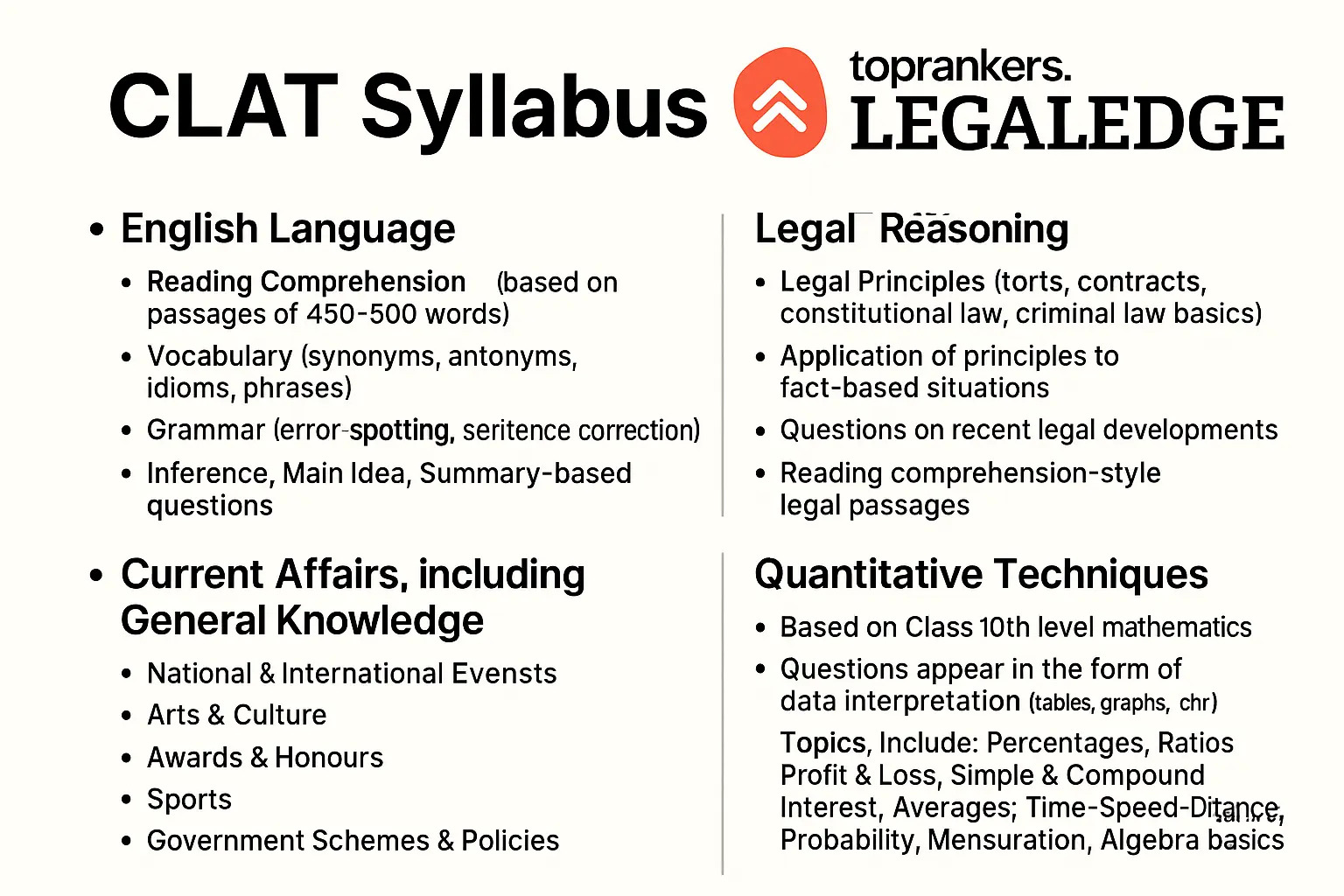
The following table gives an overview of the CLAT 2027 syllabus:
|
Section |
Topics Covered |
Skills Tested |
|---|---|---|
|
English Language |
Comprehension, Vocabulary, Grammar |
Reading, Interpretation, Language Proficiency |
|
Current Affairs, GK |
Recent Events, History, Polity, etc. |
Awareness, Retention of Facts |
|
Legal Reasoning |
Legal Principles, Scenarios |
Logical Thinking, Legal Acumen |
|
Logical Reasoning |
Puzzles, Critical Thinking |
Analytical and Reasoning Skills |
|
Quantitative Techniques |
Arithmetic, Data Interpretation |
Basic Mathematical Ability |
Download: CLAT 2027 Study Plan
The CLAT syllabus 2027 has five primary sections. It aims to test different skill sets in each of them. Each section consists of passages of 400-450 words each.
Below is a detailed CLAT exam syllabus breakdown to help you effectively strategise your preparation.
What is the CLAT English Syllabus 2027
The English section of the CLAT syllabus 2027 focuses on comprehension and language skills. It tests the candidate's ability to read, interpret, and analyse complex texts, as well as their command of grammar and vocabulary.
| Section | Details |
|---|---|
| Reading Comprehension | Passages of approximately 450+ words. |
| Questions based on: | |
| - The main idea of the passage. | |
| - Inference and conclusion. | |
| - Tone and attitude of the author. | |
| - Vocabulary in context. | |
| - Summary or paraphrasing. | |
| Vocabulary | Synonyms and Antonyms. |
| Usage of words in sentences. | |
| Fill-in-the-blanks and cloze tests. | |
| Grammar and Sentence Structure | Spotting errors. |
| Sentence correction and improvement. | |
| Sentence rearrangement and paragraph formation. | |
| Preparation Tips | Read newspapers and novels to enhance comprehension skills. |
| Use vocabulary-building apps and regularly practice grammar exercises. | |
| Try mock tests to work on reading speed and precision. |
Read Also - How to Prepare for CLAT 2027 English Section
What is the CLAT Current Affairs And General Knowledge Syllabus 2027
This section evaluates the candidate's awareness of current affairs and their knowledge of history and politics.
| Section | Subtopics / Details |
|---|---|
| Topics Covered | |
| Current Affairs | National and International Events |
| Important Government Schemes and Policies | |
| Awards and Honours | |
| Sports Events and Achievements | |
| Science and Technology Developments | |
| Summits and Agreements | |
| Static General Knowledge (Very Less Weightage but shouldn't be left entirely) | Indian History: Freedom Struggle, Important Leaders |
| Indian Polity: Constitution, Legislature, Executive, and Judiciary | |
| Geography: Physical and Political Geography of India and the World | |
| Economics: Basic Terminology, Budget, and Economic Policies | |
| Preparation Tips | Read newspapers like The Hindu or The Indian Express daily |
| Follow monthly current affairs magazines or compilations | |
| For static topics, refer to standard books like Lucent's General Knowledge |
Read more: How to prepare for Current Affairs for CLAT 2027?
What is the CLAT Legal Reasoning Syllabus 2027
The legal reasoning section is part of the CLAT syllabus 2027 that tests how a candidate can understand and apply legal principles in different situations.
| Section | Subtopics / Details |
|---|---|
| Principles of Law | Law of Contracts |
| Law of Torts | |
| Criminal Law | |
| Constitutional Law | |
| Application-Based Scenarios | Fact-situation questions where candidates must apply legal principles |
| Identifying the most logical solution or interpretation | |
| Legal Awareness and Current Issues | Recent judgments and amendments |
| Legal terms and maxims | |
| Preparation Tips | Study the basics of the Indian Constitution, landmark judgments and common legal principles |
| Practice solving case-based questions from previous CLAT papers | |
| Keep yourself updated with legal developments through online platforms |
Read more: How to prepare for CLAT legal reasoning 2027?
What is the CLAT Logical Reasoning Syllabus 2027
The CLAT Logical Reasoning Syllabus 2027 evaluates a candidate's ability to analyse arguments and solve logical puzzles critically. Critical reasoning is given significant weightage, but questions of analytical rationale can also be raised.
Topics Covered:
| Section | Subtopics / Details |
|---|---|
| Critical Reasoning | Identifying Arguments |
| Drawing Inferences and Conclusions | |
| Strengthening and Weakening Arguments | |
| Identifying Assumptions and Flaws | |
| Analytical Reasoning | Arrangements (Linear, Circular, and Matrix) |
| Puzzles and Logical Patterns | |
| Syllogisms | |
| Coding-Decoding | |
| Blood Relations | |
| Logical Sequences | Analogies |
| Series Completion | |
| Statement and Assumptions | |
| Preparation Tips | Solve reasoning questions from competitive exam books |
| Practice puzzles and critical reasoning exercises regularly | |
| Time yourself when working on mock tests to improve speed and accuracy |
You must diligently plan your CLAT 2027 Logical Reasoning Preparation.
What is the CLAT Quantitative Techniques 2027
The quantitative techniques section in the CLAT syllabus 2027 tests basic mathematical skills and numerical interpretation.
| Section | Subtopics / Details |
|---|---|
| Topics Covered | |
| Arithmetic | Percentages |
| Profit and Loss | |
| Simple and Compound Interest | |
| Time, Speed, and Distance | |
| Ratios and Proportions | |
| Averages | |
| Number System | |
| Data Interpretation | Bar Graphs |
| Line Graphs | |
| Pie Charts | |
| Tables | |
| Data Sufficiency | |
| Preparation Tips | Revise concepts from Class 10 Mathematics |
| Practice solving problems at a fast pace while being accurate | |
| Attempt data interpretation sets regularly to familiarise yourself with graphs and tables |
Read More: Quantitative Technique Study Plan for CLAT
What CLAT Syllabus 2027 Does NOT Include
This is where most students go wrong.
- No heavy legal theory: The CLAT syllabus 2027 focuses on application-based understanding rather than theoretical law, ensuring students analyse passages instead of memorising doctrinal concepts.
- No rote memorization: The CLAT 2027 syllabus prioritizes comprehension, reasoning, and interpretation, meaning cramming facts or definitions will not help candidates perform in exam situations.
- No direct GK questions: In the CLAT syllabus 2027, affairs are passage-based, testing reading comprehension and context analysis instead of factual recall or one-line answers.
- No advanced mathematics: Quantitative techniques basic, focusing on class 10 level concepts, so students need clarity, speed, and interpretation skills rather than mathematical problem solving.
CLAT is a skill-based exam, not a memory test.
How to Cover the CLAT 2027 Syllabus Smartly
Step-by-Step Plan:
- Understand syllabus deeply (you’re doing it right now): A deep understanding of the CLAT syllabus 2027 helps you focus only on relevant areas, avoid distractions, and build a strategy aligned with actual exam requirements.
- Build a reading habit (daily) Daily reading improves comprehension, speed, and vocabulary, which are essential across sections, making it a core skill for mastering the CLAT 2027 syllabus effectively.
- Start sectional practice: Sectional practice allows targeted improvement, helps identify weak areas early, and builds confidence gradually while ensuring complete coverage of the CLAT syllabus 2027 topics.
- Move to full-length mocks: Full-length mocks simulate real exam conditions, improve time management, and help integrate all sections together, aligning preparation closely with the CLAT 2027 syllabus demands.
- Analyze every test: Analyzing each test is crucial for improvement, as it highlights mistakes, refines strategy, and ensures continuous progress while covering the CLAT syllabus 2027 and CLAT 2027 syllabus thoroughly.
What Topper Strategy Looks Like
- 60% time → Practice + mocks: Spending 60% time on practice and mocks builds exam temperament, improves accuracy, and aligns preparation with the CLAT syllabus 2027 through real question exposure consistent.
- 30% time → Revision: Allocating 30% time to revision ensures retention, strengthens weak areas, and reinforces concepts regularly, which is essential for mastering the CLAT 2027 syllabus effectively overall.
- 10% time → Learning concepts: Using 10% time for learning concepts keeps focus on application, preventing overload while ensuring conceptual clarity that supports performance across the CLAT syllabus 2027 sections.
Not the other way around.
Start Your CLAT Preparation the Right Way
Understanding the syllabus is just step one.
Execution is everything. Execution determines success, as applying strategies daily, practising regularly, and staying consistent ensures that your preparation aligns effectively with the CLAT 2027 syllabus requirements.
If you want:
- Structured preparation: Structured preparation organizes your study plan, reduces confusion, ensures balanced coverage of all sections, and helps you systematically complete the CLAT syllabus 2027 without feeling overwhelmed.
- Expert mentorship: Expert mentorship provides clarity, guidance, and feedback, helping you avoid mistakes, refine strategies, and prepare smarter in alignment with the CLAT 2027 syllabus expectations.
- Real exam-level mock tests: Real exam-level mock tests simulate pressure, improve accuracy, and build confidence, ensuring you are fully prepared to handle the CLAT syllabus 2027 and CLAT 2027 syllabus in actual conditions.
Then start with a guided CLAT preparation program.
Additional Points in CLAT Syllabus 2027 [UG]
The CLAT 2027 syllabus focuses on passage-based questions in all sections, meaning the candidates must improve their reading speed and comprehension skills. Regular practice of mock tests, previous year papers, and section-wise quizzes will help aspirants stay ahead in their preparation.
Explore Law Entrance Exams other than CLAT
| CLAT Syllabus | CLAT Exam Pattern | CLAT English Syllabus |
| CLAT Mathematics Syllabus | CLAT OMR Sheet | CLAT Subjects |
Why Knowing the CLAT Syllabus 2027 Matters
- It’s your game plan – Think of the CLAT 2027 syllabus as your playbook. If you don’t know the rules of the game, how can you expect to win? The syllabus tells you exactly what’s in and what’s out.
- No more guesswork – Instead of randomly studying everything under the sun, you can focus on topics that actually appear in the exam. For example, maths is only up to Class 10 level – so you can ditch calculus stress!
- Smart time management – Once you know the CLAT syllabus, you can create a study plan that gives more time to tricky areas and less to topics you’re already good at.
- Better mock test performance – When you know what’s coming, your practice tests become sharper and more targeted. You start spotting patterns in questions.
- Boosts confidence – Walking into the exam knowing you’ve covered every topic in the CLAT syllabus 2027 feels way better than hoping for the best.
- Gives you an edge – In a competitive exam like CLAT, even one extra mark can change your rank. The syllabus helps you grab those extra marks by staying focused.
Learn More: How to prepare for CLAT 2027?
Common Changes in the CLAT Syllabus 2027 Over the Years
- Shift to comprehension-based questions – A few years back, CLAT was more about direct questions. Now, the CLAT 2027 syllabus focuses heavily on passages in English, Legal Reasoning, and Current Affairs, testing your ability to read, understand, and analyse.
- Current affairs got smarter – Instead of static GK, the syllabus now emphasises contemporary events, often linked with legal or social issues. This means reading quality newspapers is more important than cramming facts.
- Legal reasoning without legal knowledge – The CLAT syllabus shifted from expecting legal theory memorization to testing your reasoning skills through legal principles given in the question itself.
- More emphasis on critical reasoning – The section now includes more argument-based questions, reflecting the demand for sharper critical thinking.
- Concise, skill-based approach – The overall CLAT syllabus has moved towards testing skills over rote learning, rewarding candidates who can think quickly and apply concepts rather than memorize them.
CLAT PG Syllabus 2027
- The CLAT PG question paper has 120 objective-type questions, and each question will carry one mark.
- Like the UG pattern, this exam also has questions based on reading comprehension.
- Also, there shall be a negative mark of 0.25 for each wrongly answered question.
- The CLAT Exam syllabus for the PG program includes the UG program's mandatory subjects and the subjects given below.
Check out the detailed CLAT PG Syllabus from the table below:
| Constitutional Law | Jurisprudence | Administrative Law |
| Law of Contract | Torts | Family Law |
| Criminal Law | Property Law | Company Law |
| Public International Law | Tax Law | Environmental Law |
| Labour & Industrial Law | ||
The exam conducting body will provide you with extracts from primary legal materials, such as essential court decisions in various fields of law, statutes, or regulations, followed by a series of objective-type questions, which will require you to demonstrate the following CLAT syllabus 2027:
- The ability to read and comprehend the issues discussed in the passage.
- Any arguments and viewpoints discussed or set out in the passage.
- Awareness of the issues addressed in the passage.
- Legal issues and facts are related to and arise from the passage, the judgment, or the statute.
- Summarise the passage and your ability to apply your knowledge of the fields of law discussed in the passage.
Conclusion
The CLAT Syllabus 2027 may be a comprehensive and challenging curriculum designed to test the skills and aptitude of aspiring law students. You must stay updated with the latest changes and prepare diligently to succeed in CLAT.
Key takeaways from this blog are:
- To succeed in the exam, a thorough understanding of each section's topics is essential. Also, check the CLAT 2027 eligibility criteria.
- English Language and Current Affairs hold significant weightage; focus on comprehension and awareness is crucial.
- Legal Reasoning demands the practical application of legal principles in scenarios.
- Logical Reasoning tests critical thinking and analytical abilities.
- Quantitative Techniques necessitate proficiency in fundamental math concepts.
- For more details, visit the official website: https://consortiumofnlus.ac.in/
NLU Dream, Zero Cost Start: Free CLAT Demo
Fill your details
Frequently Asked Questions
What is CLAT Syllabus?

Who sets the CLAT syllabus?
Are there any changes in the CLAT 2026 Syllabus?
Is CLAT and AILET syllabus are same?
Is CLAT syllabus for UG and PG the same?
Is CLAT Syllabus changes every Year?
Is CLAT and LSAT exam syllabus are same?
How effective is CLAT Syllabus wise mock test ?
Is CLAT and SLAT syllabus are same?
Time Required to complete the CLAT Syllabus?
Which part of syllabus is very difficult for Candidates ?
What are the key sections in the CLAT 2026 syllabus for UG aspirants?
What topics are covered under the Legal Reasoning section in CLAT Syllabus?
What should candidates focus on for success in CLAT 2026 Syllabus?

Samriddhi Pandey
Content Writer
SHARE