
1723534562.png)

AILET Sample Papers 2027 PDF Download (Free) With Solutions
June 19, 2026
Overview: Solving AILET Sample Papers is one of the most effective ways to understand the real exam experience before you appear for AILET 2027. The right sample papers help you build speed, accuracy, section strategy, and confidence—especially for Legal Reasoning, which often becomes the deciding factor.
In this guide, you will learn what makes a good sample paper, how to use it properly, how to analyse your performance, and how many papers you should attempt at each stage of preparation.
| AILET Legal Reasoning Sample Question Paper | |
| AILET Critical Reasoning Sample Question Paper | |
| AILET Reading Comprehension Sample Question Paper | |
| AILET Logical Reasoning Sample Question Paper |
What Are AILET Sample Papers 2027 and Why They Matter
AILET Sample Papers are practice papers designed to simulate the latest AILET pattern, difficulty level, and question style. They differ from previous-year papers (PYQs) and full-length mocks in intent and structure. When used correctly, sample papers help you improve your attempt strategy, reduce negative marking, and develop a stable test temperament.
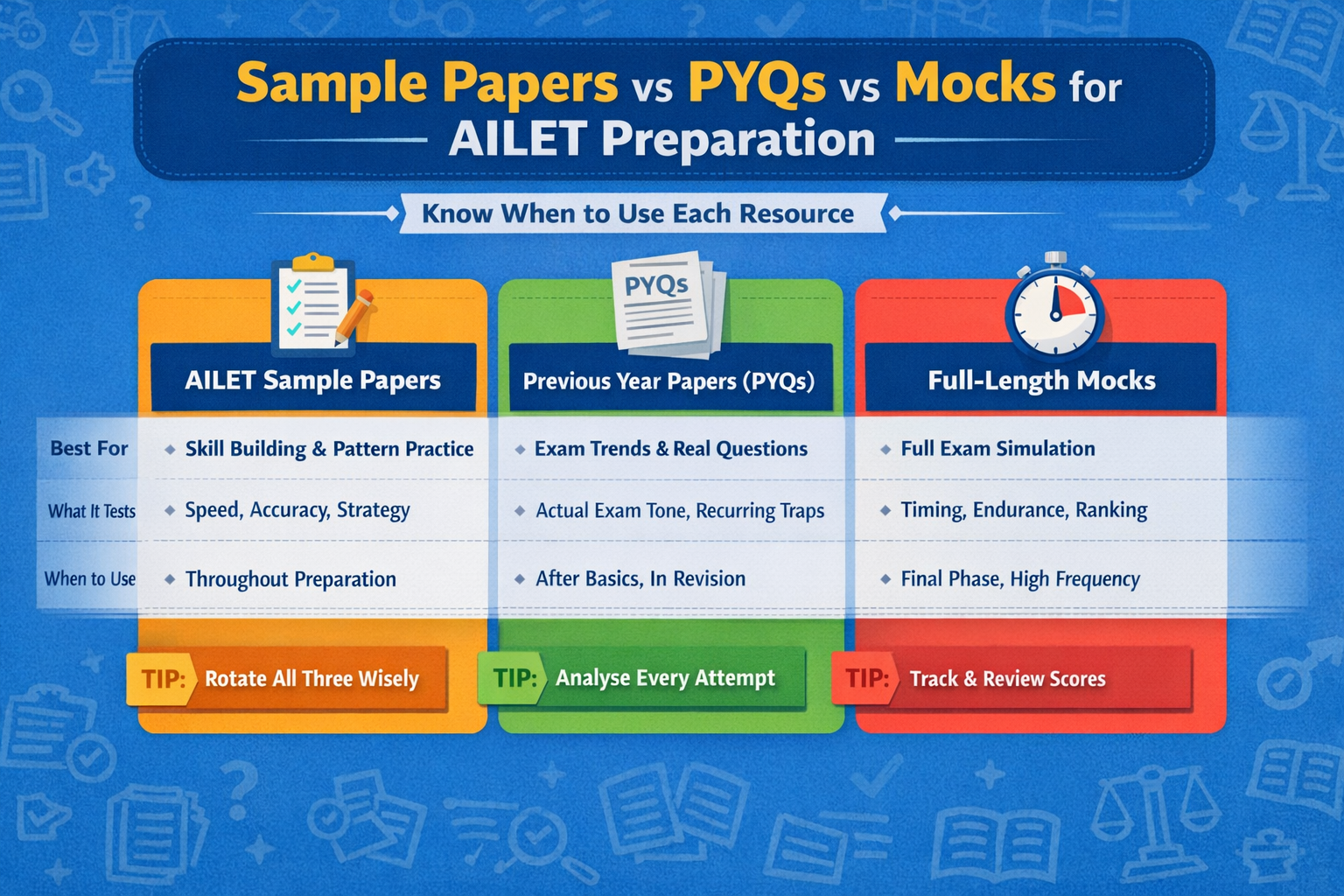
AILET Sample Papers vs AILET Previous Year Papers vs AILET Mocks
| Resource | Best For | What It Tests | When to Use |
|---|---|---|---|
| AILET Sample Papers | Pattern-based practice and skill building | Speed, accuracy, question selection, and section strategy | Throughout prep, ideal for structured practice cycles |
| Previous Year Papers (PYQs) | Understanding historical trends and actual exam framing | Real exam tone, recurring themes, typical traps | After the basics are clear, also in the revision phase |
| Full-Length Mocks | Exam simulation and rank benchmarking | End-to-end stamina, timing pressure, score consistency | Mid to final phase; increasing frequency near exam |
AILET Exam Pattern Snapshot
AILET preparation becomes easier when your practice resources match the exam structure. Before selecting AILET Sample Papers, ensure you know what the test expects and how the sections behave under time pressure.
| Section | What It Typically Tests | Practice Focus |
|---|---|---|
| English Language | Comprehension, vocabulary in context, and grammar application | Reading speed, inference accuracy, and option elimination |
| Current Affairs & GK | Static + current awareness, context-based facts | Recall + smart guessing control, revision routines |
| Logical Reasoning | Critical reasoning, arguments, assumptions, and sets | Pattern recognition, accuracy under time |
| Legal Reasoning | Principle–fact application, exceptions, inference traps | Rule application, identifying decisive facts, and avoiding overthinking |
What a Good AILET Sample Paper Should Include
- Pattern alignment: section distribution and question style should match the latest AILET expectations.
- Balanced difficulty: a mix of moderate and challenging questions (not overly easy).
- High-quality solutions: explanations should teach approach, not just provide answers.
- Answer key + rationale: especially important for Legal and Logical reasoning.
- Topic tagging: helps you identify weak areas quickly and revise systematically.
Red Flags to Avoid
- Outdated pattern or irrelevant question types
- Repeated questions across multiple papers
- Solutions without explanation or unclear logic
- Unrealistic difficulty (too easy or excessively random)
How Should You Use AILET Sample Papers Section-Wise?
Not all sections require the same preparation strategy. Here's how you can maximize your score using sample papers.
English Language
- Focus on reading comprehension passages.
- Improve vocabulary through context-based questions.
- Analyse incorrect answers carefully.
Logical Reasoning
- Practice long passages regularly.
- Learn to identify assumptions and conclusions quickly.
- Work on eliminating incorrect options.
Current Affairs & General Knowledge
- Maintain a monthly current affairs notebook.
- Solve GK-based sample tests weekly.
- Revise static GK alongside current affairs.
Topic-Wise Coverage Checklist
Use this checklist to evaluate whether your AILET Sample Papers cover the exam the way you need. If a paper consistently misses these areas, it is not helping your preparation.
| Section | Must-Have Topics | What You Should Track |
|---|---|---|
| English | RC inference, tone, central idea, vocab-in-context, error spotting | Accuracy in RC, time per passage, error types |
| GK & CA | Polity basics, economy basics, environment, awards, and international events | Revision hit-rate, guess accuracy, static vs current balance |
| Logical | Arguments, assumptions, conclusions, strengthening/weakening, sets | Time spent per set, elimination efficiency |
| Legal | Principle-fact, exceptions, inference, fact relevance, rule application | Rule application errors, over-inference, and negative marking triggers |
How to Use AILET Sample Papers the Right Way
Simply solving more AILET Sample Papers is not enough. Your improvement comes from the attempt + analysis + correction loop. Use these rules to make your practice productive.
- Attempt under real conditions: fixed time, no breaks, no looking up answers mid-test.
- Follow section timing rules: decide time limits per section and stick to them.
- Do not chase attempts blindly: a controlled attempt plan reduces negative marking.
- Analyse the same day: analysis delay reduces learning and repeats mistakes.
The 3-Step Attempt Framework
Step 1: Attempt (Real Test Conditions)
- Set a timer and attempt the paper exactly like exam day.
- Mark questions you were unsure about (even if you attempted them).
- Note time sinks (questions that took unusually long).
Step 2: Analyse (Error Buckets)
Classify every wrong/guessed answer into one bucket:
- Concept gap: You did not know the rule or method.
- Reading error: missed a keyword, exception, or condition.
- Silly mistake: calculation, mis-marking, wrong option bubbled.
- Time pressure: rushed decision-making caused wrong logic.
- Guesswork: attempted without enough certainty; negative marking risk.
Step 3: Improve (7-Day Micro Plan)
- Pick 2 weak topics from your error analysis and revise them.
- Re-attempt only the wrong questions after 48–72 hours.
- Do 1 sectional drill focused on your slowest section.
Performance Metrics That Actually Matter
Track your progress across AILET Sample Papers using measurable metrics. This avoids vague AILET preparation and shows you exactly what is improving.
| Metric | What It Means | Why It Matters |
|---|---|---|
| Accuracy % | Correct ÷ Attempted | Controls negative marking and stabilises the score |
| Attempt Rate | Attempted ÷ Total Questions | Shows speed and section prioritisation |
| Time per Section | Minutes spent in each section | Helps optimise your section strategy |
| Error Bucket Share | % of errors in each bucket | Shows whether your issue is concept, reading, or speed |
| Negative Mark Impact | Marks lost due to wrong attempts | Improves decision-making and attempts control |
Simple Performance Tracker (Copy-Paste Table)
| Paper # | Date | Score | Attempted | Accuracy % | Legal Notes (Top 1 Mistake) | Next Improvement Focus |
|---|---|---|---|---|---|---|
| 1 | ____ | ____ | ____ | ____ | ____ | ____ |
| 2 | ____ | ____ | ____ | ____ | ____ | ____ |
| 3 | ____ | ____ | ____ | ____ | ____ | ____ |
Strategy by Preparation Stage
Beginner Stage (Foundation Building)
- Start with easier AILET Sample Papers and topic-wise mini tests.
- Focus more on the correct methods than the score.
- Build reading discipline for English and Legal passages.
Intermediate Stage (Timed Practice + Skill Mixing)
- Attempt 1–2 full-length sample papers weekly.
- Track section timing and accuracy separately.
- Use error bucket analysis after every paper.
Advanced Stage (Final Phase)
- Increase full-length paper frequency and add mock test simulation.
- Practise tough Legal/Logical sets under strict timing.
- Revise your error log every week to prevent repeated mistakes.
Common Mistakes Students Make with AILET Sample Papers
- Quantity over quality: solving many papers without analysis gives little improvement.
- Ignoring Legal Reasoning structure: not reading the principle carefully causes avoidable errors.
- Over-attempting: trying to maximise attempts increases negative marking.
- No revision loop: mistakes are repeated because they are not documented and retested.
Conclusion and Next Steps
Solving AILET Sample Papers becomes truly effective when you treat them as a structured system: attempt under real conditions, analyse deeply, and correct your weak areas with a short improvement plan. Keep your tracker updated, reduce negative marking through smarter attempts, and focus on Legal Reasoning consistency. With disciplined practice and analysis, sample papers can become your fastest route to a confident AILET performance.
Official website: https://nationallawuniversitydelhi.in/
Frequently Asked Questions
How many AILET 2027 sample papers should I solve?

Are AILET sample papers better than previous year papers?
When should I start solving full-length sample papers?
How do I handle negative marking while attempting sample papers?

Admin
Subject Matter Expert


SHARE