
1723534562.png)

How to Improve Vocabulary for CAT Exam 2026: Tips & Strategies
July 7, 2026
Overview: If you are preparing for the CAT exam, you may have been stuck on "How to improve vocabulary for CAT exam." Having a good hold on the VARC section can improve your overall ranking in the CAT exam. Read on to know the expert tips and strategies here!
Key Takeaways
- The VARC section of the CAT exam comprises about 24 questions (MCQs + TITA) and carries a good weightage in the exam.
- It analyses your vocabulary, grammar and reading comprehension skills.
This article will provide you with strategies and tips on how to improve English vocabulary for the CAT and "how to improve vocabulary for the CAT exam".
Why Vocabulary Matters for CAT Even Without Direct Questions?
Here is something that surprises many CAT students: the CAT stopped asking direct vocabulary questions, such as synonyms and antonyms, after 2014.
So does that mean you don't need to build your vocabulary?
Absolutely not. Vocabulary is not tested directly. But it shows up everywhere in the exam.
CAT reading passages are taken from topics like philosophy, economics, and science. These passages use advanced, formal English.
If you don't know what a word means, you will slow down, re-read the line, and lose time. With only 40 minutes for 24 questions, even losing 30 seconds per passage adds up fast.
Here is how a good vocabulary helps you in CAT:
- Read faster in RC: When you know what words mean, you don't need to re-read sentences. This saves time and helps you attempt more questions with confidence.
- Solve Para Jumbles better: Words like "however," "therefore," "although," and "hence" show how sentences connect. Knowing their meaning helps you arrange sentences in the right order.
- Nail Para Summary: Summary questions need you to understand what the author is really saying. A good vocabulary helps you pick the correct option and avoid tricky distractors.
What CAT Toppers Say?
Students who score 99 percentiles in VARC say their vocabulary did not help them answer vocabulary questions it helped them read faster and choose answers more confidently. Think of vocabulary as a tool that makes the whole VARC section easier, not just one type of question.
9 Proven Strategies to Improve Vocabulary for CAT Exam
1. Read Strategically Every Day: The Non-Negotiable Foundation
No book, no app, and no shortcut replaces sustained reading. The aspirants who crack CAT VARC at 99 percentile are almost universally consistent readers, and they have been for months before the exam.
- The goal isn't to read everything; it's to read the right things in the right way.
- Spend 30–45 minutes daily on editorial-quality writing.
Read actively: when you hit an unfamiliar word, circle it, guess its meaning from context first, then verify. This context-guessing habit is the exact skill you will need during RC passages when you cannot look up a word.
Common Mistake
Many aspirants read passively, eyes moving over words without engagement. Passive reading builds almost no vocabulary. Always read with a pencil (or a notes app) to mark unfamiliar words and always try to infer meaning from context before checking a dictionary.
2. Master Word Roots: Decode Any Unknown Word
A large proportion of advanced English vocabulary comes from Greek and Latin root words. Memorising 50–60 key roots gives you the ability to decode the meaning of hundreds of words you have never seen before, a skill directly applicable to CAT RC passages.
How to use root words?
Each time you learn a root, immediately find 4–5 words that contain it. Write them in a sentence. When you encounter an unknown word in a CAT passage, break it into prefix + root + suffix and make an educated guess. This alone can save you from being stuck on difficult RC passages.
3. Maintain a Vocabulary Tracker: Your Personal Word Bank
A vocabulary tracker is a structured record of every new word you encounter.
Unlike random lists, a well-maintained tracker includes the information you need to retain and apply the word confidently.
Maintain your tracker digitally (Notion, Google Sheets) or in a physical notebook, whichever you will actually use consistently.
The key is that every word entry has at least: a contextual sentence, its root/etymology, and at least one synonym and one antonym.
6. Use Word Games and Apps Smartly
Word games are supplementary tools, not primary study methods. But used right, they make vocabulary building enjoyable and help with retention through active recall.
- NYT Wordle & Connections: Excellent for daily engagement with words.
- Crossword puzzles (The Hindu, NYT): Force you to think of words from definitions the reverse of normal studying, which builds deeper recall.
- Vocabulary.com: Adaptive questions in context. Better than flashcards alone because it tests application, not just recall.
- Anagram games: Build pattern recognition useful for word-formation questions.
7. Summaries Every Article You Read
This is the single most underrated vocabulary and comprehension strategy for CAT, and it is recommended by IIM toppers consistently. After reading any editorial or article, close the page and write (or speak) a 3–4 sentence summary in your own words.
Why does this work?
Because summarisation forces you to use the words you just encountered in your own voice. If you read the word "ameliorate" in a passage and then use it in your summary ("The policy aims to ameliorate urban poverty"), you have completed one full learning cycle encounter, process, produce. That is far more powerful than reading it twice.
8. Speak and Write in English Daily
Passive vocabulary (words you recognise) is significantly larger than active vocabulary (words you use). CAT RC requires you to understand passive vocabulary. But Para Jumbles, Odd One Out, and Para Summary require you to understand nuance, which only active use develops.
Practical ways to activate your vocabulary daily:
- Maintain a journal in English. Write 5 sentences each morning using 2–3 new words from your tracker.
- Discuss news articles or business topics with a study partner in English for 10–15 minutes daily.
- When messaging friends or family in English, challenge yourself to replace common words with more precise alternatives.
9. Practice with Actual CAT Questions: Apply Your Vocabulary
All vocabulary related CAT preparation must ultimately serve exam performance. Use authentic CAT previous year passages to test how your vocabulary holds up under timed conditions.
This does two things: it reveals which word categories you are weakest in, and it calibrates the exact level of vocabulary CAT actually demands (which is advanced but not extreme).
How to use PYQs for vocabulary practice?
- Attempt a CAT RC passage under timed conditions (3.5 minutes max).
- After answering, go back and highlight every word you were not 100% certain about.
- Add those words to your vocabulary tracker.
- Reattempt the passage 10 days later and see if those words slow you down again.
How to Improve Vocabulary for CAT Exam: Best Books to Consider
|
S.No |
Book Name |
Authors |
Key Features |
|
1 |
Word Power Made Easy (Most Recommended) |
Norman Lewis |
Focuses on word roots and themes, not random lists. Helps you understand and decode new words easily. Builds strong vocabulary base. |
|
2 |
How to Prepare for Verbal Ability and Reading Comprehension for CAT (Top Pick) |
Arun Sharma & Meenakshi Upadhyay |
Covers vocabulary with RC, Para Jumbles, and Summary. Integrates concepts with actual CAT question types. |
|
3 |
Verbal Ability and Reading Comprehension for CAT (Advanced) |
Nishit K. Sinha |
Strong focus on vocabulary in context. Includes advanced RC passages and word usage exercises similar to CAT. |
|
4 |
30 Days to a More Powerful Vocabulary |
Wilfred Funk & Norman Lewis |
Students who prefer daily routine |
|
5 |
All About Words (Etymology Focus) |
Rosenblum & Nurnberg |
Advanced learners + Root mastery |
VARC Important Vocab Study Material for CAT +OMETs
| Vocab Astronomy Space technology | |
| Vocab Environment Sustainability | |
| Vocab Science Technology | |
| Vocab Literature Arts | |
| Vocab Business Economics |
How to Improve Vocabulary for CAT Exam: Best Reading Sources
Your reading sources directly determine the quality of vocabulary you build. CAT RC passages are drawn from a specific register of academic-intellectual writing, not news, not social media, and not popular fiction. Here are the sources that most closely match CAT's language style:
|
Category |
Source |
Frequency |
Key Benefits |
Why It’s Useful for CAT |
|
Newspaper |
The Hindu Editorial |
Daily |
Academic tone, covers diverse topics |
Helps build strong fundamentals and overlaps with CAT RC topics |
|
Magazine |
The Economist |
Weekly |
Dense and precise English |
Very close to the actual CAT RC passage style |
|
Essays |
Aeon Essays |
Daily |
Covers philosophy, science, and society |
Matches CAT RC themes exactly |
|
Journalism |
The Atlantic |
Daily |
Long-form and analytical writing |
Improves reading stamina and comprehension |
|
Business |
Business Standard |
Daily |
Focus on economics and policy |
Useful for business-related RC passages |
|
Science/Ideas |
Nautilus Magazine |
Weekly |
Covers science, psychology, philosophy |
Helps handle complex and abstract RC passages |
6 Vocabulary Mistakes That Are Quietly Killing Your VARC Score
1. Skipping Revision After Learning
- Without spaced repetition, 80% of newly learned words are forgotten within a week.
- Build a revision system from day one, not as an afterthought when you have "learned enough."
2. Learning Vocabulary in Isolation from RC Practice
- Vocabulary books alone will not help you on exam day.
- You must apply your word knowledge to actual CAT-level passages regularly, so you can process words at reading speed, not dictionary speed.
3. Starting Too Late
- Many aspirants start vocabulary preparation 2–3 months before CAT. By then, it is too late to build genuine depth.
- Language skills are cumulative; early starters have a structural advantage that cannot be compensated for by last-minute cramming.
4. Only Reading, Never Writing or Speaking
- Reading builds passive vocabulary. Using words in writing and speech builds active vocabulary and deeper recall.
- Both are needed for VARC mastery, especially for tone-identification questions.
5. Treating Vocabulary as a Separate Subject
- Vocabulary is not a standalone section in CAT. It serves RC, Para Jumbles, and Para Summary.
- Treat it as a cross-cutting skill that improves through reading, tracking, and application, not as a topic to "finish" before moving on.
6. Memorising Random Word Lists Without Context
- Isolated definitions evaporate within days and cannot help you understand words as they appear in RC passages.
- Every word must be learned in a sentence, with its root and usage.
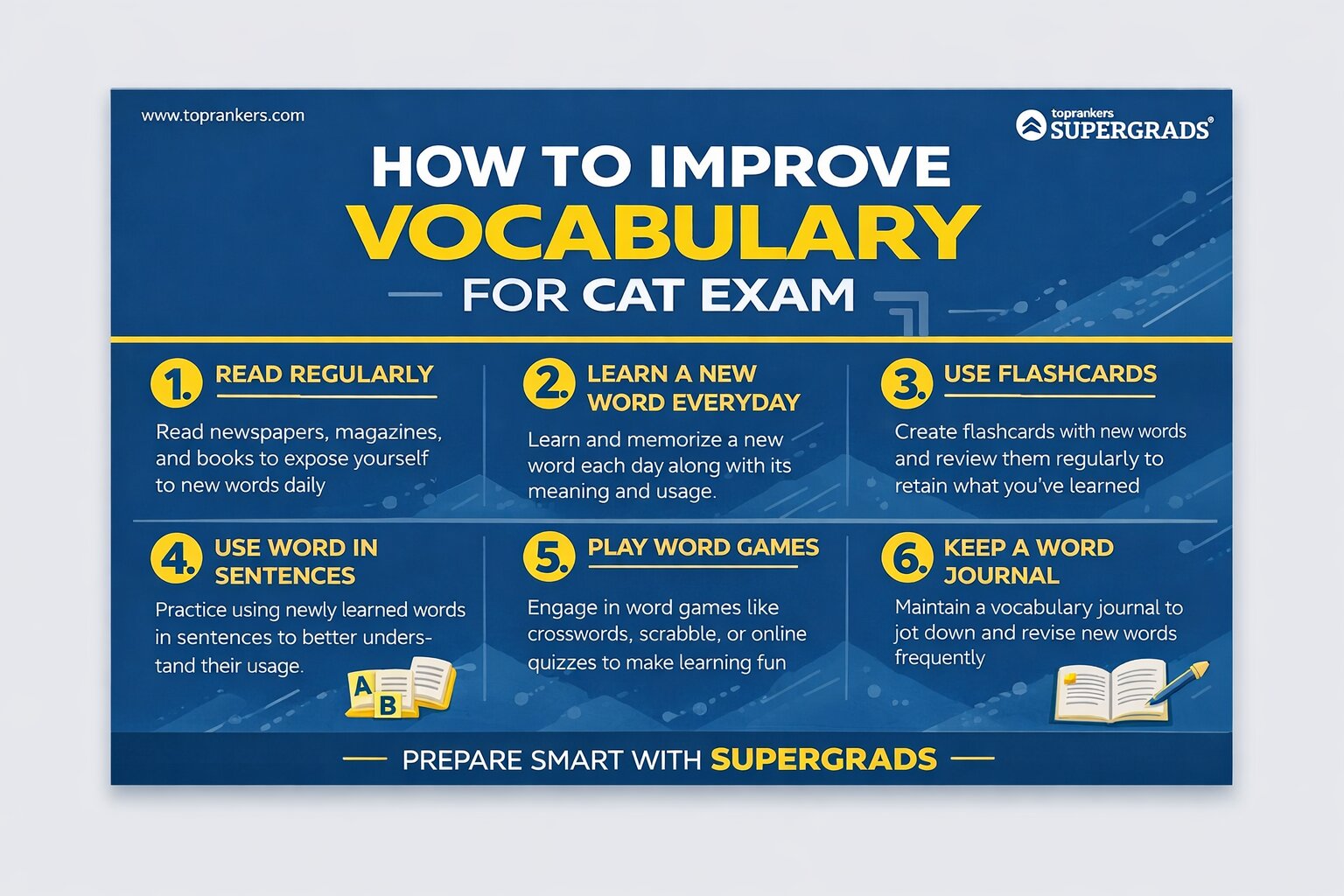
Conclusion
How to Improve Vocabulary for CAT, you can improve your chances of success by improving your vocabulary for CAT entrance exam.
Resources such as flashcards, online vocabulary games, and books can help you quickly learn and remember new words. Reading extensively in different CAT subject areas can also help expand your vocabulary and comprehension skills.
Finally, practice makes perfect – the more you practice, the better you will use the words you’ve learned. You can improve your vocabulary and succeed in the CAT 2026 exam with hard work and dedication.

Smart Prep for CAT: Join Our Free Demo Class
Fill your details
Frequently Asked Questions
How can I improve my vocabulary for CAT exam?

What type of reading materials should I use to improve my vocabulary?
What are some online resources I can use to improve my vocabulary?
How often should I review my vocabulary words?
What other tips should I follow to improve my vocabulary for the CAT exam?
How to improve english vocabulary for CAT?
Is vocabulary important for CAT?

Zubeen Siddiqui
Content Writer | MBA & CAT Preparation


SHARE