
1723534562.png)

AILET Logical Reasoning Important Topics 2027: Your Complete Guide to Mastering the Section
May 18, 2026
Overview: If you are preparing for the All India Law Entrance Test, understanding the AILET logical reasoning important topics can significantly improve your score. Logical Reasoning is one of the most scoring yet tricky sections in the exam because it tests your analytical ability, critical thinking, inference skills, and argument evaluation.
Over the past few years, AILET has shifted towards passage-based critical reasoning questions instead of direct analytical reasoning. Therefore, aspirants must focus on high-weightage topics such as assumptions, conclusions, strengthen-weaken arguments, inference-based questions, syllogisms, and legal reasoning.
In this detailed guide, we will cover the most important AILET logical reasoning topics for 2026, topic-wise weightage, previous year trends, preparation strategy, best books, and expert tips to help you maximize your score.
Why Logical Reasoning Matters in AILET 2027?
Before we jump into the nitty-gritty, let’s pause for a second. Have you ever wondered why law entrance exams like AILET place such a heavy emphasis on reasoning? The answer is simple: being a lawyer is less about cramming information and more about analysing situations, drawing inferences, identifying flaws, and building strong arguments.
That’s exactly what the AILET Logical Reasoning Important Topics 2027 aim to test. Your ability to evaluate assumptions, spot logical loopholes, and interpret data isn’t just an exam skill; it’s a professional necessity for the career you’re aiming for.
Most Important AILET Logical Reasoning Topics 2027
The following topics are considered the most important for the AILET 2027 Logical Reasoning section based on recent paper trends and previous year analysis.
| Topic | Expected Questions | Difficulty Level |
|---|---|---|
| Inference-Based Critical Reasoning | 8-10 | Moderate |
| Assumptions | 5-7 | Moderate |
| Strengthen & Weaken Arguments | 4-6 | Moderate |
| Conclusions & Statements | 4-5 | Easy-Moderate |
| Legal Reasoning | 5-8 | Moderate-Tough |
| Syllogism | 2-4 | Easy |
| Coding-Decoding | 1-2 | Easy |
| Blood Relations | 1-2 | Easy |
| Statement & Course of Action | 2-3 | Moderate |
| Analytical Puzzles | 2-3 | Moderate |
The Nature of Questions: Para-Based vs Core Critical Reasoning
The Logical Reasoning section can broadly be divided into two kinds of questions:
1. Para-Based (or Passage-Based) Questions
These are short passages where you’ll need to identify assumptions, draw inferences, evaluate arguments, or strengthen/weaken claims. Essentially, you’re asked to “read between the lines.”
Read more: AILET 2027 Logical Reasoning syllabus
2. Core Critical Reasoning and Analytical Puzzles
These include classic reasoning puzzles, blood relations, directions, syllogisms, coding-decoding, and data interpretation. They test your ability to apply logic in structured problem-solving.
When we talk about AILET Logical Reasoning Important Topics 2027, both these categories are equally relevant, and mastering them requires a slightly different approach for each.
Para-Based Topics in AILET Logical Reasoning
1. Assumptions
Every argument is built on hidden assumptions. For instance:
- “All law aspirants who work hard will clear AILET.”
The hidden assumption? Working hard is the only factor that guarantees success.
Spotting assumptions requires practice because they are rarely stated outright. The trick is to ask: What must be true for this argument to work?
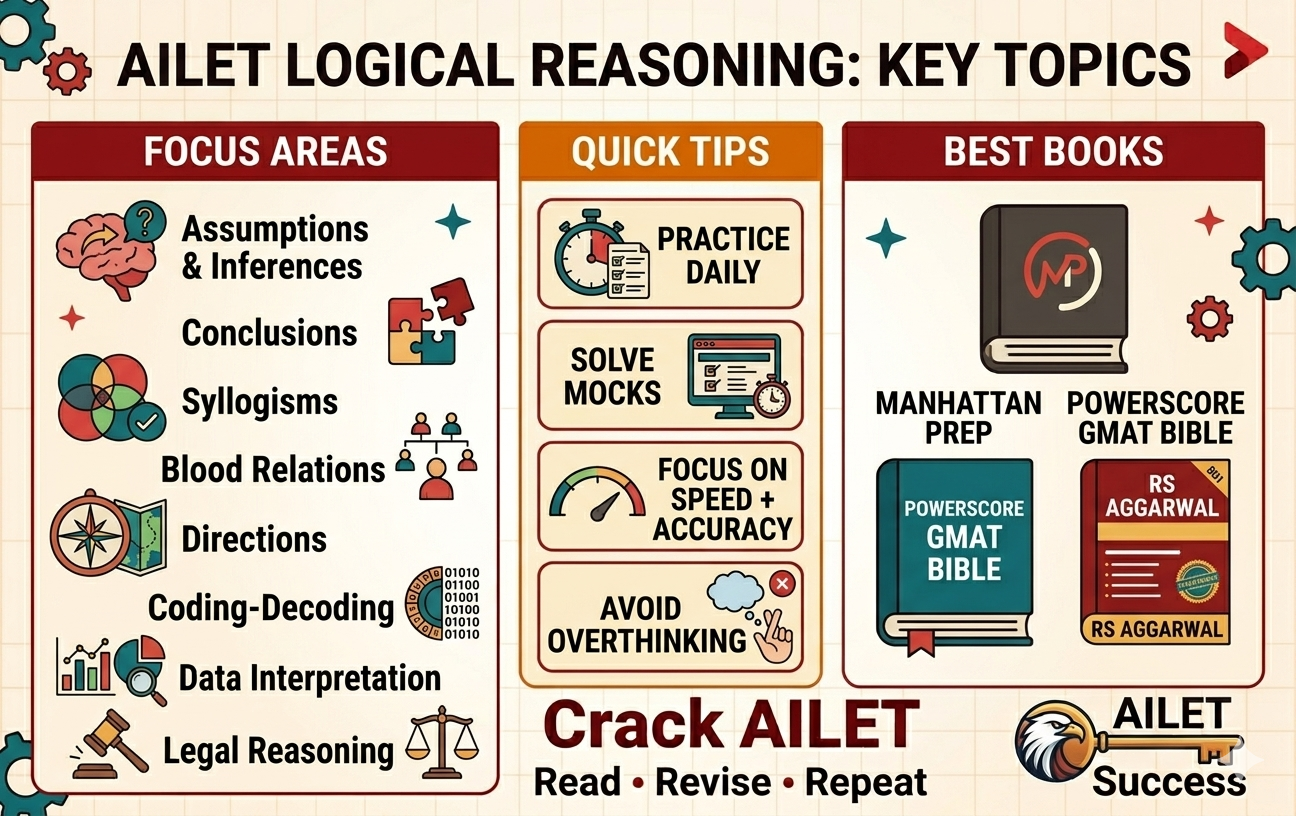
Preparation Tip: Try solving practice questions from GMAT guides (like Manhattan Prep and Powerscore GMAT), as they are goldmines for assumption-based reasoning.
2. Conclusions
In para-based conclusion questions, you’re asked to determine what logically follows from the given information. Unlike assumptions, conclusions are about identifying the logical endpoint of an argument, not what lies beneath it.
Think of it like this: If the argument is a train, the conclusion is its last stop.
Read more: AILET 2027 Logical Reasoning Preparation Books
3. Inferences
Inferences are slightly different from conclusions. Here, you need to deduce what must be true based on the information given.
For example:
- Passage: “All contracts are agreements, but not all agreements are contracts.”
- Inference: Some agreements are not contracts.
Why it’s important: Inference-based questions are a favourite in AILET papers because they test precision. The examiners want to see if you can separate what is “definitely true” from what is “probably true.”
4. Strengthening of Arguments
Here, you’ll be asked to choose information that makes an argument more convincing.
Example:
- Argument: “Online classes are more effective than offline classes.”
- Strengthening Statement: “Recent studies show that students score 20% higher in online exams.”
Tip: Always pick the option that directly supports the reasoning, not just the topic.
5. Strong and Weak Arguments
This topic is about judging the quality of arguments. Strong arguments are logical, relevant, and directly address the issue. Weak ones are vague, emotional, or irrelevant.
Practice by questioning everyday claims. The next time someone says, “This movie is the best ever,” ask yourself: Is that a strong argument or just personal preference?
Read more: AILET 2027 Logical Reasoning Preparation Tips
6. Syllogism (Para-Based)
Syllogisms often show up in both para-based and analytical sections. They test your ability to connect statements logically.
Example:
- Statement 1: All judges are lawyers.
- Statement 2: Some lawyers are professors.
- Conclusion: Some judges are professors. (False)
Diagramming syllogisms can be a lifesaver here.
Core Critical Reasoning & Analytical Topics
1. Blood Relations
These questions revolve around family connections. The trick is to create a family tree.
Example:
- “A is the father of B, and C is the sister of B. How is C related to A?”
- Answer: Daughter.
Pro Tip: Use symbols (+ for male, – for female, = for spouse, | for sibling) to save time in the exam.
2. Directions
These test your ability to visualise movement in space.
Example:
- “A walks 5 km north, then turns right and walks 3 km. Where is A now in relation to the starting point?”
Draw diagrams quickly. Trust me, even toppers don’t solve these purely in their head during timed exams.
Read more: CLAT Logical Reasoning Most Important Topics 2027
3. Coding-Decoding
This is about spotting patterns in how letters, numbers, or words are represented.
Example:
- If CAT = DBU, what does DOG = ?
Answer: EPH.
4. Data Interpretation & Logical Reasoning
This is where maths meets reasoning. Graphs, charts, and tables may be presented, and you’ll have to analyse them.
Example: “A pie chart shows that 30% of students chose Law as a career. If the total students are 600, how many chose Law?”
Answer: 180.
These questions are often calculation-heavy, so practicing shortcuts can save you precious minutes.
5. Core Syllogism (Analytical)
Beyond para-based syllogisms, you’ll also encounter pure logic-based ones. Using Venn diagrams is non-negotiable here; they cut down confusion and help you spot valid conclusions quickly.
6. Legal Critical Reasoning
This is where AILET makes its law-oriented focus clear. You’ll be given principles of law and asked to apply them to factual scenarios.
Example:
- Principle: “Whoever causes harm by negligence is liable.”
- Fact: A doctor forgets to sterilise surgical tools, causing an infection in a patient.
- Inference: The doctor is liable.
This area overlaps with the Legal Aptitude section but is tested under Logical Reasoning too.
AILET Logical Reasoning Previous Year Trends
The AILET Logical Reasoning section has evolved significantly in recent years. Earlier, the paper focused more on direct analytical reasoning questions such as coding-decoding, series, and blood relations. However, recent exams have become more passage-oriented and inference-based.
Key Trends Observed in Recent AILET Papers
- Critical reasoning dominates the section.
- Passage-based questions have increased.
- Questions now test analytical interpretation rather than memorization.
- Legal reasoning and argument analysis are becoming increasingly important.
- Direct analytical reasoning questions are fewer but still scoring.
Students preparing for AILET 2026 should therefore prioritize comprehension-heavy logical reasoning practice.
Best Books and Resources
When it comes to AILET Logical Reasoning Important Topics 2027, the right resources matter more than quantity. Here are some must-haves:
- Manhattan Prep (Critical Reasoning): Known for breaking down reasoning questions in a simple, structured way.
- Powerscore GMAT Critical Reasoning Bible: A holy grail for mastering para-based questions.
- GMAT Official Guide (Critical Reasoning Section): Offers real test-standard questions with detailed explanations.
For analytical puzzles, you can complement these with standard reasoning books like RS Aggarwal’s “Modern Approach to Logical Reasoning.”
What Experts Say About AILET Logical Reasoning
According to recent AILET paper analysis, students who focused primarily on critical reasoning and inference-based passages performed significantly better than those relying only on traditional analytical reasoning.
Experts suggest that aspirants should:
- Practice editorial-based comprehension daily
- Solve previous year AILET reasoning questions
- Focus on argument analysis
- Improve reading speed and interpretation skills
- Attempt sectional mock tests regularly
The recent AILET pattern clearly rewards analytical interpretation over rote preparation.
How to Prepare Strategically
- Divide Your Study Time: Dedicate specific slots for para-based reasoning and analytical puzzles. They require different mindsets, so mixing them up can be confusing.
- Practice Daily: Logical reasoning is like a muscle; the more you train it, the sharper it gets. Even 30 minutes a day can make a huge difference.
- Mock Tests Are Non-Negotiable: You can be great at solving questions slowly, but AILET is all about speed + accuracy. Timed practice is essential.
- Analyse Your Mistakes: Don’t just mark answers wrong and move on. Ask yourself: Why did I fall for that trap? Most reasoning questions are designed with tempting but incorrect options.
- Stay Calm During the Exam: Logical Reasoning often comes toward the end of the paper. Fatigue can make you rush. Take a deep breath and tackle questions methodically.
Read more: How to prepare for AILET 2027 in one month?
Quick Revision: AILET Logical Reasoning Important Topics
Focus primarily on:
- Critical reasoning passages
- Inference-based questions
- Assumptions and conclusions
- Argument strengthening/weakenings
- Legal reasoning
- Statement-based reasoning
Secondary focus areas:
- Syllogism
- Blood relations
- Coding-decoding
- Analytical puzzles
Common Mistakes Students Make
- Overthinking: Sometimes the simplest option is the correct one.
- Skipping Diagrams: Whether it’s directions or syllogisms, diagrams save time.
- Ignoring Legal Critical Reasoning: Many students treat this as optional, a big mistake! It’s often the tie-breaker for high ranks.
- Relying on Rote Learning: Logical Reasoning cannot be memorised. It has to be practised.
Conclusion
The AILET Logical Reasoning section has become increasingly comprehension-driven and analytical over the years. Therefore, students preparing for AILET 2026 should focus more on critical reasoning, inference-based passages, assumptions, conclusions, and legal reasoning instead of relying only on traditional analytical reasoning topics.
A smart preparation strategy combined with consistent mock test practice, previous year paper analysis, and strong reading habits can help aspirants score exceptionally well in this section.
Prioritize the high-weightage AILET logical reasoning important topics mentioned above and build a structured preparation plan to maximize your performance in the exam.
Frequently Asked Questions
What are the most important topics in AILET Logical Reasoning?

Are para-based questions more important than analytical puzzles in AILET Logical Reasoning?
Which books should I refer to for AILET Logical Reasoning preparation?
How much time should I spend on Logical Reasoning daily?
How can I avoid mistakes in AILET Logical Reasoning?

Samriddhi Pandey
Content Writer


SHARE