
1723534562.png)

AILET 2027 Syllabus PDF Download Here [Subject-Wise]
September 16, 2026
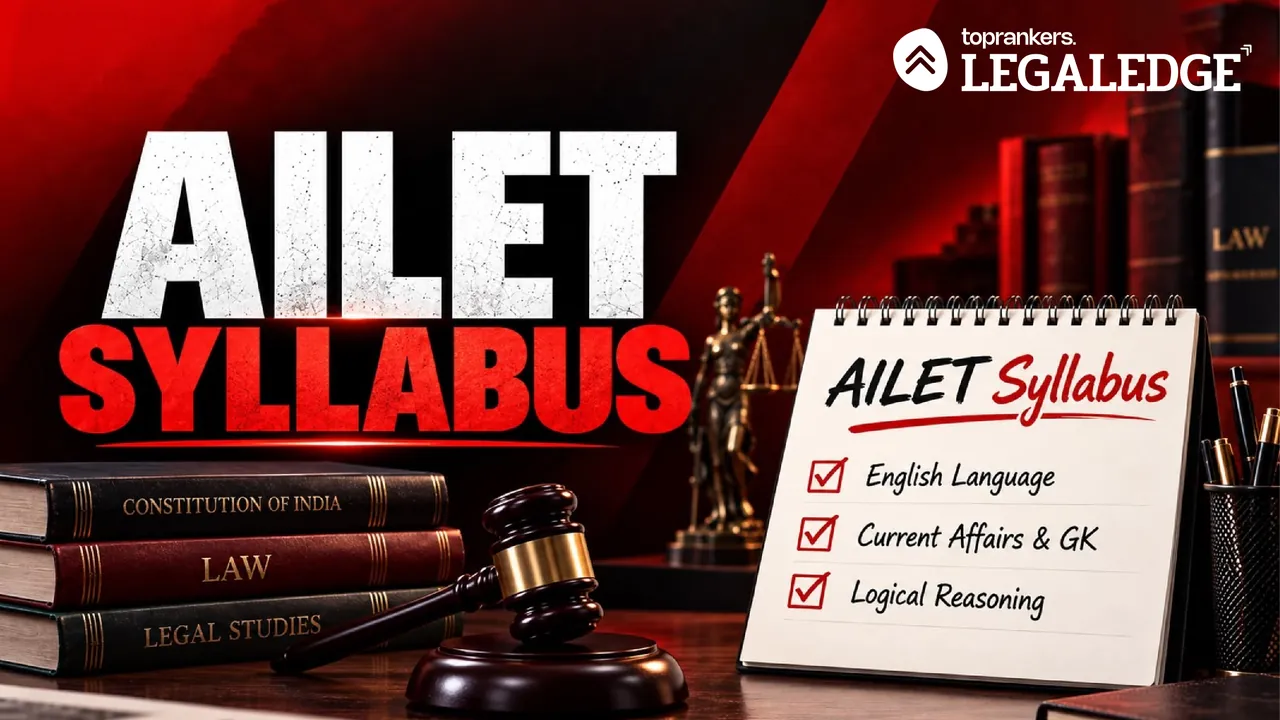
Looking for the AILET syllabus. The most recent AILET 2027 syllabus update? This guide explains the exam pattern, including the different sections the weightage given to each section and the marking scheme. It also gives an idea of the topics that're likely to be covered based on trends from previous years’ question papers. This is because NLU Delhi does not provide a detailed syllabus in a PDF format.
The AILET 2027 syllabus for the BA LLB (Hons.) program includes three sections: English Language, Current Affairs and General Knowledge and Logical Reasoning. The test consists of 150 multiple-choice questions that must be answered within 120 minutes. Each correct answer gives +1 mark. Each incorrect answer deducts 0.25 marks.
Tip: Use this page alongside the AILET Exam Pattern and AILET Previous Year Papers to understand what is repeatedly asked and prioritise high-return topics.
AILET 2027 Syllabus (UG) – Official Sections & Weightage
| Section | Questions | Marks |
|---|---|---|
| English Language | 50 | 50 |
| Current Affairs & General Knowledge | 30 | 30 |
| Logical Reasoning | 70 | 70 |
| Total | 150 | 150 |
Time: 120 minutes | Marking: +1 (correct) | Negative marking: -0.25 (incorrect)
Note: In AILET UG, legal-principle style situations may appear inside Logical Reasoning to test aptitude and rule-application. You are not expected to have prior legal knowledge.
AILET 2027 Syllabus for BA LL.B (Hons.)
The AILET syllabus for the UG exam is best understood in two layers: (1) the official section-wise structure released by NLU Delhi, and (2) the expected topic list (compiled from previous papers and repeated question patterns) to help you prepare in a practical, exam-focused way.
Important: NLU Delhi typically specifies the sections + number of questions for AILET. A detailed, chapter-wise “syllabus PDF” is usually not released separately—so the topic lists below are an expected syllabus based on trends, not an “official topic list”.
What are the Subjects in the AILET 2027 Syllabus?
- English Language – Reading comprehension, vocabulary, grammar, and language skills.
- Current Affairs & General Knowledge – National and international current events, along with important static GK topics.
- Logical Reasoning – Critical thinking, analytical reasoning, arguments, inferences, and logical problem-solving.
Download AILET Syllabus 2027 PDF
Download the AILET 2027 syllabus PDF to understand the latest exam pattern, section-wise structure, and marking scheme prescribed by NLU Delhi. Referring to the official syllabus will help you prepare strategically and focus only on the topics relevant to the exam.
AILET 2027 English Language Syllabus (UG)
The AILET 2027 syllabus for English Language checks your reading ability, vocabulary, grammar usage, and sentence-level clarity. Expect a mix of reading comprehension and objective language questions that test how accurately you understand meaning and structure.
Key Topics in AILET English Syllabus
- Reading Comprehension (RC): idea, tone, inference, fact vs opinion, title-based questions, contextual meaning
- Vocabulary: word meaning in context, synonyms/antonyms, idioms & phrases one-word substitutions, commonly confused words
- Grammar & Usage: parts of speech, subject–verb agreement, tenses, articles, prepositions, modifiers, active/passive, direct/indirect
- Sentence Skills: error spotting, sentence improvement, sentence rearrangement, logical word order eliminating ambiguity
- Cloze Tests / Fill in the blanks: contextual fit, connectors, grammar + vocabulary blend
What matters most: AILET English rewards accuracy. You should build a habit of reading. Always look for traps in the options. Make sure to answer Reading Comprehension (RC) questions based on what the passage supports.
How to Prepare for AILET English (Practical Approach)
- Practice English Section - daily practice of RCs - 1-2 passages practice - emphasis on inference and tone-based answers (most candidates lose marks in this section)
- Vocabulary - context-based - practice new words from editorials; revise list weekly
- Grammar - learn error spotting technique - practice with short sets; maintain a “mistake list” (SVA, modifiers, tenses, articles)
- Time-bound drills - practice English sets in a time-bound manner to ensure RCs are not overread.
Suggested practice mix - Practice RCs (most important), error spotting, sentence completion, vocabulary in context, cloze tests.
AILET 2027 GK & Current Affairs Syllabus (UG)
The AILET syllabus for GK & Current Affairs is a blend of static GK (foundational facts) and current affairs (recent events and developments). The goal is to test whether you can connect what’s happening around you with core national and global knowledge.
Key Areas to Cover in AILET GK & Current Affairs Syllabus 2027
- National Current Affairs: major government schemes, policy decisions, key appointments, awards, important days, major reports
- International Current Affairs: global events, international organisations, summits, treaties, global indices and rankings
- Polity & Governance (Static + Current): Constitution basics, Parliament, judiciary, constitutional bodies, landmark governance developments
- Economy (Basics + Updates): Budget & Economic Survey themes, inflation/GDP basics, major economic programmes and trends
- Science & Technology: space missions, new tech developments, health/science breakthroughs, cybersecurity basics
- Environment & Ecology: climate change updates, biodiversity, conferences (COP etc.), wildlife sanctuaries & national parks
- History & Culture: modern history highlights, art & culture, heritage sites, festivals, GI tags (high-frequency areas)
- Geography: India + world basics, maps (rivers/mountains/important locations), resources and physical geography headlines
- Sports: major tournaments, winners, records, sports awards
Current affairs range (safe plan): Prepare at least the last 8–12 months thoroughly. If you’re short on time, do a high-quality revision of the last 6 months plus important static GK fundamentals.
How to Prepare GK & Current Affairs for AILET 2027
- Routine (20-30 minutes): Read a quality newspaper + micro-notes (5-7 bullet points per day)
- Compilation technique for the month: Divide each month into 6 buckets namely: Polity, Economy, International, S&T, Environment, and Awards/Sports
- Parallel study of static GK: Revisit Polity basics + Modern History + Geography maps (once a week)
- Revision Technique: 24-hours revision + 7-day revision + monthly revision (Spaced repetition)
- Practice: Attempt 30-50 GK questions weekly and learn why each option is right or wrong
Things to avoid (mistakes that are common)
- Reading many sources and not revising (GK improves with revision, not reading)
- Ignoring Static GK completely (Static knowledge usually helps you eliminate options)
- Not maintaining a list of mistakes (wrong answers or repeated topics)
- If you don’t have time to read newspapers and take notes, then go for Detailed weekly current affairs.
If you don't have time to read newspapers and take notes, you can check the detailed weekly current affairs.
AILET 2027 Logical Reasoning Syllabus (UG)
The AILET 2027 syllabus for Logical Reasoning focuses on your ability to understand information, spot patterns, evaluate arguments, and apply rules to situations. This section often carries the highest weightage and is designed to test speed + accuracy under time pressure.
Key Topics in AILET Logical Reasoning Syllabus
- Critical Reasoning: assumptions, conclusions, strengthen/weaken, inference, cause–and–effect, paradox, analogy, statements & arguments
- Argument & Passage-based Reasoning: short passages with questions on logic, claims, evidence, and reasoning validity
- Logical Deductions: syllogisms, statement–conclusion, statement–assumption, statement–inference
- Seating/Arrangement (light to moderate): linear/circular arrangements, ordering, scheduling (focus on quick patterns)
- Series & Patterns: number/letter series, odd-one-out, analogy-based patterns (usually quick-win questions)
- Venn Diagrams / Set-based reasoning: basic set relationships and conclusions
- Direction/Distance & Coding-Decoding: simple logic mapping and symbol-based decoding
- Data-based reasoning (basic): interpreting short tables/charts and answering logic questions from them
Important note: Some Logical Reasoning questions may use short legal-principle style situations to test your reasoning and rule-application skills. You are not expected to know the law in advance—treat these as logic questions based on the information provided in the question.
Legal-principle style contexts that may appear inside Logical Reasoning (as reasoning scenarios)
- Rule-application scenarios: “If condition A is met, outcome X follows; otherwise outcome Y” type questions
- Rights & duties style situations: duty/breach style narratives used purely for inference and application
- Contract-like situations: offer/acceptance-like logic framed as a scenario (focus is on applying stated rule)
- Liability/fault-like narratives: cause, intention, negligence-like framing used to test reasoning (not legal knowledge)
How to Prepare Logical Reasoning for AILET 2027
- Start with Critical Reasoning: it builds the base for most AILET-style logic questions
- Practise in timed sets: 25–30 questions in one sitting to build stamina and decision-making
- Build an “error log”: track repeated mistakes (assumption vs inference, strengthen/weaken traps, extreme options)
- Option elimination habit: eliminate using logic first, not intuition
- Mock analysis rule: analyse every wrong question and write the exact reason (misread, concept gap, time panic)
High-return focus order (if you’re short on time)
- Critical Reasoning (assumption, inference, strengthen/weaken)
- Passage-based reasoning
- Syllogisms / statement-based logic
- Quick-win topics (series, analogy, coding-decoding)
Read More: Time Management Tips for AILET Exam 2027
AILET 2027 LLM Syllabus (Overview + Expected Topics)
The AILET LLM syllabus is broadly framed around questions from different branches of law. The LLM entrance test is conducted in an objective (MCQ) format, so your preparation should focus on concept clarity, application-based questions, and quick recall of key legal principles.
AILET LLM Exam Snapshot: 100 MCQs (1 mark each) | 120 minutes | Negative marking: -0.25 for each incorrect answer.
Expected Subjects in AILET LLM Syllabus (High-Probability Areas)
Since the official notice generally describes the syllabus as “different branches of law”, candidates usually prepare the following core subjects for the AILET LLM syllabus:
- Parliament and the judiciary, constitutional remedies and basic doctrines, key concepts of jurisprudence, and the basic structure of the Constitution
- The basics of interpretation of legal concepts, duties and rights, the basics of criminal and administrative law, legal reasoning, and schools of law
- Options in criminal law, the process of criminal law, general principles of criminal and administrative law, procedural elements of criminal law, the defense of criminal responsibility, natural justice, judicial control of administrative discretion and the limits of judicial review
- The basic liability in criminal law, a brief explanation of the law of contracts, the law of torts, the law of bailment and pledge/guarantee, and the basic principles of international law and the law of international organizations
- Basic family law, property law and Transfers, basic leases, and basic mortgages
- Sales and basic negotiability, company law, basic international intellectual property law, the fundamental principles of negotiable instruments and company law
AILET Exam Pattern 2027
| Subjects | Number of Questions | Maximum Marks | Time Duration |
| English Language | 50 | 50 | 120 minutes (2 hours) |
| Current Affairs & General Knowledge | 30 | 30 | |
| Logical Reasoning | 70 | 70 | |
| Total Marks | 150 | 150 |
Common Mistakes to Avoid in AILET Syllabus
- Avoid spending excessive time learning legal concepts, as AILET primarily tests reasoning skills rather than prior legal knowledge.
- Don't focus only on static GK—make daily current affairs an essential part of your preparation.
- Give Logical Reasoning the highest priority, as it carries the maximum weightage in the exam.
- Stick to a limited set of reliable study resources instead of switching between multiple books and materials.
- Practice previous years' question papers regularly to understand the exam pattern and question trends.
- Start taking AILET mock tests early to improve speed, accuracy, and time management.
- Follow the AILET syllabus carefully and avoid preparing unnecessary topics or sections meant specifically for CLAT.
How to Use the AILET 2027 Syllabus for Preparation
The AILET Syllabus becomes useful only when you convert it into a plan. Start by treating the section-wise syllabus below as a checklist and align it with your weekly practice.
- Step 1: Cover basics first — complete English fundamentals, GK static basics, and core Logical Reasoning question types.
- Step 2: Practise in sets — solve section-wise question sets daily and track accuracy, not just attempts.
- Step 3: Add current affairs monthly — revise one month at a time and maintain short notes for quick revision.
- Step 4: Take mocks regularly — attempt mocks under timed conditions and analyse every incorrect question.
- Step 5: Revise with repetition — follow a 24-hour + 7-day + monthly revision loop to retain topics.
Quick tip: Since Logical Reasoning has the highest weightage, practise it daily—but don’t ignore English and GK, because these sections often decide rank when scores are close.
How to Prepare for AILET LLM (Smart, MCQ-focused)
- Achieve good scores in foundational or core courses like the Constitution, Jurisprudence, and Contract and Criminal Law as they usually dominate the paper.
- Study in 'principle + illustration' format; write 1 or 2 line rules with 1 example for each case or topic.
- Place equal importance to doctrines and tests over focal and long facts of cases.
- Spend at least 100 to 150 minutes every day taking MCQ’s, and maintain a daily error log.
- Revise core concepts and exceptions for 24 hours, 7 days and a month.
Note: This list will not include minor or unimportant topics and will prepare you for most of the core topics for this exam. Although the exam description states it covers several branches of law, it is best to focus on the core topics and practice MCQs consistently.
AILET 2027 Syllabus: Section-wise Study Plan (8–10 Weeks)
Understanding the AILET 2027 syllabus breakdown is the first step in planning. Here’s a general, practical 8–10 week plan for the English, GK/CA, and Logical Reasoning sections, along with a consistent practice of mocks.
Weeks 1–2: Build Fundamentals
- English: Lay the basics of RC and grammar. Learn SVA, tenses, modifiers and vocabulary.
- GK/CA: Learn the basics of Modern History and the fundamentals of Static Polity. Start current affairs notes for the day (5–7 points).
- Logical Reasoning: Learn the basics of assumption, inference, strengthen and weaken.
- Practice target: Take 3 section wise mini tests per week.
Weeks 3–4: Add Speed + Topic Coverage
- English: Begin doing error spotting and sentence improvement. February approach 1-2 RC passages per day.
- GK/CA: take 2-3 months of current affairs. Review Static GK.
- Logical Reasoning: Focus on passage-based reasoning. Do quick-win sets of series, analogy and coding.
- Practice target: Do one mock per week with detailed analysis.
Weeks 5–6: Strengthen Weak Areas + Mixed Practice
- English: Review vocabulary. Focus on vocabulary accuracy, tone, inferences, and traps. Do timed section drill practice.
- GK/CA: Take a monthly recap GK quiz. Make a one-page monthly recap. Repeat Static GK.
- Logical Reasoning: Do mixed practice with elimination.
- Practice target: Do two full-length practice mocks per week. Maintain an error log.
Weeks 7–8: Mock-heavy Phase
- Do a full analysis of mocks done the same day. Focus on time management and question selection. Do 2-3 mocks per week.
- English: Practice RC passages to increase speed and revamp vocabulary notes.
- GK/CA: Review last 12 months' current affairs notes. Make quick review sheets for Static GK.
- Logical Reasoning: Practice passage-based reasoning and time management.
Weeks 9–10 (Optional): Final Revision & Score Stabilisation
- Practice: 3 mocks per week, error log review.
- Revise: High-frequency GK, weak topics and error log.
If you already know the AILET 2027 syllabus sections, the next step is converting it into a weekly plan. Here’s a practical 8–10 week schedule that balances English, GK/CA, and Logical Reasoning while keeping mock practice consistent.
Conclusion
The AILET 2027 Syllabus highlights the key areas for aspirants preparing for the exam, focusing on the English Language, General Knowledge and Current Affairs, and Logical Reasoning. Though the detailed AILET syllabus PDF isn't officially outlined, past papers serve as a guide.
Here are the key takeaways:
- English Section: Grammar, vocabulary, reading comprehension, idioms, literary devices, and different writing styles are essential components.
- GK & Current Affairs: Covers international affairs, politics, national & state events, Supreme Court judgments, science, arts, culture, and historical events.
- Logical Reasoning: Focuses on analysing, inferring, and applying legal principles, critical reasoning, and problem-solving skills without requiring prior legal knowledge.
- Legal Topics: Constitutional law, law of contracts, property law, international law, and law of torts are essential for both BA LLB and LLM aspirants.
Related AILET 2027 Resources
If you’re preparing using the AILET Syllabus and the updated AILET 2027 Syllabus, these resources will help you practise and revise faster:
- AILET Exam Pattern – section structure, marking scheme, and paper overview
- AILET Previous Year Question Papers – practise with real paper-level questions
- AILET Mock Test – timed practice and performance tracking
- Monthly Current Affairs – month-wise GK/CA revision notes
- Weekly Current Affairs – weekly revision PDFs for quick coverage
Tip: Use the syllabus as your checklist, question papers to understand the question style, and mocks to improve speed + accuracy together.
Frequently Asked Questions
What is the AILET 2027 syllabus for BA LL.B (Hons.)?

Does AILET have Maths?
Is Legal Reasoning a separate section in the AILET syllabus 2027?
What is the marking scheme and negative marking in AILET 2027?
How many questions are there in AILET UG and what is the duration?
What is the AILET LLM syllabus 2027?
How many months of current affairs should I cover for the AILET syllabus?
Is the AILET syllabus the same every year?

Samriddhi Pandey
Content Writer
SHARE