
1723534562.png)

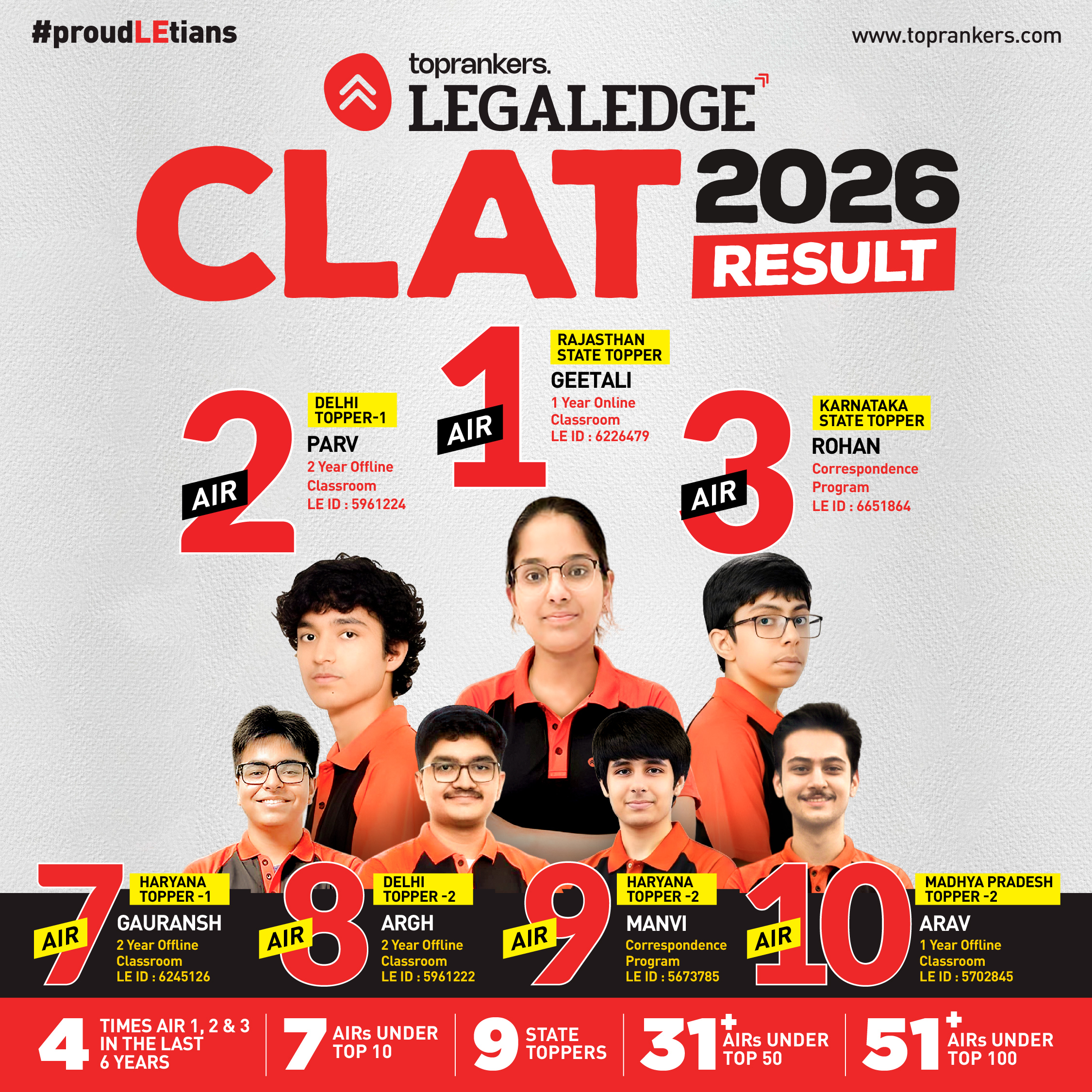
CLAT 2026 AIR 1 Geetali Gupta: I am a Bona Fide Toprankers LegalEdge Student [Check Full Story]
May 22, 2026
For every CLAT aspirant who has ever stared at a mock score and thought, “Is this even working?”, this update hits different. LegalEdge student Geetali Gupta has secured CLAT 2026 AIR 1 with 112.75 marks and has been allotted a seat at NLSIU Bengaluru.
Geetali Gupta, enrolled in a one-year integrated legal programme at LegalEdge, shared that her journey started early—back in school—because she genuinely enjoyed debating, reasoning, and persuading people to choose what’s right. Like many students, she didn’t begin with “perfect preparation” from day one. In Class 11, she tested the waters with a few mocks, but real momentum came later when she decided to get serious and build discipline.
CLAT 2026 AIR 1 Geetali Gupta says, “What makes this even more special: I prepared only with LegalEdge. No other institute, no parallel coaching—just one system, followed consistently.”
Securing AIR 1 in CLAT 2026 is not just about intelligence—it’s about structure, feedback, repetition, and discipline. In this exclusive conversation, Harsh Gagrani interviews Geetali Gupta, the CLAT 2026 Rank 1 achiever and an exclusive LegalEdge student from the LegalEdge One-Year Program. She speaks about how her preparation evolved from light practice in Class 11 to a focused, consistent journey powered by LegalEdge mentorship, regular mocks, mock analysis, and daily current affairs reading.
If you’re a CLAT aspirant aiming for 2027/2028/2029, this interview gives you a realistic template of how a top rank is built—with the right strategy, the right guidance, and a preparation ecosystem like LegalEdge.
CLAT 2026 AIR 1: Information at a Glance
| Details | Information |
| Name | Geetali Gupta |
| CLAT 2026 AIR | 1 |
| CLAT 2026 Marks | 112.75 |
| State | Rajasthan |
| Coaching Institute | LegalEdge |
| Enrolled Batch | LegalEdge Warriors Batch |
| NLU Allotted | NLSIU Bangalore |
| Mode of Preparation | Online & Offline |

Interview: Harsh Gagrani [Co-Founder, LegalEdge] X Geetali Gupta [CLAT 2026 AIR 1]
Harsh Gagrani: Hi Geetali, how are you?
Geetali: I’m good, sir. How are you?
Harsh Gagrani: All well. And congratulations on getting a great score and a great rank in CLAT 2026.
Geetali: Thank you so much, sir.
Harsh Gagrani: How does it feel?
Geetali: The feeling is actually complicated to explain. On one hand, it feels surreal—like I can’t believe I’m getting such a rank. But on the other hand, I’m equally happy for the rank and for all the efforts I put in. So yes, it’s unbelievable as well as happy.
Harsh Gagrani: That’s great. So which LegalEdge batch were you enrolled in, Geetali?
Geetali: I was enrolled in the Droppers / Warriors batch—the Gold one.
Harsh Gagrani: Okay. When did you decide on law as a career, and when did you start preparing for CLAT?
Geetali: I decided back in 9th grade that I would do law because there’s one thing I love—debating, and persuading people to do what’s right (according to me). So I decided in 9th grade that I would pursue law. And of course, CLAT and AILET were the two exams that could get me into a good college.
I started preparing in 11th itself—like I started giving some mocks, but it was only one mock a month. It wasn’t very concentrated or focused preparation. So 11th went away with minimal studies. Sometimes I studied one or two legal topics, sometimes I practised a bit of quant, but it wasn’t focused. It was more like—if I did it, I did it; if I didn’t, I didn’t.
But in 12th I decided—no, now I have to do it properly. So, around January to March (start of 12th), I started focusing on GK. And the things I had done in 11th—like the main static legal concepts such as Torts and Contract—I had covered the basics and revised them almost completely by mid-12th. In 12th, I was fully focused on CLAT.
Harsh Gagrani: And you enrolled with LegalEdge around February, right? February 2025?
Geetali: Yes, sir, that’s when I started.
Harsh Gagrani: When you started, which section felt the weakest? And by the end, did it stay the same or change?
Geetali: In the beginning, my weak section was GK because in the initial months, I didn’t really understand how to do GK. I mainly read topics I liked—like politics-related stuff or national issues—and for other topics, it was like, if I read it, then fine, otherwise not. I didn’t read one-liners at all. But the n in mocks, many questions came from one-liners and related research topics, and I couldn’t do them.
So one part was GK, and the other was Legal, because picking out principles from a passage and applying them to the given facts was difficult. But towards the end, Legal kind of became my strong section, and Logical became a bit tough for me, because I used to do Logical after Legal, and by the time I reached Logical, it would get frustrating. So by the end, Logical felt difficult for me, and GK was still there as a challenge.
Harsh Gagrani: Did you read the newspaper daily?
Geetali: Yes. It was like—no matter what happens, I have to read the newspaper daily.
Harsh Gagrani: Approximately how many mocks did you write in the last year?
Geetali: There’s no count, sir. I gave last year’s mocks, even older mocks. I repeated the same mocks two to three times as well—so there’s no fixed number.
Harsh Gagrani: For someone who is just starting prep, what were your mock scores initially, mid-way, and closer to CLAT?
Geetali: In the beginning, my scores were around 60, 70, 80. I remember my lowest score was 60—so usually between 60 to 80. Mid-way, they dipped a bit and then started going up again—so again around 70 to 90. In the last 2–3 months, thankfully, my score didn’t go below 80.
Harsh Gagrani: Did you ever face a phase where scores dropped, and morale went down for days or weeks? If yes, how did you deal with it?
Geetali: In terms of scores, sometimes one mock would go bad, or two to four alternate mocks would be bad, but not so frequently that a whole month was ruined.
But yes—around May, June, July, even up to August—my ranks weren’t that good. When the final rank used to come online and offline, it would be somewhere in the 100s or 200s, and that upset me—because after putting in so much effort, the rank still wasn’t good. Rank matters a lot.
My teachers advised me to focus only on my work because anything can happen on exam day. Someone who’s doing very well can mess up, and someone who’s doing poorly can do very well. So I sidelined ranks and scores and focused on analysing what’s going right and what’s going wrong. And then it depends on the final day.
Harsh Gagrani: Which teachers did you follow/stay connected with? Who helped you?
Geetali: I was mostly connected to the Bhopal centre—Utkarsh sir, Saurabh sir, Mayur sir, Sukanya ma’am, Shazli ma’am—everyone from the Bhopal centre. Apart from that, I used to come to the Chandigarh centre sometimes, so Shitij sir and Nidhi ma’am also helped.
Harsh Gagrani: Were you enrolled anywhere else in any other classroom program?
Geetali: No, sir.
Harsh Gagrani: What was your parents’ first reaction? How happy are they?
Geetali: It goes without saying—they are extremely happy. I found out later, but they told me they weren’t even expecting less than 100 because in AIOMs, my rank never went below 100.
In AIOMs, there are selected students, but in the actual exam, it’s around 70,000–75,000 candidates, so there’s a wide gap. Still, because I never went under 100 in AIOMs, when I opened the final result, it was shocking. I opened it quite late—calls had already started coming that my result was good. When I opened it at home with everyone around me, I couldn’t believe it was my rank and my score.
Estimating from answer keys is different, but seeing the actual result felt like—okay, everything is done now. Now it’s just happiness. I don’t have to study for CLAT anymore. So obviously, I was very happy, and everyone was happy. And yes, my mom was very, very happy—dads aren’t as expressive—but both were extremely happy.
Harsh Gagrani: Tell us 2–3 consistent habits from the past year that helped you get such a rank and score.
Geetali: First: reading the newspaper daily. No matter how long—read it. Even if it’s just 30 minutes, even if I only read a few topics or read them lightly, reading was necessary. It gave me a feeling of consistency that, yes, I studied GK today. It will add on. Knowledge never goes to waste—whatever you read will be useful.
Second: doing something CLAT-related daily—either giving a mock, analysing a mock, practising questions, or revising any topic—so that the habit doesn’t break.
Harsh Gagrani: Any message for future CLAT aspirants (CLAT 2027, 2028, 2029)?
Geetali: Do your work well—the result will come. And just be consistent.
Harsh Gagrani: Awesome. Congratulations again on a great rank and score in 2026, and all the very best for your future endeavours.
Geetali: Thank you, sir. Thank you so much.
Explore LegalEdge Online Coaching Courses 2027-2028
Find the right preparation course for CLAT, MH CET Law, CUET Law, NLSAT, CULEE, and 3-Year LLB entrance exams. Explore LegalEdge’s online coaching programs designed for different law entrance aspirations.
| LegalEdge Courses | Course Link |
|---|---|
| CLAT 2027 Courses | Explore Courses |
| CLAT 2028 Courses | Explore Courses |
| MH CET Law Courses | Explore Courses |
| CULEE Courses | Explore Courses |
| CUET Law Courses | Explore Courses |
| NLSAT Courses | Explore Courses |
| 3-Year LLB Courses | Explore Courses |
| MHCET LLB Courses | Explore Courses |


Geetali Gupta Journey At Glance
| Phase | What Geetali Did | LegalEdge-Style Actionable Takeaway |
|---|---|---|
| Class 9 | Chose law as a career (interest in debating/persuasion) | Start with clarity, then build consistency through a planned system |
| Class 11 | Light prep; one mock a month; minimal legal/quant practice | Early foundation is fine; serious growth comes with a structured routine |
| Jan–Mar (Class 12) | GK focus begins; revises static legal basics (Torts/Contract) | Shift to disciplined daily habits + revision loop |
| Feb 2025 | Joins LegalEdge Droppers/Warriors Gold (One-Year Program) | Mentorship + test practice ecosystem improves execution |
| Final Months | Mocks + analysis daily; score stabilises (80+) | Consistency compounding + error reduction = score stability |
Mock Score Progression
| Stage | Typical Mock Score Range | What It Signals |
|---|---|---|
| Early Phase | 60–80 | Normal starting band; build fundamentals + routine |
| Mid Phase | 70–90 | Fluctuations happen; focus on the analysis and improvement loop |
| Last 2–3 Months | 80+ | Stability + confidence; execution becomes consistent |
Weak-to-Strong Section Shift
| Section | Earlier Challenge | How It Evolved (LegalEdge Approach) |
|---|---|---|
| GK | Selective reading; skipped one-liners; inconsistency | Daily newspaper habit created consistency and retained learning over time |
| Legal Reasoning | Principal extraction + application felt difficult | Practice + revision turned it into a strong scoring section |
| Logical Reasoning | Manageable earlier | Became tougher later due to fatigue—order & stamina management matters |
Insights (What CLAT Aspirants Can Learn from LegalEdge AIR 1)
- LegalEdge-style consistency wins: Geetali’s daily newspaper + daily CLAT task ensured momentum, even on low-motivation days.
- Mocks are not just attempts—mocks are training: repeating mocks multiple times builds pattern recognition and reduces avoidable errors.
- Don’t overthink predicted ranks: Geetali improved when she focused on analysis instead of being controlled by rank calculators.
- Your strengths can change: Legal grew from weak to strong—proof that consistent practice can flip your section performance.
- Mentors matter: teacher feedback from LegalEdge centres helped her stay steady through the 100s/200s rank phase.
Conclusion
Geetali Gupta’s CLAT 2026 AIR 1 journey is a clear example of how a structured ecosystem like LegalEdge can turn potential into performance. With consistent newspaper reading, daily CLAT practice, disciplined mock repetition, and mentor-backed analysis, she built the habits that compound into top ranks. Her final message is simple and powerful: do the work daily, stay consistent, and the result will come.
Start CLAT 2027-28 preparation with LegalEdge, Watch Free Demo Classes: CLAT Demo Classes
Relevant Important Links
| CLAT 2026 AIR 1 | CLAT 2026 AIR 2 |
| CLAT 2026 AIR 3 | CLAT 2026 AIR 7 |
| CLAT 2026 AIR 8 | CLAT 2026 AIR 9 |
| CLAT 2026 AIR 10 | CLAT 2026 Toppers List |
| CLAT Rank List | CLAT 2026 Topper Interviews |
CLAT 2026 AIR 1 Geetali From LegalEdge Says
Stay consistent every day, even if it’s a small slot of study, and make sure you’re doing something CLAT-related daily—a mock, mock analysis, practice sets, or revision. She also stresses building a daily newspaper habit (even 30 minutes or selective reading) for GK/CA, and not getting mentally shaken by fluctuating mock ranks—focus on your own process, keep revising and practising, and trust that sustained effort will compound into results.
Preparing for CLAT 2027–2028? Watch FREE demo classes by LegalEdge—start here: CLAT Demo Classes
CLAT 2027 Latest Updates
| Event / Milestone | Expected Month (for CLAT 2027 cycle) | What to do (quick action) |
|---|---|---|
| Official notification/information brochure | Late July 2026 (expected) | Check the Consortium website and note eligibility, fees, and key dates. |
| Application form opens | August 2026 (expected) | Register early, upload documents, and lock your test city preferences. |
| Application last date | Late October / early November 2026 (expected) | Submit well before the deadline; avoid last-day payment issues. |
| Correction window (if announced) | October / November 2026 (expected) | Fix photo/signature/category details (only if the window is enabled). |
| Admit card release | Late November 2026 (expected) | Download and verify the centre, slot, and instructions. |
| CLAT 2027 exam date | Early December 2026 (expected) | Carry admit card + valid ID; follow exam-day instructions. |
| Provisional answer key | December 2026 (expected, shortly after exam) | Download key + response sheet (if released) and calculate score. |
| Objection window | December 2026 (expected) | Raise objections with proof within the given time window. |
| Final answer key | December 2026 (expected) | Recompute score using the final key. |
| Result declaration | Mid–late December 2026 (expected) | Download the scorecard and prepare a preference list for counselling. |
| Counselling registration & fee payment | December 2026 (expected) | Register for counselling immediately and lock your preferences carefully. |
| Seat allotment rounds | Late December 2026 – January 2027 (expected) | Choose Freeze/Float/Exit as per your target NLU and backup options. |
CLAT 2027 Roadmap
| Timeline | Stage | Primary Focus | What to Do (Non-negotiables) | Mocks/Test Target |
|---|---|---|---|---|
| Feb–Mar 2026 | Foundation | Build base + routine | Daily newspaper (30–40 min), RC habit, vocab (15–20 words/day), Legal basics (principle→fact method), QT fundamentals (percentages, ratio, averages), LR basics (assumption/inference) | 0–2 mini tests/week |
| Apr–May 2026 | Coverage | Complete core topics | Legal: contracts, torts, constitutional basics; LR: arguments + critical reasoning; QT: arithmetic-heavy topics + DI basics; English: RC + grammar error spotting; GK: weekly monthly CA notes | 2 sectional tests/week |
| Jun–Jul 2026 | Practice | Accuracy + speed building | Start timed sets, daily RC + LR, legal caselets, QT mixed practice, weekly GK compendium revision, start “error notebook” | 1 mock/week + 2 sectional |
| Aug–Sep 2026 | Mock Phase 1 | Strategy + analysis | Full mocks seriously, analyse every mock (why wrong, why slow), fix weak areas, revise Legal principles weekly, CA revision cycle (June–Sep) | 2 mocks/week |
| Oct 2026 | Mock Phase 2 | High intensity + revision | Increase mock frequency, repeat wrong questions, strengthen speed strategy (attempt order), QT formula sheet + drills, GK: revise June–Oct twice | 3 mocks/week |
| Nov 2026 | Final Prep | Peak revision + exam temperament | Only high-yield revision, daily RC + LR sets, legal mixed sets, GK rapid revision, reattempt mock errors, sleep discipline | 3–4 mocks/week |
| Dec 2026 (Last 2–3 weeks) | Exam Mode | Light practice + calm execution | Reduce load, focus on short notes + error notebook, 1 mock every 3–4 days, revise only what you’ve already studied | 2–3 mocks total |
Guidelines to Choose a CLAT Institute
Choosing the right CLAT coaching institute comes down to results consistency, mentor quality, and how well the program matches your learning style. Start by checking the institute’s past NLU selections, faculty profile, mock-test quality (difficulty + analytics + solutions), and doubt-solving/mentorship support. Prefer institutes that offer structured study plans, regular sectional + full-length mocks, performance tracking, and personalised feedback—because that’s what actually improves scores. If you’re looking for a recommendation, LegalEdge by Toprankers is a strong option due to its structured preparation approach, robust mock ecosystem, and student support system designed specifically for CLAT performance.
Relevant CLAT Blogs:
Frequently Asked Questions
Who is Geetali Gupta in CLAT 2026?

Which institute did Geetali Gupta study with for CLAT 2026?
When did Geetali Gupta start preparing for CLAT?
What were Geetali Gupta’s mock scores during preparation?
What were Geetali Gupta’s biggest challenges in CLAT preparation?
What daily habits helped Geetali secure AIR 1?
How did she handle low ranks or demotivating phases?

Admin
Subject Matter Expert
SHARE