
1723534562.png)

NIFT 2019 Question Paper PDF Download (GAT Answer Key + CAT Questions)
August 17, 2026
The NIFT 2019 question paper comes in two parts, because the NIFT entrance is two separate tests. The Creative Ability Test (CAT) was a 3-hour, 100-mark drawing paper with three questions (worth 30, 30 and 40 marks).
The General Ability Test (GAT) was a 100-question objective paper split across English comprehension, English grammar, mathematics, reasoning and general knowledge.
NIFT conducted the exam itself on 20 January 2019, before NTA took over.
NIFT 2019 Question Paper PDF Download (GAT + CAT)
You can download both parts of the 2019 paper below. Note the honest distinction- the GAT comes with an answer key you can score yourself against, while the CAT download is the set of drawing prompts.
For the CAT (Creative Ability Test) section, there is no single correct answer, so an official answer key is not available.
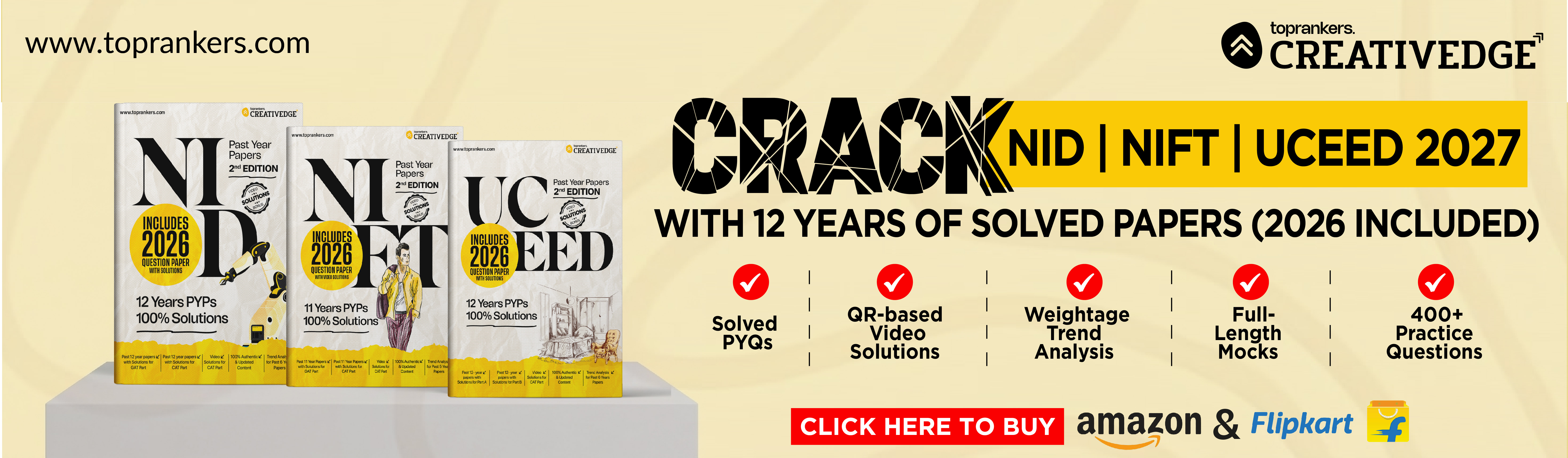
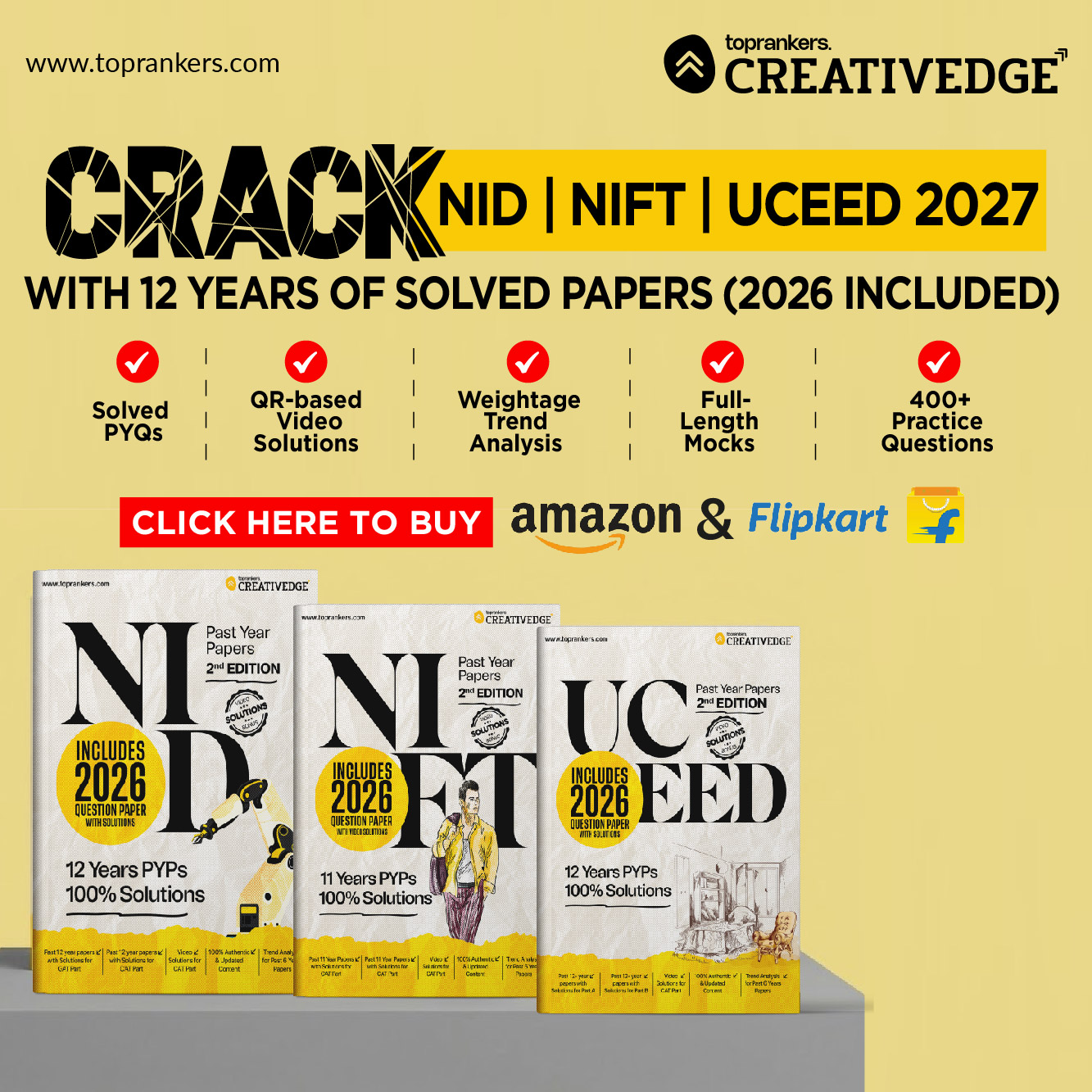
If you'd like to understand the expected approach and expert solutions, refer to Creative Edge's NIFT Previous Year Papers Book, which includes fully solved papers from 2016-2026, along with QR-based video solutions for every CAT question to help you improve your problem-solving and drawing approach.
| NIFT 2019 Question Paper PDF (B.Des) | Download Link |
|---|---|
| NIFT 2019 question paper with answers pdf - GAT | |
|
NIFT 2019 question paper pdf free download - CAT |
Source: Official NIFT Website
For every other year in one place, use our NIFT previous year question papers library, which has year-wise GAT and CAT downloads from 2016 onward.
Key Highlights: NIFT 2019 Question Paper
- Exam date: 20 January 2019 (conducted by NIFT, pre-NTA).
- Two papers: GAT (objective, all courses) + CAT (drawing, B.Des and M.Des only).
- CAT 2019: 3 questions - 30 + 30 + 40 marks; widely felt to be easy that year.
- GAT 2019 (B.Des): 100 questions across 5 areas.
- Answer Key: GAT yes (objective); CAT no (holistic evaluation).
- Best used for: GAT accuracy and speed, and reading NIFT's CAT prompt style.
If you're preparing for NIFT 2027 or 2028, the first thing to get straight is that "the NIFT 2019 question paper" isn't one document. It's a GAT paper and a CAT paper that test completely different skills and need completely different practice. This page breaks down both, tells you honestly what "with solutions" means for each, and shows you how to use them today.
Table of Contents
- NIFT 2019 GAT & CAT Papers Download Links
- Is the NIFT 2019 Paper GAT, CAT, or Both?
- Questions Asked in NIFT 2019 GAT Paper
- Questions Asked in NIFT 2019 CAT Paper
- Does the NIFT 2019 Paper Come with Solutions or an Answer Key?
- Was there Negative Marking in NIFT 2019 Exam?
- Difficulty Level of the NIFT 2019 Exam
- What has Changed Since 2019?
- How Should You Use the 2019 GAT and CAT Papers in Your Prep?
- Common Mistakes Students Make with the NIFT 2019 Paper
- Which NIFT Paper and Year Should You Solve First?
Is the NIFT 2019 Paper GAT, CAT, or Both?
Both. Every NIFT aspirant sits the GAT (General Ability Test), an objective paper testing quantitative ability, English, reasoning and general knowledge.
On top of that, applicants to the two design courses, B.Des and M.Des, also sit the CAT (Creative Ability Test), a drawing-and-design paper. Technology and management courses (B.F.Tech, M.F.Tech, MFM) sit GAT only, followed by a Situation Test or interview.
So the paper you need depends on your course. A B.Des aspirant needs both the 2019 GAT and CAT; a B.F.Tech aspirant needs only the GAT. If you're unsure how these two differ, our guide on the difference between CAT and GAT for NIFT lays it out simply. Getting this right first saves you from practicing the wrong paper.
What was in the NIFT 2019 GAT Paper?
The 2019 B.Des GAT carried 100 questions, and the section balance tells you exactly where to spend prep time. English dominated the paper that year.
|
GAT section (2019, B.Des) |
Number of questions |
What it tested |
|
English comprehension |
25 |
Reading comprehension & related questions |
|
English grammar |
25 |
Synonyms, antonyms, word replacement, spelling, fill in the blanks, idioms, one-word substitution, etc. |
|
Mathematics (quantitative) |
20 |
SI/CI, work & time, ratio, mixtures, profit & loss, ages, speed, mensuration |
|
Reasoning / analytical ability |
15 |
Series, seating & linear arrangement, coding, blood relations, directions, syllogism-style reasoning, puzzles |
|
General knowledge & current affairs |
15 |
Fashion/retail brands, designers, textiles, GI tags, plus general current affairs |
|
Total |
100 |
- |
The highlight for 2019 NIFT paper is that half the paper was English (comprehension plus grammar). Students that year generally found English the most approachable and the quantitative section the trickiest under time pressure.
If your English base is weak, an old GAT paper will expose it fast, and it's the cheapest section to improve. For a structured plan on the objective side, see GAT preparation for NIFT, and drill the two hardest areas with our NIFT maths questions and GK questions for the NIFT exam.
What were the NIFT 2019 CAT Questions?
The 2019 CAT was a 3-hour, 100-mark paper with just three questions, and how those marks were split matters for strategy:
|
CAT question |
The task |
Choose one of |
What it tested |
|
Q1 |
Design and color the object as you imagine it in the year 2050, and support it with a tagline |
Umbrella · Door Lock · Lunch Box |
Futuristic imagination, product design, color, and idea-in-a-line communication |
|
Q2 |
Design the object using only the given shapes (resize and repeat allowed, don't slice), plus a 100-word write-up |
Letter Box · Wind Chime · Personal Computer |
Working within constraints, building form from basic shapes, and explaining design intent in words |
|
Q3 |
Draw and color the subject in 4 stages of change |
Bird taking flight (ground → sky) · Rose (bud → full bloom) · Shirt drying (wet → dry) |
Sequential visualization, observation of a process, and visual storytelling across frames |
Candidates that year mostly found the CAT easy, which is a trap worth naming- an "easy" CAT means everyone draws something competent, so the paper is won on ideas and composition, not on whether you can draw at all.
The 40-mark question is where selection really happens, so it deserves the most planning time. If drawing intimidates you, that's normal and fixable - start with how to attempt CAT in NIFT and practice with NIFT drawing questions.
Does the NIFT 2019 Paper Come with Solutions or an Answer Key?
This is the most-searched question about the 2019 paper, and the honest answer has two halves.
The GAT does come with solutions, because it's objective. A NIFT 2019 question paper with solutions PDF works well for the GAT: you check your MCQ answers, see where you went wrong, and fix it. Just remember the freely available keys for 2019 are third-party reconstructions, since NIFT didn't publish formal GAT answer keys in the way NTA does now.
The CAT does not, and it never will. The CAT is scored by a panel on originality, observation, idea and composition, not matched against fixed answers. So any site selling a "solved CAT paper with answers" is overpromising.
What actually helps for CAT is seeing strong sample responses and getting your own drawings reviewed by someone experienced. Our NIFT CAT question paper with solution page shows worked approaches to CAT prompts, which is the right substitute for a non-existent answer key.
How was the NIFT 2019 Paper Marked, and was there Negative Marking?
When NIFT ran the exam itself, the design courses (B.Des, M.Des) were generally not penalized for wrong GAT answers, so a 2019 B.Des aspirant could attempt freely.
Negative marking of a quarter mark per wrong answer became the norm for every program only after NTA took over from 2024. The CAT has never carried negative marking in any year.
Why does this matter for practice?
Because your attempt strategy depends on it. On a no-penalty paper you attempt everything; on today's NTA GAT with −0.25 per wrong answer, you guess only when you can eliminate at least two options.
To see the current rules, check the latest NIFT exam pattern.
How Difficult was the NIFT 2019 Exam?
Overall, 2019 sat at easy-to-moderate. The CAT was widely felt to be easy, which raised the bar on ideas rather than lowering it. The GAT drew mixed reactions: English (half the paper) felt comfortable to most, reasoning and GK were manageable, and the quantitative section was the main source of difficulty and time pressure.
In short, 2019 rewarded students who were quick and accurate in English and calm under the clock in Maths. To turn a difficulty read into a target score, compare it against the NIFT cut off trends for your campus and course.
What has Changed Since 2019? NIFT to NTA trend
You're not sitting the 2019 exam, so the useful question is what's different now. The exam has changed hands and tightened up.
|
Then (2019, NIFT-run) |
Now (NTA era, 2024 onward) |
|
Conducted by NIFT itself |
Conducted by NTA |
|
Design courses attempted GAT freely (no penalty) |
−0.25 negative marking for all programs |
|
No formal public GAT answer key |
Provisional and final GAT answer keys released, with an objection window |
|
CAT leaned on drawing skill |
CAT leans more on design thinking, storytelling and concept |
Download NIFT previous year papers with solutions or attempt a free NIFT mock test to see where your GAT and CAT stand today.
How Should You Use the 2019 GAT and CAT Papers in Your Prep?
Because they test different things, you use them in two different ways. This is the step most students skip, and it's why some solve dozens of papers without improving.
For the 2019 GAT:
- Set a timer for your program's real GAT duration and don't pause it.
- Attempt the full 100 questions, then score with the answer key.
- Label every wrong answer by cause - didn't know it, misread it, or ran out of time - and fix the most common cause first.
- Re-drill your weakest section (for most people in 2019, that's quant) before moving on.
For the 2019 CAT:
- Give each question its real time budget, weighted toward the 40-mark question.
- Plan the idea before you draw - thumbnail the composition first.
- Get the finished sheets reviewed by a mentor; you cannot self-score a CAT reliably.
- Compare your idea against strong sample responses, not against a "correct answer."
Common Mistakes Students Make with the NIFT 2019 Paper
- Expecting a CAT answer key. It doesn't exist. Chase feedback on ideas instead.
- Practising the GAT with today's negative-marking mindset when the 2019 design paper had none - or the reverse.
- Only solving the GAT because it's easy to self-check, and neglecting the CAT that decides design admissions.
- Trusting every "solutions PDF" without cross-checking; third-party 2019 keys can carry errors.
- Ignoring the NTA shift and being surprised by the current pattern.
Which NIFT Paper and Year Should You Solve First?
Don't solve everything blindly. Match the paper to your stage and course.
|
Your situation |
Start with |
|
B.Des aspirant, early prep |
2019 GAT for English/quant base + 2019 CAT to learn prompt style |
|
Tech/management aspirant |
GAT-only papers; skip CAT entirely |
|
Mid to late prep, any course |
Recent NTA-era papers for current pattern and marking |
The smart sequence is a couple of older papers like 2019 for fundamentals, then the newest papers for realism.
NIFT Last 10 Years Question Papers with Solution PDF Download Free (Year-Wise Papers & Their Deep Analysis)
| NIFT 2023 Question Paper | |||
| NIFT 2022 Question Paper | - |
Conclusion
Used well, the NIFT 2019 question paper is one of the sharpest prep tools you have for 2027 and 2028. Download the NIFT 2019 question paper with solutions PDF, solve Part A against the answer key, and pay attention to how much of the GAT was English based and how much was fashion and design awareness.
That's the layer generic aptitude practice leaves out, and it's exactly what focused NIFT preparation and mentor-led guidance are built to cover.
On the CAT side, remember that two of the three 2019 questions asked for words alongside the drawing, so practice explaining your idea, not just rendering it. Solve it, review it honestly, and turn every gap into next week's plan.
Preparing for NIFT 2027 or 2028? Creative Edge trains the GAT and CAT as the two separate skills they are - timed objective practice for the GAT, and mentor-reviewed idea-and-composition work for the CAT. Explore NIFT coaching by Creative Edge.


1764684691.webp)
Attempt a Free NIFT Mock Test
Fill your details

Vineeta Agrawal
Communications Executive
SHARE