
1723534562.png)

LegalEdge's Case Study: How LegalEdge Mock Tests Prepare Students for CLAT Success
December 27, 2025
Overview: Every CLAT aspirant wants one thing: to see their name in that final merit list. But that single moment is the product of strategy, practice and steady improvement. At LegalEdge, we’ve watched 70000+ students walk the same path. Some trip early, some panic at the finish line, and the ones who make it all the way share a habit: they treat mock tests as their most trusted training partner.
Before we dive in, one crucial fact to set straight: the current UG CLAT format is a 2-hour test with 120 multiple-choice questions, each worth 1 mark, and negative marking of 0.25 for every wrong answer. We design our mocks with that exact structure in mind so practice feels like the real exam.
Why CLAT rewards more than just “studying hard”?
Many aspirants still think finishing books equals success. CLAT doesn’t reward only knowledge; it rewards accurate application under time pressure.
What makes CLAT different:
- It’s a reading-intensive exam with paragraph-based questions across English, Current Affairs & GK, Legal Reasoning, Logical Reasoning and Quantitative Techniques.
- Because every question follows passages, reading speed and comprehension matter as much as raw knowledge.
- Time management decides who completes the paper; brilliant students often lose out because they can’t finish.
Books build foundations. Mock tests convert that foundation into exam-ready performance.
Read More: LegalEdge Mentorship Programme
What Makes LegalEdge Different Key Highlights
| Name of the Institute | LegalEdge |
| Number of Students Trained Till Now | 70,0000+ |
| Number of Students Per Batch | 40 to 50 |
| Number of Centers | 50 |
| Number of Ranks in Top 10 (Average) | 6 |
| Fee's | 25,000 to 85,000 |
| Official Link | LegalEdge Website |
| Contact Number | +91-6363286363 |
LegalEdge (RE)CREATES HISTORY — Yet Again
CLAT 2026 Highlights
-
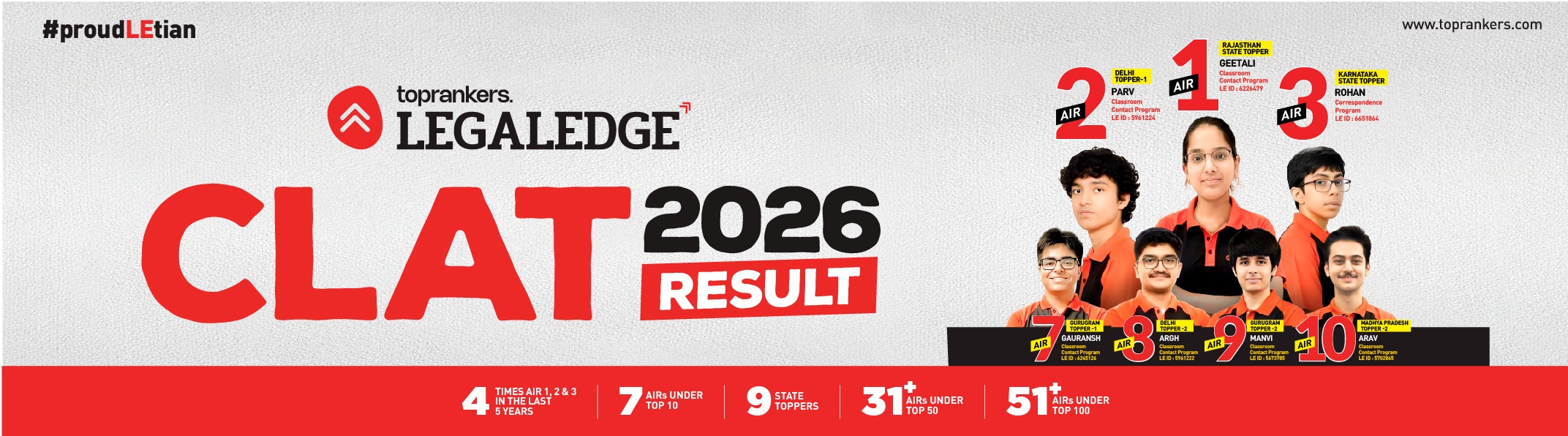
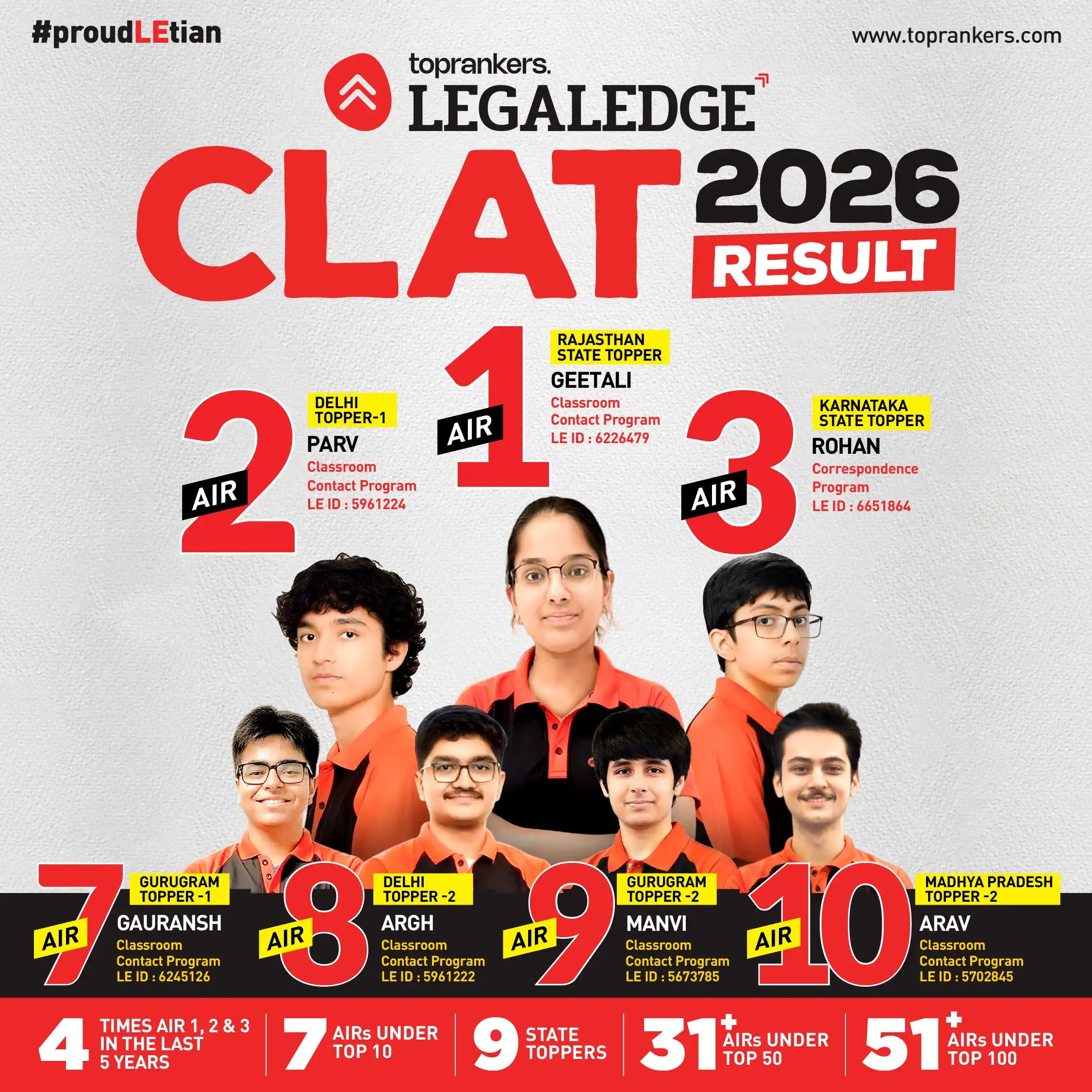
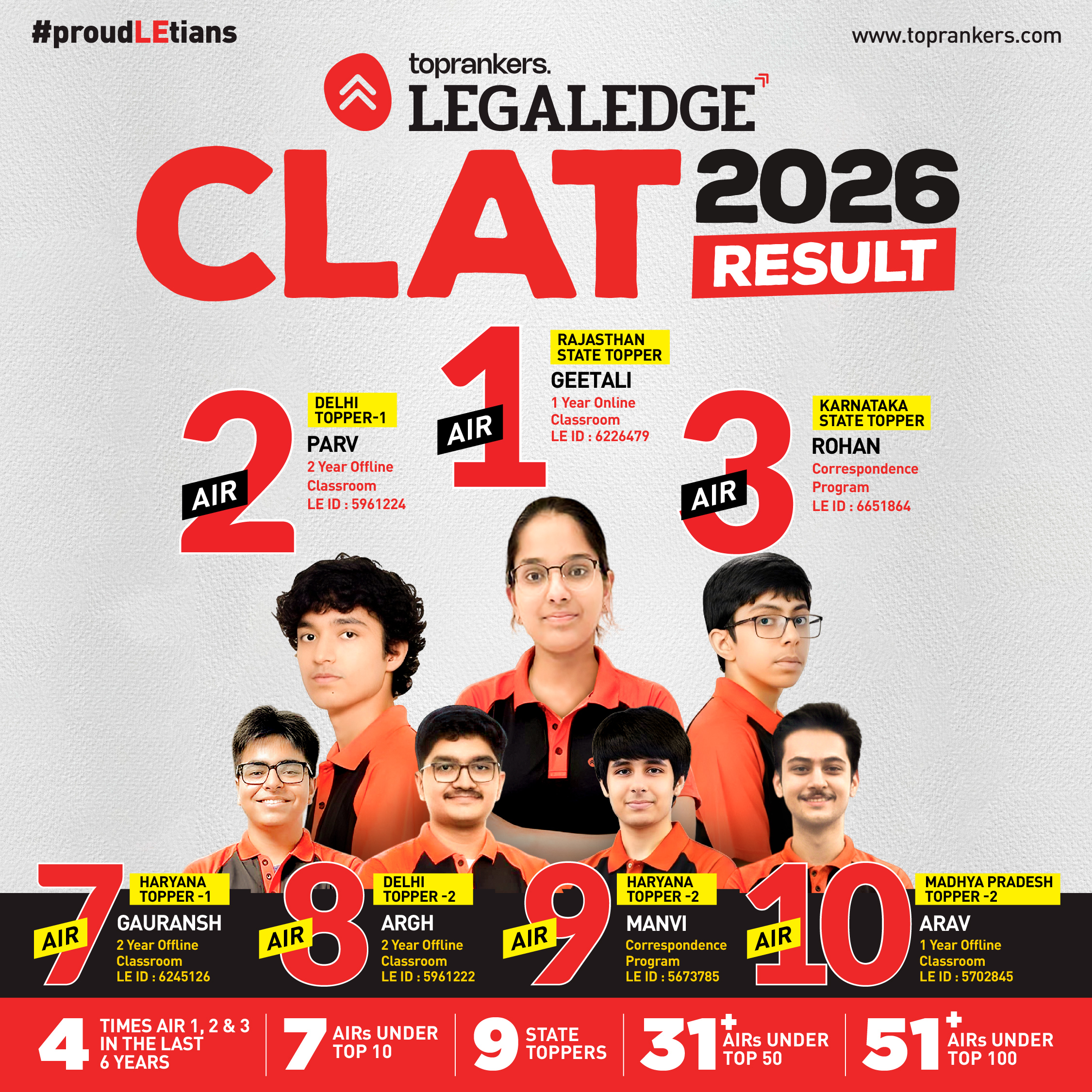
🌟 7 AIRs in the Top 10
-
🌟 13 AIRs in the Top 20
-
🌟 29 AIRs in the Top 50
-
🌟 51 AIRs in the Top 100
-
🏅 9 State Toppers
-
🏆 12 City Toppers
-
📈 And counting…
To our dear LEtians, we are incredibly proud to have been a small part of your inspiring journeys. This isn’t just success — this is the unmatched LEgacy ❣️
AILET 2026: LEtians Lead by a BIG Margin
-
🏆 AIR 2, 5, 7, 8 & 9 in AILET 2026
-
🏅 26 ranks under AIR 75 (and counting)
-
🎓 Classroom Contact Program students: 19
-
📚 Correspondence Program students: 7
After securing AIR 1, 2 & 3 in CLAT 2026, LEtians have once again outperformed all in AILET 2026.
The LegalEdge philosophy behind mocks
We tell students: “Don’t wait until you’re ‘fully prepared’ to start mocks. Start mocks to become prepared.”
That’s the engine behind LegalEdge Mock Test Series. Every mock is crafted to mimic not just the difficulty of CLAT but the experience, the timing, the stress, the variability.
Explore: LegalEdge Offline Coaching Centres
How we design them:
- CLAT-like format: 120 passage-based MCQs across the five sections, taken in 120 minutes.
- Balanced difficulty curve: easy, moderate and tough questions in each test, so students learn pacing.
- Current, topical content: GK and legal-reasoning items reflect real events and recent legal developments.
- Real exam simulation: same time limits and test conditions so students build “exam muscle.”
Case Study: How LegalEdge Mocks shape an aspirant’s journey
Let’s talk about Riya, an actual LegalEdge student (names changed for privacy).
- April (first mock): Riya hesitated to attempt a mock, thinking she “wasn’t ready.” When she tried her first LegalEdge mock, she scored 34/120 and was disappointed, but interested.
- May–June: Weekly mocks plus our discussion sessions bumped her to the mid-50s (≈56+). She discovered patterns: strong in Legal Reasoning, shaky in GK.
- July–September: Detailed analysis taught her time allocation, how long to spend on passages, when to guess, and when to skip. Her score climbed to the mid-70s (≈76+).
- October–November: We worked on test temperament, not letting a hard passage derail the rest of the attempt. Her attempts became steadier and more efficient.
- December (pre-CLAT): Riya averaged about 88-95/120 across mocks and walked into the exam calm and prepared. She’d already faced 50+ full-length, CLAT-style mocks from LegalEdge. The result: she secured a seat in her dream NLU.
Riya’s path is familiar. Year after year, toppers repeat the same line: mocks made them ready.
Read More: LegalEdge Last 5 Years' Results
What makes LegalEdge mock tests different?
There are many test series. Here’s what students consistently tell us sets LegalEdge apart:
1. Closest alignment to CLAT
Students often say: “The real CLAT felt like another LegalEdge mock.” That’s our quality benchmark.
2. Deep, actionable analysis
Attempting a mock is only half the battle; learning from it is the other half. After every test, students receive:
- Section-wise accuracy and time-spent reports
- Strength/weakness mapping and percentile among peers
- Concrete improvement tasks (not vague pointers)
3. Mentor-led personalization
Numbers alone don’t change an outcome; the right feedback does. Our mentors review each student’s report and give tailored action items: “Focus on inference questions in LR; revise current affairs timelines weekly.”
4. Frequency with structure
Mocks are released on a regular, planned cadence, enough to build momentum but spaced to allow deep analysis and correction.
Read more: LegalEdge Success Stories
The psychological edge: beyond knowledge
CLAT is a mental endurance test. Many falter not on content, but on exam day stress. LegalEdge mocks build the psychological muscles students need:
- Stamina: Sitting 120 minutes for concentrated reading becomes normal.
- Desensitization: Students who have faced many real-condition mocks don’t panic when a passage looks hard.
- Confidence: Incremental score improvements, and learning to recover from a poor mock, create a resilient mindset.
Read More: All About LegalEdge Bootcamps
CLAT 2025 Toppers Interviews [AIR 1,AIR 3 & More] LegalEdge Check CLAT 2025 Toppers interviews to get complete insights about the exam, study plan & toppers tips to get AIR.
How to use LegalEdge mocks the right way?
Mocks without a plan are practice without progress. Here’s the LegalEdge roadmap:
- Start early. Don’t wait till the end of your syllabus. Early mocks give you direction.
- Simulate the real test. Full focus, no interruptions, strict timing. Treat every mock as the real thing.
- Invest in analysis. Spend 2–3 hours per mock reviewing mistakes and time patterns. Know why you erred.
- Track trends, not single scores. Ignore day-to-day noise; focus on the upward trend across weeks.
- Test strategies. Try different section orders and time splits in mocks to find a personal optimum.
Read More: All India Open Mocks by LegalEdge
Real success stories
Aditya S., AIR 18 (CLAT 2023, NALSAR Hyderabad)
“When I started with LegalEdge, my mock scores were hovering around 50/120. I felt lost and anxious. But after every mock, the detailed analysis showed me exactly where I was going wrong. By October, I was consistently scoring 90+. On CLAT day, the paper felt like just another LegalEdge mock. That confidence made all the difference.”
Sneha R., AIR 43 (CLAT 2022, NLSIU Bangalore)
“I used to dread GK and left passages half-read in mocks. My mentor at LegalEdge taught me how to approach them systematically. I didn’t just improve my GK scores, I improved my stamina. Taking 60+ mocks gave me the resilience to stay calm throughout the real paper.”
Rahul K., AIR 56 (CLAT 2021, NLU Jodhpur)
“Mocks were 80% of my prep. I treated every single one like the real exam, strict time, no breaks, no excuses. My first few mocks were disasters, but I never skipped analysis. LegalEdge mentors helped me identify patterns in my mistakes. By the end, my average was 95+, and I walked into CLAT with no fear.”
Megha T., AIR 72 (CLAT 2023, NUJS Kolkata)
“What set LegalEdge apart for me was the feedback loop. I didn’t just get marks; I got strategy. I learned when to skip, when to guess, and how to manage time. Without LegalEdge mocks, I’d never have discovered my best exam strategy.”
Hundreds of students share versions of these stories: steady mock practice + corrective analysis = results.
Mocks in the wider LegalEdge ecosystem
Mocks are the backbone but not the whole spine. They sit inside an ecosystem:
- Concept classes (online & offline)
- Sectional tests for targeted practice
- Monthly current affairs capsules for GK upkeep
- Mentor check-ins to keep effort focused and accountable
When mocks are combined with these resources, they don’t just measure readiness; they accelerate it.
Conclusion
If you take one thing from this case study, let it be this: Mocks are essential, not optional. A mock test doesn’t just show where you stand; it shows how to get forward.
LegalEdge mock tests are built to mirror the CLAT experience, the 120-question layout, the 2-hour pressure, and the negative marking, so that on the day of the exam, nothing about the test is “new.” The results we’ve seen repeatedly are simple but powerful: students who embrace mocks consistently improve, academically and mentally, and they perform on exam day.
If you’re preparing for CLAT, make mocks the center of your strategy. Start early, analyze deeply, and iterate. The next success story we celebrate could very well have your name on it.
NLU Dream, Zero Cost Start: Free CLAT Demo
Fill your details
Frequently Asked Questions
How many LegalEdge mock tests should I take before CLAT?

When should I start attempting mock tests?
Are LegalEdge mock tests exactly like CLAT?
How should I analyze my mock test performance?
Do mock test scores really reflect CLAT results?

Samriddhi Pandey
Content Writer


SHARE