
1723534562.png)

3-Year Practice Rule Review Petition 2026: Is There Still Hope for Judiciary Aspirants?
February 27, 2026
Quick Answer: Is There Still Hope for Judiciary Aspirants? For months now, the reinstatement of the 3-year practice rule for entry into Civil Judge (Junior Division) posts has shaken the judiciary aspirants. But now, with the Supreme Court agreeing to hear the review petition in open Court, the question echoing everywhere is: Is relief still possible? Read More!
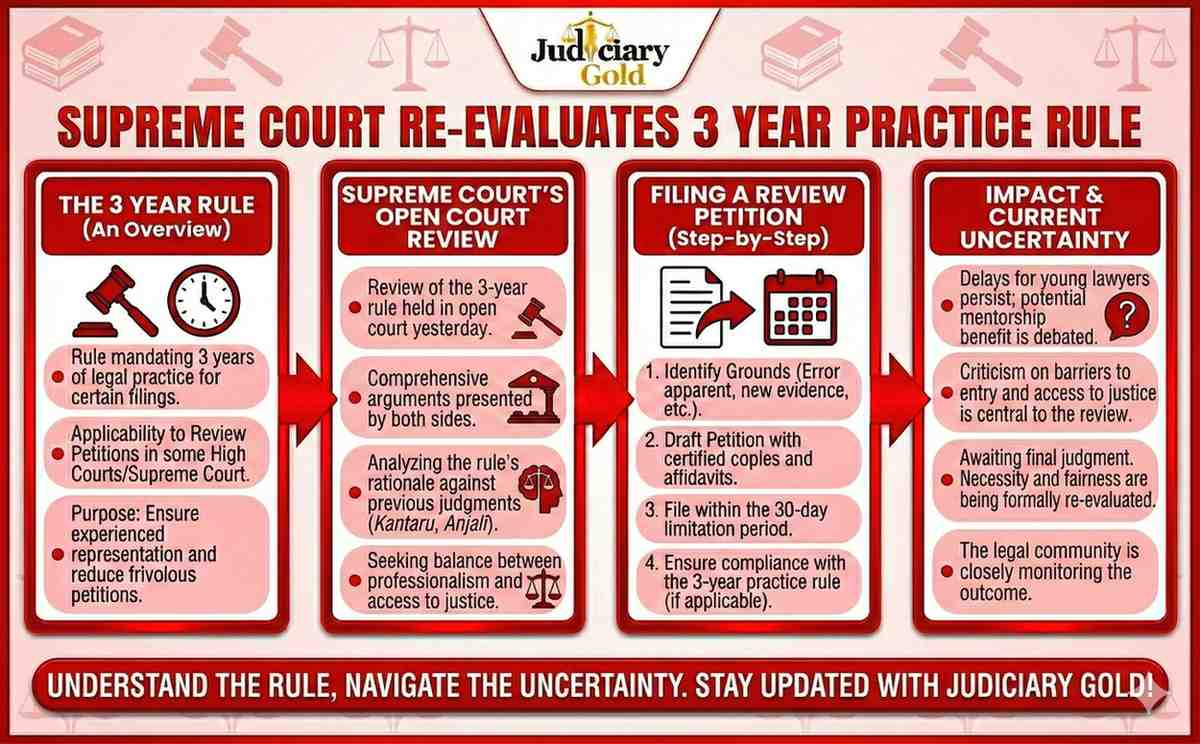
The Supreme Court’s decision to hear 3 year practise rule review petitions for entry into the Civil Judge (Junior Division) cadre marks a significant procedural and substantive moment in the evolution of judicial recruitment policy in India.
While the Court had earlier restored the practice requirement in the All India Judges’ Association proceedings, subsequent challenges have brought to light deeper constitutional and administrative law concerns regarding fairness, institutional competence, and transitional justice.
Unlike routine review petitions, which are frequently disposed of in chambers by circulation, the Court’s choice to entertain oral arguments in open courts suggests that the issues raised transcend mere reconsideration of factual errors or narrow legal oversight. Instead, the review proceedings appear to engage broader questions concerning the nature of judicial qualifications, the limits of ppolicymakingwithin judicial directions, and the impact of sudden eligibility changes on a large class of aspirants.
This blog examines the legal framework underlying the 3 year practise rule for judiciary, the doctrinal arguments likely to shape judicial reasoning, and the possible outcomes emerging from the review stage.
Background: Evolution of Entry-Level Judicial Entry in India
Historically, recruitment to the subordinate judiciary in India has undergone multiple phases of reform. Earlier judicial service frameworks allowed fresh law graduates to enter judicial service directly, with state judicial academies expected to provide intensive training to bridge experiential gaps.
However, concerns were periodically raised about the preparedness of fresh graduates to handle trial-level adjudication, particularly in procedural management, evidentiary evaluation, and courtroom administration. The All India Judges’ Association litigation provided the Supreme Court with an institutional platform to address systemic issues in judicial administration, including recruitment standards.
The reinstatement of the three-year practice requirement reflects the Court’s beliefthat practical courtroom exposure enhances judicial competence. The rationale rests on the assumption that litigation experience cultivates procedural instinct, professional maturity, and familiarity with the dynamics of trial advocacy.
Yet, the sudden implementation of the 3 year practise rule generated immediate backlash among judiciary aspirants who had relied upon the earlier eligibility regime.


What is 3 year practise rule Review Hearing all about?
The Court’s decision to hear the review petition in open Court is procedurally noteworthy. Under Article 137 of the Constitution and Order XLVII of the Supreme Court Rules, review jurisdiction is narrow in scope. Traditionally, the Court interferes only where:
- The decision to grant oral hearing suggests that the Court may be examining whether the original judgment overlooked critical considerations of transitional fairness or proportionality.
- This procedural posture elevates the review beyond technical correction and suggests potential reconsideration of implementation aspects, even if the underlying policy rationale remains intact.
Constitutional Framework Governing lower judiciary entry
Articles 233 and 234
Recruitment to the subordinate judiciary is governed by Articles 233 and 234 of the Constitution, which allocate responsibility between High Courts and State Governments. Eligibility criteria traditionally fall within the domain of rule-making authorities, subject to constitutional limitations.
The Supreme Court’s intervention through the All India Judges’ Association framework reflects its supervisory role over judicial administration rather than legislative policymaking. However, such judicial directions must still comply with constitutional principles, particularly the principle of quality under Article 14.
Article 14 and Reasonable Classification
Any eligibility requirement must satisfy the test of reasonable classification and non-arbitrariness. The Court’s earlier judgment implicitly relied upon a rational nexus between mandatory practice and improved judicial competence.
The review petitions appear to challenge not merely the existence of the rule but the manner and timing of its implementation. The constitutional question, therefore, shifts from whether the rule is valid to whether its immediate application is proportionate.
Doctrine of Legitimate Expectation and Transitional Fairness in 3 year practise rule
One of the central arguments raised by petitioners concerns legitimate expectation. Aspirants who structured their preparation based on existing eligibility norms argue that sudden regulatory change without transitional safeguards violates administrative fairness.
Indian administrative law recognises legitimate expectation as a principle ensuring procedural fairness rather than substantive entitlement. Courts typically assess:
However, precedent suggests that policy changes in public employment eligibility are rarely struck down solely on legitimate expectation grounds. Instead, courts often grant transitional relief, allowing affected cohorts to adjust.
The review proceedings may therefore focus on whether transitional mechanisms are necessary to avoid disproportionate hardship.
Comparative Institutional Approaches
Compared with judicial recruitment models, those vary across jurisdictions. Some systems prioritise early entry combined with rigorous training, while others emphasise prior advocacy experience.
India’s shift toward a practice-oriented model aligns with a broader trend emphasising experiential competence. However, the absence of uniform access to litigation opportunities complicates implementation.
What can be the Possible Outcomes on the 3 year practise rule Reveiw Petition?
1. Affirmation of the Rule Without Modification
The Court may reaffirm its earlier reasoning, emphasising institutional necessity and declining to interfere with policy decisions already made.
2. Transitional Relief
A more balanced outcome may involve prospective application, allowing aspirants who graduated before the judgment to remain eligible under previous norms.
3. Clarificatory Directions
The Court may clarify:
- What amounts to practise under different high court rules
- Will LLM be counted under practise
- How this rule is affecting women across India
What Should Judiciary Aspirants Do Now?
Do Not Freeze Your Preparation
Stopping preparation is the worst strategic move. Whether the rule stays or not:
If Required, Choose Smart Litigation
Litigation does not mean random chamber work. Be strategic: Three years can either feel like a delay or become your competitive advantage.
Reframe the Timeline
Judiciary is not a race to early selection. It is a race to sustained judicial competence. If practice becomes mandatory, everyone adjusts together. You are not behind. The timeline shifts collectively.
A Personal Note to Every Aspirant Reading This
Right now, uncertainty feels heavier than preparation itself. But remember: Every serious judiciary aspirant has already proven one thing: "resilience".
This is another phase. If the rule stays, you gain courtroom depth. If relief comes, you gain clarity. Either way, your preparation does not go to waste. Because the law studied deeply never becomes redundant.
Final Word: Stay Prepared, Stay Flexible, Stay Focused
The Supreme Court will decide on legal principles. But your success will depend on adaptability. Do not let uncertainty defeat discipline. The bench is not meant for those who panic at policy shifts. It is meant for those who understand systems and evolve with them. And if you have come this far in judiciary preparation, you already belong to that category.

Download Judiciary Study Material
Fill your details

Admin
Subject Matter Expert


SHARE